Monday, June 4, 2018

Keeping Their Identity: the Shan in Chiang Mai


                                        by Jim Goodman

Por Sang Long procession at Wat Ku Tao
       The Kingdom of Lanna ruled over most of northern Thailand from the late 13th century to the middle of the 16th century.  Its ruling family and inhabitants were mainly Tai Yuan.  But during its heyday the capital Chiang Mai was the most important city in the region, enjoying trade connections with neighbors in all directions.  As a result, many foreigners also came to reside permanently or temporarily in the capital and Chiang Mai became known as ‘the city of twelve languages.’
       One of these was Shan, or Tai Yai, a dialect close to that spoken by the Tai Yuan, with a very similar alphabet, by a people largely populating northeast Burma.  Some of the Shan immigrants ran businesses in Chiang Mai.  Others were involved in the caravan trade, transporting goods back to the Shan States or north to China. 
       They were never very numerous but as a community they remained through the period of Burmese occupation, from the conquest of Chiang Mai in 1558 until their expulsion in 1774.  But by then the city was deserted.  Not only were all the Shans gone, so were all the Tai Yuan, who had fled to isolated spots of rural refuge during the long campaign by King Kawila of Lampang and his Siamese allies to drive out the Burmese.   
traditional Shan style--male
traditional Shan style--female
       To repopulate Chiang Mai and other northern cities Kawila next led raids into northeast Burma, particularly Kengtung and Mong Pong, to capture people and take them back to Chiang Mai.  By early 19th century the Burmese presence and threat had been eliminated and life returned to normal.  Lanna was not an independent kingdom like before, but this time a vassal of Siam.  Over the course of the century Lanna gradually lost most of its autonomy as the government in Bangkok, worried about imperialist encroachment on all sides, sought to extend its authority over everything within its boundaries.
       However, Siam did not attempt to insulate itself against the Western colonialists.  It sought to engage with them commercially in hopes that would curb their voracious territorial appetite.  After Great Britain annexed southern Burma, Siam made a deal—the Bowring Treaty of 1852--that allowed the British to sell their products inside Siam and granted them concessions to exploit the teakwood business, as well as to bring in some of their colonial subjects to work in it. 
the main chedi at Wat Pa Pao
Burmese-style roofs over a shrine at Wat Pa Pao
       Burmese and Mon immigrants were already working the border area forests since 1840.  From the 1850s Shans also came, not only to the border provinces of Mae Sarieng and Mae Hong Sin, but to legging depots like Chiang Mai, Phrae and Lampang.  In Chiang Mai they settled in the neighborhoods opposite the moat on the northeast side of the old city. 
       The Shan are also followers of Theravada Buddhism and easily fit into Chiang Mai society, even at the upper levels.  Shan aristocrats felt an affinity with their counterparts in Lanna’s upper class and one high-ranking Shan lady, Mom Bua Lai, became the consort of Lanna’s King Inthawichayanonda.   In 1883 she sponsored the construction of Wat Pa Pao on Maneenoparat Road to service the Shan community.
Buddha images, Wat Pa Pao
Shan guardian at the viharn entrance
       Instead of following the Lanna style of the dozens of temples in the city, Wat Pa Pao’s designers created a compound in which every element, from buildings to sculptures, reflects the Burmese Shan tradition of religious art.  The original wooden main viharn has been replaced by a more recent structure of brick and plaster, with red, corrugated iron roofs.   Statues of a pair of armed Shan guards flank the staircase.  Portraits of local Shan personalities and historical events hang from the front interior walls.  At the end of the capacious assembly hall sit two Buddha statues, a large one behind a smaller one, both in the Burmese style.
the chedi at Wat Ku Tao
Universal Ruler Buddha, Wat Ku Tao
       Everything else in the compound is from the original construction and very different from those of Thai temples.  It’s more crowded, for one thing, with not too much space between the structures.  The narrow, four-tiered entrance gate is unique to the city, but similar to those in the Shan States.  Even more typically Burmese-Shan are the multi-tiered roofs over the smaller viharn and the little shrine next to it.  Both are heavily embellished with carvings along the edges of the roofs.   Such roof towers are quite common in Myanmar, but in Chiang Mai they only exist in Wat Pa Pao.
       The yard to the right of the viharns is filled with chedis, columns and sculptures.  The tallest chedi, shaped like an inverted bell, the usual type in Thai temples, was modeled on those of Pegu, as replicated in the Shan States.  At the four corners of the base stand the mythical creatures called kilin, with a dragon’s head over a lion’s body. 
Shan woman at Wat Ku Tao
Khao Phansa ritual at Wat Ku Tao
       A couple smaller chedis stand in the yard, in between skinny trees, and a tall white column rises topped by the same multi-tiered type of roof that ascends over the shrine next to the small viharn.  A very different chedi stands between the viharns and the big, bell-shaped chedi.  It rises above a cubic stone shrine with the same multi-tiered roofs, also topped by a golden spire. 
Shan students at the Wat Pa Pao school
       In the late 19th century the concept of nationality began assuming importance.  The Shan migrants, as British subjects, were supposed to be exempt from corvée labor or labor tax imposed on Siamese.  But at the end of the century the Bangkok government promulgated land reform laws that took away most of Lanna nobles’ rights and laid a labor tax, in lieu of corvée labor, on all commoners, Shans included.
       Theoretically, Shans were exempt from the tax if they could provide documentary proof they were from Burma.  Most didn’t have such evidence.  Most were former poor farmers who migrated to Thailand to seek a better life—the usual immigrant motive.  They didn’t anticipate needing documents to stay.  Borders were looser in those days.  People came and went easily.
       Shan resentment boiled over into violence in the 1902 Shan Uprising.  It was not a very righteous campaign, though, not one involving those in the logging trade or urban commerce, and characterized by massacres and wanton destruction.  Shan bandit gangs in Phrae province started the rebellion, backed by Lanna nobles who hoped to retrieve their lost privileges.  The uprising spread to other northern provinces, though not Chiang Mai.
Por Sang Long at Wat Pa Pao
Shan girls at Wat Pa Pao
     
Bangkok dispatched troops to quell the uprising and from then on accelerated the rate of assimilation and integration of the north with the rest of Siam.  It appointed its own administrators, whittled away at the Lanna king’s authority and required school lessons to be taught in the central Thai dialect with the very different central Thai alphabet.  When the last king of Kawila’s dynasty died in 1937, no one succeeded him.   By then Siam was Thailand and the assimilation process was in high gear.
Por Sang Long procession in Wat Ku Tao courtyard
       Wat Pa Pao continued as the main religious center of Chiang Mai’s Shan community.  Specific aspects of Shan culture fell into desuetude, but the language remained in use domestically.  As the community grew in the last half of the 20th century, they expanded north of their original neighborhood and Wat Ku Tao, a couple blocks beyond Chang Puak bus station, became another focus of Shan religious activities.  Unlike Wat Pa Pao, where the monks wear yellow robes, like the Thais, at Wat Ku Tao they wear red robes, like in Myanmar and the Shan States.
       The unusual chedi at Wat Ku Tao was built in 1613 to enshrine the ashes of Nawrahta Minsaw, the first Burmese-born governor of conquered Lanna, (1579-1608).  It rises in five diminishing spheres, representing five historical and future Buddhas.  The large, two-story viharn next to it is in typical modern Thai style, but the main image inside is of the Buddha as Universal Ruler, a depiction commoner in the Shan States than in Thailand. 
       Dressed in royal costume and lots of jewelry, he rules over a future world when the Buddhist Dharma has triumphed everywhere.  On holidays like Khao Phansa, the beginning of the Buddhist retreat season, a network of strings stretches out from the image.  Devotees grab one of them to receive the blessing a monk has imparted into it. 
novice in the Por Sang Long procession
women in the Por Sang Long procession
       The main activity at this festival, though, is out in the courtyard.  A few commercial stalls go up, hawking food, textiles and other items.  Some people listen to monks’ lectures, others paste gold leaf stickers on a Buddha image and lay offerings at shrines, while a few men may do an impromptu music show with the ‘elephant-leg drum’ and a rack of cymbals.   Some folks come primarily just to meet and talk with each other, for festivals are social occasions as well as religious ones.  And both men and women dress in traditional Shan attire.
       Like Thai women, Shan women wear blouses with ankle-length sarongs, but the stripe patterns and embroidered sections differ somewhat from Lanna designs.  They may also wear headscarves with the flaps tied up over each ear, a particularly Shan custom.   It’s a Shan festival, so they want to look very Shan celebrating it.
through the Wat Ku Tao neighborhood streets
       The Shan in Chiang Mai never really lost their identity, but in the last few decades they have become more inclined to demonstrate it.  The official attitude towards Tai sub-groups and other minorities has also changed over the years.  Rather than continuing to subsume all sub-groups into a pan-Thai identity, Thailand, in this age of tourism, now advertises its diversity, giving more scope to cultural revivalism among the Shan, Tai Lue, Tai Dam and others.
       In 1997 Wat Pa Pao’s abbot set up the Pa Pao Foundation to Support Education, Art and Culture.  The following year the temple opened a school in the compound, first for adults and later for children.  The language of instruction is Thai and the courses are those taught in Thai schools.  In addition, it teaches children the Shan language and alphabet.  Books and magazines in the Shan language are also on sale at the temple.  The students wear traditional Shan clothing rather than Thai school uniforms.
       Wat Pa Pao also sponsored the revival of an old Shan festival called Por Sang Long, held for three days in late March or early April.  It marks the occasion boys temporarily enroll in the monastery as novices, a Theravada Buddhist tradition.  The Thai have the same custom, for every male is supposed to ordain once at some point in life, but with them it is a private affair, carried out any time of year, usually at the start of the retreat season.  With the Shan, it is done collectively, with sometimes dozens of boys all at the same time, making it a community event.
Wat Ku Tao abbot in the procession
novices carried in the Por Sang Long procession
       The Shan also add another aspect to the occasion.  Por San Long mimics an important event in the life of the Buddha, when he gives up his luxurious life in the palace to become an ascetic in search of spiritual salvation.  Shan families dress their boys in something resembling royal garments, jewels and crown and feed them special food, fit for a prince.  Fathers, uncles and older brothers hoist the boys on their shoulders and take them on a procession to and around the temple.  Afterwards, the boys stay in specially decorated cubicles for two or three nights. 
       Though its revival began at Wat Pa Pao, the celebrations there nowadays are rather small; this year, for example, involving about ten novices.  The Por Sang Long focus has shifted to Wat Ku Tao, held twelve days earlier this year, where over sixty boys and a few young men took part.  On the first day families prepared the cubicles in the temple compound and the novices had their heads shaved.  For three successive mornings relatives carried the splendidly costumed boys in a grand procession several times around the temple and on the third morning through the streets of the neighborhood as well.
Shan girls at Por Sang Long
novice in the procession
       Groups of two to five boys paraded, preceded by lines of devotees in traditional Shan attire, bearing money trees, banners on tall poles, trays of flowers and other offerings, and men playing ‘elephant leg drums’ and racks of cymbals.  Fully-grown young men sat in rickshaws or other mobile platforms or in a chair hefted by several bearers.  The abbot also rode a chair in the procession.  The atmosphere was both festive and polite.  Nobody pushed their way around or tried to stop any action to get a photo.  After the processions, many participants went to the market beside the eastern gate to shop for Shan textiles or dine at one of the restaurants.
       The crowd was almost entirely Shan.  Despite official publicity about this being a prime tourist attraction, only a handful of foreigners and perhaps a dozen Thai tourists from Bangkok came to observe.   Obviously tourism was not a factor in the festival’s revival.  The prime motive was ethnic pride.  In a fast-changing and homogenizing world, the Shan cling to their separate history and identity and with Por Sang Long celebrate the art of being Shan.

assembling before the procession at Wat Ku Tao
                                                                        * * *


Tuesday, May 22, 2018

Wat Mae Kaet Noi—the Temple of Hell


                                   by Jim Goodman

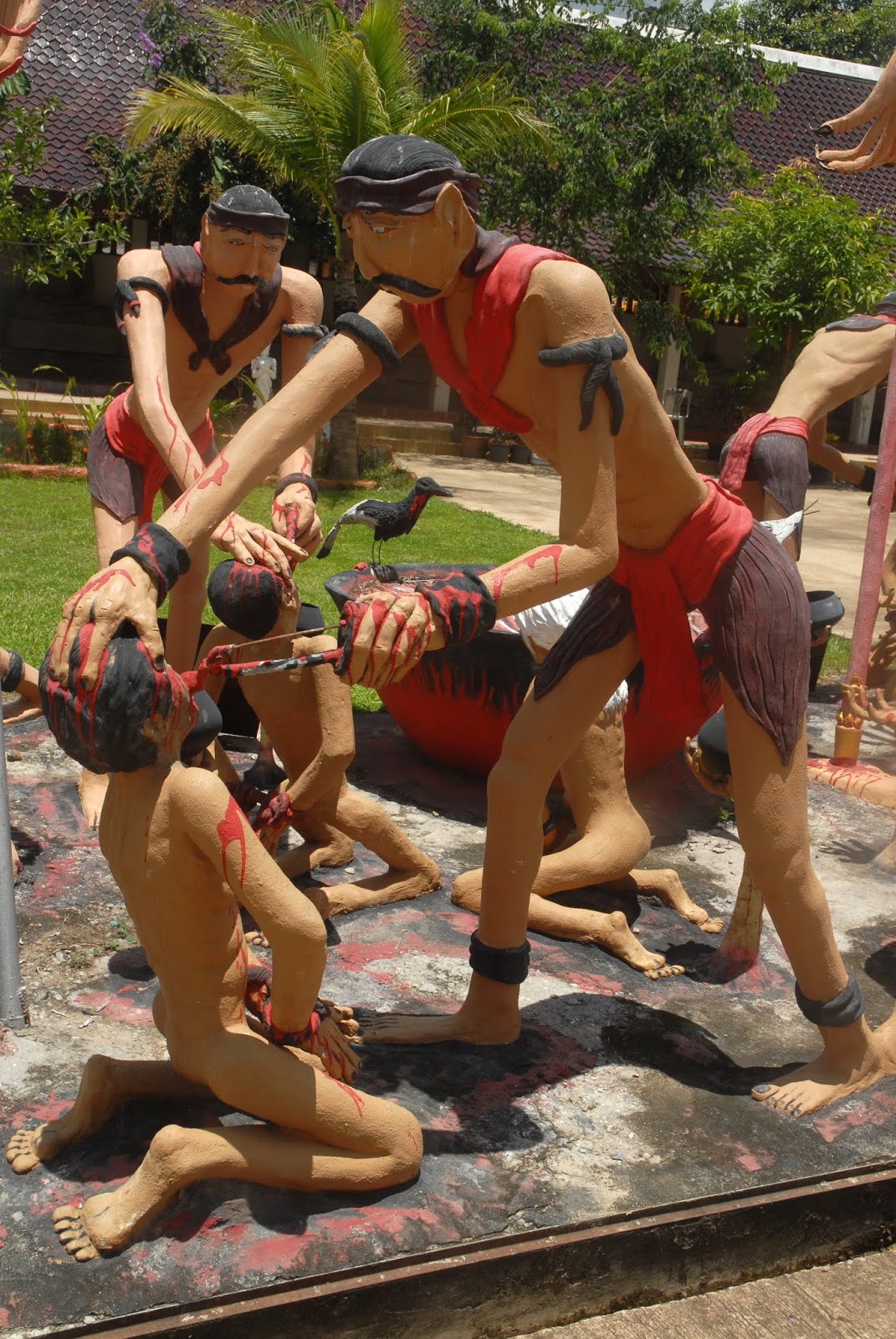
sinners boiled in oil at Wat Mae Kaet Noi's Hell Garden
       Generally speaking, to visit a Buddhist temple compound in Thailand is to enter a zone of peace and piety.  Serenity reigns, from the expressions on the faces of the statues to the reverential attitude of the devotees.  Fierce warriors and lions stand at the compound gates and fanged, serpent-like nagas and lizard-like moms line the stairways to the temple buildings, but they are there to scare away evil spirits, not the worshipers.  Elsewhere the imagery, whether in sculptures or paintings, is all religious, designed to enhance an atmosphere of contemplation on Buddhist precepts and how to live a good life.
the Hell Garden at Wat Mae It, Chiang Dao
       The statues of Buddha, other deities, and revered monks serve to remind the people of exemplars of the holy life.  Paintings on the wall may depict famous scenes from the life of the Buddha, portraits of Heaven and its denizens, religious activities on Earth, festivals, seasonal work, handicraft production, daily chores and other village vignettes of olden times.  Together they reinforce the concept that the Buddhist religion is closely intertwined with ordinary human affairs.  In such surroundings the good Buddhist will renew vows to follow the Buddhist ethical code, exhibit compassion for all beings and make merit.
       What is usually missing from temple imagery is any representation of the consequences of not following the Buddhist ethical code.  This is the or else! side of  Buddhist teachings.  In this case it is Naraka, an underworld Hell where sinners undergo eons of gruesome punishments.  The Buddha himself gave sermons to his followers describing Naraka in detail.  Occasionally a temple wall mural will contain a scene of such suffering, but in general, the tortures of the damned is not a theme emphasized in the upbringing of children in Thai Buddhist families.
the punishment of liars, Wat Mae It
Phaya Yom, the God of Death
       Some monks think it should, though.  Among them was Phra Kru Vishanjalikon (the name means Clean Teacher Monk), abbot at Wat Mae Kaet Noi, three km east of Mae Jo, a half hour drive from the center of Chiang Mai.  About 28 years ago he had a troubling lucid dream of being in a desolate, scorching hot, pitch-black city.  A big red demon approached him and told him to go back to Earth and create a city like this for the edification of the people.
the classroom hall at Wat Mae Kaet Noi
       For the next twenty years the monk spent much of his time designing the city of his nightmares, raising funds (not very easy), hiring and directing sculptors and conceiving the horrific imagery that fills the area.  It opened as a separate park in the compound about eight years ago.  From then on Wat Mae Kaet Noi had a new nickname—Temple of Hell.
       It is not the only such temple compound in Thailand, for there are about twenty others scattered throughout the country.  It’s not the only one in the area, either, for another is Wat Mae It in Chiang Dao, on the edge of the town beside the road from the central market to the cave.  Instead of a Buddha, the big image in the courtyard, of a monk wearing a floppy hat and dipping his hand into a boil, is a rendition of Upakhu, the Thai name for Upagupta.  He was religious tutor to Emperor Ashoka in the 3rd century BCE, the ruler who patronized the spread of the Dharma (as Buddhism was called then) through most of the Indian sub-continent.
painting of a World War II bombing raid
       Wat Mae It’s Hell Garden is a long narrow area in front of the Upakhu statue, as if implying that the monk’s sermon is about Naraka.  Four stick figures, towering higher than the temple roofs behind them, stand in a line.  Below them demons work their punishments on the condemned sinners.  Adulterers are forced to climb a tree full of piercing thorns .  Demons skewer others on poles and pull the tongues out of liars.
       While it’s not very big, Wat Mae It’s Hell Garden is right inside the entrance to the compound.  The one at Wat Mae Kaet Noi is not so obvious, for it is off to the side.  Upon entry, the compound looks rather ordinary.  The viharn is in typical Thai style.  To its right is a long hall that serves as a classroom for children’s religious instruction.  Paintings decorate the walls, with scenes of life in pre-electricity years:  village parties, planting and harvesting, celebrating Loy Kratong, etc.  All the figures in the pictures wear traditional clothing and the settings and houses are all pre-modern.
demon raping a sinning woman
       On the back wall, though, are two paintings dealing with more recent times; namely, World War II.  They depict American B-24 Liberator planes dropping bombs on the northern Thailand countryside.  In 1942 Japanese forces were stationed in various places in northern Thailand, particularly Lampang and Chiang Mai, preparing their invasion of British Burma.  The painting scenes are not very accurate historically, for the bombing raids were closer to the cities, aiming at the railway stations and Japanese military camps in Haiya, south of Chiang Mai’s old city.  They did manage to disable the railway station, but also destroyed the viharn of Wat Srisuphan, which was next to the Japanese camp.    
cleaving a sinner's peis
       A little to the left of the viharn is the compound’s main feature—the Hell Garden.  Visitors insert a ten baht coin at the entry gate and proceed down a pathway.  On the left is the Heaven section and to the right lies the much larger Hell section.  Just inside the latter sits a sculpture of Phaya Yom (a.k.a. Yama), the God of Death and Lord of Naraka.  According to Buddhist belief, souls of the deceased must appear before Phaya Yom to be interrogated.  He already has a book recording the deeds on Earth of the interviewee.  He asks then whether they have broken any of the five main injunctions, if they are guilty of murder, stealing, sexual crimes, intoxication or lying.
intoxication punishment
demonic face in the Hell Garden
       For those who are guilty, Yama assigns the appropriate punishment.  In some cases it fits the crime.  Liars have their tongues ripped out.  Thieves get their hands amputated.  Sexual miscreants suffer mutilation of their genitals.  But there are obviously more sins punished than the five major transgressions Yama inquires about, for the Hell Garden exhibits include a host of victims skewered, crushed, ripped apart, boiled in a cauldron, shot or sawed in half. 
part of the abortion exhibit
       Those tortured don’t die, for souls are immortal.  They just feel continuous excruciating pain.  It won’t be forever, as in the Hell of Western religions, but not a whole lot less.  Depending on the sins, the ordeal can last from hundreds of thousands of years to hundreds of millions of years. 
       Besides the torture scenes, the Hell Garden also has a variety of ghouls and demons, male and female, some extremely tall, all extremely ugly and horrific.  Severed heads with their guts dangling below them hang from trees.  Sinners buried in the earth up to their waists scream through distorted faces and raise their arms in horror.  They often have weird cartoons painted on their chests.  Perhaps they have been cast into the hot Naraka, as opposed to the cold Naraka, and are screaming because of the heat.  Or they could be grotesque figures from Phra Kru Vishanjalikon’s lucid nightmare.
sinner trapped in the ground
the punishment for abortion
       The old Buddhist books describing Naraka reflect the ancient Indian propensity to exhaustive, minute classification of the various sections of both the hot Naraka and the cold Naraka on what punishments are inflicted at each section, for what sins and for what length of time.  Some of this information went into creating the exhibits, but other displays reflect the imagination of the garden’s creator, influenced by modern times.  Hence, we see giant demons in the robo-cop, wire-frame style and demons driving motorbikes with spiked wheels over the bodies of their victims.
students at their lesson
       One large section of the Hell Garden is devoted to abortion, considered a violation of the Buddhist concept of the sanctity of all life.  In addition to scenes of an abortion in progress, there are also sculptures of the distorted bodies of offending mothers and of transgressors skewered on a sharp pole.  Outside this section is a giant boiling cauldron with demons forcing sinners into it.  An enormous female demon with a grotesquely distorted body stands nearby, next to a display of demons sawing victims in half.  Visitors can drop a ten baht coin into one of the machines here and listen to the screaming of the victims or the ranting of the big female demon    
the punishment of wicked students
       Punishment for sexual crimes is a frequent theme.  As at Wat Mae It, adulterers are forced to climb up trees with big thorns that pierce t heir bodies.  Elsewhere, a group of smiling, seductive ladies rips apart a man’s genitals.  A demon thrusts a gigantic phallus into a terrified woman’s vagina.  A horrid, misshapen woman uses a knife to cleave a man’s outsized penis.  And another man agonizes as he drags around his preposterously sized penis and scrotum.
   The sin of intoxication is represented by a statue of a man with two heads.  One head is raised to drink from a bottle of spirits, while a syringe is plunged into his stomach.  The other head is vomiting.   Near it stands a statue of a grossly fat and ugly woman with a horrid, gaping mouth and protruding eyeballs.  Sin of vanity perhaps?   
Children Tree in the Heaven Garden
   Another unusual display is of a group of uniformed students listening to the lectures of a male and female in police uniforms.  Statues of benevolent gods stand in the vicinity.  Behind them, as if to remind the students of what happens if they don’t follow the rules they’re being taught, are several bloodied students hanging from meat hooks.
   Just past this classroom is the section of the Heaven Garden, dominated by statues of the Buddha, enlightened monks, other saints and deities and pious devotees.  After a walk through the much larger Hell Garden, it is almost anti-climactic.  There’s nothing horrific here.  A kneeling skeleton has its hands folded in prayer and the multi-headed figures with fierce faces are obviously guardians on the side of Heaven. 
   The one truly exotic exhibit in this garden is what might be called a Children Tree.  It rises several meters high, with big, serrated leaves resembling those of a banana tree.  Long, green, tendril-like vines hang down from various points on the trunk, with young boys and girls attached to the end, as if they were sprouting from the vines.  And inside one opening leaf is a newborn baby.  At the base of the tree are figures of fully dressed couples in traditional outfits, one pair dancing, one pair seated and exchanging food.
devotees in the Heaven Garden
   Clean Teacher Monk’s objective in constructing this elaborate Hell was to scare people, to instill in them a sense of shame regarding sinful deeds and a fear of their consequences.  It certainly makes an indelible impression on Thai visitors, who are already familiar with some of the dark themes of the place.  It may be just an imaginative version, but according to their religion, the garden is based on a Hell that is very real.
   It has already had one measurable effect.  Inspired by the abortion exhibit, some aborting women have left their dead fetuses beside one of the grosser statues in this section.  Rather than get rid of it on their own, as an act of repentance they deposit the fetus at Wat Mae Kaet Noi for a proper burial. 
preening in the Earth Garden
old-fashioned farmer types
   Although it is not high on the list of the Chiang Mai area’s tourist attractions, Wat Mae Kaet Noi has had a trickle of foreign visitors.  They do not particularly view the Hell Garden as a site for moral and religious instruction.  They are ore likely to see it as an excursion into Oriental creepiness.  But for Thai Buddhists, Hell Garden notwithstanding, Wat Mae Kaet Noi is still a Buddhist temple, and therefore a proper venue for celebrating birthdays, weddings and funerals.
couple smoking cheroots and a lounging, long-haired lady
   As if catering to this aspect of temple use, this year the wat opened a new exhibit on the opposite side of the compound from the Hell Garden.  This area features statues of ordinary rural Thai people, dressed in the same early 19th century attire as in the paintings on the interior walls of the adjacent classroom building.  A few are naked from the waist up—bare-breasted women and heavily tattooed men.  Others are engaged in daily chores.  There are statues of kick-boxers, dancers, a reclining woman with ankle-length hair, couples smoking Burmese cheroots, women preening with mirrors and monks meditating. 
    Surrounded by imagery of an idyllic earthly existence of a not-so-long-ago past, the Earth Garden here is probably a more appropriate spot for happy events like birthdays and weddings.   But perhaps a newlywed couple might take a stroll through the Hell Garden and see the adulterers impaled on the thorn tree and the tortures undergone for sexual crimes, intoxication or lying.  Or maybe parents will take their children on a walk through Hell for their birthday lesson on morality.  For the true believers, in terms of ethical influence, fear also works.

sleeping princess in the Heaven Garden
                                                                      * * *                  


Tuesday, May 8, 2018

Tales of Guilin and the Beautiful River


                                                           by Jim Goodman

tour boats on the Li River
       Guilin has been a tourist attraction for many centuries before the word ‘tourist’ was even coined.  Ancient poets lavished praise, calling it the most beautiful place under Heaven.  Artists journeyed there to make pictures of its incredible scenery of steep hills and weirdly shaped mountains.  In fact, too incredible, for the artists often found that back home people doubted their works were realistic portraits, not fantasized.  There was no landscape like that anywhere else in China, so they couldn’t be real.
Camel Hill, Guilin
       
      The paintings were not exaggerations, though, and the fanciful scenery is very real and the main attraction of the city.  Guilin straddles the Li Jiang—Beautiful River in English—with oddly shaped hills jutting up throughout the city, as well as all the way downriver south to Yangshuo and beyond.  The unique setting is what draws people, for Guilin has no old town to appreciate.   The Japanese occupied the city during the war and before they were forced to evacuate in 1944 they razed the entire city, destroying every building except their own headquarters.
       Guilin County lies in the northeast corner of Guangxi Autonomous Zhuang Province.  Guilin is a Han city, though, and the nearest minorities, mainly Miao and Dong, live a hundred kilometers away.  It lies on a completely flat plain, with several streams branching off the Li River to run through the city.  Ponds, some used for fishing, mottle the urban area as well.
Elephant Trunk Hill at night
       Residents enjoy an active social life.  On Binjianglu, a downtown street, crowds assemble for tai qi exercises and ballroom dancing.  At night the karaoke joints are popular, but also bars, restaurants and shops tend to stay open late and large numbers of people just like strolling around.  They can be quite friendly to foreigners, shouting “Hello” as they pass by, or stopping to practice their English. They are proud of their city and its beauty and appreciate it when visitors agree with them.  Restaurants serve the usual Chinese dishes, with an accent on fish from the river and eels, shrimps, snails and turtles from the ponds.  A couple of them also offer more exotic fare like rabbit or snake.
Single Beauty Peak in central Guilin
     
Guilin people are also familiar with how they got their marvelous mountains in the first place.   According to local mythology, long ago lived a ruler who called himself ‘King of All under Heaven.’  One night he had a dream of fighting the Dragon King of the South Sea and losing.  He then ordered his subjects to fill up the south Sea with dirt and stones from the mountains of central China.  As time passed and his subjects suffered, a goddess intervened and gave the people her special hairs that, when tied to a rock, moved it easily. 
       Suddenly the task seemed achievable.  Soon the King seized possession of the magic hairs and made a whip of them to move whole mountains faster.  The Dragon King began fretting.  But Shark Girl volunteered to go seduce the King and steal the whip.  She succeeded and so the moving hills stopped at Guilin.
Crystal Palace of the Dragon King, Reed Flute Cave 
       Many of the hills have names, sometimes because they resemble something else, like Camel Hill in the city’s southeast and Elephant Trunk Hill next to the river.  They may also have origin tales that include elements of Chinese myths or history.  An example of the former is the story of Single Beauty Peak, a very steep hill in the middle of the city.  It incorporates elements of the Weaving Maiden and the Cowherd, star-crossed lovers who are only allowed to meet once a year, when the cowherd crosses the Milky Way on a bridge of magpies.
Maitreya Buddha sculpture
       The Single Beauty Peak story begins when an official representing the Heavenly Emperor comes to a village with fine wooden houses and demands all the trees and house beams and posts for the construction of a celestial palace.  When the villagers refuse, a storm and fire ensue, destroying both forest and village.  Afterwards the hero Xiao Da plants a melon seed given him by two phoenixes that shoots out a vine that enables him to climb all the way to Heaven, where he meets the Cowherd just as he is about to cross the magpie bridge.
      Xiao Da also crosses over and happens upon the celestial palace under construction.  It is being made with the wood swept away by fire from his village.  He even finds a house post that he had inscribed his name upon and wants to take it back to earth.  He gets away with the post by cleverly distracting the Earth God guarding the site, crosses the magpie bridge and hastens down the vine.  But the latter then sends an eagle to split the vine and Xiao Da has to release the post.  He eventually splashes into river, while the post lands upright in the city center, where it remains today as the Single Beauty Peak.
poems and statues, Returned Pearl Cave
Guan Yin of 1280 arms
       Nearby Fupo Hill gets its name from an early Han Dynasty general Ma Yuan, nicknamed General Fupo--Restraining Wave.  After a tribal uprising in the area expelled the Chinese garrison and took over Guilin, Emperor Wu Di dispatched Ma Yuan to quell the rebellion, preferably at the least cost to lives.  Ma Yuan arranged a parley with the rebel leader Bo Yue and persuaded him to settle claims with an archery contest.  While Bo Yue made an impressive show of skill when it was his turn, Ma Yuan climbed Fupo Hill and shot an arrow that pierced the next hill and carried on a long way to land at the original Han-tribal border.   The hill where he stood now bears Ma Yuan’s nickname and the legend accounts for the open cleft in Pierced Hill.
sculptures carved from the rock at Returned Pearl Cave
       Other hills have origin tales to account for their shapes.  A father who waited in vain on the top of a hill for the return home of his prodigal son turned to stone and became Old Man Hill.  In the Elephant Trunk Hill story, a sick elephant abandoned by the emperor on his march through the area recovers its strength after treatment by sympathetic villagers.  In return he helps the people plow the fields.  When the emperor learns the animal has recovered he demands it return to the capital.  The elephant refuses, but eventually the emperor tricks it into drinking water while he stabs it from behind.  Instead of falling over, though, the elephant turns into stone.
       Walking around Guilin, every couple of blocks offers a fresh vista.  But if it’s a foggy or rainy day, one has the option of the subterranean scenery of its caves.  The biggest and most rewarding is Reed Flute Cave, within a hill across the Peach Blossom River past the northwest part of the city.  In the past, reeds grew here that people fashioned into flutes; hence, its name.
Li RIver near Xingping
      Along the passageway inside, stalagmites jut up from the ground in the shape of lions, mushrooms and breasts and the vertical fissures along the wall resemble waterfalls.   The trail terminates at a capacious cavern, said to be able to hold a thousand people, called the Crystal Palace of the Dragon King.  From the center of its smooth ceiling hangs a stalactite resembling a chandelier-like grouping of icicle-shaped rocks.  A broad pool lies below, bounded on the far side by stalagmites shaped like the hills along the Li River, a case of the inside aping the outside.
sunset near Xingping
       None of the other caves can match Reed Flute Cave for its rock formations.  But aome, even though basically long tunnels, are interesting for what man put into them, primarily religious sculptures and votive inscriptions.  One cave features Ming and Qing Dynasty free-standing statues of a Guan Yin with 1280 arms, a sage with incredibly long eyebrows, a stately Lao Zi and a corpulent Maitreya Buddha with children crawling over his belly. 
       In Returned Pearl Cave the sculptures are carved from the rock walls.  Also grouped near the tunnel entrance are flat carved slabs inscribed with ancient poems and Buddhist sutras.  In mythical times the cave was home to a dragon.  While it was out, a young fisherman found a pearl that lighted the whole cave and took it home so his mother could have light while she was sewing and mending clothes.  But she bade him take it back, because it didn’t belong to him.  He returned the pearl and the dragon later rewarded the youth with a magic needle to sew with and a lamp that never ran out of light.
Camel Crossinn the River near Xingping
       With a plethora of story-enhanced attractions, Guilin has long been geared up for the tourist business.  This means a broad range of accommodations, but also an annoying number of ubiquitous ticket booths.  City authorities even erected a thick stand of tall bamboos that blocked a view of Elephant Trunk Hill unless you paid for a ticket to step inside of it.  But the booth closed at night, when Elephant Trunk Hill, like a few other monuments, was illuminated.
       Despite the high prices, many visitors still take the half-day boat ride downriver to Yangshuo.  On this stretch the Beautiful River certainly lives up to its name.  Passengers marvel at the continuously changing shapes of hills, with exotic names like Beautiful Woman Peak, Fairy’s Pen, Expectant Husband, Mitten Mountain, Lion Riding a Carp and, near Xingping, 20 km north of Yangshuo, Camel Crossing the River. 
steep pinnacle on the Li River near Xingping
Xingping farmer going home
       Boats don’t stop at Xingping, but this picturesque river port is a short taxi or bicycle ride from Yangshuo and worth an overnight stay.  Sunsets can be quite stunning from here.  A hike upriver offers a delightful view of oddly shaped hills, including one at the river’s edge that rises straight up 90 degrees.  In the afternoon the tour boats return to Guilin, mostly without passengers, as the tour groups lunch in Yangshuo and go back to Guilin by minibuses.  Rice fields flank the hills, children play in the river and fishermen ride rafts of a few long bamboo poles tied together and cast nets.
Ylongshan, central Yangshuo
Li River scene near Xingping
       In the past people also used cormorants to catch fish.  They tied the bird’s neck so that it couldn’t swallow the fish it caught so they could remove it from the beak.  But the use of electric stun guns upstream to immobilize fish sharply reduced the fish population around Xingping and Yangshuo.  By the turn of the century fishing with cormorants was all but a memory, reduced to re-enactments at the request of tour groups.
Yangshuo
       Yangshuo, the tour boat terminus, is smaller than Guilin, but has an equally impressive setting.  Groups of stunning hills to the east and southeast cast their reflections in the river.  Steeply sloped hills like upright loaves of bread flank the town, while the more unusual Dragon Head Peak hems in the northern side of Yangshuo.  Green Lotus Peak towers over the southwest quarter and near the city’s central park stands Yulongshan, with a staircase ascending to a viewing pavilion a third of the way up the cliff and on to another pavilion at the top of the pinnacle.
       In terms of the tourist business, Yangshuo was always more oriented towards the budget traveler crowds, who tended to stay much longer than in Guilin.  Like Xingping, the rural atmosphere was a short walk from town, up river or down.  There was no two-tier pricing system, nor the abundance of ticket booths that wrought so many frowns on travelers’ faces in Guilin.  The people are friendly, just as proud of their city’s beauty as the folks in Guilin, and just as appreciative of the visitors who share that impression.
Moon Hill
       The hilly landscape continues downriver as well as along Li River tributaries.  The easiest and most enchanting excursion out of Yangshuo is to take a bicycle ride across the river to Moon Hill.  The road is flat and takes less than an hour, but that’s not counting inevitable stops to admire the scenery.  It is especially gorgeous along the Yulong River, which branches off from the Li Jiang a little past the bridge, with small hills whose sides rise perpendicular to the rice fields around them
       Further on is a park featuring a gigantic banyan tree and from here is a view of a distant mountain with an oval crevice in it (also the result of Ma Yuan’s arrow?).  Less than two km ahead is Moon Hill, the most famous mountain with a hole in it.  The opening here is just below the rounded summit, in a shape resembling a six-day setting moon.  Through the hole, or from the top of the pathway to the summit above it, a wide cluster of peaks of sundry shapes and sizes stands in the distance, beckoning the bold traveler to further discoveries of odd peaks, timeless rural atmospheres and perhaps another set of origin tales that explain the unique landscape.

rural landscape north of Xingping

                                                                        * * *