Showing posts with label Bingzhongluo. Show all posts

Sunday, January 20, 2019

The Last Wild River in China

                                                                              by Jim Goodman

the Nu River in upper Gongshan County
       Even in Yunnan, a province famous for its different landscapes, biodiversity and ethnic variety, Nujiang, its westernmost prefecture, stands out as something special.  Three of its four counties straddle the Nu River, one of East Asia's mightiest, 2020 km long from the Tibet-Qinghai border to the Gulf of Martaban (a.k.a. Moktaba) in Myanmar.  And throughout the river's 315 km-long run in Nujiang Prefecture towering mountains flank it on both sides. It is the longest stretch of sustained great scenery in the entire province, looking ever better the further north you go or the higher you climb up the slopes on either bank.
Liuku, Nujiang Prefecture administrative capital
       The Chinese have dubbed Nujiang theGrand Canyon of the East, in conscious reference to the Grand Canyon in southwestern United States.  The latter, though, is very different.  The Colorado River cuts through a flat tableland, with mountains far away, and its main feature is the stunning and picturesque erosion of the canyon wall.  It is also uninhabited.
       In the Grand Canyon of the East, by contrast, mountains flank the river, sometimes rising near vertically from the banks.  Villages and their farms mottle the slopes, in between forests that swathe two-thirds of them.  The people are mostly of the Lisu minority nationality, with smaller numbers of Nu and TIbetan in the north, Yi and Bai communities in the south and Han in the cities.
the Nu River near Chenggan
waterfall just south of Fugong
       The river runs at an average altitude of 800-900 meters.  The mountains, the Biluoshan range east of the river and the Gaoligongshan range to the west, rise an average 4000 meters on either side. The forests vary with the altitude.  Nearer the river grow bamboo, teak, kapok, fig, banyan and tung, an oil-bearing species.  From 1600-2800 meters are bald pine, cypress, yew, chestnut, leach, walnut, magnolia, camellia and Yunnan cherry. Up to 4000 meters, the dominant species are fir, rhododendron, hemlock, dragon spruce, Yunnan pine and dwarf bamboo.
riverside rice fields in summer
       The forests also contain all eight of Yunnan’s famous flowers (azalea, camellia, rough gentian, primrose, orchid, lily, magnolia and meconopsis) and 6000 species of plants, including 370 recognized medicinal plants.  Around 1600 species of insects peculiar to Nujiang live in the canyon, as well as 280 kinds of birds and 70 different mammals. 
       The name of the river is taken from the name of the indigenous Nu nationality in the northern part of the canyon.  (The Lisu didn’t move in until the 17th century.)  In their language nu means dark; hence, the dark people and the dark river.  In Tibet, the Nu River is Heishui (Black River).  But for nu, the Chinese use the ideograph for ‘angry’, which certainly doesn’t characterize the temperament of the people.  But it does seem appropriate for the river. 
plowing a field next to the river
      Rapids make up much of the river’s course.  Its rate of flow can be up to seven meters per second, slightly increased in the summer from rain-fed tributary streams.  In spite of carrying this extra volume of water, the Nu River never floods.  It is safe to plant crops on land just a few meters above the water.
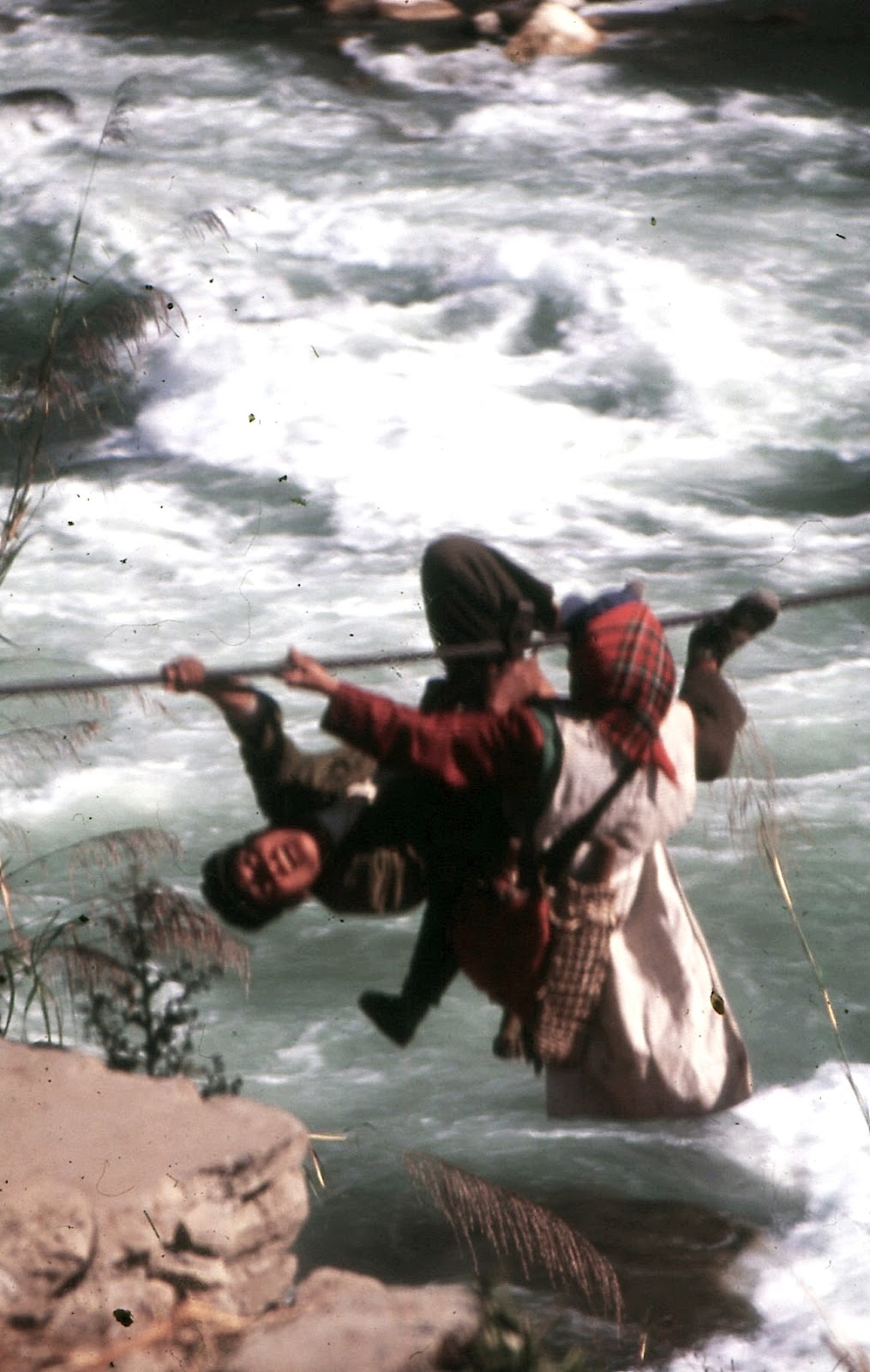
    
It does change color with the rains, becoming a dull medium brown.  When the rains cease and good weather prevails again, the river turns blue-green.  The water level is lower and at some points, especially in Gongshan County, patches of white sand appear along the banks.  In between the long stretches of rapids, where the river runs relatively smoothly, people use rafts or canoes to cross to the other side or to cast fishnets.  They also fish from the shore with poles or use a net stretched between two curved bamboo rods.
crossing the river by rope-bridge
fishing from the bank, Nujiang-style
     Nujiang was one of the last places modernized in Yunnan.  Not until the 1950s did the government begin constructing a good road from Liuku to Bingzhongluo to replace the caravan trails.  They also built suspension bridges to cross the river, replacing the previous rope-bridges, though in 2000 about two dozen rope-bridges were still in place.  By the turn of the century electricity had been extended to the highest villages. People’s lives had marginally improved, but a large portion was still mired in poverty.
Fugong city
       In 1999 the government banned logging throughout the province.  This was Nujiang’s biggest earner and in attempting to replace it, the local government the following year proposed a hydropower development project involving the building of 13 dams at various points on the river, including a 300-meter-plus behemoth at Maji, and two large reservoirs.  This would result in a power generation of 21 million kilowatts, 3 million more than the one at the Three Gorges in Sichuan, which would be exported to southeast China.      
       The proposal also claimed that as a result of switching to cleaner hydropower the nation could use some of the profits from the dams project to spend on environmental protection.  That point provoked opponents of the dams to launch a campaign against the project.  They wanted to extend the idea of environmental protection to the whole canyon, citing its ecological diversity. Though it comprised but 0.4% of the country’s total area, the canyon was home to over 20% of China’s plants and flowers and 25% of the earth’s animal species (over half of China’s).
rafts used on the river
      The dams would also kill off Nuiang’s 48 species of fish, 36 of them unique to this part of the river, by preventing them from spawning upstream.  Changes in the river’s current would lead to greater contamination, while the putrefying flooded plants would cause a greater emission of greenhouse gases than coal-fired industrial plants. Besides the ecological destruction, the dams would displace 10% of the valley’s half million residents, including the entire population of Gongshan city, saddling the government with the messy problems of resettlement and compensation.
      Though the central government approved the project in the summer of 2003, eco-activists and other opponents kept up their campaign.  By the end of the year they had persuaded Premier Wen Jibao, who called a ‘temporary’ halt to the project.  It was not part of the next five-year plan, nor any since.  In China, the Nu River still runs free.
on the trail to Lumadeng
Gaoligong Mountains at Lumadeng
      It’s possible to explore the Nujiang canyon starting in the far north.  But that involves trekking from Cizhong, on the Lancangjiang, and over the Biluo Mountains to Dimaluo in Gongshan County and then down to the road along the river.  The usual way in is from southwestern Dali Prefecture to Liuku in the south, from where a good road now runs all the way to Qiunatong at the top of the canyon.
suspension bridge below the Stone Moon
      The road into Liuku follows a stream until its confluence with the Nu River.  Liuku, Nujiang’s largest city and administrative capital, straddles the river at the confluence and mountains of 2500-3000 meters flank the river north and south of the city.  Turning south at Liuku, the road continues along the river through the same kind of landscape until Shangjiang.  Then it passes into Baoshan Prefecture, where the mountains are suddenly further away and the river’s current less hurried.
      Though it’s the capital of a Lisu Autonomous Prefecture, Liuku doesn’t have much of an ethnic flavor.  Minorities here and in nearby villages dress in modern styles.  The city has a scenic location, with good views from the bridges and the riverside park on the eastern bank.  As for social scenes, the most interesting takes place at the eastern gate of one of the pedestrian suspension bridges, where a few White Lisu women gather towards evening to sell rice liquor and sing old Lisu songs.
the Nu River near Lishadi
      The road north through Lushui County keeps to the west bank.  Gradually the mountains rise higher, steeper and closer to the river, though still without any snow at their peaks.  At Chenggan, in northern Lushui County, cliffs plunge vertically at the river’s edge.  Continuing north, the road crosses a bridge to the eastern bank just as it passes into Fugong County.  It will stay on this bank all the way to Gongshan city.
       From Pihe, sited opposite a steep sheer cliff and the first town inside the county, the scenery keeps improving.  Mountains are higher, steeper, closer and craggier.  Waterfalls plunge from the sides more frequently.  Terraced fields rise higher on the slopes and several rope-bridges are installed along the river.  Most of residential Fugong city, the county capital, lies on a slope adjacent to the narrow strip of land beside the river. 
Maji village, northern Fugong County
      A few mountains in the vicinity crest at over 4000 meters, permanently mantled with snow. The city has the canyon’s biggest and liveliest market day, held every five days, with the greatest variety of products on sale. Most of the Lisu women from nearby villages wear their traditional clothing while in the city, especially market day.  Crossing the bridge to the west bank leads to a path south to villages and their farms beside the river, a walk especially rewarding during planting time or the early autumn harvest.
      Continuing north, the Gaoligongshan mountains creep closer to the river.  To attend Lumadeng’s Wednesday market day, villagers on that side have to make a long descent and then walk on a narrow path on a steep slope just above the roaring river rapids.  Or they could come down north of the town and use one of the rope-bridges to get to the road into Lumadeng. 
Gongshan city
      Between here and Lishadi, the next town north, stands Nujiang’s most famous mountain—the Stone Moon.  Though not one of the highest Gaoligongshan peaks, it is unique for its huge oval hole, 80 meters wide, just beneath one of the peaks. On the approach to the Stone Moon the road climbs higher than usual above the river, thus affording a great view of the phenomenon from a point above the gorge just south of it. Further on, around Lishadi, too, the mountains take on attractive shapes, with fluted cliffs near the summits.  One right beside the road is peaked like a perfect isosceles triangle.
      Continuing north, the road follows the river past the same kind of mountain scenery into Gongshan County.  Here mountains of 4000-meter peaks are more common, their slopes more forested.  The main road crosses the river before entering Gongshan city and then continues on the west bank of the Nu all the way to Tibet.  For the most part it stays just above the river, but nearing Bingzhongluo is rises a couple hundred meters above the river level, thus affording a wonderful view of the First Turn of the Nu River.
First Turn of the Nu River
      Here the Nu River swirls very dramatically around the ’toes of Biluoshan’—two protrusions of land at the bottom of steep cliffs, each one hosting a village.  Bingzhongluo, on a high plateau above the river, is just around the corner.  From this town Kawagapo Mountain, 5173 meters high, is visible.  Most of the villages in northern Gongshan County are of the Nu ethnic minority, but there a few Lisu and Tibetan settlements as well as Dulong on the other side of Gaoligongshan.
      Going upstream, the new road passes through the Stone Gate, a pair of sheer vertical cliffs flanking the river.  Road engineers had to blast a tunnel through the cliff on the western bank to clear passage for the road.  Continuing north, just short of Qiunatong, a sheer cliff on the eastern bank features a long tunnel through it to allow for local and caravan traffic connecting Qiunatong and the Biluoshan side villages.
the southern 'toe' of Biluoshan
      Travelers cross a suspension bridge to enter Qiunatong.  A mixed Christian Nu and Tibetan village, this is the last major settlement in Nujiang Prefecture.  The boundary of Tibet Province is just a little further.  But across the boundary the landscape changes abruptly, as it did south of Shangjiang.  The mountains are still high, but lie further away from the river, with very little forest cover. 
      The termination of the dams project did not halt development in Nujiang.  The government has continued to renovate and improve the main highway, extend it north into Tibet, construct roads up the slopes of the more densely inhabited mountains and build more suspension bridges spanning the river, designed for motor vehicle traffic as well as pedestrian. 
      With more tourists coming to Nujiang, the canyon now has more hotels and restaurants, the inevitable minority song-and-dance shows and even an established spot just beyond Lumadeng where visitors can experience riding a rope-bridge.  In northern Gongshan County near Shuangla, a pair of Nu villages, Christian on the east bank, Protestant on the west bank, a toll gate in place for over a decade charges non-locals a fee to enter Bingzhongluo Scenic Area.
Stone Gate cliff on the western bank
the river on the way to Qiunatong
      These additions may slightly augment Nujiang’s tourism income, but do not alter what is really the main attraction of the canyon—its pristine natural scenery.  Residents may eventually cease wearing their ethnic garments and suspension bridges may one day replace the last of the rope-bridges.  But the mountains, waterfalls, tributary streams, flora and fauna of the last wild river in China will continue to enchant visitors for many generations to come.

the Stone Moon, Fugong County
                                                                               * * *      

Tuesday, June 10, 2014

Learning to Use a Crossbow


                                                        by Jim Goodman

    I saw my first crossbow on the shoulder of a middle-aged Akha man in Saen Charoen Mai, northern Thailand, way back in 1988, as he sauntered down a trail into the thick jungle above the village.  I didn’t pay him much mind.  Everybody I knew there then used traps and long-barreled rifles to hunt, which was anyway already much less often than when they were all boys.  Many men still had crossbows, but mounted them on the interior walls and didn’t use them anymore.  And as I never again witnessed somebody carrying a crossbow into the forest, I lost interest.
    After a few years even the traps disappeared from the jungle, at least the ones for medium-sized mammals, which were also former crossbow targets.  Rare was the Akha hunter successful enough to bring home a wildcat, bamboo gopher, civet, pangolin or even squirrel, much less a boar or a barking deer.  The animals are now so rare that Akha men don’t even go looking for them anymore.  In fact, the hunting tradition everywhere has been largely reduced to trapping or shooting small birds and an occasional squirrel.
en route to the market, Lisu man with his crossbow
    But in Yunnan Province, China, from where most of Thailand’s hill people originated, the hunting tradition lasted until the government proscribed it in 1998.  Until then the Akha (in Yunnan called Aini) in Xishuangbanna and Pu’er Prefectures, as well as their neighbors the Lahu and Jinuo, were renowned hunters and crossbow users.  Now they’ve stopped.  But crossbows are still in use in Nujiang Prefecture in the far west.  Men carry them to the field and to the forests above their villages, make them at home and sell them in the markets.  Crossbows are still an integral part of life with the Lisu and Nu in the mountains along the river.
crossbow seller in Liuku making bolts
    I bought one myself in Liuku, the prefecture capital, on a trip in November 2001 with the assistance of a local Lisu friend.  Not knowing anything about them myself, I thought it better to have a native choose my first.  The bow part, or prod, was made from mulberry wood and the stock from mahogany.  My purchase included the bowstring, made of 4-ply hemp thread, 3 mm thick, plus an extra string, a small knife for sharpening the bolts, a bearskin quiver and about 60 bolts, in three bamboo tubes inside the quiver.  The bolts were 25 cm long, 6 mm thick and fletched near the end with a triangular piece of dried bamboo leaf. 
    Nujiang crossbows resemble those in other parts of Yunnan and work the same way, but the stock shape differs.  Those made by the Yi, Wa and Lahu have a bulge hanging down on the stock where the prod goes through.  Hani crossbows have a double bulge and the Jinuo model is straight, but has an angled section, like a rifle stock, at the end.  Nu and Lisu crossbow stocks are relatively straight, with only a slight bulge where the prod goes through the stock.
    The top of the crossbow stock had a groove 3 mm wide and 3 mm deep, about as long as the bolt.  The trigger, about halfway down the stock, was made of ivory (others are made of bone).  The user draws back the bowstring to a notch just above the trigger, then lays a bolt in the groove, aims and pulls the trigger.  This pushes up the bowstring and the force released propels the bolt.  I never did try it out while I was there that month and when it was time to return to Thailand I had a new focus.  I had to put up some sort of target
firing a bolt
in my yard, put the bowstring back on and try out my crossbow.  I had a specific reason for wanting to learn how to use it.  I intended to research Nujiang for the next few years for a book project, so it was good to become familiar with something so much a part of Nujiang culture.  I might even be invited on a hunting trip with my new friends in the mountains there.  But I didn’t really intend to become a skilled hunter and firing at targets in my yard has a limited run of excitement.  The real goal was to become proficient enough to one day take part in a certain crossbow demonstration during the Lisu Kuoshi Festival in late December.
    In the event, the young Lisu women, in their beaded headdresses and long skirts, stand in a row, each with a bowl of rice on her head.  A 15-cm bamboo tube inserted upright in the rice holds an egg perched on its top.  Their boyfriends stand opposite them about twenty meters away, level their crossbows and shoot the eggs off the girls’ heads.  I’d seen photos of this in books and quick shots of it in television documentaries about Nujiang, so I was well motivated to start becoming proficient.  My fantasy was to get so good at it that when Kuoshi came around and someone invited me to try firing his crossbow, I would fire it so accurately that a beautiful young Lisu woman would volunteer to be my partner in the local version of the William Tell act.
Lisu girl in her ethnic style
Lisu girl in Fugong  
     I should have gotten a lesson first while I was there in Nujiang, except I didn’t think my Chinese vocabulary was good enough to understand the instructions.  It’s easy enough to figure out how to fire it, but I had immediate problems, like how tautly should I twist the bowstring when I put it back on.  I had an old door in my shed, left behind by a previous tenant.  So I erected it in my yard, put some tape over the wood for something to aim at, cocked the crossbow, laid a bolt in the groove, aimed down the end of it like a shotgun and pulled the trigger.  In the blink of an eye the bolt shot forward and penetrated the door right up to the fletching at the end of the bolt.  It was quite wide of the tape, though, and when I tried a second shot I heard a loud twang, the bolt missed the whole door and the string flew off.
    So I re-tightened the bowstring, hooked the ends onto the bow, loaded up and tried again.  This time I hit the door, but still far from the target tape.  I continued to practice, sometimes getting close to the tape, usually not.  Neighbor children came to watch, to hand me a bolt after I had cocked the crossbow and help me fetch the bolts after I’d fired a few shots.  This got to be an almost regular 5 o’clock routine for the next couple weeks.  Eventually I hit the bulls-eye a few times, but several dozen tines I did not, nor did I ever get the bowstring taut enough not to fly off every now and then.  It was time to return to Nujiang for the Kuoshi Festival and I was nowhere near proficiency, but maybe I could meet someone at the crossbow event who could give me a proper lesson.
crossbow competition at the Lisu Kuoshi Festival
    Unfortunately, the Kuoshi schedule near Fugong, where I chose to see the festival, did not include the event that inspired me to take up the crossbow.  Rather than girls with eggs on top of their heads the men fired from about 50 meters at small, dangling, woven bamboo targets strung between two posts on the knoll.  And some of them weren’t much better than me.  As an experienced beginner, I knew what that loud twang meant, and whenever I heard it I didn’t look to see where the bolt had gone, but instead how far off the bowstring flew.  I asked folks where the traditional crossbow event took place, but no one seemed to know, though they all seemed pretty sure some place or other staged it.
    It was an enjoyable festival even without that particular show and I returned home feeling I had a whole year in which to both improve my skill and find out exactly where to go next Kuoshi.  But four days after I got back, when showing a friend how a crossbow works, I pulled the trigger and with an ear-splitting crack the stock broke, snapping apart right at the point where the prod goes through.  I then took out my magnifying glass to look at all the photos I had taken of crossbows in Nujiang to see what was different from mine.  I soon discovered why mine had broken.  The hole in the stock was too close to the top, with only a very thin bit of wood between the top of the hole and that of the stock.  That was precisely where it snapped.  Crossbows in my photographs had the same thickness of wood on either side of the hole.  Obviously my Lisu friend who had selected the crossbow was not a hinter himself.
hunters examining crossbows in Fugong
    Hoping to replace it with a local crossbow, I checked out the ones in the Night Bazaar, but they were not as well made, nor as long, nor were they sold with a set of bolts.  Like those in the villages themselves, these crossbows looked purely ornamental.  Until I could get back to Nujiang I had to satisfy my new passion by researching about crossbows instead of firing them.  I soon found out these Yunnanese crossbows were very different from those used in Europe in the Middle Ages and the Renaissance.  And very unsophisticated compared to modern pistol-crossbows.
    The old European ones were heavier and used a thick rope for the bowstring.  Unlike the Nujiang crossbows, they couldn’t be cocked easily by hand.  Men had to use a geared winding apparatus called a rannequin to draw the bowstring back to the notch.  The stocks were sometimes decorated with carved figures and symbols, while scenes of hunting with crossbows were sometimes engraved on furniture.  Even after the introduction of rifles some hunters preferred crossbows because they were silent, did not require extensive cleaning or maintenance to use and had reusable ammunition.
    The high-tech crossbows sold nowadays use metal bolts.  They can be particularly lethal-looking, like the pistol-crossbows, or the one modeled on a 15th century Venetian style and called “the assassin’s crossbow.”  Seems like a perfect terrorist weapon, with an effective range of 2000 meters, though the advertiser does issue the disclaimer “not to be used in re-enactment.”  Other pistol-crossbow dealers, however, seem less concerned about the customer’s intentions.  One states that with the purchase you get “a starter kit that includes everything you need to begin target practice, or whatever you have in mind.”  
crossbow quarries--flying squirrels in Gongshan
Lisu hunter takes aim
    What I had in mind, of course, didn’t require a pistol-crossbow but a good, local Nujiang crossbow.  On my next trip to Fugong I waited for market day, carefully examined the crossbows on offer, selected one with the prod hole exactly in the center of the stock, and a whole bunch of new bolts, plus a deerskin quiver. It came with one of those poisonous aconite roots that Nujiang people sometimes use on their bolts.  They cut grooves near the tip and rub the juice from the root into the grooves.  In the past they did this when hunting big game and going to war.
testing my crossbow in Bingzhongluo
    I took my new crossbow up to Bingzhongluo, 45 km north of Gongshan, where I intended to see a Nu festival.  Because it had been raining all the time I was in Fugong County, I still hadn’t tested my new purchase.  So I decided to look for a spot near the town and when anyone asked me where I was going I told them I was going to look for flying squirrels.  The real reason would be a little problematic for me to explain in Chinese.
    I found a big tree just behind the town, inserted a square piece of paper in a loose piece of the bark, stood 30 meters away, cocked, loaded and fired.  I hit the tree a little bit left of the paper.  I aimed again, fired and got closer.  I made one more adjustment in my aim, fired again and pierced the paper exactly in the center.  So my new crossbow worked, shot straighter than the old one, had better bolts and I fancied I could get good at using it.  Maybe no Lisu shoot eggs off their girlfriends’ heads anymore at Kuoshi, but I could still get invited on a hunt with Lisu friends.  Perhaps we’d spot a flying squirrel and all go for it.  It would be wonderful to see the expression on their faces if I turned out to be the one who shot it down.  And they all missed.


painting in a Gongshan park pavilion
                                                                       * * *