Showing posts with label Zhangfeng. Show all posts

Tuesday, November 7, 2017

The Frontier Peoples of Western Dehong


                                    by Jim Goodman

Dai farmer and his son riding buffaloes outside of Ruili
       Dehong in southwest Yunnan is an Autonomous Dai and Jingpo Prefecture.  Only about 20% of Dehong consists of plains and valleys.  The rest of the prefecture is hilly or mountainous and has a forest cover of around 60%, the highest rate in the province.  The population tops one million, with the Han a slight majority.  The Dai dominate the plains and valleys, while the Jingpo constitute the largest ethnic minority in the hills, especially in the western part of the prefecture.  Han Chinese only began migrating to Dehong after the eradication of malaria in the early 50s and largely, but not entirely, reside in the urban areas.
       The Dai are not the only indigenous folks in the plains, nor are the Jingpo the only hill people.  As for the Han, some also have farms in the plains, while others work in the coffee and tea plantations in the hills ,such as Dachang, east of Lianghe.  Such Dehong features become apparent when taking a trip from Tengchong, just north of Dehong in Baoshan Prefecture, to Ruili in southwest Dehong.
Nandin Xuanfu, the former palace in Lianghe
       Lianghe, the first city on the route, is an easy ride through the plains from Tengchong.  But even when I visited two decades ago the city was thoroughly modernized, almost entirely Han-inhabited.  The only Dai elements consisted of a couple small restaurants, a pagoda in the inverted bell shape built around 1980, and the palace of the former Dai ruler.
       This is the city’s main attraction, originally built in 1851, when Lianghe was known as Nandin.  The palace (Nandin Xuanfu) consists of seven connected courtyards, with gardens, pools and red brick buildings with dark gray, tiled roofs.  The doorways from one courtyard to another are circular or oval, a feature seen in many temples in the prefecture as well.  Here the district’s chaopha (Lord of the Sky in the Dai language) lived in sumptuous splendor, while lesser members of the aristocracy owned smaller houses, but still in marked contrast to the simple dwellings of the commoners.
Achang woman
Achang woman returning from the fields
       The Dai in Dehong speak a different dialect than the Dai further east and use a different alphabet than that used in Xishuangbanna.  They generally live in houses of gray-brown brick and tiled roofs that sit on the ground.  In rural villages some build homes, one or two stories, with walls of plaited split bamboo, with roofs of tin or thatch.  Like other Dai, they are accomplished rice farmers, with irrigation canals that intersect the fields and provide a source of fish.  Dehong rice is especially tasty and that grown in Zhefang district in Luxi County was one of the tribute items demanded by the imperial Qing Court.  The prefecture is also famous for its pineapples.
countryside near Yingjiang
       Dai villages lie west and south of Lianghe, but to the north and east lie settlements of the Achang minority nationality.  The Achang in Yunnan number a little over 40,000, nearly all of whom live in Dehong.  Another 2000 or so reside across the border in Myanmar.  Chinese historical records indicate the Achang were living in Dehong in the 13th century. 
       They speak a Tibeto-Burman language and under imperial China enjoyed a measure of autonomy.  But their chieftains were subordinate to the Dai chaopha, who could make tax and service demands on the Achang as he wished.  Consequently, Dai culture has had a strong influence on the Achang.  They live in the same kind of gray-brown brick houses, practice Theravada Buddhism, with a temple in each village, and dress similarly.
Yunyan Pagoda near Yingjiang
       The men wear a side-fastened, long-sleeved, dark jacket over trousers.  The married women dress in the same back sarong as the local Dai women, with a long-sleeved blue or black jacket, also similar to that of the Dai.  The main difference is the headgear—a tall, tubular, brimless black hat.  Unmarried girls wear no hat, but tie their braids over their heads.  They also wear trousers instead of sarongs.
       The other major Achang concentration is in Husa district, Longchuan County.  Besides boasting the finest Achang Buddhist temple, Husa is renowned for its swords.  The tradition is a very ancient one among the Achang and they are so skilled at it that other peoples around them rely on Achang swords rather than make their own.
De'ang woman
Burmese-style tiered pagoda near Yingjiang
    
 The sword is like a machete, used to chop bamboo and wood, in defense against wild animals and bandits and part of local military gear.  The Lisu use Husa swords in their Climbing the Sword Ladder festival.  And Jingpo men brandish them upright during the ceremonial dance of the Munao festival.
Three Elephants Pagoda, Zhangfeng
       The Lisu and Jingpo minorities are especially prominent in the mountains of Yingjiang County, the next one west of Lianghe.  Yingjiang city is 50 km distant, after crossing a mountain to get to it.  Like Lianghe, its population is manly a Han, but with some minority touches, like a Jingpo statue and Munao festival house and arena, Dai elephant sculptures and a few Dai restaurants.  Jingpo swarm into Yingjiang for the Munao events, but rarely otherwise.  The Lisu live in the northern mountains and seldom venture to the city.  Dai villages constitute the city suburbs, so they are often in town during the day, the women in black sarongs and carrying their goods in baskets at each end of a bamboo pole.
Guangmu Pagoda, Jinghan
       Yingjiang was built around a reservoir a few km west of the Daying River.  A long, straggling Dai village lies between the city and the river.  A path at the end of the cemetery (Dehong Dai bury their dead) leads to the Yunyan Pagoda.  Rising from a square base, it consists of a white mound, with brass spires, topped with filigreed silver crowns, the central pagoda towering above forty smaller ones.  A nearby temple features a modest assembly hall and a five-tiered, pale red pagoda in a very different style from Yunyanta.  The resident monks, as in Myanmar, wear red robes.
       The road from Yingjiang to Zhangfeng, the administrative seat for Longchuan County, measures 136 km.  It crosses the Daying River and runs along the eastern side until entering Longchuan County, crossing high mountains tp gradually descend into the plains and Zhangfeng, seven km from the border town of Laying.
       Longchuan is about the same size as Lianghe, but had more of a non-Han feel to it back then.  Foreigners could only stay in the Hongchuan Binguan, a few blocks from the central market, but sited alongside a plain with a good view of the mountains to the west.   Dai, Bai and Achang restaurants were nearby and at the latter I tried the Achang specialty—guoshou mixian (over-the-hand rice noodles). 
       The noodles are made from reddish hill rice, served with chopped and ground pork, peanuts, chili, coriander, sauce and soup.  Achang folks take a handful of noodles and add the other ingredients, which gives the dish its name.  I and other non-Achang diners however, preferred to use chopsticks.
Jingpo men in Zhangfeng on market day
       Also near the hotel stood the finest religious monument in Zhangfeng—the Dai-style Three Elephants Pagoda.   All white, its base sits on a small island underneath the sprawling branches of a huge pipal tree, with the central spire rising above the three sculptures of trumpeting elephants.   Other pagodas in the suburbs and beyond were the Burmese kind, with several tiers of tin roofs, each level smaller than the one below.
       Jinghan, 12 km  northeast of Zhangfeng  is a nondescript town that was formerly the county capital.  Just outside town is the hilltop Guangmu Pagoda, accessible by a flight of about 300 steps.  On a white mound with a bronze spire, its original construction dates to 1632 and marks the spot where Dehong Dai believe Buddhism was first established in the prefecture.
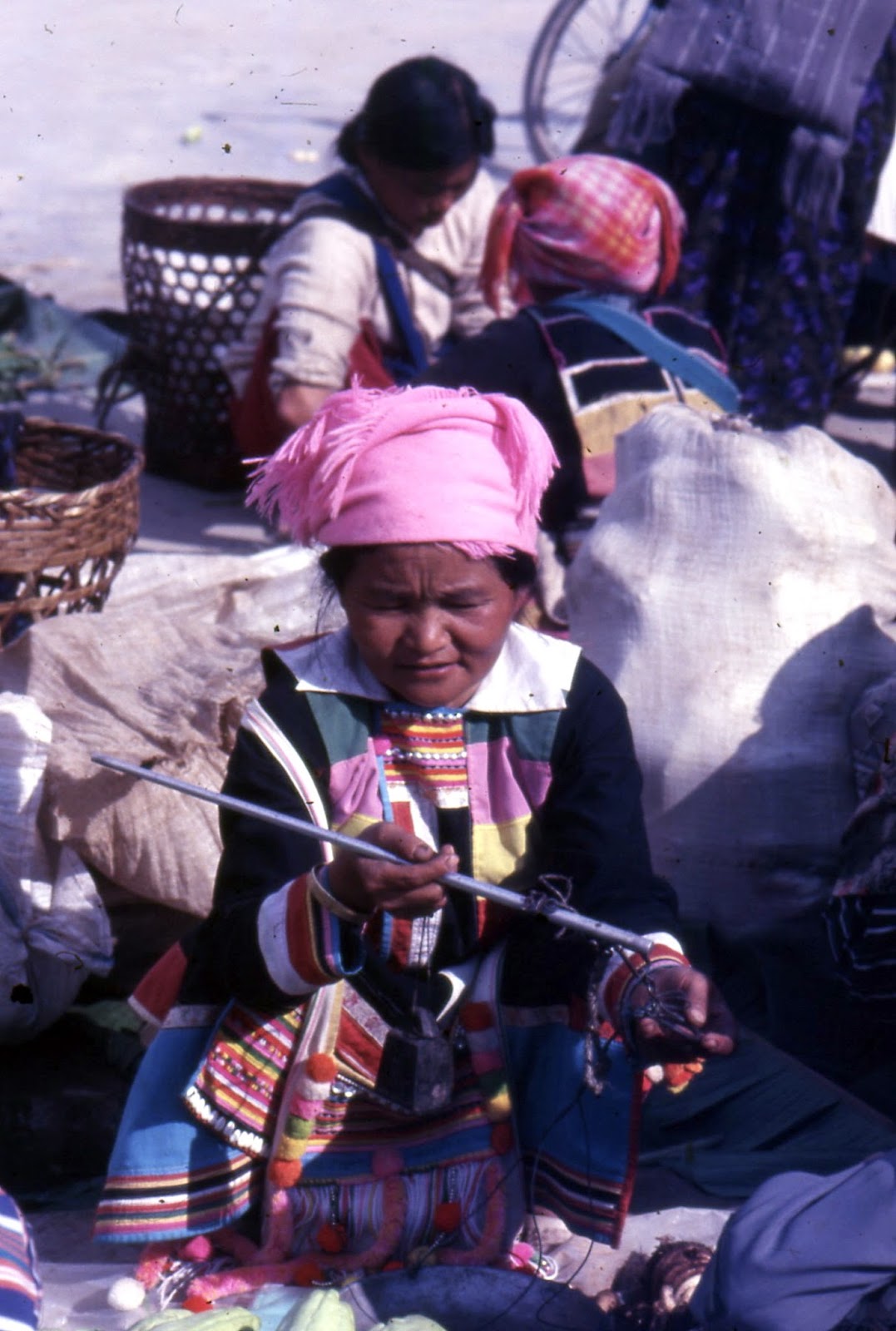
Lisu woman in Zhangfeng
Dai food stalls in the Zhangfeng market
       Every five days Zhangfeng hosts open market day, attracting people from both sides of the border.  Besides the Dai, Jingpo and Lisu from the mountains to the northeast show up, hawking hill crops, deerskins, split-bamboo baskets and other items.  A few De’ang women may also turn up, recognizable by their bright, multi-colored jackets and headscarves, woolen tassel earrings, striped sarong and perhaps, like some Jingpo women, rattan rings around the hips.
rural Dai temple, Longchuan County
       From the Mon-Khmer linguistic group, the De’ang population is only half that of the Achang,.  A few scattered De’ang villages lie in the hills near the Myanmar border, but most of Dehong’s De’ang live in Santaishan district, especially in the hills south of the main road om the way up to the Buddhist cave temple at Sanjiaoyan.  They live in stilted wooden and bamboo houses with thatched roofs and, like their Dai neighbors, practice Theravada Buddhism.
       The last of western Dehong’s cities is Ruili, 37 km south of Zhangfeng, the largest of the four.  From the 8th-12th centuries it was the capital of Mengmao, the most powerful  kingdom in the immediate region.  The Mongols conquered it in the 13th century and the Ming Dynasty reasserted Chinese suzerainty in the 14th century.  It retained a measure of local autonomy until the 20th century and in recent decades has become important because of its commercial ties to neighboring Myanmar.
Dai women cycling home from the fields west of Ruili
       Ruili has all the hallmarks of a prosperous border town, with skyscrapers and expensive hotels towering above the rows of royal palm trees on the main streets.  It rises late, with few shops open before 10 a.m., and stays active late, with most people having dinner after dark and the warren of shops and stalls inside and outside the covered central market busy until midnight.  Many Burmese wander through town, including individual jade merchants hawking ornaments to Chinese tourists who came to Ruili specifically to buy jade.
       The other Ruili feature drawing Chinese tourists two decades ago was its proximity to the Myanmar border.  They could take a short trip from Ruili to Jiehao, step across the border to the other side and be able to say they’d been to a foreign country, even if but a few hours.  The main road, Highway 320, ran another 34 km southwest from Ruili to Nongdao, at the extreme end of the prefecture.
       The road ran more or less parallel to the Ruili River, a branch of the Nu River that, after crossing the boundary, becomes the Salween River.  The road runs in a straight line, but the river is somewhat winding, so that pieces of Myanmar territory lie between the river and the boundary line.  And at Jiehao, a chunk of Chinese territory lies south of the river.
the Snake Tree near Mengling
       The land is relatively flat on this route, featuring a succession of Dai towns, villages and farmlands, a rural relief after the bustle of Ruili.  Every Dai village has a temple, usually a modest wooden one, but occasionally grander, with multi-tiered pagodas in the Burmese style, flanked by tall bamboo poles with long, narrow cloth banners fluttering from the top and great banyan trees in the courtyards.  Hansha Temple, a few km from Ruili, and Leizhuangxiang, on a hill north of the highway and further down towards Nongdao, are two fine examples.
       The most famous is Dadenghan Temple, 20 km southwest of Ruili, near Jiexiang.  On stilts, with red wooden walls and silver-colored roofs and pagoda spires, with a covered entrance corridor, it is typical of the Dehong Dai Buddhist style.  It was built in the 18th century and is supposed to house bone relics of the Buddha.  According to local legend, the Buddha stopped for a night here on his mission to preach the religion throughout Asia.
Jiele Pagoda, Dehong's finest
       East of Ruili, Highway 320 runs 25 km to Wanding, the last major town before the boundary of Luxi County.  It’s not much to look at today, but from the hill behind it, especially from the Thousand Buddhas Temple on top, one has a commanding view of the city and Myanmar beyond the bridge.  Wanding had a brief flare of importance in the Second World War as the terminus of the Burma Road, established after the Japanese seized eastern China and the government removed to Chongqing.  Tons of supplies, food and weaponry crossed into Yunnan from the British colony of Burma, until the Japanese conquered Burma and closed the road.
       Returning to Ruili, I made two last stops at Mengling and Jiele.  The former town hosts a patch of old banyan trees, with multiple roots descending from their lower branches.  One is called the Snake Tree, similar to the Single Tree That Makes a Forest in another park in SE Yingjiang County, as well as the one of the same name in Daluo, Xishuangbanna. 
       Jiele’s attraction is its pagoda, the finest in Dehong, originally erected in 1500 and restored ten times since, most recently in the 1980s.  The central spire, rising above several subsidiary golden spires, stands on a white base with the top part covered in dark orange tiles, unique in the prefecture.  With views of Dai farmers riding their buffaloes on the way back to Ruili, it was a fitting way to close my exploration of Dehong, a day of history, culture and everyday rural Dai life.

Dadenghan Monastery
                                                                         ° ° °    


Monday, April 13, 2015

When It’s Market Day in Yunnan


                                                           by Jim Goodman 

Hani villagers en route to Majie market day, Yuanyang County
       The problem with most towns in the southern half of Yunnan is that they are basically uninteresting in themselves, consisting primarily of drab, box-like, concrete buildings.  They may have an attractive park or temple, and perhaps an old-fashioned Dai neighborhood to wander through, but not much else to maintain interest. But on market day everything changes.  The otherwise boring town bubbles with excitement.
       Market day (gangai or ganji in the Yunnan dialect) is a periodic event common to most county seats, as well as many townships up in the hills.  Some places host them weekly, others every four, five or six days.  (Check the link to yunnanexplorer.com for a complete schedule.)  At such times not only does the central market fill with buyers and sellers, the commercial activity spills out into the adjacent streets and lanes.  In some small towns market day stalls fill the only road going through, resulting in an often incredible traffic jam all afternoon.
Miao examining batik cloth
Laomeng Sunday market
       Villagers from the surrounding plains and nearest mountain ranges swarm into town, some leaving their homes at sunrise in order to arrive at mid-morning, when everything's still fresh.  They carry their goods, perhaps including their afternoon rice, in baskets of split bamboo, suspended on a carrying pole, if Dai, or slung on the back, if from the hills.  Others lead ponies or mules laden with full saddle baskets.  Unless they rent space in the central marketplace, they will look for a convenient empty spot on a nearby lane, drop their loads and set up shop.  Most markets, though, do have designated areas for the poultry, the pigs, for keeping the ponies, etc.  The rest of the streets are open for any kind of business.
Wa women in Gengma
       The phenomenon is not restricted to the southern counties of the province.  Some in the north, such as the ones around Dali, have long been tourist attractions.  Generally speaking, though, market days in the northern counties attract only one, at most two, ethnic minorities.  Bai dominate around Dali Prefecture and further north, Yi in Chuxiong Prefecture, Lisu in upper Nujiang, Naxi in Lijiang and Weixi. 
       In contrast, the populations in the south, particularly along the international boundaries, are ethnically more mixed, thus making market day more interesting and colorful, for the crowds, mostly women, tend more often to wear their ethnic clothing.  Zhangfeng's market in Dehong, for instance, draws Dai, Jingpo, De'ang, Lisu and Burmese.  At the other end of Yunnan in Jinping, market day attracts Hani, two kinds of Yao, Miao, Dai and Yi, plus Vietnamese, Yao and Giay from over the border.
Dai woman embroidering in Gengma market 
     
Yunnan has long had the market day tradition.  19th century French explorers made use of it to replenish their provisions as they trekked across the province.  The practice fell into abeyance after 1949, but its revival was encouraged from the onset of the Reform Era in 1979.  Farmers now had the incentive to produce surpluses.  And as agricultural production has expanded in the time since, so has the rural transportation network.  Mountain roads are constantly being improved.  Minibuses add new shuttle routes every year.  And more farmers own tractor-trailers, used to haul people as well as goods to the market.
       Trade is the primary attraction.  People pile their garden produce, jungle herbs, grain, firewood, animal parts, costume components or whatever into their baskets and take the sometimes long and hilly trail to town, hoping to sell the contents and replace them with something unavailable or out of stock at home.  But that may not be their only activity.  If they sell out early they will take time looking around, checking what else is for sale, at what price, especially if it's something they might be able to grow, make or find themselves.  Some even walk all that way precisely to just look around, bearing no load of goods to sell and bringing no money to purchase anything.  They hadn't anything special to do back in the village, they can get some ideas for their future maybe, and anyway market day is always pleasantly diverting.
checking deerskins in Zhangfeng, Dehong
       Certainly socializing is part of the action. Relatives and old friends from outlying villages may meet, take a break from shopping, and dine together at one of the noodle stands.  Or they could make new friends by taking an empty seat at a table with other diners or joining the drinkers at one of the places selling liquor.  Neighbors make the journey in groups.  Young men scout the scene for attractive young women, for courtship in village societies often begins with an introduction at the market.
       Aware of this, the young women dress their best.  Dai girls pin flowers to their hair.  Miao girls wear newly embroidered clothes.  Yao girls don their heavy silver jewelry.  For most minority women in the southern counties aesthetic standards are still within the tribal parameters.  They feel the most attractive outfit they can wear is their finest traditional costume.  At many of these market venues ethnic minority women set up stalls selling traditional jewelry, materials for making ethnic apparel, components or even whole outfits, for those too busy to make their own.
medicinal herbs in Yuanyang
     
For the visitor this is a bonus and makes the day replete with color and beauty.  Yet it is also an indicator of the strength of local custom and conservatism in the particular minority concerned.  Nowadays one shouldn't expect too many men to dress in ethnic style.  Except for Tibetans in the northwest, some Hua or Black Lisu in the west, older Jingpo and Wa men in the southwest, Aini in Menglian and Yao in the southeast, men tend to favor urban styles or military surplus. 
       In traditional societies the men are more in contact with the outside world, more likely to be influenced by the opinions they hear as a result, and more likely to want to move anonymously in unfamiliar environments, not calling attention to themselves by, for instance, wearing ethnic clothing.  The women, by contrast, move out of their immediate environment far less often and so are more likely to retain their traditional esthetic sense.
Lahu girls in Menglian
Hani girl in Jinping
     
Clues to the strength of tradition then will come from the women.  In relatively old-fashioned villages the middle-aged and older women will dress ethnic style, as will perhaps a good portion of the younger married women.  Mothers carry their babies on their backs in cloth harnesses (sometimes elaborately embroidered), with the child in a traditional baby's cap.  But the true indicator is how young the females are who dress in the ethnic style.  The stronger the ethnic tradition is, the more teen-aged and primary school girls will put on their traditional costumes.  And the more local minorities prefer their ethnic style the more likely market day will feature tables and stalls run by minority women selling traditional costumes, components and jewelry.  If they are selling other kinds of goods they may engage in embroidery work or spinning thread while they tend their stalls.
Yi clothing stall in Yuanyang
       With this in mind, a traveler can choose which minority seems to be the most interesting, find out who they are and where they live.  In some cases you won’t learn by asking the minority women themselves, for they may not speak Chinese.  But the shopkeepers and minibus drivers probably know or can find out for you.  There may be mini-buses going to the places they come from and you can decide when to pay a call.  Or if they came to market day on foot they may live close enough to the town that you need but a short hike to visit them.  They may even invite you themselves (which has happened to me quite a lot) for your own personal encounter, particularly if you are alone, to enjoy the conviviality of a new friendship at their home.
       Much can be deduced about the area's economy by observing market day activity.  Urban vendors sell prepared food, ready-made clothing, metal containers, farm tools and other items not produced in the countryside.  What the rural folks bring to sell tells the visitor something of their lifestyle and their role in the local economy.  The vegetables mountain folk offer may differ from those grown in the valleys.  If only the hill people are hawking firewood, bamboo, jungle herbs, etc., that means valley people depend on them for such items.  If the hill folks are buying rice in autumn or winter, it means they don't cultivate it.  If they are selling rice, that means they’ve produced a surplus.  If they've walked all this way to sell something that costs but a few yuan for the entire contents of their baskets, they are obviously poor people.
Yao and Hani in the Jinping market
     
Ethnic diversity is the most attractive feature of market days for a visiting traveler.  In the south and southwest, besides the Han, the Dai populate the plains, while in the southeast the Zhuang replace the Dai.  Two or more sub-groups of colorful Miao and black-clad Yao, plus the nearest branch of Yi, attend the markets in Wenshan prefecture, mainly selling vegetables and jungle produce.  The Zhuang sell vegetables, grain, fish and fish traps.
       In the south and southwest the Dai are the grain merchants and run most food stalls.  Xishuangbanna has three weekly markets; Thursdays in Xiding, drawing mainly Aini and Bulang, and Sundays in Menghun, with local Dai joined by Aini, Ake (a colorful sub-branch), Bulang and Lahu from the hills, and Mengman in the west, with mainly Dai and Aini.  Menglian's market day attracts very traditional and colorful Lahu, Aini and Wa from the hills, while Menga's, on the Myanmar border two days later, draws the same folks, except Aini, from both sides.  In Gengma, one of the largest markets in the southwest, Dai and Han join Wa, Yi and Lahu, where all but the Han dress traditional style.  And in Mengding, Wa and De’ang join two kinds of Dai.
Hani in Yuanyang for market day
       In lower Ailaoshan, the four counties--Honghe, Luchun, Yuanyang and Jinping--between the Red River and the Vietnam border, the institution of market day is at its most developed.  Yuanyang hosts it every four days, the other three county seats every six days.  In addition, every major township holds its own market day and by now enjoys regular minibus service to and from the county seat. 
       The Hani are the dominant mountain people, with a dozen or more sub-groups.  Branches of the Yi, Miao and Yao are next most common, while the Zhuang and Dai here are largely terrace-farmers, too.  Ailaoshan Dai are animist, not Buddhist, except for a small group in Jinping County, and often travel from the plains up into the mountains for market day activities.  Successful surplus production and improved transportation links make market day in this area a real spectacle.  And at every venue several stalls will sell Hani or Yi jackets, trousers, embroidered belts, sashes, silver jewelry, Miao batik cloth, etc., for most Ailaoshan minority women own several traditional outfits.
Yi on guitar in Yuanyang
       Certain Ailaoshan residents, mostly men, have become professional market-goers.  Familiar with the buying and selling prices of commodities from one venue to another, they tour the townships every week, buying from one and selling for a profit at another a day or two later.  Others, often women, sell the same product moving from one market day venue to the next.  In Jinping County, for example, Hongtou Yao women start at Adebo’s market day, north of Jinping city, move next day to Jinping, the following day to Mengla and the fourth day to Nafa, on the Vietnam border.
       For the rural folks of southern Yunnan, market day gets better every year. No wonder it’s still a popular institution   It’s like a regular working holiday, with lots to see, much to learn, many items to trade, sometimes music to hear as stall-tenders bring along a flute or guitar to play while they are there, or a drunken lute-player wanders through the crowd.  There are old friends to meet and new friends and contacts to make.  Even the younger generation is enthusiastic and youth make up a large proportion of those in attendance.  For not only can they make a little money through their participation, they may even find a suitable marriage partner, one with whom to set up house and field, produce more than the family can consume, and take the surplus to town on market day, where their new life actually began.
.
going home after market day in Yuanyang

                                                                      * * *
            for more on Ailaoshan markets and people se my e-book The Terrace Builders


Monday, June 2, 2014

Dance of the Swords—the Jingpo Munao Festival


                                                            by Jim Goodman

Jingpo girls at a Longchuan County fair
    Dehong Dai and Jingpo Autonomous Prefecture lies in the southwest corner of Yunnan Province, surrounded on three sides by Myanmar.  Besides the Dai who dominate the plains and the Jingpo,  Dehong is also home to Hua Lisu in the western hills and two smaller minority nationalities—the De’ang and the Achang.  Both of these peoples show heavy influence by their Dai neighbors in domestic architecture, agriculture and religion. The De’ang number close to 18,000, are dispersed in southern Dehong and reside in parts of Lincang Prefecture as well.  The Achang are more numerous, about 33,000, 90% of whom live in Lianghe and Longchuan Counties.  They have historically been more culturally important to Dehong because in Husa, their main cultural center, they produce the swords used by everybody in the prefecture.
    All but a few of Yunnan's 120,000 Jingpo live in the southwestern prefecture of Dehong, mostly in the mountains at 1500 meters or higher.  Across the border in Myanmar the Jingpo are the largest of six ethnic groups (including Lisu) that are classified as Kachin, a Burmese word.  They originated in the mountains along the eastern edge of the Tibet-Qinghai Plateau and migrated south to northern Myanmar and western Yunnan.  By the early 15th century they were numerous enough in Dehong that the Ming government created two autonomous Jingpo districts and appointed one Jingpo chieftain in each as hereditary headman (tusi).
elderly Jingpo wo
    The following century witnessed a great migration of Jingpo to Dehong's mountains.  They became the largest ethnic group in the hills and today comprise one-eighth of the prefecture's population.  Around that time they learned to use iron ploughs and grow rice, a major transition from their previous economy of hunting and gathering.  Living in the mountains where the soil is less fertile they generally resorted to the slash-and-burn style of farming.  Contemporary governments have been weaning them away from this form of agriculture by introducing terracing, fruit orchards and crop substitution--tea and sugarcane instead of rice.
     Most Jingpo settlements are ensconced in the forest or within bamboo groves and all but hidden from view.  Traditional houses were made of wood and bamboo with thatched roofs.  The walls were of plaited bamboo and a square hearth occupied the centre of the main room.  The house stood on stilts or had one end against the higher part of the slope.  This is still the norm in most areas, but brick housing, with tile roofs, like the Dai, are the current choice for any Jingpo family that can afford it.  These rest on the ground, while separate sheds house the animals.
    Jingpo men have a reputation as great drinkers, though not, it must be pointed out, as drunken revelers.  But alcohol is part of a social encounter and men often carry wine flasks and cups with them.  Both men and women chew tobacco, claiming it as an aid to digestion.  Women like to chew catechu and betel nut, too, which darkens their teeth.  In the old days this was considered a sign of beauty.  The younger generation prefers sparkling white teeth though, and that particular Jingpo custom seems destined for desuetude.
Jingpo female clothing style
decorative rattan hoops
    The Jingpo still like their ethnic style of clothing, even if most reserve it for special occasions. Women make or weave the components, though nowadays the woman's wraparound skirt is more likely to be made on a knitting machine, if woolen, or a power loom, if cotton or silk. In the past during dry season they sat in the yard or on the porch with a back-strap loom hooked on to a house post.  Older women usually wear dark sarongs and jackets, while younger women wear red, with yellow trim and inlaid patterns, or a multi-colored piece with many intricate, inlaid patterns.
    The side-fastened, long-sleeved velvet jacket is plain black, but on special occasions- a Jingpo woman wears one covered with silver ornaments:  three rows of big half-globes, stitched around the collar, shoulders and back.  At the bottom of these rows hang many thin, flat pendants on chains.  These drop down to the midriff in front and below the shoulder blades in back.  A few round, embossed discs may also be attached to the bottom of the front of the jacket.  To complete her outfit the Jingpo woman wears a red woolen tubular hat and a dozen or more lacquered rattan waist hoops.
Jingpo monument in Yingjiang
    The men don't dress up so colorfully, even on festival days.  The older men tend to wear the older styles of Han clothes, the younger ones contemporary urban fashions.  On special occasions they will don a black vest and a white turban, the ends colored with many small, attached pompoms.  They also carry the Jingpo shoulder bag, of red wool, black strap, and covered in front with silver bulbs and pendants on chains just like the woman's jacket.  A sword, with a straight edge and no pointed end, in a decorated scabbard (more than likely made in Husa) is the final item. Traditionally, Jingpo men carried the sword at all times, for use in defense (rarely necessary) and as a cutting tool for chopping everything from trees to sugar cane.
    Besides these uses, the sword was and still is an essential part of the men’s outfit during the annual Munao Festival.  Groups of men wield their swords in stylized, synchronized patterns as part of a ritual dance.  Because of this Jingpo custom the people of Dehong have a saying, “The Achang make the swords; the Lisu climb the swords; the Jingpo dance the swords.”  Munao is a celebration of being Jingpo and the sword’s very prominent visibility in the event reflects its importance to the Jingpo cultural identity.   
"dancing the swords"
    In Jingpo mythology Munao is something people staged in gratitude for some favor or another.  Its origin is as old as that of the people themselves.  When the divine parents of Ning Gawn Na, the mythical Jingpo progenitor, lay in their deathbed, they instructed their son to give them a good sending off ceremony for their souls.  Then they would metamorphose into Heaven and Earth and Ning Gawn Na would become fully human and father the Jingpo race.  A proper send-off could only be a Munao Zongge, Jingpo words for "let's dance together."  But Ning Gawn Na did not know the dance, for the only performers were the children in the Kingdom of the Sun.
    One day, however, Grandfather Sun invited a representative of the bird community to the dance.  A sparrow attended and when he returned home he taught the other birds.  The peacock took on the lead singing role and the hornbill organized the choreography.  Ning Gawn Na and his wife happened to be watching and they took the dance home and taught others.  A wild boar cleansed the corral for them and two Han brothers sent a dragon robe for the dance leader to wear.  The Munao performance made the Jingpo more united, courageous and intelligent and so they have continued to stage it ever since, for four days beginning the full moon of the first lunar month.
the Munao dance
     Munao symbolizes the solidarity of the Jingpo people, so many separate villages join to celebrate it at one of the major festival sites such as the hills of Laying township, near Zhangfeng, and the knoll beside the Yunyan Pagoda on the outskirts of Yingjiang.  The latter keeps the Munao poles up all year, plus a wooden hall with a buffalo skull mounted over the front door.  Nearby, a white statue of a Jingpo man using his crossbow stands on a tall pedestal beside the pond.  Since it is beyond the urban area, and even the adjacent Dai village, the Yingjiang Munao grounds has a very rural atmosphere.
    Because it is the prefecture capital, Luxi (also known as Mangshi) hosts Munao in a big way, converting the athletic stadium into the staging grounds.  A large corral is constructed, with gates at two sides and viewing platforms for the spirits at the other two sides.  In the center the Jingpo erect four tall poles, painted with designs symbolizing aspects of their history and economic life.  Small paintings at the top of mountains, for example, represent their mythical Himalayan origin.  The crossed swords separating the two middle pillars remind them of their past battles, both against wild animals and human enemies.
Jingpo type of woodwind
    At the base of the pillars in front stands a large drum, beaten during the dance to signal the pace and rhythm.  To either side of this are gongs mounted in racks.  Behind the pillars sits an orchestra, mostly of horns and woodwinds.  Its members dress in fancy white coats with epaulets, black trousers and Jingpo headscarves.  When the dance begins they play, sometimes with a singer accompanying them, sometimes without.  Occasionally they pause and let an a cappella singer take the microphone or allow a long solo performance.  Usually the soloist plays the flute or a specifically Jingpo instrument comprising a buffalo horn attached to a bamboo flute, which makes a sound similar to the woodwind instrument played in funeral processions.
    Munao lasts four days, with one 90-minute dance in the morning and one in mid-afternoon.  On the third night the bigger host venues like Luxi will present a stage show of songs and dances of both Jingpo and Dai, young troupes and middle-aged ones.  A Lisu dance and the Wa Hair Dance may be included for good
preparing refreshments
Munao dance leader
measure. A great number of Dai attend Munao, dressed in their best brocaded sarongs, their jackets pinned together with filigreed gold butterflies.  A few Dai and Jingpo women take advantage of the event to open stalls by the stadium entrance, selling sarongs, silver ornaments, shoulder bags and Husa swords.  Only a few Dai participate in the dance, though, preferring to watch from the grandstand or outside the corral.
    Explosions and strings of firecrackers announce the beginning of the dance.  The corral is empty, save for the orchestra, which strikes up its first tune.  Then, slowly rocking in a two-step as they advance, the long line of dancers enters through the gate, led by four men in red or gold silk "dragon robes," like the ones presented by the Han brothers at the first Munao.  They hold their swords upright in front of them.  On their heads they wear painted, split-bamboo helmets that symbolize the origin of Munao.  On the sides wild boar tusks are attached, to remind them that the boar cleansed the first festival corral.  Affixed to the top of the helmet is a hornbill beak, in honor of the organizer of the Birds' Munao, from which the Jingpo learned the dance.  As a plume, the helmet uses feathers of the peacock and the hornbill, the singer and emcee at the Birds' Munao.
Munao at Luxi, the prefecture capital
    The line keeps to the corral railing until it has gone all the way around, then begins a more sinuous route in the open space around the poles. Eventually this fills up, too, and near the end of the dance the robed priests simply march back and forth in front of the drum. 
    Hundreds of Jingpo are by now in line, a group of women, then a group of men, with women slightly more in number.  Every variation of the Jingpo sarong is on display, including the tight, red woolen miniskirt version.  Men hold their swords aloft and sling the silver-laden bag over their shoulders.  Women wave fans or kerchiefs as they dance.  Outside the line, women attendants pour cups of rice-beer from bamboo containers to refresh the dancers.  And when the dance concludes, much of the crowd stays in the corral, snapping photos of each other now that they're dressed in their Jingpo best.  This is, after all, a festival that glorifies their ethnic identity, that reminds them no matter how much or how little they have assimilated into the modern world, this is who they all really are.

posts and priests of the Jingpo Munao
                                                                        * * *