Thursday, June 25, 2015

The Transformation of Nha Trang


                                                                                     by Jim Goodman

Tháp Bà, Cái River, Nha Trang
       Lying beside one of the most beautiful bays in East Asia, with a long beach, excellent seafood, picturesque islands and good weather practically the year round, Nha Trang is one of the top tourist destinations in Vietnam, both for foreigners and for the Vietnamese themselves. Tourism is by far the biggest factor in the local economy and new hotels and restaurants are opening practically every month. Over a half million people now reside in metropolitan Nha Trang, making it one of the fastest-growing cities in the country. About eighty years ago there were just a couple thousand inhabitants of a few small fishing villages at the mouth of the Cái River, north of today’s downtown area.
       On a small hill beside the river here stands Tháp Bà, an ancient Chăm temple that testifies to Nha Trang’s ancient glory, long before any Vietnamese had ever heard of it, as a small but independent Chăm kingdom called Kauthara. The city’s contemporary name, Nha Trang, is a corruption of Ya Trang, River of Reeds in the Chăm language, their own name for what is now called the Cai River.
Po Nagar Temple
     The Chăm are an Austronesian people who established several states in Central Vietnam from the 3rd century C.E. The smallest of these, Kauthara, basically consisted of what is today the province of Khánh Hòa. Like other Chăm states, Kauthara adopted the Indian model for its state, religion and society, influenced by its southwestern neighbor Funan, an alliance of maritime city-states that dominated southwestern Vietnam and eastern Cambodia from the 2nd through the 7th centuries. The earliest Sanskrit inscription in any of these Chăm states came from a stele at Võ Cạnh, a site near Nha Trang, dated from the 4th century.
       While the Chăm adopted the whole pantheon of Hindu deities, they also assigned equal importance to their own indigenous mother-goddess Po Nagar. Chăm society was matrilineal and Po Nagar was a goddess for all Chăm, not just those in Kauthara. Her biggest, most prestigious temple was in Kauthara, perhaps first constructed in the 6th or 7th centuries. As a sanctuary, the Chăm considered it on a par with the Mỹ Sơn site in Quảng Nam, where most religious monuments were dedicated to Shiva.
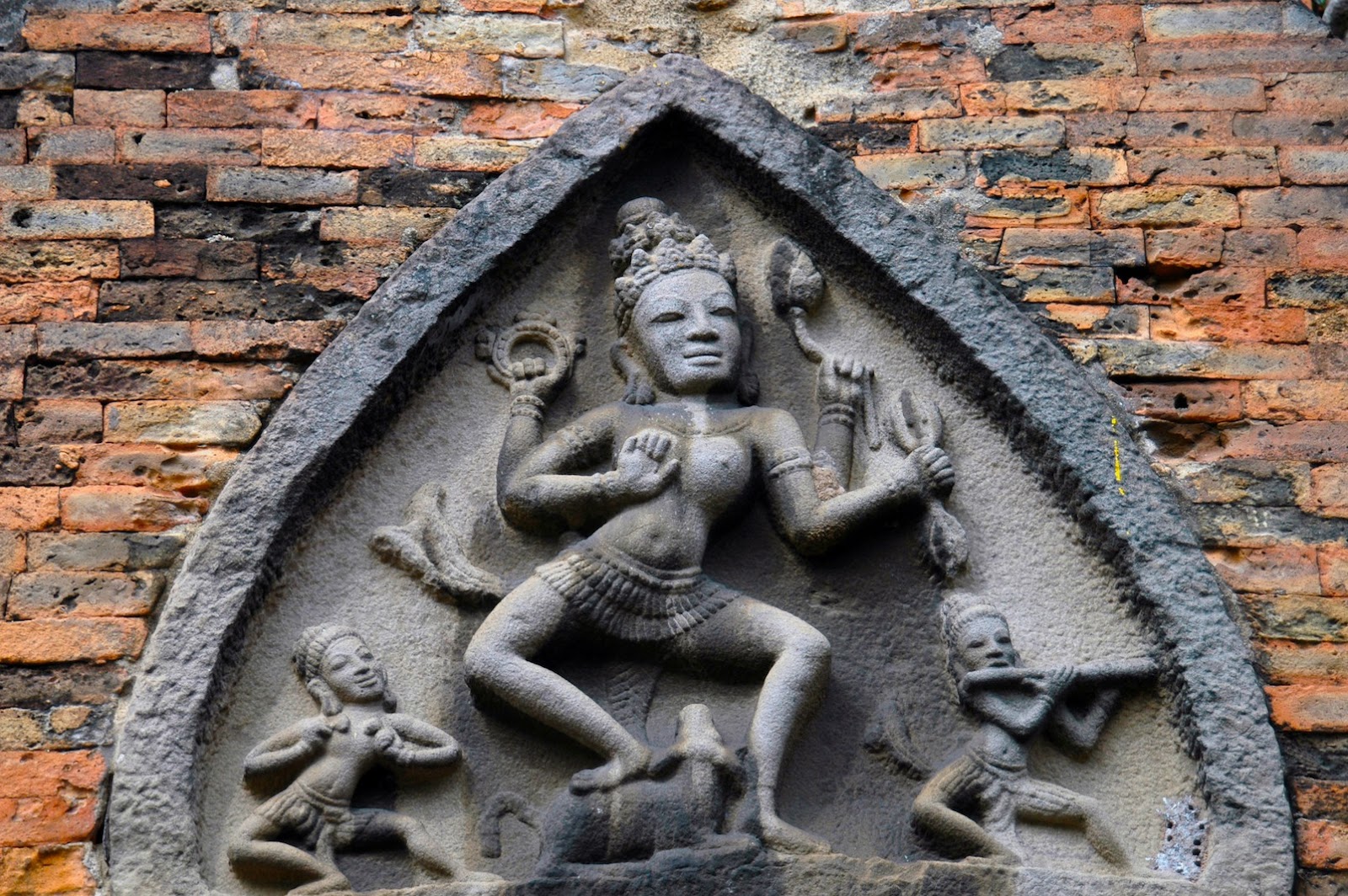
stone carving of Shakti, Po Nagar Temple
       In the small ancient state of Kauthara arable land in the plains was also limited. It could not survive on agriculture alone. But the state had good trading relations with the nearest hill peoples, overland connections to Cambodia and, most importantly, enjoyed a thriving maritime commerce. Chăm trading ships made regular journeys to the islands of Indonesia, while Kauthara itself was an important stopover for vessels plying the route between Srivijaya and China. Given the importance of Po Nagar to Chăm culture we can assume the city also drew Chăm pilgrims from the other coastal kingdoms.
       By the 8th century Kauthara was a wealthy and active port, thereby arousing the envy and cupidity of some unsavory neighbors. In 774 Javanese raiders attacked and plundered the city, burned down the Po Nagar temple and stole its sacred lingam. The Chăm king led his navy in pursuit, caught up with the Javanese, destroyed their ships, but was unable to recover the temple treasures. The king ordered the temple rebuilt, this time in brick and stone instead of wood. This structure survived until 944, the year Khmer invaders sacked the city, smashed the temple buildings and stole the main image, which was gold.
columns at the entrance to the temple compound
       Following the Khmer withdrawal the Chăm rebuilt Po Nagar Temple one more time, replacing the central gold image with one of stone. They also added more buildings and sculptures over the next couple of centuries, eventually covering about five hundred square meters of the hill. They embellished the corners of the towers with little stone figures and added stone steles, like the one of Shakti, Shiva’s consort, to the side of the main sanctuary, and relief sculptures, like Indra atop his elephant, directly on the sides of the walls.
       Kauthara fought a war with its southern neighbor Panduranga in the 1060s, but when peace was restored maintained friendly relations with Panduranga for the next several centuries. The little kingdom may have sent forces with the King of P:anduranga’s army that expelled the Khmers from Vijaya in 1149, four years after the Khmer invasion and occupation. But Kauthara largely abstained from involvement in Vijaya’s wars with, successively, the Khmer, the Mongols and the Vietnamese.
Chăm dancers at Thạp Bà
       In 1472 the Vietnamese conquered the Chăm state of Vijaya and annexed all of its territory down to the Cả Pass at the northern border of Kauthara. Except for parts of Phủ Yên province, just north of Kauthara, Chăm residents in Vijaaya mostly fled. Some moved into Kauthara, but at any rate the border remained quiet for a long time. Vietnamese migration into former Viyaya was slow and in the 16th century the country plunged into a protracted civil war and power struggle that by the end of the century had effectively divided it into two parts. The Trịnh Lords ruled the northern provinces down to Quảng Bình and the rival Nguyển Lords governed everything south as far as Kauthara.
       Chăm in Kauthara, particularly those descended from Vijaya refugees, began interpreting the Vietnamese political discord as a sign of weakness in their old enemies and a chance for the Chăm to recover Phủ Yên. Soil and land conditions in Phủ Yên were much more conducive to large-scale agriculture than in Kauthara or the even more arid lands of Panduranga. In 1611 the Chăm launched an incursion into Phủ Yên, but the Nguyễn forces soon drove them back across the border. That didn’t put an end to Chăm ambitions regarding Phủ Yên, but Kauthara was also involved in serious internal sectarian conflict.
the Cái River at Nha Trang
       Kauthara Chăm society was split between its Hindus, largely the peasantry, Brahmins and ruling class, and the Muslims, mostly from the commercial elements. In 1622 the Muslims staged a coup, killed the Hindu king and installed one of their own as monarch. This inaugurated a civil war that soon involved the Churu, Êdê and Giarai highlanders from the western hills. In 1627 a Churu chieftain named Pô Rômê took the throne of Panduranga and with that state’s army forcibly quelled the faction fighting in Kauthara and took over its administration.
       Pô Rômê ruled for 24 years, a time of rising prosperity until, perhaps inevitably, he was drawn into the burgeoning conflict between the Chăm and Vietnamese in Phủ Yên. Violence broke out along the border in 1651. Pô Rômê got caught in one of the skirmishes and was mortally wounded. His half-brother took the throne and launched an invasion that forced Vietnamese defenders to retreat all the way to Bình Định. The Nguyễn Lord Nguyễn Phúc Tần dispatched 3000 troops under a Chăm general that retook Phủ Yên, then seized Nha Trang, captured the Chăm king and forced him to cede Kauthara and all territory down to the Phan Rang River. Kauthara’s Chăm population all fled; the Hindus for further south, the Muslims west to southwest Vietnam, Cambodia and Siam. Nha Trang port ceased to exist, the hinterland was deserted and the erstwhile kingdom now had a greater population of tigers and other wild animals than it did of people.
Khánh Hòa landscape, west of Nha Trang
       When Vietnamese began settling in the province they tended to establish villages in the Cái River Valley west of Nha Trang. Their administrative center was at Diên Khánh, 11 km west of Nha Trang, an important stop on the north-south route. Because mountains to Nha Trang’s immediate south and southwest block a direct southern exit from the city, even today vehicles heading south from Nha Trang still have to detour first to Diên Khánh to get on Highway 1A.
        Diên Khánh would have its moment in history in the late 18th century when it became the focus of campaigns in the 1790s by Nguyễn Ánh, the surviving member of the Nguyễn royal family, against the Tây Sơn Dynasty that had overthrown them. In 1794 Nguyễn Ánh felt strong enough to make Diên Khánh a permanent base and so ordered a citadel built there. One of his French advisors, Olivier de Puymanul, a fortifications specialist, oversaw the construction, the four main gates of which are still in place. He stayed there through the expected, but unsuccessful Tây Sơn siege and two years later led Nguyễn forces in the capture of Nha Trang port.
citadel gate at Diên Khánh
       It took Nguyễn Ánh six more years until final victory, but the installation of a new dynasty changed little around Nha Trang. It did not revive as a busy maritime commercial port and Diên Khánh was much bigger and more important. Even when the French took control of Central Vietnam, their base in Khánh Hòa was in Diên Khánh. But after emerging victorious from World War I, and convinced their stay in Vietnam would be permanent, French authorities began seeing Nha Trang as a possible seaside vacation venue for their colonists and administrators to spend their leisure time.
       In 1924 the French combined villages and recognized Nha Trang as a minor town, upgrading it to a full town in 1937 and the de facto provincial capital. Local residents around this time built the Long Sơn Pagoda on a hill in the western suburbs that today is one of the landmarks of the city. The huge white Buddha at the summit, however, was only added in 1963, the year South Vietnam’s President Diêm was killed, as a protest against the Diêm regime’s anti-Buddhist policies. Carvings of Buddhist monks and nuns who killed themselves in protest at this time surround the base of the sculpture.
Chùa Long Sơn
       Besides setting up a tourist zone for their fellow countrymen, the French also involved themselves in restoration work on the long neglected Po Nagar Temple. Only five of the original buildings still stood, but the columns of the entrance at the foot of the hill, which had survived the 10th century Khmer invasion, were relatively intact. The French did not replace the original, boat–shaped roof, but renovated the steep staircase leading up to the kalan, or main sanctuary. Some of the standing sculptures they removed to a small museum in the compound. But essentially, the compound as it exists today is the work of French restoration.
embroidery work at XQ village
      Nowadays the temple compound is a top tourist attraction, but also a place of worship for the Vietnamese, who long ago incorporated Po Nagar into the pantheon of their Holy Mothers cult, renaming her as Thiên Y A Na. From the compound’s hilltop location visitors get a wonderful view of the mouth of the Cái River and its myriad boats. A couple of picturesque island temple compounds lie offshore nearby. Further back towards the city center the unusual shape of Tháp Trầm Hương (Agarwood Tower) enhances the northern shoreline and the nearby X Q embroidery village has workshops with girls doing silk embroidery, displays of such items and a pleasant tea garden. But beyond Tháp Bà, Nha Trang’s main attraction is its beach, the longest municipal beach in the country.
Nha Trang beach
       On ordinary days the waves are relatively modest, never reaching a size appropriate for surfing, but all the other seaside activities are possible here. Boating clubs offer cruises to the offshore islands. Diving and snorkeling clubs introduce people to the underwater attractions and an Oceanographic Museum at the far southern end of the beach informs visitors of everything they could want to know about marine life in the vicinity. All these are popular activities, but for most visitors splashing around in the sea, relaxing under a beach umbrella or strolling on the sand are sufficient.
       Mornings and afternoons the crowds on the beach are almost entirely Westerners, particularly Russians, who first became familiar with Nha Trang when the Russians had a naval base at nearby Cam Ranh Bay 1979-2002. Russian tourism really took off here in the last decade, with regular direct flights from Moscow. After Vietnamese, Russian is the second most commonly heard language in Nha Trang. Bilingual signs in Vietnamese and Russian proliferate the downtown area.
       Vietnamese begin coming out to the beach only from late afternoon, when temperatures are cooler. So do the roving vendors, selling drinks, fruits, snacks, lobsters, scallops, oysters and other shellfish, raw or cooked. Bars on the beach begin preparing for Happy Hour and restaurants start assembling the ingredients of the special dishes they will offer for dinner, knowing that every visitor caps a day at the beach with a sample of Nha Trang seafood.
buying lobsters on the beach
Tháp Trầm Hương (Agarwood Tower)
       Tháp Bà, Chùa Long Sơn and the little embroidery village provide visitors to Nha Trang with a cultural and historical backdrop. But sun, sand, surf and seafood form the basis of its attraction and its success as a tourist destination. And no wonder it’s popular. If these are the features a traveler seeks in choosing a site for a holiday excursion, Nha Trang is the city that, from its reconstitution in colonial times, deliberately designed itself to be precisely that kind of venue.

Pn Nagar/Thiên Y A Na
                                                                        * * *
                    Nha Trang is one of the sites on my cultural/historical tours of Vietnam. 
                              For more information, go to jttp://deltatoursvietnam.com

Tuesday, June 16, 2015

Appreciating the Huayao Dai


                                                  by Jim Goodman

Huayao Dai on the Red River near Mosha
       The most common picture of Yunnan’s Dai minority originates from the prefectures of Xishuangbanna and Dehong.  Tropical, palm-strewn plains, monks and temples, young women in matching blouses and sarongs, with flowers decorating their hair buns, and the Water-Sprinkling Festival of mid-April are the dominant images of the Dai.  Indeed, most of the province’s million-plus Dai are followers of Theravada Buddhism, like their cousins in Myanmar, Thailand and Laos.
Dai Sa snack seller on market day
       But a significant portion is not and that includes virtually all the Dai of the Red River valley, which begins in central Yunnan and runs into Vietnam.  These Dai still follow the animism that all Dai followed before any of them converted.  Theravada Buddhism began penetrating southern Yunnan perhaps as early as the 10th century.  By the 12th century important Buddhist temples and communities were already established in Xishuangbanna,  Lincang and Dehong.  Missionaries carried the faith as far north as Jinggu, in central Pu-er Prefecture.  But they never crossed into the Red River valley, where Dai communities had taken up residence many centuries earlier.
       Upper Ailaoshan, however, namely the mountains and valleys of the Red River in Xinping and Yuanjiang Counties, is home to several related sub-groups known collectively as the Huayao Dai.  Huayao means Flowery Waist in English.  Han Chinese coined the term to identify the Dai whose women dressed in highly colorful costumes, with the most resplendent section being that around the waist.
       The Huayao Dai of Xinping County, Upper Ailaoshan comprise three sub-groups—Dai Ya, Dai Sa and Dai Kat—who inhabit the alluvial plains and adjacent mountain slopes.  Where the Red River valley is fairly broad, like around Mosha, the Huayao Dai live on the plain.  Where it is too narrow, like at Manbong further upriver, they built their villages on the slopes, 200 or more meters above the river, constructed hillside terraces and engineered the water from the mountain streams to run through them and their villages as well.  The Ailao Mountains are famous for their ancient irrigated rice terraces and the Huayao Dai, as the oldest residents in the region, were the people who introduced them.
Huayao Dai village, Xinping County         
       Huayao Dai houses are flat-roofed, like cubes on blocks.  They are bunched together with cobblestone lanes between them.  Their rice terraces lie below and beside the settled area.  Usually a bamboo grove stands off to one side of the village and the area between is planted with a variety of vegetable crops and some sugar cane.  With sugar factories at Mosha and Donge this is a popular cash crop and small stands of sugar cane often take up the end zone of a paddy otherwise used for growing rice.
       Besides rice and vegetables and the meat of such domestic animals as pig, duck and chicken, the Huayao Dai also supplement their meals with aquatic animals caught in the rivers, streams and flooded paddies.  Every house has a collection of fishing traps of various shapes and sizes, made from split bamboo.  They don’t often catch big fish, but small eels are abundant and these, usually deep-fried in oil, are a frequent dish at their meals.  A common filler is steamed glutinous rice, eaten with the hand, while chopsticks are used for the other dishes. 
Dai Ya woman in the field
       Compared to the Buddhist Dai, or even the Dai of Lower Ailaoshan, Huayao Dai women are not as attached to their traditional clothing.  Only the older generation still wears it every day.  The younger women, married or not, prefer ordinary Western clothing, dressing up Huayao style only for weddings and big festivals.  The traditional women’s outfit is made from hand-woven cotton, dyed indigo or black, and cut and assembled into several components.  These comprise a shin-length tubular skirt, apron, leggings, bodice, jacket, wide sash-belt and headgear.  Women fold and tuck the skirt in a way that leaves the hem on the left side slightly higher than on the right.  With the Dai Ya and Dai Sa it is black at the top, red in the middle and embroidered all over the lower third, reaches mid-calf and is worn over black leggings.  The black apron hangs down only to the knees, with a wide border of multi-colored, embroidered bands. 
       On the upper part of her body the Dai Ya woman wears a sleeveless bodice, the front embroidered or decorated with silver studs and pendants.  Over this goes a long-sleeved black jacket, open in the front, reaching only to the breasts.  The collar, lapel and bottom third of the jacket are trimmed in colored strips or embroidery.  Around her waist she ties a wide, multi-striped belt, with a small, decorated basket attached to the back. 
typical Huayao Dai mud-brick house
       The Dai Sa women dress in a similar style.  They use basically the same items with a few color variations.  The most readily apparent difference from the Dai Ya outfit is the headgear.  Dai Sa women wrap their hair in a headscarf, the lower part embroidered like the jacket, the ends tasseled and tucked so as to fall loosely over the left ear.  Dai Ya women also wrap their hair buns in scarves, but attach a saucer-shaped, bamboo sun-rain hat.  Its wide brim keeps their faces shaded from the sun.
       On festivals and other special days the Huayao Dai girl loads herself with silver ornaments.  She wears a band of small silver plaques or studs around the base of her headscarf, with three rows of pendants dangling over her forehead.  Her bodice and jacket both will be trimmed with silver studs sewn on in triangular patterns and more rows of the same pendants will hang from the top and bottom of the bodice and the lower half of the jacket.  She nay also don thick silver bangles and enameled silver finger rings.
Dai Ya in the rice fields
Dai Sa in the garden
       Even more flamboyant than these two Huayao styles is that of the young women of the Dai Kat.  Black is the color of the body of the skirt and apron, but the material is usually silk, the border trim augmented with tiny pompoms or rows of sequins.  The leggings are bright patterned silk, striped at the ankles.  The top half of the side-fastened bodice is covered with silver half-globes, while the lower half is covered with dangling silver pendants.  Dai Kat women also wear an open-fronted, long-sleeved jacket, reaching just to the breasts, in two contrasting colors: red and blue, green and orange, red and green, orange and purple, or blue and gold.
baskets worn at the back
       Dai Kat women tie their long hair into a bun that sits on the crown of the head and wrap around it a cloth band with seven or eight rows of silver half-globes.  From all around the bottom edge of this band hang the typical Huayao pendants, same as those on the jacket and bodice.  On top of the hair bun goes the bamboo sun-rain hat.  Differing from the Dai Ya hat, the Dai Kat hat is like a wide cone, similar to the Vietnamese nón lá, but with a broad orange stripe around the edge.
       Perhaps one reason why Dai Kat women like silk and flashy colors is that they only dress in their ethnic style on special occasions.  Getting dressed Huayao style is a complicated procedure even for ordinary everyday clothes, and the simpler outfits of modern times—trousers, blouse and/or jacket—seem to be the choice of the younger Huayao women.
jewelry for the hand of a Huayao Dai
       Yet once a year, during the Street of Flowers Festival in Mosha township, Huayao Dai women of all three sub-groups assemble in a single village, dressed to the hilt in what is one of the most attractive ethnic outfits in all of Yunnan.  The festival—Huajiejie in Chinese—is staged the 13th day of the first lunar month in the typically Dai Ya village of Longhe, about a half hour walk north of Lower Mosha, close to the river. The Street of Flowers is not a traditional Huayao festival.  It was created and sponsored by the Xinping Yi and Dai Autonomous County government, with its debut in 1991.  Besides the host Dai Ya and the Dai Sa and Dai Kat, other ethnic groups in Xinping County—Lahu, Yi and Hani-- participate in the day’s program.
       The stage show doesn’t begin until after lunch, to allow time for government officials and their guests to make the journey from Xinping, which takes over three hours.  Spectators fill the field in front of the stage.  Many are local Dai Ya but the great majority are Han villagers, some of whom make a journey, mostly on foot, of a few hours just to see this spectacle.
       All three Huayao Dai put on shows.  Most of the dancers are young women in their splendid apparel, with one group of little Dai Ya girls and a couple troupes of young men, generally clad all in black, who join the girls for the courtship sets.  The young women perform in groups of five to ten, no solo acts, with traditional Dai percussion accompaniment—drum, gong and cymbals.  Their props are farming and household implements like fishing traps, clay water jugs, spindles, thread winders, whisks, baskets and the Dai Ya sun-rain hat.
Dai Sa dance troupe
       Some stage acts are vignettes of traditional courtship.  In one a group of Dai Kat girls meets a group of boys and they establish a line, attached to listening tubes at each end, between their groups and pretend to communicate over this line.  In the Dai Ya skit girls sit on stools hiding their faces behind their tilted sun-rain hats.  The boys pretend to be looking for them and then, when they spot them on the stools, shine flashlights into their faces to find out who they are.
       Dai Sa girls demonstrate another Huayao courtship custom, feeding their boyfriends a lunch of sticky rice, deep-fried eel, sliced pork and boiled egg in a private picnic for two in a secluded spot in the woods.  The boy does not use his hands, as the girl uses hers to place the food into his mouth. 
Dai Ya courtship custom
       After the stage performances conclude the various ethnic troupes move to the nearby lot and dance there, soon surrounded by spectators. In another neighborhood visitors can observe the re-creation of a Huayao Dai wedding ceremony.  The Xinping County government also arranges for gorgeously dressed Huayao girls to take their male guests to spots in the woods to experience for themselves the private picnic that is a feature of Huayao Dai courtship and was just demonstrated on stage.  After lunch the hostess also takes the guest for a walk to the riverbank and perhaps a stop at one of the other culture stalls, where traditional skills like Dai-style cooking, spinning and weaving, dyeing, tattooing and teeth-blackening are demonstrated.
       With its emphasis on music and dance, the participation of the hill people, and its lack of any authentic ritual or connection with Huayao tradition, the Street of Flowers Festival (the Flowers are the young Dai women) has the essential markings of a government-organized event.  It is less a festival than an Exposition of Huayao Dai Culture.  This accounts for the wedding re-enactment, the picnic for two arrangements with the official guests and the booths where one can learn how to cook eel or blacken one’s teeth.
Dai Kat dance
       Yet this kind of festival has its merits.  Traditional skills, from dancing to tattooing, are recognized for their value, publicized, promoted and perhaps therefore more likely to be preserved.  Public admiration of traditional clothing makes the women proud to wear it and be photographed in it, so more liable to at least hang onto it and even look forward to other occasions to put it on, even if they don’t re-adopt it as everyday clothing.
\Dai Kat girl
                 Beyond the hope that a positive public reaction will help the preservation of traditional culture, this kind of festival has a beneficial effect on both the audience and the performers.  It was, after all, an ethnic minority-led county government that conceived it in the first place.  And one can be pretty sure individual Huayao Dai officials had much to do with the creation of the festival agenda.  Huayao Dai culture is put on free public display and Han villagers come from all around Mosha to view and appreciate it.  They can’t help but go home with a better impression of their ethnic minority neighbors.  As for the Huayao Dai, the stars of the show, they go home knowing their customs and traditions are now better understood by outsiders, with their ethnic pride enhanced and the feeling that their Han neighbors don’t look down on them, but appreciate and respect them.  In the Street of Flowers Festival everybody gains.

young Huayao Dai woman
 for more on the Huayao Dai and Upper Ailaoshan, see my e-book The Terrace Builders

                                                         * * *

Monday, June 8, 2015

The Branch Peoples: Minor Minorities of Xishuangbanna


                                       by Jim Goodman

Ake village, south of Menghun
       The population of Xishuangbanna Autonomous Dai Prefecture can be divided into three roughly equal parts:  the Dai, the Han and the other twelve different recognized minority nationalities (xiaoshu minzu).  Four of Xishuangbanna’s ethnic minorities—the Ake, Kunge, Kemu and Kucong—do not have sufficient numbers to qualify for official recognition as xiaoshu minzu.  Instead, they are classified as “people (ren)’ who are branches of recognized nationalities.
       The Ake (pronounced áh kéu) have been classified as a branch of the Hani minority, like the Aini.  Their Tibeto-Burman language is considered to be a dialect of Aini (a.k.a. Akha), but differs so much in vocabulary it is unintelligible to Aini elsewhere in Xishuangbanna.  Ake villages are clustered in two main areas in the prefecture:  the hills south of Menghun, where their neighbors are Bulang and Lahu, and the hills above Mengkuan, east of Jinghong, where their neighbors are all Aini           
Ake house above Mengkuan
       The Ake live in stilted wooden houses with an open-air balcony and peaked roof with wood tiles.  Around Menghun they are indistinguishable from Bulang or Lahu houses.  But in Mengkuan district they differ from Aini houses by the addition of two or three gables.  According to their own mythology the Ake say there were originally three brothers—Ake, Aini and Han—who decided to divide up the territory.  The Ake was the oldest and hardiest of the three, so he chose the mountains.  The Aini got the lower hills and the Han took the plains.
       The Ake say they adopted Aini culture twelve generations ago, though acculturation to the Aini Way stopped short of being complete (no Swing Festival, for example).  Like the Aini, every year the Ake erect new boundary gates at the main entrances to the village to mark the line between the human world and that of the spirits.  The longbatou (village spiritual leader) ritually consecrates the gates so that spirits cannot pass through them. The longbatou is also the village headman and the one who fixes the dates of the big festivals, in consultation with the elders.  The major event of the year is the autumn New Year, held sometime in November. The longbatou relies on the luchi to assist in the rituals.  The other major office in Ake society, as with the Aini, is the pima, the one who memorizes the oral tradition and is the ultimate authority on questions of custom.   Like the Aini also, the Ake rely on their shamans to treat inexplicable illnesses that do not respond to medicine.
Ake woman at home
       The still popular Ake woman’s traditional outfit combines a black and red, calf-length Bulang-style sarong and Bulang-style black, wraparound turban, with a jacket that looks like that of an Aini sub-group, of blue-black cotton, with colored bands on the lower sleeves.  From the breast to the lower hem, front and back, the Ake woman covers the surface with rows of embroidered patterns, a process taking months.  Bands of contrasting colors and embroidery also decorate the pair of leggings she wears below the sarong.
       Ake ear ornaments are distinctly different from those worn by Aini or Bulang women.  Like the Wa, Ake women enlarge the holes in their ear lobes as big as the thickness of a thumb to hold big lugs of plain ivory or, more commonly, embossed silver.  Below these they wear pendant earrings, to which might be attached hoops, jewels, strings of beads and/or pompoms or long woolen threads. 
       The Ake men’s jacket is rather sedate in comparison.  Plain black, with a little color trimming at the end of the sleeves, its main feature is a thick strip of bright embroidery around the stand-up collar and all the way down the center in the front.  The men generally save these for special occasions.  The women however, despite their more frequent exposure to modern influences in the town markets, are more attached to their ethnic style.  They wear it in the villages and get especially dressed up when they go to the Menghun market, where they are easily the most exotic attraction in the crowd.
Ake ear ornaments
       An ethnic group a bit smaller than the Ake, and basically confined to Mengyang district, is the Kunge.  The Kunge people are classified as a branch of the Bulang nationality.  They are not particularly happy with that classification because they are not Buddhist, live far from any Bulang village and do not understand the Bulang language, despite their own being from the same Mon-Khmer linguistic family.
        The Kunge live in the hilly sub-district of Kungeshan, 8-15 km east of Mengyang town, having migrated to the area from Sichuan over a century ago. The eight Kunge villages lie in little patches of woods near the streams in between the hills.  Small rice fields lie in the immediate, relatively level vicinity of the village, while in the hills neat rows of cultivated tea bushes swathe the slopes, providing the Kunge with their primary income. 
       Kunge houses were originally simple, one-story structures of bamboo with thatched roofs.  While Banna’s tea boom lasted in the earlier part of this century, most Kunge families earned enough money to replace these with sturdy new ones of good quality timber.  The new houses stand on strong wooden posts, with hardwood floors and walls, open-air balcony and angled, wood-tiled roof; in short, the typical indigenous Xishuangbanna style.
old-style Konge house
       Income from tea has also provided a cash reserve in case of disaster in their farms; specifically, damages wrought by their old natural nemeses the marauding wild elephants.  These beasts make almost one raid a year somewhere in Kungeshan and in recent years have become more aggressive, even attacking houses.  The only Kunge defense, for they would never shoot at animals like elephants that they consider sacred, is to frighten them off by blowing horns, lighting firecrackers and firing guns straight up 90 degrees into the air.
       Compared to their Jinuo and Huayao Dai neighbors, the Kunge woman’s costume is rather simple.  She wears a plain black sarong and a short-sleeved, pullover top, with a v-neck, reaching to the hips.  The upper two-thirds is dark blue, often with a rectangle of three bands—green, yellow and red—below the V.  The lower third is bright red.   She also carries a large white shoulder bag, with a bit of red trimming at the top.
       Until the end of the last century Kunge women also practiced the peculiar custom of calf-binding.  They did this when fully grown, using a thick string, dyed black, to wrap around the calf from just below the knee to the ankle.  With constant adjusting and tightening, this had the effect of pushing the calf muscles downwards and eliminating the curve of the lower legs.  The result was lower legs shaped like perfect pipes. 
tying up the calf
elderly Kunge woman
       Unlike foot-binding, the process did not alter the bones of the lower leg in any way, nor did it affect the way a woman walked.  Kunge women have different aesthetic sensibilities nowadays, however, and the custom survives only among the very old.  They do not wear their traditional clothing very often, either, other than special events like weddings and perhaps the occasional trip to the Mengyang market. 
       While the Kunge preference for the traditional look has abated, Kunge ethnic consciousness remains strong, even as they have become more linked to the modern world.  When invited to join the Poshuijie parade in Jinghong, the Kunge insisted on marching on their own as the Kunge people, and not as part of a Bulang contingent. 
Buddhis tKemu village above Jinghong
       Also officially classified as a branch of the Bulang, though their language is only distantly related, is a small ethnic minority called the Kemu.  Originally from Laos, most of them live in southern ,Mengla County, but Kemu villages also lie in the hills just northwest of Jinghong, surrounded by their rubber tree plantations.
       Like the Bulang, though, most Kemu in Xishuangbanna practice Dai-style Theravada Buddhism and have their own Dai-style temples.  They celebrate the same Buddhist festivals as the Dai and Bulang and keep a permanent rocket launcher in the courtyard for use during the mid-April New Year.  They build their houses in the Dai style and dress the same way.  For some years they were known as the Kemu Dai for their near-wholesale adoption of Dai culture, though they speak their own language among themselves.
Kemu man, southern Mengla County
       Not all Kemu have adopted Buddhism.  In fact, most of the more than half million Kemu in Laos are animist and animist Kemu villages exist in southern Mengla County.  Their beliefs resemble those of the other animist peoples in Banna, with the house spirit accorded the most importance.  Besides shamans to deal with illnesses they have ritual specialists for propitiating spirits, who are publicly active at the New Rice Festival, full moon of the 8th lunar month. and during Honghuajie, the Red Flower Festival, akin to Kemu New Year, held the 2nd lunar month.           
       Also living in southern Mengla County is Xishuangbanna’s smallest ethnic minority—the Kucong.  They are classified as a branch of the Lahu, share many Lahu traditions and the Lahu dialect spoken in Menghai County is more or less intelligible to a Kucong dialect speaker.  Banna’s Kucong migrated here in the early 20th century from their original homeland in Phong Saly Province, Laos.  But by then most of the Kucong had migrated further east, to their current concentrations in Zhemi Autonomous Lahu District, in western Jinping County, where they are the largest ethnic group, and over the border where several thousand live in the far northwest of Vietnam, around Mường Tè.  As for the Kucong who remained in Phong Saly, the Lao government in the 80’s relocated them to northern Luang Nam Tha Province.
       For the first several decades of their existence in Xishuangbanna the Kucong lived hidden away deep in the forest, subsiding on hunting and gathering and a small amount of slash-and-burn farming.  Men with crossbows would sit on branches high up in big trees to patiently await the arrival of game birds in the trees and mammals on the ground.   Women gathered wild edible plants and tubers.  The Kucong avoided contact with other communities and carried on a barter trade indirectly by placing slain animals and other forest products on a major path and then hiding themselves in the woods.  Passers-by interested in the goods left in place an amount of salt, cloth, etc. they deemed of equivalent value and departed.  The Kucong then emerged from the jungle to collect what the buyer paid.
traditional Kucong man's jacket
Kucong woman dressed in her finest
       All this changed in the 1950’s, when the new government of the People’s Republic sent work teams into the remote areas of Xishuangbanna and cadres eventually persuaded the Kucong to move to the plains west of Mohan and take up a more sophisticated kind of agriculture.  Kucong houses are not as big or as fine as those of their Dai neighbors or new Kunge houses.  Many of them are simple, rectangular buildings with corrugated iron roofs. The community has always been relatively poor and only got in on the tea business when the boom was nearly over.
       They do keep traditional clothing on hand, though only wear them for very special occasions. The woman’s outfit comprises a waist-length, slightly flared black jacket, sarong and turban.  The V-necked jacket features colored bands on the lower third, embroidered strips enhancing the neckline and a row of embossed silver buckles running diagonally along the lapel.
Kucong altar to the Sun and Moon
       The best and perhaps only time of year Kucong women are likely to dress in full ethnic style is the Sun and Moon Festival, marking their New Year on the full moon of the 12th lunar month.   The ritual activities take place in the village temple, a modest, one-room building at a quiet end of the settled area, its exterior decorated with paper streamers and cutouts.  In the yard stands a table of split bamboo, flanked on two sides by a tall bamboo pole, the top festooned with paper streamers and cutouts.  People leave offerings—spirits, rice, tea, etc-- on the table.
            The village spiritual chief conducts rituals inside at an altar decorated with a fringed strip of white paper.  Behind the altar hangs a poster of two white disks, one with a jagged edge representing the sun, one with a smooth edge representing the moon, on a blue-green background, above and between vertical bands of color with cutout designs.  The spiritual leader asks the gods to bless the people and give them good fortune in the coming year.  With the rituals done the people can commence the feasting, singing and dancing, for they know that since their gods are now happy, the Kucong can be, too.

Ake woman, south of Menghun
                                                                       * * *
      for more on Banna minorities, see my e-book Xishuangbanna:  TheTropics of Yunnan


Saturday, May 30, 2015

Some Surviving, Some Thriving--Craft Villages in Vietnam


                                                                     by Jim Goodman

       
carving wooden panels in Xuyên Thái
       From the time the Vietnamese first cleared lands to make farms in the Red River Delta, the basic aim of any village was agricultural self-sufficiency.  Along with animal husbandry and trapping and fishing in one of the ubiquitous streams and ponds, such a lifestyle provided everyone with enough food.   But after the Lý Dynasty moved its capital to what is now Hanoi in 1010, over the next few centuries some villages began supplementing their farming income, or even replacing it, by specializing in craft production.  Some produced select items for the royal Court and the temples, but many more of them supplied a whole range of products for domestic use everywhere.
       In some cases a particular villager went to China, learned a craft and returned to teach it to his fellow villagers.  Often this person has been deified as the village tutelary deity, or guardian spirit, with a festival staged in his honor every year.  But in many places no one knows how the craft originated, just that it began with an anonymous innovator, imitated by more and more of his neighbors until eventually the entire village became employed in it.
making furniture in Đồng Kỵ
       Over time some villages abandoned their craft specialties while others took up new ones.  The heartland of Vietnamese culture and history—the Red River Delta—is home to over 800 of these craft villages.  A quarter of them date their tradition back several hundred years.  Then in the Lê Dynasty, when Vietnamese began migrating southward, they took the craft village tradition with them.   Another 650 craft villages exist in the rest of the country.
       The concept of craft villages originated with the Lý Court’s requirements for building and furnishing its palaces, shrines and royal compound.  Certain villages produced the building components, furnishings, bedding, clothing and ornaments, etc., and were exempt from ordinary taxes.  Specialized villages also produced the state’s arms and the paper for its official documents.
       Inevitably, the craft village idea spread beyond those that had made some arrangement with the Court.  For items of bronze and wood, silk and ceramics, there were other customers besides the Royal Court.  Temples and village communal houses needed bells, candlesticks, sculptures, incense burners, carved altars and furniture.  Eventually these villages found customers among the wealthy upper class, especially for furniture, silk or something to embellish the family shrine.
building a boat in Kim Bồng
       This still holds true today, as increasing prosperity has enabled many Vietnamese to improve their material life by indulging in things like elegant furniture.  Craft villages devoted to wood products, from statues to carved cabinets with lavish mother-of-pearl inlaid decorations, are flourishing   The streets of the ancient village of Đng K in Bắc Ninh province are lined with sawmills and furniture workshops, supplying the steady demands of households throughout metropolitan Hanoi.  Kim Bồng, in Quảng Nam, whose ancestors built and furnished the elegant homes that make Hội An a tourist attraction and who furnished the palaces of the Nguyễn Citadel in Huế, is still an active woodcrafts producer both for the region and an international market.  The village has also expanded its work to household implements, sculptures and building boats.
young lacquer worker in Xuyên Thái
       The religious revival of recent decades has boosted the business of craft villages catering to temples.  Sơn Đồng village, in Hoài Đức district, west of Hanoi, has for centuries been the major supplier of wooden statues, ceremonial weapons and the sedan chairs and palanquins used in processions.  Đoi Tam, near Phủ Lý south of Hanoi, makes drums for temples all over Vietnam.  Xuyên Thái, in Thương Tín district south of Hanoi, specializes in altars, decorative panels and other furnishings.  All the items are meticulously lacquered, the original specialty of the village and even today it still gets orders to do the lacquered coating for products made by other villages.
       Xuyên Thái artisans apply at least ten coats of lacquer to protect the wood and give it a deep glossy sheen.  They also add gold or silver leaf to highlights of low-relief sculptures, Chinese characters on plaques and signboards, the heads and hands of large statues and even the entire surface of smaller ones.  The production of this gold and silver foil, however, was the work of another craft village, Kiêu Kỵ, across the river from Hanoi, which has been doing it since the Lý Dynasty.  The technique hasn’t changed.  The women prepare small black squares of rough paper or cellophane, then insert thin square wafers of gold, somewhat smaller, in between the black squares.  A man in the adjacent workshop slowly, methodically pounds these out until the ultra-thin gold wafer has been flattened to the same size as the black squares, about 3 cm per side.
preparing gold foil in Kiêy Kỵ
       The expense of gold or silver embellishments on furnishings restricts its customer base to basically temples and communal houses undergoing renovation. The average Vietnamese household will likely eschew such embellishments.  But mother-of-pearl inlay, made from the iridescent insides of mussel shells, is quite affordable.  It’s almost always part of wooden furnishings, as well as tea sets, jewelry boxes, vases, musical instruments and even chopsticks.  Designs range from flowers and vines at the corners of cabinets to large vignettes of rural life splashed across doors and bed panels.  Furniture-making villages know this craft, but the village with the most venerable reputation, dating to the 11th century in the Lý Dynasty, is Chuông Ngô in Chuyên Mỹ district west of Hanoi.  It’s not an easy craft, as it involves sitting bent over for long hours while polishing the shells and then carefully laying the pieces into the desired design.  
bronze worker in Hanoi
      Temples also required the work of stone carvers and masons.  They produced the gates, the guardian lions and other animal sculptures, the wells, the statues and the carved pedestals the pillars stood upon.  Ninh Vân village in Ninh Bình province still specializes in stone products, though more secular-oriented nowadays.  Ninh Vân masons built the famous Phát Diêm Cathedral complex in Kim Sơn village, in southeast Ninh Bình.
       Marble ware is the specialty at Non Nước, just south of Đà Nẵng.  The village lies at the base of one of the Five Marble Mountains, the original source of its raw material though nowadays Non Nước imports its marble.  The skills are still intact, though, and the village produces a huge variety of statues of all kinds and themes for the international market.  Further south, Hội An, a preserved old town that had its heyday in the 16th—18th centuries, seems to have partially adopted the role of a craft village.  Catering to the unceasing flow of tourists, a significant number of local residents started getting into the clothing business, mainly ready-to-wear garments, often of inexpensive silk.  The town and its approaching streets are full of these clothing shops.
marble work in Non Nước
       After its demise as a port, though, Hội An did develop a local craft—silk lanterns.  Several resident families still practice this trade in old town shop houses in full view of passers-by.  A good portion of Hội An houses feature mounted or suspended lanterns.  They are distributed throughout the region.  And in recent years the local government has publicized this aspect of Hội An culture by requiring that on the 14th night of every lunar month, the night before full moon, only lanterns may be used to illuminate old town streets and building interiors.  Visitors and residents also float little lamps in the river. 
       Originally the silk for Hội An’s lanterns came from Thi Lai village, up the Thu Bồn River in Duy Xuyên district.  The village has been working in a partnership with Đông Yên village since the establishment of the craft by immigrant weavers from the North in the 15th century.  Đông Yên raises the silkworms and produces the cocoons.  Thi Lai does the spinning and weaving.
making lanterns in Hội An
Hội An silk lanterns
       Silk has a much longer history in the North.  According to legend, a Hùng princess introduced the whole complex process—mulberry tree cultivation, care of the worms, extraction of thread and weaving of cloth—to a Red River Delta village 3000 years ago.  From there it spread and several villages adopted the trade.  The most famous is Vạn Phúc, near Hà Đông, just southwest of Hanoi.  The wife of a Tang Dynasty official set up the village here because of its lovely riverside setting.
       It's still an active production center, supplying shops in Hanoi and throughout the North.  You can hear the sound of looms as you walk down any of its lanes.  Hanoi residents like to come to Vạn Phúc to shop if they want something special, rather than check the shops in the city.  The prices will be lower, the atmosphere pleasant and the selections greater.  As silk is still the preferred material for special clothing among Vietnamese, Vạn Phúc’s future as a viable craft village looks pretty secure.
transporting craft products in the countryside 
       So does that of Chuông, south of Hanoi, which makes the conical cap that is the favorite headgear of rural Vietnamese, a preference not likely to change for some time. Villages specializing in a particular food item, like the green sticky rice (cốm) of Vọng, or supplying flowers, fresh or embroidered, are likely to retain their customer bases.  The fate of other craft villages is less certain.  Even those relatively successful now, like those producing furniture, are facing a raw material shortage.  The wood now comes from Laos, rather than Vietnam.  For some Vietnamese wooden furniture has become too expensive and so villages that specialize in bamboo and rattan work, making furniture, strong baskets and cases, household implements and so on, have attracted more interest and customers, reviving their trades.
Bát Tràng ceramics village
       Industrialization also threatens the future of some craft villages.  Plastic sieves, for example, are easier to produce, and cheaper to buy, than sieves made from split bamboo.  Another problem might be simply a change in taste.  People might prefer plastic sieves because they come in several colors and are easier to clean.   Or take the case of the sleeping mats, of sedge, jute or rush plant, that every traditional household had.  Nga Sơn in Thanh Hóa and Cẩm Nê near Đà Nẵng have been famous for their sedge mats, thick and soft, cool in the summer and warm in the winter.  Kim Sơn in Ninh Bình produces mats from the rush plant peculiar to the area.  If future generations decide to sleep on raised beds, they won’t need these mats and these villages may have to revert to farming.
18th c. Bát Tràng vase, Hanoi History Museum
       That probably won’t happen to the most famous craft village in the country—Bát Tràng, the ceramics village on the east bank of the Red River, 15 km downstream from Hanoi.  It lies in an area rich in deposits of high quality clay, kaolin and natural oxides.  In the past boats took the village products—bricks, tiles, earthenware and glazed ceramics—up to the capital for local consumption and to Phố Hiến for export.  Its artisans achieved a high standard many centuries ago, mastering the application of different colored glazes and developing a new technique of crackled glaze.   Bát Tràng skills peaked in the 18th century and exquisite ceramics found their way to ports all over East Asia and eventually to museums in the region and in Europe.
       Virtually every family in Bát Tràng is involved in the ceramics business and practically all the houses have at least one kiln.  Products of all kinds, shapes and sizes stand outside many homes.  Tourists can pass by an active workshop on any lane they wander down and later marvel at the incredible variety of items on display at the central market.  They can learn how to make small pieces themselves.  And their purchases and a major factor in Bát Tràng’s continuing success.
Bát Tràng workshop
       Elsewhere in the Delta production in ceramics villages, like Hương Canh and Phú Lãng, north of Hanoi, has declined.  The number of families employed in the trade has dropped from all of then to just several in each.  They make household pottery for the most part, which suffers from competition with more durable modern alternatives.  Thanh Hà, however, a Lê Dynasty ceramics village near Hội An, has, like Bát Tràng, benefitted by marketing new products to the tourist crowds. 
       Thus, many craft villages have survived because of their success in attracting non-Vietnamese customers.  But domestic demand for everything, including traditional craft products, has also increased thanks to ever-increasing incomes among the population.  Workers in these crafts are earning enough to keep them from looking for a different line of work. The innate conservatism of crafts workers is also a factor.  So long as what they already know garners a sufficient return they prefer to remain in that line and train their children to keep it up.  That attitude, combined with the importance of craft village production to the economy, as well as the beauty of the craft items themselves, augurs a good future for this Vietnamese tradition.

Thanh Hà's children learn basic pottery skills at an early age.
                                                                                * * *
                     Craft villages are on the itinerary of my cultural/historical tour of Vietnam.  
                                        See the website http://deltatoursvietnam.com