Tuesday, July 24, 2018

The Yi Torch Festival—Urban Celebrations


                                     by Jim Goodman

Yi from Fuheng district in Yangbi for the festival
       The summertime Torch Festival is the best-known annual event in the Yi people’s calendar.  With 11% of the population, the Yi are the largest minority nationality in Yunnan, with about 25 sub-groups and five dialects, living all over the province except the southwest borderlands.  Not all the sub-groups celebrate it, and the Bai and Naxi have a Torch Festival of their own, but most visitors think of it as a Yi festival, partly because of the massive publicity given to the extravagant celebrations of it in the Stone Forest.
       Several origin stories exist, but the one most common to Yi in central and western Yunnan attributes it to a hero’s successful defense against the wrath of a jealous god.  Accordingly, once upon an ancient time lived a famous Yi wrestler named Eqilaba, with a reputation for being invincible.  A jealous god in Heaven, determined to undermine his fame, dispatched a champion of his own to challenge Eqilaba.  The challenger lost his life in the attempt.
bridge in Longjiang Park, Chuxiong
       Furious, the god sent a swarm of insects to attack the Yi people’s crops.  Eqilaba organized the people and ordered them to light torches to drive away the insects.  It worked.  The people repelled the attack.  And ever since then, on the 24th day of the 6th lunar month, the Yi stage the Torch Festival to commemorate their victory.  Village or city programs may include wrestling matches, bull fights and horse races to enliven the day, and then conclude in the evening by lighting torches and dancing around a bonfire.
       I witnessed the Torch Festival of the Nuosu Yi in Ninglang city in the northwest on my first trip to Yunnan in 1992.   The following summer I attended a multi-village celebration of it in the mountains northeast of the city.  Some years later, when my research took me to other parts of Yunnan, I tried to see it with the Huayao Yi in Shiping County.  But just when all the participants, dressed in their finest, turned up at the venue it began to rain heavily and didn’t stop until morning.    
dinosaur display, Chuxiong Museum
       That was unlucky, but not unusual.  The 6th lunar month is in the middle of the rainy season.  A few years later I scheduled another attempt, this time near Damedi, in Shuangbai County in Chuxiong Prefecture.  But a landslide had just recently cut off the village.  So I opted to take the earliest minibus to Chuxiong city and try to see it there.  Chuxiong is a Yi Minority Nationality Autonomous Prefecture, which means the folks in charge of the government are Yi.  They would be sure to sponsor something.  And the closer I got to the city the more the skies cleared, though they remained dark to the south.
the stage at the Yi nationality theme park in Chuxiong
       Chuxiong was never a popular tourist destination.  Most travelers in the 90s only knew it from a lunch break stop on the bus route from Kunming to Dali.  And by the end of the decade buses used the new highway and didn’t even stop in the city.  The city had little of interest; a couple nice parks, a single Buddhist temple, and a plethora of new, unimaginative, concrete buildings.  A statue of Miyilu, the heroine of the Yi Flower Festival in spring, was the only visible Yi motif in this capital of a Yi Autonomous Prefecture.
       By 2000 that had changed.  The city now had a new prefectural museum, one of the finest in the province, much of it—four floors in the central part of the complex--devoted to various aspects of local culture, predominantly Yi.  The ground floor displays all the items used in traditional daily life—tools and implements, baskets and containers, hunting and fishing gear and musical instruments.  There are also house models of the Yi and Chuxiong’s other minorities the Miao, Lisu and Dai.
selling Yi guitars in Longjiang Park
Yi bimaws in ceremonial clothes
       The second floor exhibits over fifty traditional clothing outfits, mostly women’s, from the prefecture’s Yi sub-groups, other parts of Yunnan and sub-groups from Guizhou and Sichuan.  The exhibit includes spinners, winders, looms and accessories like jewelry and embroidered shoulder bags.  The third floor features the books in the Yi alphabet used by the bimaw, or religious specialist, as well as grotesque wooden masks, painted gourds, lacquered bowls and other antiques.  The fourth floor contains books on Chuxiong and the Yi.
Yi women with torches ready to light
lighting their torches
       It is not just an ethnic museum, though.  Rooms around the center are devoted to other topics.  One features the prefecture’s fauna, its reptiles, amphibians, birds, insects and mammals and another the extinct creatures of the past, such as the dinosaur skeletons found in Lufeng County and the remains of ancient man.  There’s a calligraphy room, exhibiting elegant brushwork as well as thin pieces of wood shaped into Chinese characters.  Another hall features ceramic and bronze artifacts from the Zhou Dynasty, with paintings beside them that show how they were used.
Yi singing group performing in Chuxiong
       The other major change in the city was the recently completed construction of an elaborate park northwest of the city on the other side of the Longchuan River.  With the wordy name of The Park of the Ten Month Calendar Culture of the Yi Nationality in China, this was the new venue for the Torch Festival.  Previously, the celebrations were held in the roundabout with the Miyilu statue.  But this was now covered by an overpass complex and the statue removed. 
       The park’s name refers to the pre-modern Yi calendar that divided the year into ten, 36-day months.  The month contained three ‘weeks’ of twelve days, each named after an animal in the Yi zodiac.  The Chinese also have a twelve-day cycle with each day named after an animal, but the two zodiacs are slightly different; the Yi pangolin day being one example.  The Torch Festival back then was Yi New Year Day.
Yi dancers at the Torch Festival
      It seems everything in this park was intended to be big and impressive.  Enormous blocks of carved stone stand at the entrance, depicting dance scenes from the Yi Laofuzhuan (Dressing Up as Tigers) festival in Shuangbai County, flanked by a huge bronze drum replica.  Dominating the rear of the park is a tall, carved column, surrounded by smaller ones, on top of a monumental edifice of walls and stairs. 
       The city’s Han, who form at least 90% of the population, also enjoy the Torch Festival as a holiday of their own   On this day red lanterns and vertical banners decorated shops and offices.  Stages went up in Longjiang Park for performances by singers, jugglers and magicians, street vendors were everywhere and some Yi men set up stalls selling ‘moon guitars’, gourd-pipes and flutes.  Since the government-sponsored program would not begin until after dark, early arrivals from the Yi contingents in the prefecture, dressed in their finest traditional clothing and ornaments, wandered the urban streets and parks.
the festival bonfire at Chuxiong
       At sunset people began heading for the park.  The program was scheduled to start at 8 p.m. but got delayed until after 10, when the fireworks launched from tall buildings in the city center had already been illuminating the sky.  Then a group of Yi girls, in red jackets and turbans, climbed onto the stage in front of the columns and lit their torches.  They strode offstage to a central bundle of faggots in a big iron cauldron in the plaza as other Yi contingents followed them, including a few bimaws dressed in fancy ritual garments and miters.
       The bimaws seemed to be there just for show, for they didn’t actually do anything.  (In traditional village celebrations, aside from morning ancestral rites performed by the senior lady of the household, the Torch Festival never involved any ceremonies.  It was a secular event, full of games, songs and dances.)  The young women tossed their torches into the pile of faggots and soon a bonfire was blazing.
Yi visitors in the Yangbi park
       Performers still occupied the stage for a while—solo singers, duets, comedy skits and groups of traditional Yi singers and musicians.  Finally the stage action concluded and the Yi sub-group contingents in the square commenced ring dances around the fire.  The activity continued past one a.m., both here and in the city.
       Most Yi-inhabited areas hold the Torch Festival on the 24th day of the 6th lunar month.  The exception is Dali Bai Nationality Autonomous Prefecture, where the Yi follow the Bai custom of marking it on the 25th day.  This gave me the chance to see it again the day after the Chuxiong affair.  I left in the morning for Yangbi, 38 km from Xiaguan, the nearest Yi-administered county in Dali Prefecture.  Thanks to detours because of road repairs and construction of a new road from Xiaguan to Yangbi, it took most of the day to get there.
torches in a Yangbi street
Yangbi statue of Miyilu
       Yangbi is a much smaller city than Chuxiong, notable for its old bridge, traditional Hui quarter and indigenous-style mosque.  The rest of it is a rather run-down modern city with the only Yi symbol being its own Miyilu statue.  It is a Yi-run county, though, so its local government sponsored the celebrations, meaning sub-groups from all the county districts would be paid to come to the city for the event.
Nuosu Yi group in Yangbi
       Rather than the bundles of long wooden sticks of Chuxiong, the torches here were mostly structures of colored paper in several tiers, with pennants on each side, like the Bai torches, and stood at intervals in the streets.  Dark clouds were already filling the sky when I arrived, making the torches’ bright colors stand out.  By the time I got my hotel room night was beginning to fall and the procession to the central stadium was about to begin.
       Four different sub-groups participated, wearing distinctly different outfits.  The least colorful of them dressed mainly in black and white with sparse embellishment.  The men wore long-sleeved white shirts over dark pants and an open black vest.  The women wore the same shirts with sleeveless, knee-length black tunics trimmed in blue over black trousers, with a wide white belt.  Women of another sub-group wore knee-length, side-fastened tunics, blue on top and black on the bottom, with thick, multi-colored, appliquéd bands around the collar, hems and lower sleeves. 
       The female contingent from the western district of Fuheng wore brighter, flashier tunics and aprons, covered with appliquéd strips and embroidery.  Complementing this were their round black caps with a silver band along the bottom and colored pompoms sticking up from them.  Their men wore plain white shirts and black pants.
Nuosu Yi girl
Nuosu Yi man
       Finally, the cast included the Nuosu Yi from the northern part of the county.  I knew and had written about them in Ninglang County, but didn’t know they also lived this far south.  The women dressed in long, tri-colored skirts, vests and long-sleeved blouses and the same very wide-brimmed hats as in Ninglang, or the flat cloth head cover with a front brim that is more common in Xichang, Sichuan.  The men wore black turbans, embroidered vests and black woolen capes.
another Yi contingent in Yangbi
       When all those in processions had filed into the stadium and taken up positions around the central torch, two Nuosu Yi youths, shirtless and in wide-legged trousers, beat drums and cavorted around the torch.  Then two of their women came out to give a bowl of rice-liquor to each of the men charged with lighting the torch.  Because it had been doused with paraffin already, the torch caught fire easily.  One of the Yi groups then commenced dancing around the burning torch.
       Soon it began raining, though that didn’t dampen the dancers’ spirits, especially the lead male wielding a long curved sword.  But when it got heavier the audience fled for shelter and the dancers stopped.  After 40 minutes the rain was just a slight drizzle, so the dancers and crowd returned and all the contingents got their turn.  The torch had continued burning and folks added more paraffin-soaked rags to keep it going.  In spite of the rain, the dances were quite vigorous and no one slipped on the wet pavement.
taking rice liquor before lighting the  torch
lighting the torch in the Yangbi stadium
       From the top of the bleachers men set off a series of fireworks.  While not as plentiful as in Chuxiong, they were quite spectacular and closer to the audience.  The dance groups occupied other areas of the stadium besides around the main torch and continued for another couple of hours.  Out in the city streets, the torches that had been standing all day were now piles of cinders, while youths with mini-torches prowled the streets with resin in one hand to toss onto the torches to make them flare up whenever they met anyone in their path.
       Around midnight the activity began slowing.  The stadium emptied of dancers and observers.  The last shops still open shuttered their doors.  The kids with the flare-up torches ran out of resin powder.  Reveling was over.  It was time to retire, review memories of the day and sleep secure in the knowledge that, being Yi, they will be able to enjoy it all again next year.

Yi waiting to add their bundles of sticks to the Chuxiong bonfire

                                                                        * * *    

Wednesday, July 11, 2018

Salt and Pepper City—Kampot, Cambodia


                                                                       by Jim Goodman

park in central Kampot
       After entering Cambodia from Hà Tiên, the port city at the southwest corner of Vietnam, the journey to Kampot, the nearest city, takes about two hours.  Partly that’s because the road is not in as good condition as those on the Vietnam side of the border.  Lots of potholes slow down progress.  But that gives a traveler more time to appreciate the scenery, perhaps the most attractive countryside in the country.  Lush rice fields and fruit orchards flank the road, while limestone outcrops pop up from the plain, adding various shapes to the landscape.
Chăm girls visiting Kampot
       Villages are usually set back from the highway a bit, with an ornate gate over the entrance road.  If it’s Khmer, it will likely be embellished at the top with miniature replicas of Angkor Wat towers.  Khmer villagers live in stilted houses, often with decorative elements on the corners of the roofs and in the center of the top.  This feature starts to disappear close to Kampot, but shows up again north of Kampot en route to Takeo and Phnom Penh. 
       Many of the villages are Chăm, an Austronesian people who migrated to Cambodia from south central Vietnam in the 15th century after the fall of Vijaya, a once powerful Chăm kingdom, to the Vietnamese in 1472.  In Vijaya, Chăm communities were both Hindu and Muslim.  The Muslim Chăm fled mainly to Cambodia and further on to Thailand and Indonesia.  Chăm villages in southeast Cambodia are recognizable by the images of mosques on their entrance gates.  A few Chăm villages lie close to Kampot and Chăm women in their distinctive black headscarves make regular trips to the city’s markets. 
Teuk Chhou RIver and the old iron bridge
       The city lies mostly on the east bank of the Teuk Chhou River, about five kilometers from the Gulf of Thailand.  Elephant Mountain, with its former French hill resort Bokor, rises to the west.  A relaxed, uncongested city of about 50,000 inhabitants, with its colonial architecture, panoramic riverside scenery and great sunsets, it is becoming a more popular travel destination, including for Phnom Penh residents, since it’s only a couple of hours from the capital.
       No monuments or ruins from the Angkor Era exist anywhere in the province.  The area was part of the Angkor Empire, but although roads connected Angkor’s capital with territories to the north, west and northeast, none of them led to the coast.  The empire was land-based and scarcely involved in maritime trade, obviating the necessity for a good port.
Khmer Buddhist monks in Kampot
       Only after the fall of Angkor and the eventual removal of the Cambodian capital to Phnom Penh did Kampot begin to play, in the 16th and 17th centuries, the role of an important seaport.  Still, the post-Angkor Cambodian state did not get too involved in maritime commerce.  In the late 17th century the country allowed the influx of Chinese refugees from Guangdong in southeast China, fleeing their homeland after the collapse of a rebellion against the Manchu Dynasty rulers.
monument to the salt workers
       Many settled in Kampot, where their descendants live today, but towards the end of the century their leader Mạc Cưu persuaded the Cambodian Court to allow him to build a new port at Hà Tiên.  This proved to be a more important commercial center for Phnom Penh than Kampot.  No roads connected Kampot with Phnom Penh, so during the rainy season goods could not be transported to the capital.  Hà TIên had good, all-year connections north to Châu Đốc, from which goods could travel easily up a major branch of the Mekong River to Phnom Penh. 
       With the establishment of Hà Tiên, even Kampot traders found it easier to ship their goods to Phnom Penh via Hà Tiên.  Mạc Cưu set up a quasi-independent state at Hà Tiên and eventually allied with the Vietnamese and the port became part of Vietnam.  Kampot only revived after the French colonized Cambodia and built roads to Phnom Penh.  In the 1950s, after the country’s independence, the government built up a new seaport at what would be called Sihanoukville and Kampot’s maritime trade declined again.
colonial-era building in Kampot
       While it did not have a very long career as an international trading port, Kampot was still of economic significance because of its local products.  It is the only source of salt in Cambodia.  Its peppers have a worldwide reputation.  And its fruits, particularly durian, are rated the tastiest in the country.
       The salt flats lie south of the city near the sea.  About two hundred families are involved in the production.  In December, at the early part of the dry season, they channel the sea water to flood the adjacent plain, then build a dike to prevent further flow and channel the sea water to the next field.  After the area has been blocked from further flooding, they allow the water to evaporate, leaving the salt crystals in its wake. Collection begins by March.  (Heavy unseasonal winter rains, however, as occurred this year 2018, prevent evaporation and wipe out production.)
river view from the west bank
       All the work is manual, mostly done by women, who carry loads of salt to the factory.  There it is cleaned and dried for 30-45 days and then packed for shipment.  About 5000 hectares of land is devoted to salt collection, typically producing 100,000 tons of salt annually, rich in iodine, with at least 20 tons exported to France.  Most of the rest is distributed within Cambodia, with portions exported to neighboring countries.  In recognition of the value of its salt industry, a monument honoring the salt workers stands in a roundabout in downtown Kampot.
the Durian Roundabout
       No such monument honors pepper, Kampot’s other famous product.  Bit it’s been around longer than the salt fields.  The Chinese traveler Zhou Daguan, visiting the Angkor Empire near the end of the 13th century, recorded pepper production in his account of his exploration.  Pepper plants take three years to mature and are sensitive to sunlight.  So farmers protect them with overhead rows of dried palm leaf branches.  Once they start producing, the plants can last twenty years.
       Kampot pepper vines grow in soil with high quartz content.  Pepper connoisseurs claim it has a taste that lingers on the tongue, rather than, as with most pepper varieties, overwhelming the taste buds.  There are different types.  The black pepper comes from sun-drying green peppercorns.  The red peppercorn is boiled to remove the skin and results in white pepper.  The red pepper comes from peppercorn left on the vine four months longer and has a touch of sweetness.  The stalks are also edible, often served with fried squid.
colonial-era shop houses
       The World Trade Organization has granted Kampot pepper Geographical Indicator status, identifying it as a high-quality product specific to a certain location on earth; in this case Kampot and nearby Kep.  (Other GI status products include Champagne wine and Darjeeling tea.)  It also certifies that no pesticides or inorganic fertilizers are used in the production process. 
       Kampot and Kep are not the only places where this kind of pepper is cultivated, however, and much of what is sold in the Kampot market comes from Hà Tiên and Phú Quc in Vietnam or northeastern Cambodia, where the restrictions on pesticides and chemical fertilizers are not necessarily in force.  Depending on the type, genuine, GI-labeled Kampot pepper nowadays sells for $13-$17 a kilo.  Small packets of 100 grams are popular souvenir purchases.
red sky, red river:  twilight over the Teuk Chhou
       Another major input to Kampot’s economy is its fruit.  Fields and orchards in the province grow durians, mangos, coconuts and watermelons.  Cambodians reckon Kampot durians as the best in the country.  Beneath their hard, spiky covering skin they are soft, delicious and extra sweet.  Durians are notorious for their strong odor though, and people are either quite fond of them or, because of the smell, which is not repugnant but certainly noticeable, avoid them entirely.
       For durian lovers, Kampot is the place to get them.  But its high reputation has meant the inevitable infiltration of other durians, which are indistinguishable from the outside, grown elsewhere and not as tasty, but passed off as local products.  The government is now trying to get a GI status so as to protect and promote Kampot durians over the competitors.  The city is certainly proud of them.  Perhaps the best-known and most photographed building in Kampot is the huge sculpture of the fruit at the Durian Roundabout.
Kampot Music School for Orphans and DIsabled Children
       Kampot’s maturity as a city came during the French colonial period, when it was Cambodia’s main seaport.  French colonists came to live here, build homes and shop houses, paved streets and an iron bridge across the river.  They also established a hill resort at Bokor in the early 20th century, with a church, hotels, restaurants and a casino.  Cambodia’s king also had a house here. 
       After the Second World War, beset by the insurgency in Vietnam, the French stopped taking holidays in Bokor and the place was abandoned.  Decades later Bokor was the site of a ferocious battle between the Vietnamese, basically holed up in the church and hotel and the Khmer Rouge, based in the casino.  The scars of that battle are still visible to contemporary tourists, to whom Bokor was like a preserved ghost town. 
waiting hall at the inter-city taxi stand
       After Cambodia’s independence in 1953 the French residents of Kampot also pulled out, but local Cambodians moved into the vacated houses.  The city did not suffer much damage when the Khmer Rouge captured it in 1974.  As soon as the Khmer Rouge breached the French-built iron bridge across the river, government forces abandoned the city without further resistance. 
       Decades later, these colonial houses have become one of the city’s prime attractions.  Many have been turned into hotels, restaurants and guesthouses.  Several city streets are dominated by rows of two-story shop houses built in the colonial style.  The more modern, post-colonial buildings, as well as the main covered market, are in the northern part of the city.
the city's covered market
       Most city buildings are leftover colonial era structures or ordinary modern ones.  The city has few outright religious buildings, just a small Chinese temple on the river and a modest Khmer Buddhist temple in the suburbs.  But architectural motifs associated with Khmer temples, such as sloping, angled roofs, upturned corners, decorative plaques beneath the roof apex and spires on the top, are part of secular buildings and add to the variety of street scenery. 
       Pavilions in the parks resemble small Buddhist shrines.   The roof of the waiting stand in the western suburbs for inter-city transportation looks like it was lifted from a Buddhist assembly hall.  And a building that from a block away looks like it’s an urban temple compound turns out to be the Kampot Music School for Orphans and Disabled Children.
the walkway along the Teuk Chhou River
       The city stays active all day, people go shopping and boats ply the river, but it doesn’t have a true rush hour.  So it’s a very pleasant walk anywhere, especially along the river’s east bank.  A row of tall shade trees flanks one side of the walkway, which also has street lamps and garden plots, though as yet no cafes or bars except next to the new road bridge at the north end.
       Such establishments lie on the other side of the road, especially in the square near the iron bridge.  After the ouster of the Khmer Rouge, the government repaired the damaged bridge, but didn’t renovate it sturdy enough to bear heavy traffic.  Now it is restricted to motorbikes, bicycles and pedestrians. 
Kampot kids playing on a trampoline
       By crossing the bridge and turning right on the other bank one gets a different view of the city and the river traffic and can continue through the riverside neighborhood, mostly Chinese, to the new bridge and return to the walkway along the east bank.  This is absolutely the best place to enjoy the spectacular sunsets that often grace Kampot evenings in the dry season, splashing colors across both the sky and the river. 
       The main pleasure for travelers to Kampot is the city’s relaxed and congenial atmosphere.  Local food is quite good, especially the chicken or fish amok, baked in leaves and flavored with coconut milk.  Because of the large expatriate community, various kinds of Western food are available.  Beer is cheap and most guesthouses have garden bars with extended happy hours.  The more energetic folks might opt for day trips to the beach at Kep, the salt fields, pepper farms or a boat ride up the river.  But for others, pleasant walks, good food and drink and taking it easy while making new friends makes an equally enjoyable way to spend the time.
Kampot's business district
       How long will this situation continue?  Will ‘tourism development’ soon alter the Kampot experience?  Bokor lost its attraction a few years ago with the construction of a million-dollar casino complex.  And this year Chinese investors are pouring into Kampot with their own specific schemes in mind.  The transformation of Kampot into a Chinese-style tourist hotspot may be about to begin.  One can only hope it doesn’t happen quickly.   At any rate, now and in the future, nothing will interfere with those wonderful sunsets.
                                                                            
sunset in Kampot

 * * *


Friday, June 29, 2018

A Religion of Fusion—Vietnam’s Cao Đài Faith


                                            by Jim Goodman
      
      
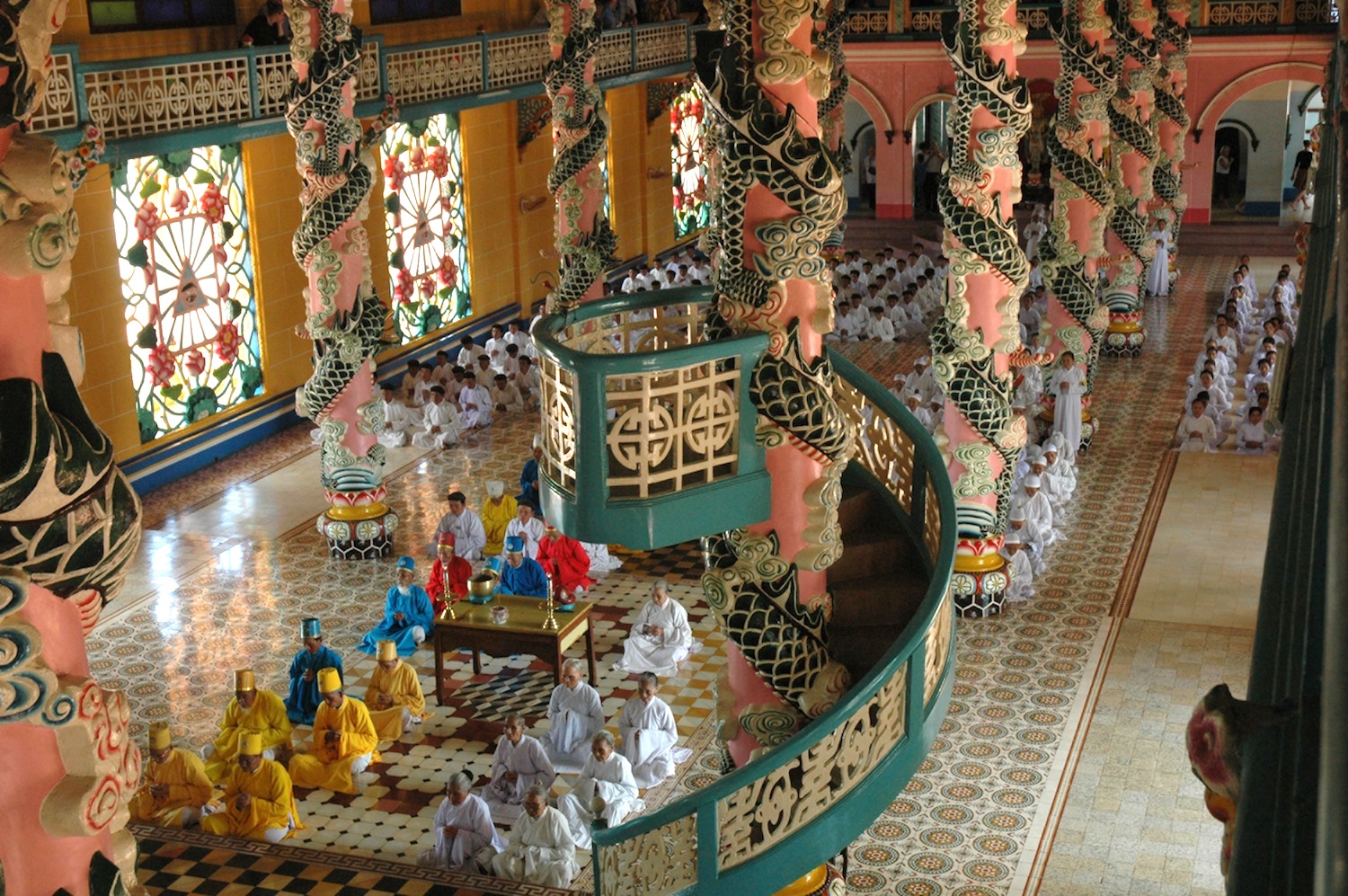
noon prayers at the Cao Đài Cathedral in Toà Thánh
A popular day-trip for tourists out of H Ch Minh City takes them to Tây Ninh, 90 km northwest, to the Cao Đài Cathedral.  They will arrive just before the noon worship services, stay less than half an hour, leave for lunch in a roadside restaurant and then head for a walk through the C Chi Tunnels used in the American War.  The main impression they will have of their Tây Ninh excursion will be the unique architecture of the cathedral, with tall twin towers in front and an long vestibule, the rows of white clad devotees at prayer and, in particular, the great, All-Seeing Eye over the interior altar, on the windows and above the entrance.    
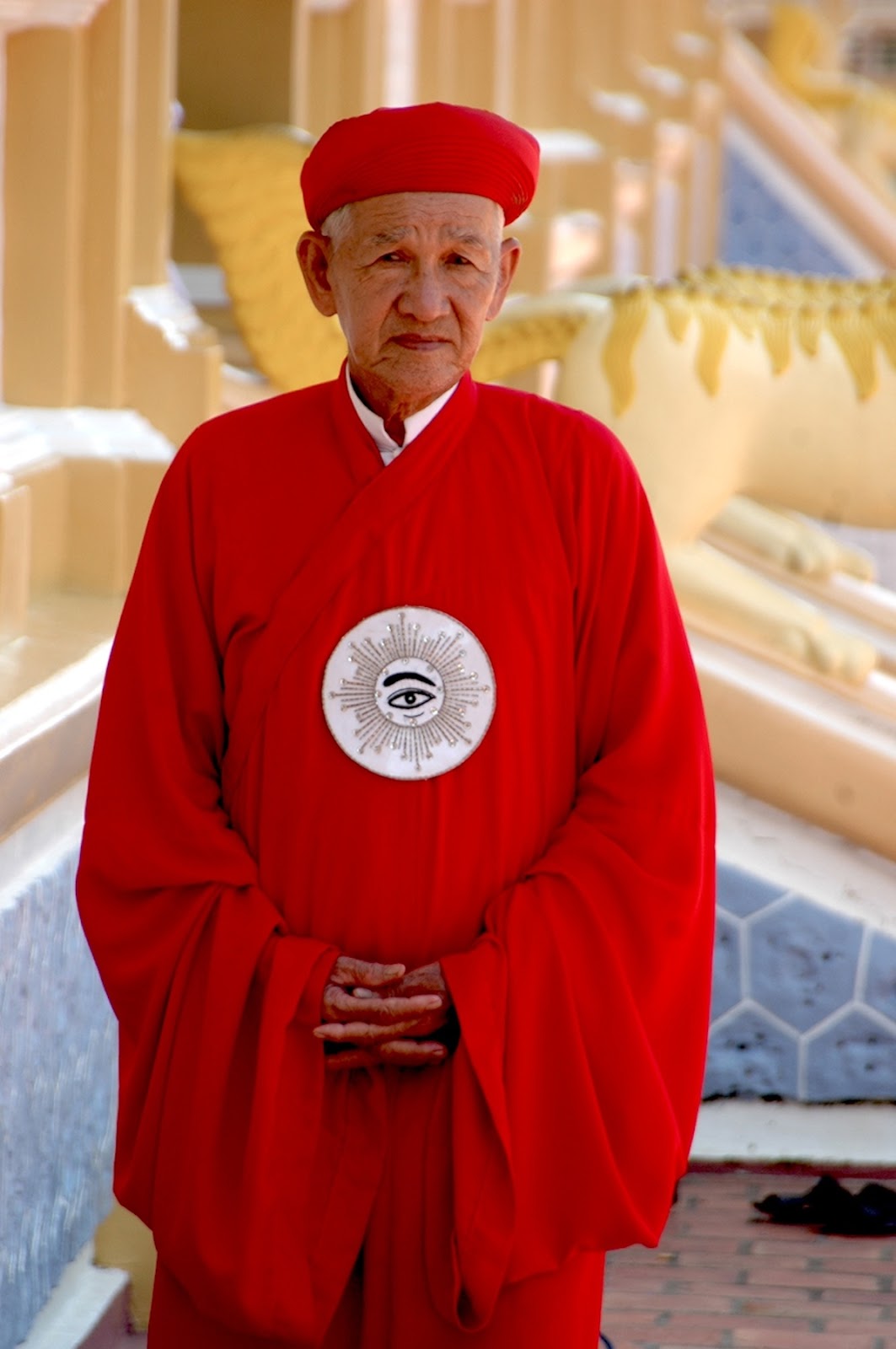
       This eye, the left eye of God (left being the yang side), the iconic symbol of the Cao Đài religion, first appeared in a vision of Ngô Văn Chiêu, a Vietnamese working as a colonial official on Phú Quc Island in 1921.  In his free time he studied about Buddhist and Taoist beliefs, as well as spiritism—the belief humans could contact the deceased and other spirits.  He attended séances and in one of these he claimed messages from Đức Cao Đài, Lord of the High Stage (or Tower), or God, according to his interpretation, that were instructions on the tenets of a new religion for a new epoch.
Cao Đài symbols on the cathedral ceiling
       Moving to Saigon soon after, he was joined by other séance practitioners with similar experiences, particularly Lê Văn Trung and Phm Công Tc.  By 1926 these men had molded the massages of the séances into a specific creed of principles and rules and applied to the French colonial government for recognition as a new religion.  The French approved.  Ngô Văn Chiêu having decided to retire to a life of meditation by then, Le Văn Trung became the first Giáo Tông, or Leader of a Religious Group. 
       The central Cao Đài tenet is that the current age is the Third Period of revelation and salvation.  In the First Period God transmitted his messages through Dipankara Buddha (a previous incarnation of Buddha dating back 100,000 years), Lao Zi, the founder of Taoism, and other ancient Chinese sages.   In the Second Period, God’s agents were Shakyamuni Buddha, Moses, Confucius, Jesus and Mohammed.  But these truths were limited to their historical periods and geographical conditions and have been distorted since their introduction.
the Left Eye of God, cathedral windows
Cao Đài pantheon
       The Cao Đài creed aims to become the Universal Religion of the Third Period and draws upon existing religions for its articles of faith.  From Buddhism it adopted the notion of reincarnation and the five taboos against killing, lying, licentious behavior, stealing and intoxication.  From Confucianism it incorporated its social order and code of behavior.  From Taoism it took the yin-yang concept and from Catholicism it got its organizational structure.
Cao Đài temple in Trà Vinh
       The Cao Đài religion assigns nearly equal importance to men and women.  They pray separately during the services, and women enter from the left side, while the men enter from the right.  But the women line up in ranks opposite the men and they can be members of the clergy.  Because the order of the clergy so resembles that of Catholicism, outsiders describe them as priest, bishop, cardinal and pope.  Actually, there are more ranks than these and more words used to identify them.  And the use of ’pope’ to identify the giáo tong is inaccurate, for the Vietnamese word for ‘pope’ in the Catholic sense is actually giáo hoàng. 
      The only position a woman cannot hold is giáo tông.  According to Taoism (or perhaps a Confucian prejudice), yin cannot rule over yang, lest chaos ensue.  Taoist influence also established the veneration of the Queen Mother of the West, a Chinese goddess, as the celestial representative of yin. 
       The binding element in this fusion of beliefs in the years of its formation and growth, distinguishing it from established religions, was spiritism.  The preferred method of contacting spirits was the séance, during which famous personalities, as various as Joan of Arc, Napoleon, Victor Hugo, Louis Pasteur, the Vietnamese poet Nguyễn Bỉnh Khiêm, other Vietnamese personalities, Sun Yat-sen and even William Shakespeare and Vladimir Lenin.  They sent messages regarding finer points of doctrine and organization, sometimes transmitted via automatic writing.  And sometimes blank sheets of paper were locked up in a box and opened after some time, containing messages allegedly written by spirits.
Cao Đài priest
the Covenant with God
       Three of these personalities became important Cao Đài saints:  Nguyễn Bỉnh Khiêm, Victor Hugo and Sun Yat-sen.  Nguyễn Bỉnh Khiêm was a famous 16th century scholar and poet during the turbulent time of the usurping Mạc Dynasty, with a reputation as a political prophet.  Victor Hugo, the French novelist whose works Les Misérables and Toilers of the Sea expressed much sympathy for the poor and downtrodden, also was a believer in spiritism.  Sun Yat-sen founded the Chinese Republic in 1911, an event Cao Đài adherents believed helped set the stage for the Third Period.  A painting in a ground floor room of the cathedral in Toà Thánh, reproduced at other Cao Đài sites, shows the three of them signing a Covenant with God.  Nguyễn Bỉng Khiêm holds an ink stone, while Victor Hugo writes with a quill pen and Sun Yat-sen with a brush the words “God and Humanity, Love and Justice” in French and Chinese.
Cao Đài clergy leaving the cathedral
devotee at prayer
       The newly recognized religion set up its Holy See in Toà Thánh, a few kilometers east of Tây Ninh city.  Its membership grew quickly, especially among the peasantry.  But it also became troubled by doctrinal disputes.  Since the principles of the religion came from séances, some new adherents began searching for these messages through their own informal séances.  The leadership decided to officially restrict the practice to two recognized mediums, one male, one female, in the Holy See.  Eventually it published The Compilation of Divine Messages, as well as a Religious Constitution.
devotee with offerings
Cao Đài priest representing the Taoist element
     
In trying to restrict the séances, the Cao Đài leadership cited the problems of auto-suggestion, message manipulation and interference by evil spirits.  This was already a problem for a newly formed religious organization that promoted the idea of letting God speak to you in your heart.  By the time Lê Văn Trung died in 1934 (or according to the Cao Đài interpretation ‘became dis-incarnated’), eleven small splinter groups had set up their own organizations.  The government eventually banned séances, even in Tây Ninh.
Cao Đài Cathedral in Toà Thánh
       The Tây Ninh-run branch remained by far the largest Cao Đài organization.  Phạm Công Tắc assumed leadership, though not the office of giáo tong.  The Cao Đài message began evolving from then on, taking on a more nationalistic flavor.  Southwest Vietnam at that time witnessed several new Buddhist sects that emphasized temporal works more than spiritual; i.e. involving oneself in improving the world rather than withdrawing from it.  Cao Đài advocated self-cultivation, but also promoted equality and opposed exploitation, factors which spurred peasant conversion.
       Cao Đài had always opposed colonialism as a matter of religious doctrine, but tempered this by calling for increasing dialog with the colonial authorities.  Under Phạm Công Tắc the notion of dialog was all but muted and the religion took on a more openly nationalist stand as the messages revealed by the mediums started criticizing colonialism and its hardships.  At the same time he oversaw the construction of the great cathedral in Toà Thánh, which elevated the Cao Đài prestige and influence. 
cathedral interior
       In 1941 widespread revolts against French rule broke out over much of Vietnam.  In the course of the crackdown, French authorities seized the Holy See at Tây Ninh, temporarily forbade religious services and hustled Phạm Công Tắc and other Cao Đài dignitaries off to exile in Madagascar.  Cao Đài leaders then formed an army, which eventually grew to 25,000, to protect its believers and, hopefully, ally with the Japanese to overthrow French rule.  But the alliance never materialized, Japan lost the war and the French returned.
       However, the re-installed colonial government immediately faced a Việt Minh-led insurgency.  Seeking local allies, the French reversed their attitude about Cao Đài, brought the leaders back from exile and enlisted them as allies against the Việt Minh.  Phạm Công Tắc agreed, but others didn’t and the Cao Đài army was not an effective French ally. 
cathedral garden
       When the war ended and the country was split in two, Cao Đài leaders initially supported Ngô Đình Diệm, but in 1955, after a government raid on the Holy See, opposed him.  They remained just as opposed to the Communists, though, so after re-unification in 1975 the Hanoi government disbanded their army, confiscated their lands and closed their temples.  This was similar to what the government did to all private religious armies (Hòa Hào being another) and establishments—Buddhist, Taoist, Catholic and Protestant included.  Only in the late 80s did the government return the confiscated lands and in 1997, with a far more tolerant policy in place, lifted prohibitions on Cao Đài religious expression.
       In the 21st century religion in Vietnam began enjoying a period of rejuvenation.  Temples and churches drew crowds again and festivals revived.  How much religious sentiment influenced daily behavior again after decades of secular propaganda and the onset of the century’s materialism is debatable.  Yet the revival of piety and respect for tradition is certainly sincere.  For Cao Đài adherents, following the moral precepts and cultivating a personal relationship with God are still the essence of the faith.  As part of their reverence for all life, they are supposed to eat vegetarian food ten days a month and the clergy must abstain from meat entirely.
the other Cao Đài temple in Toà Thánh
       Today, estimates of the number of Cao Đài followers ranges from six to eight million, making it Vietnam’s third largest religion.  Most of them are in the Mekong Delta and travelers can spot Cao Đài temples in most Delta provinces, recognized by their tall twin front towers and the All-Seeing Eye mounted on the front façade.  They also exist further north, as far as Hội An, Đà Nẵng and Huế.  The congregations there are much smaller, though.  Basically the further southwest you go in Vietnam, the greater the number of Cao Đài devotees and temples.
       Tây Ninh is still the Cao Đài heartland and the ostentatious cathedral at Toà Thánh its most splendid house of worship and the model for most of the others in the Mekong Delta.  The front features two tall towers, the entrance between them leading to a long hallway, supported by thick, dragon-entwined pillars, at the end of which sits a huge globe with the Left Eye of God prominent in the center.  The same Eye, inside a triangle, is on the rows of window grilles at either side.  Smaller towers stand on the roof at the halfway point and at the rear.
       A large garden park, with a few towers and other buildings, lies adjacent and a path past statues of other Cao Đài saints and message-bearers leads to another Cao Đài temple in the same compound.  It has just one front tower, but an equally long hallway behind it and is used to accommodate the spillover from the cathedral during services.
Cao Đài priest representing the Confucian element
Cao Đài clergy at Toà Thánh
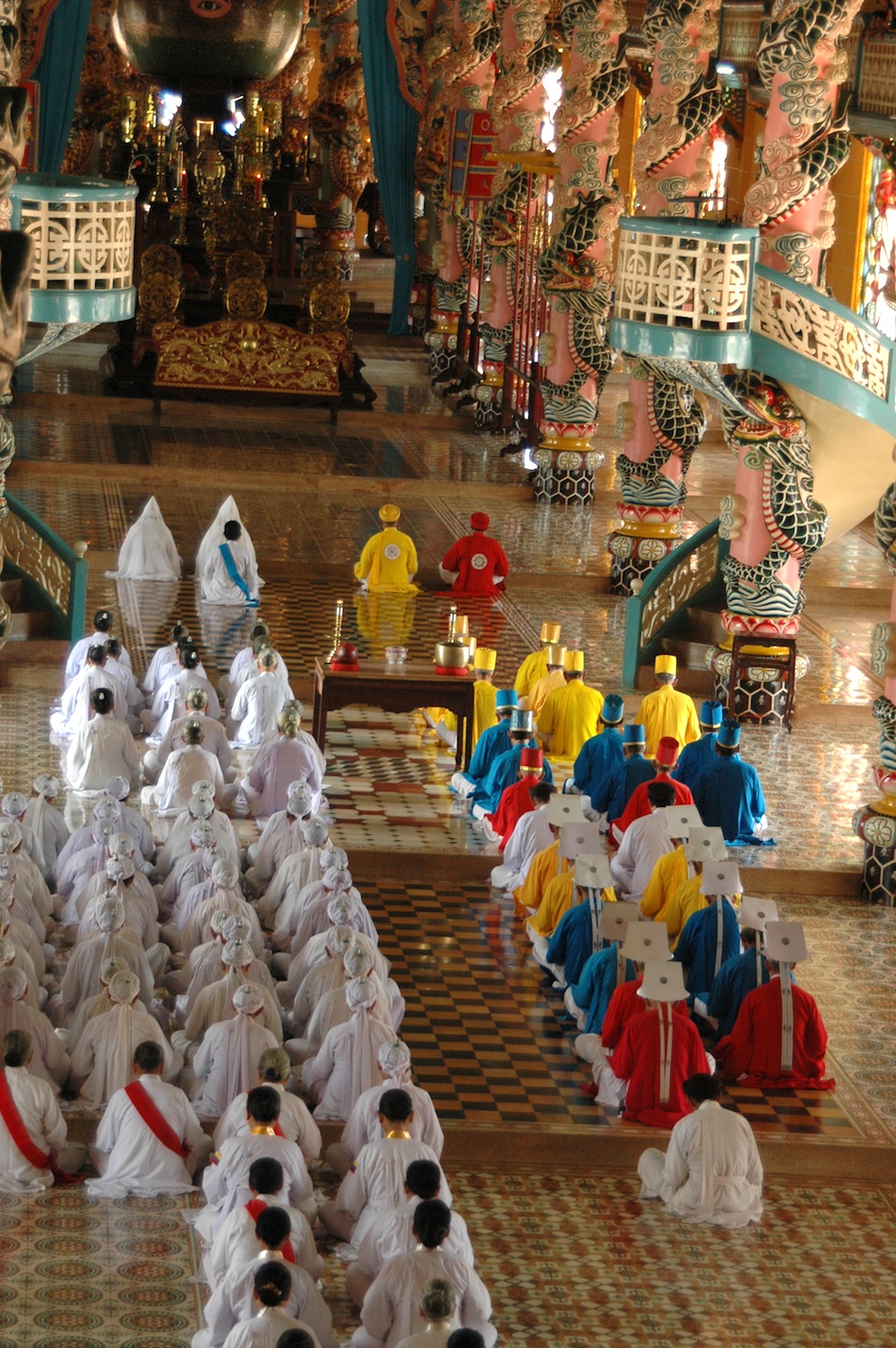
       Prayer time for Cao Đài devotees begins daily at 6:00 and 12:00, a.m. and p.m.  Services are the same each time, Sunday is no different and there are no special holy days or festivals.  Attendance is not mandatory, but on an ordinary day devotees fill the Tòa Thánh cathedral, at least at noon, dressed in white.  The clergy, who sit in front, wear robes of different colors, symbolizing the three main elements of the faith—yellow for Buddhism, Blue for Taoism, red for Confucianism.
       The offerings they might bring are simple—flowers, incense, candles and water.  Devotees pray while kneeling erect and kowtow at intervals while a priest raps a gong or a large bronze bowl at the altar.  The rituals, which altogether last about an hour, include music and singing, performed on the indoor balcony above the hallway. 
Cao Đài Cathedral services
leading the Cao Đài prayers at Đà Nẵng
       The ground floor is off-limits to non-worshipers during prayer sessions.  Tourists can watch the rituals, but only from the second floor balcony.  This prevents them from disturbing the devotees by coming in to take close-up photographs while people are trying to privately communicate with God. 
       As for the future, the question is how long can the revival of Cao Đài faith continue?  The attraction of religion is decreasing among each younger generation.  Yet a large percentage of the daily congregation at Toà Thánh is young, especially the females, who in any religion are more involved than the men.  Compared to other religions in Vietnam, Cao Đài is the only one with a strong nationalist identity.  It is uniquely Vietnamese and considers itself the universal religion of the future.  Cao Đài devotees associate keeping their faith with retaining their Vietnamese identity in a globalized world.  Perhaps these convictions will insure its survival in the ever more secular-minded times to come.

musicians and singers accompanying the Cao Đài prayers
                                                                               * * *