Showing posts with label Honghe Prefecture. Show all posts

Wednesday, December 23, 2020

Luchun: the Hani Majority County


                                                               by Jim Goodman


       Southern Yunnan’s Honghe is a Hani and Yi Autonomous Prefecture, wherein the Hani and Yi minority nationalities comprise a majority of the population or occupy over 50% of the land.  Usually the latter is the case, especially north of the Red River, where Han immigrants have long been settled in both rural and urban areas.  South of the Red River the land is much hillier, farmed by using the ancient and famous water-filled terraces, and Han residence is confined to the cities.  Even there, employed by the government bureaucracy or as shopkeepers or involved in other urban services, they are in competition with local minorities.

       Luchun County, in the southwest and bordering northwest Vietnam, attracted but a handful of Han immigrants after 1949.  Much of its territory is mountainous and still heavily forested and it has always been relatively isolated, off the main trade routes and mainly accessible via Yuanyang County to its east.  As a result, Luchun County’s population is 80% Hani, nearly all of whom can trace their residence back many generations.

       Entering from Yuanyang County, after 15 km the traveler comes to Luchun city, the county capital, lying on a long, high, narrow, east-west ridge.  Its modern buildings, largely whitewashed cement, line the ridge, with Hani villages and rice terraces immediately below on each side.  The bus station, central market and public park are in a four-block stretch in the city center.  From the park and from glimpses between the buildings are good views of the terraces and mountain scenery.

       Most urban residents are Hani.  Most shop signboards are bilingual—in Chinese characters and the English letters used to write the Hani language.  The Hani call the city Donya and their language is used more often here than Chinese. 

       The main Hani sub-group call themselves Awo Hani.  Females of all ages still prefer their traditional clothing, consisting of a very Chinese-style, long-sleeved jacket over trousers and a round decorated turban.  Most jackets fasten on the right side, with a few buttoned down the front.  The style is relatively uniform, but they could be any color.  Some prefer black or dark blue, and not just the older women.  Others choose a variety of soft pastel colors, often patterned, no two alike.  The trousers are usually plain or else black with a blue stripe around the shins.     

       On their heads they wear a round cloth turban shaped like a pillbox hat with a tassel hanging over the side.  Women from Sanmeng to the south can be identified by the huge woolen tassel draping over the right ear.  The turban could be plain or decorated with silver studs or cultured pearls.

       Every horse and rat day in the 12-day animal cycle Luchun stages its market day.  Villagers swarm into the city bearing a variety of products to sell or empty pack-baskets to fill with goods to take home.  They set up stalls to offer rice, various vegetables, spices, forest goods, medicinal herbs, baby frogs caught in the terraces, honeycombs, edible insects or clothing.  Some may even just stand somewhere on the street holding a single item, like a cooked bird or a newly made traditional jacket. 

       Market day also attracts Hani from other parts of the county, mostly the south, like Sanmeng and areas closer to the Vietnam border.  Some groups from the far south wear fancier turbans with decorative flaps and tassels and a jacket festooned with several triangles of silver studs.  The crowd may also include a sprinkling of other minority nationalities in the county, like Yi, Dai and Yao.

       A few Yi are migrants from the Nisu sub-group in Yuanyang County, who run small shops and businesses.  Their women wear brightly colored, side-fastened jackets with bands of appliqué on the hems, sides and cuffs, and a belt with long, wide, decorated ends hanging over the buttocks.  Younger Nisu girls may also wear a silver-studded, chicken-shaped hat.

       The county’s indigenous Yi belong to another sub-group from four villages near Niukong, 37 km west of Luchun.  The road winds down from the high ridge and runs along the Niukong River, passing many Hani villages, mostly on the south side, with mud-brick houses and thatched or more often tiled roofs—the typical rural Yunnan style, though not enclosed by compound walls.  After passing a few bamboo bridges the road reaches Niukong town beside the river.  Market day here takes place a day before Luchun, on snake and pig days, drawing local Yi as well as a few Hani sub-groups.

       The Yi villages are up above the town and consist of houses similar to those of the Hani.  Yi women here wear a long-tailed coat, sometimes shorter in the front, side-fastened, over plain black trousers.  Older women wear white, younger ones prefer indigo or black with red, light blue or magenta sleeves and shoulders.  They appliqué stylized patterns of dragons, phoenixes, fish, butterflies, birds and peonies below the neck, front and back, around the shoulders and on the cuffs and elbows.  Most wrap their hair in a simple kerchief, but some don a silver-studded “chicken hat” and tie a hair braid over it to keep it in place.   

       West of Niukong the road rises into the hills and away from the river to a turnoff about 15 km later that runs south for 65 km to Qimaba, a large Dai settlement of over 200 houses almost exactly in the center of the county.  Hani villages sprinkle the hills in the beginning, but soon the environment is heavily forested until Qimaba, which lies on a gentle slope above its terraces. Irrigated by streams that also run through the residential area, reinforced by stone walls on their sides, the terraces stretch out like a fan in front of the village and end at the cliffs above the Chama River. 

       The Dai inhabitants belong to an animist sub-group that migrated from Shiping County to this isolated venue in the 19th century.   They have the same mud-brick, tile-roofed, two-story houses as elsewhere in the county, but with an open section in the center without roof, over a slightly sunken square pit next to a water tank, where they do their washing, while a drain carries the waste water into the stream along the path outside.  Thus, in Qimaba, water engineering is not just for their agriculture; it extends to the settled area as well.

       Most of the women prefer their traditional outfits:  blue or black tubular skirt, side-fastened, long-sleeved top with embroidered front, hems and cuffs and sometimes the entire back of the jacket.  They wear these basic components all day, even when working in the fields.  For social occasions or going to the market they may also wear a tall, elaborate head piece lined with coins and silver studs above the brim, with a long black flap hanging down the back.

       Most of the area north of Qimaba is part of the Huanglianshan Reserved Forest, a mountainous wooded zone around the Huanglian Mountain peak of 2637 meters.  A few stray Hani and Yao villages lie tucked away in the forest, but the Yao are more accessible in Shangpinghe, a large village just west of Pinghe in the southeast.  The houses are mud-brick or whitewashed concrete, closely placed in rows on a slope above their rice terraces.

       The Yao here are members of the Landian sub-group, also found in Yuanyang and Jinping Counties.  Both sexes usually dress in their traditional plain black clothing, the women in bulky, side-fastened jackets with tails in the back, the men in knee-length jackets buttoning vertically in front.  Women also wear a skein of magenta woolen threads draping across the jacket front and don a tall black headdress over a coil of black braids.  Men wear a round cap with silver disks around the bottom.

       The turn-off south to Pinghe is just before entering Luchun County from the east.  The road skirts the eastern side of the county for 47 km to Pinghe, overlooking valleys cut by tributary streams of the Mengman River.  This is the most heavily populated part of Luchun County and Hani villages lie all along the slopes, with their water-filled terraces climbing up to cover over 80% of the hills flanking the streams.  

       A branch road just after the Pinghe turnoff winds for 37 km up and down hills to Sanmeng, a Hani town directly south of Luchun geographically.  The bus stops at the bottom of the hill, from which it is a steep hike to the village itself.  The reward is the splendid scenery visible all around, accented in winter by low-lying, wispy morning cloudlets.   

       Compared to the eastern and northern sectors of Luchun County, the rest of it is rather sparsely settled and very forested.  Not many roads link the isolated villages with main thoroughfares.  After the Qimaba turnoff the main highway continues to Dashuigou, a nondescript town itself, but interesting for the different sub-groups of Hani.  The women of one dress in similar style as Hani around Luchun, but with a fancier head-covering, knee-length trousers and colored cloth wrappers around the calves.  Another group wears long jackets and very tall black cloth headdresses with a rectangular top, along with big round silver earrings.  Both sub-groups are spillovers from Mojiang County to the west.

       From Dashuigou the main road runs through the hills south to Daheishan, a town about the same size and look.  Then it turns southwest and soon enters Jiangcheng County.  The Hani in this part of the county dress more like those in Luchun, but their dialect differs considerably, being more like the Hani dialect of Pu’er Prefecture.

       The Hani language is a member of the Yi branch of the Tibeto-Burman linguistic family.  It is related to Yi, Lahu and Lisu, and like them has several dialects.  The basic grammar and syntax for all Tibeto-Burman languages is the same, with a subject-object-verb word order.  When the Chinese government decided to devise writing systems for those languages without them, the dialect spoken in Dazhai, just beyond the western outskirts of Luchun city, became the standard for the Hani language and the one used to make a Hani-English dictionary.  It is the one spoken over most of Luchun County, as well as, with a few vocabulary differences, Jinping, Yuanyang, Honghe, Hekou and northwest Vietnam. 


After long campaigns to Sinicize minority nationalities and eradicate traditional culture, after the Reform Era began the government reversed that policy and encouraged ethnic identity.  Not every old custom was revived, but certainly ethnic pride returned.  As part of that manifestation, in 1994 the primary school in Guangma village, on the slope across the stream on the south side of Luchun, began instructing in the Hani language and teaching students how to read and write in Hani, using English letters.


   For the first three years instruction is given in both Hani and Chinese and afterwards mainly in Chinese.  Up through the fifth grade students also have twice weekly Hani language lessons.  The Honghe Prefecture government sponsored the publishing of books in Hani, generally folk tales, Hani proverbs and seasonal work songs. 

       Revivalism has also meant an active role once again for the Hani ritual specialist.  The Hani are animist and employ the specialist to perform the proper traditional rites to appease potentially troublesome spirits, protect the fields and the people’s health, and be able to read portents in the liver of the sacrificial animal. 

       Hani festivals like the Long Table Feast are back in vogue.  For this one all the village men dine together with all the tables lined up on a single village lane and crammed with a great variety of dishes, from meat cooked myriad ways to different edible insects, with each family’s women bringing a tray full for the collective feast.  Liberally punctuated by toasting and drinking, the meal takes all afternoon.  The men then retire and it’s the women’s turn, though not including the drinks.

       Some villages have the traditional gates at the main entrance.  Consisting of a wooden beam aid across two upright poles, it has carved swords or other warning symbols to keep evil spirits from visiting.  When villagers sicken and no medicine seems to work they will call on a shaman to go into a trance to find out what the afflicting spirit demands in order to recuperate and then follow the shaman’s advice afterwards.  They claim it always works.

       For the Lunar New Year villages erect swings and teeter boards for the youth to enjoy.  The swing consists of four long tree limbs lashed upright together with a pair of ropes suspended from the top and joined by a plank at the bottom.  The teeter board is a long beam inserted into hole in a tree stump.  A rider sits on each side, steering the board both up and down and around in a circle.

       For adults, the main activity is family visits and banquets.  And the Hani women will put on their fanciest traditional jacket and turban and whatever jewelry they have.  New Year is always a time of hope and it’s better to dress in your finest to welcome it.  


                                                                 * * *  

               For more on Hani culture, see my e-book The Terrace Builders    

Friday, July 22, 2016

The Reclusive Alu of Laojizhai


                                       by Jim Goodman

Alu woman, Laojizhai district
       Yunnan is famous for its great variety of ethnic minorities.  Altogether the province is home to 25 different minority nationalities, but the larger ones are divided into many sub-groups.  Even when they live in the same physical environments, these sub-groups may dress very differently from each other.  Nowhere is this ethnic diversity more obvious than in Lower Ailaoshan, below the Red River in Honghe Prefecture, especially Yuanyang and Jinping Counties.
       Officially, it’s Honghe Hani and Yi Autonomous Prefecture and the Hani and Yi are the majority of Yuanyang and Jinping County’s population, divided into several sub-groups each.  The area is also home to Dai and Zhuang in the valleys and Yao and Miao in the hills, all of them with at least three sub-groups each.  For the traveler, a big part of the enchantment of the two counties, besides the scenery of irrigated rice terraces climbing up the mountains, is the fact that nearly all the females dress in traditional ethnic clothing. 
       This makes the many market day venues in the towns particularly colorful, but also a way of finding out who lives in the vicinity.  The greatest variety is at the Sunday Laomeng market, my own favorite, south of Xinjie, just inside Jinping County.  It was here that I first spotted women in black garments, with lots of color embellishments, silver studs and multi-colored woven belts.  People in the market identified them as Alu but didn’t now if they were Yi or Hani or something else.
Duoni Hani gitls
Laowo Yi girl
       They were from Laojizhai district, up the mountain south of Laomeng.  In the company of my Hani friend from Huangcaoling, with a couple days left in my time in the area, we headed for Laojizhai in search of the Alu.  It was also market day there, but we arrived when the action had already shut down.  The last Alu family was packing up and only a couple dozen Hani were still around. 
       The remaining Hani included the headman of the nearest village, 3 km away, so we accepted his invitation and had our evening meal there.  The women of this Hani sub-group, the Duoni, dress like those of the Doko Hani of Huangcaoling, except that the girls wore the silver-studded ‘chicken hat’ worn by the Nisu Yi of Yuanyang. 
Alu Yi family
foggy morning in an Alu village
       Their dialect also differed considerably from that spoken around Huangcaoling or Xinjie, such that the headman and my Hani friend found it easier to converse in Chinese than in Hani.  The headman also remarked that night that according to their history, the Duoni are Hani.  But their customs are mostly Yi.  He didn’t elaborate, but I recalled a Hani adage I was already familiar with—“Hani and Yi are children of the same mother.” 
Alu weaver at work
     
Knowing the headman of the nearest Alu village, 5 km out of Laojizhai, he arranged to take us there by tractor-trailer in the morning.  Unfortunately, thick fog covered the area the entire excursion.  We couldn’t see past ten meters, so I had no idea of the landscape or the view.  But once the foreigner and his entourage got to the village, I at least got to see what the people looked like.  Within minutes folks of all ages came to get a glimpse of me, well within my ten meters of visibility range.
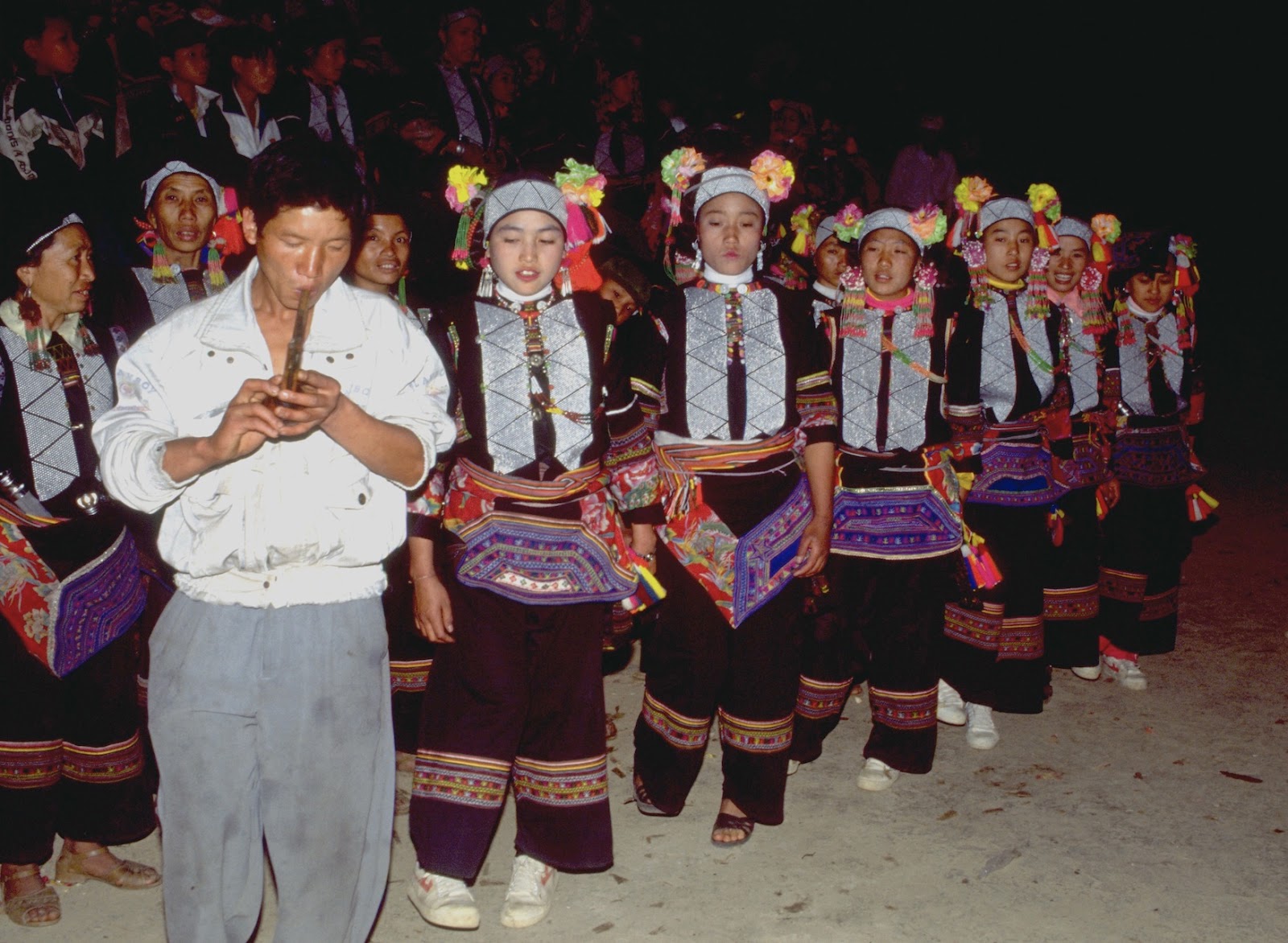
       Black is the basic color for practically all of their clothing components: jacket, loose trousers and headdress.  Yet it also serves as a background to accentuate all the colorful additions.  These include bands of colored strips around the calves of the trousers, piping on the sleeves, a short blue apron, appliquéd patches on the jacket sides, sleeve cuffs and the top flap of the headdress.  The women’s jackets also feature vertical sections on the front lapels comprising many rows of little silver studs.  The front of the headdress may also be studded in a similar way, while from the flaps on each side hang little red pompoms. 
       As with most ethnic fashions, variations exist in the general style.  Older women may use less color embellishment.  Younger women may wear a round cap, studded widely across the front and topped with flowers on each side.  The men’s outfits are less colorful—plain black for the older men, but for the younger generation color on the jacket cuffs, hems and pockets.
      Alu women purchase from the market most of the materials used to make their clothing.  The one item they make themselves is the multi-colored belt, 10-15 cm wide, that ties around the jacket at the waist.  They weave this on a simple bamboo-frame loom, leaning against an outside wall of the house at a 70 degrees angle. The weaver sits on a stool at the bottom of the loom and passes the weft shuttle through the warp threads at shoulder level.
young Alu woman
Alu mother and child
       It was November, long past harvest, a season when women make clothing and men build houses.  Several looms were in operation the morning of my visit.  After observing the weaving we were invited inside the headman’s house for tea and learned that the main events in the Alu calendar were the Torch Festival in mid-summer and Rhamatu, held the third day after Lunar New Year.  Rhamatu was the same name of the most important annual Hani festival, and the Alu version included the same rituals to the three stones at the village altar, representing humans, animals and crops, and involved a collective village feast.  However, it would also feature dances, in which the girls picked their boy partners.  Our host encouraged us to return for either event.
       We didn’t stay much longer, for our Duoni Hani friend had to return to Laojizhai and the heavy fog precluded any possibility of exploration.  However, my interest in the Alu already aroused, in February I was back in the area at Lunar New Year time.  Once again in the company of my Hani friend from Huangcaoling, on the third day of the year, the first day any vehicles were running again, we left Huangcaoling early for Laomeng.  Unfortunately, no bus was going to Laojizhai until early afternoon.
Alu Yi village
       However, by coincidence the Miao were celebrating their Caihuashan festival 10 km east and the fellow who informed us of it gave us a ride there in his truck.  Hundreds of colorfully dressed Miao females certainly provided plenty of photo-ops and eyeball enchantment.  Besides traditional and modern Miao dances, the program also included performances by the Laowo Yi, a sub-group also in the Laojizhai area.
       We made it back to Laomeng in time to catch the bus, but arrived in Laojizhai too late to find out anything about the Alu Rhamatu.  Our Duoni Hani contact didn’t know.  Too late to hike all the way to the Alu village, we stayed the night in Laojizhai hoping that, as the next day was a tiger day, and several Yi sub-groups held important Lunar New Year festivals on the first tiger day, maybe we weren’t too late.
       We set out early for the fog-bound village we had visited before, but the headman there regretfully informed us we missed it.  They held it on buffalo day, the day before.  The rites at the three stones took place early morning, so we would have missed that anyway.  Then came the procession of each household delivering meat, rice and alcohol to the headman’s house to make a collective feast.  After that were the dances.
young Alu Yi woman
little girl in full Alu clothing
       Anyway, he had a lot of food left over, so he invited us to a sumptuous meal.  Afterwards he speculated that since today was a no-work day in Alu tradition, dances might be continuing at the biggest of the thirteen Alu villages, 5 km away.  It was courtship season, after all.  And Alu youths are free to choose their own spouses.
       It was still early and the weather lovely so off we went on a high but relatively level road, with fine views of distant villages, tea gardens and rice terraces.  The only traffic was pedestrian, mostly young couples or pairs of couples in full Alu traditional clothing.  Our destination lay on a slope just below the summit of a hill, with a view across the valley to the west.  Except for a school and a couple government offices, all the houses were box-like, one-story, mud-brick and timber structures with flat roofs.  No utility poles stood anywhere, for the village still had no electricity.
Alu Rhamatu dance
       As the first foreigner to ever visit, I found crowds forming everywhere I went. Everyone was polite, though, and not many ducked the camera like in the first village.  My presence soon drew the attention of the local Party official, who invited us to his office.  Yes, we had missed the festival and the dances.  But he could arrange dances tonight if I would pay the same 300 yuan the local government had given them to sponsor the Rhamatu dances for neighboring villages.  My Hani friend argued that the local government had much more money than me and that I only carried enough to cover my trip in Yunnan.  He settled for 200, including meals and lodging. 
       The meal, shared with eight others, comprised the still tasty leftovers from the feast the day before.  It included a large green leaf vegetable that is an Alu specialty, one I’d see them hawking in the markets in Laojizhai and Zhemi.  Besides this, they grow rice, maize and other vegetables and a high-quality green tea, that was selling then for 200 yuan a kilo.
       After dark our host got busy making arrangements for Rhamatu Dances Part Two.  A couple tables went up, laden with alcohol, beer and cups, in front of a row of stools for the elders and the two special guests.  Masses of villagers surrounded us on all sides, full of curiosity, but not pressing on us.  Hardly any of them had ever ventured beyond Laojizhai district and had no idea what a foreigner might look like.  As for me, I totally enjoyed being stared at by people wearing such attractive apparel.
Alu women in the Laojizhai market
       Speeches preceded the start and even I had to give one, in my limited Mandarin, which probably hardly anyone in the crowd past my table understood.  Then the dances began, led by a young man playing a gourd-pipe, followed by a line of other young men.  But no girls.  Another dance, same result.  Our host then claimed it was difficult to persuade the girls to dance.  Perhaps if I gave another 100 yuan they would.  I replied that if the girls were too shy, it didn't matter. 
       But the young men were tired of dancing alone.  So they somehow persuaded eight girls to join the line and from then on it became more authentic and participation grew.  The show continued for well over an hour, climaxing with a ring dance.  We were pleased.  Next morning as we were about to depart, our host claimed I owed him another 100 yuan just because the girls had finally danced.  Not wanting to leave in a mood of acrimony, or prejudice the visit of the next foreigner, I gave it to him.
       It was Sunday now, so we were back in Laojizhai in time for the peak of market day activity.  Groups of Alu women stood behind baskets of the green leaf vegetable we’d enjoyed the night before.  Others sold maize or bean sprouts.  Duoni Hani women wore their Huangcaoling-style, side-fastened, black-bordered blue jackets and many, young and old, donned the ‘chicken hat’ as well. 
       Several Laowo Yi women were there, too, easily recognized by the bright jackets of pink and blue and their long hair braided with a woolen thread extension and coiled on top of the head, rather like the Hani in Jinping.  Altogether, it was a typically colorful Ailaoshan market day.
Laowo Yi woman in Laojizhai
Alu selling maize in the market
       I did not return to Laojizhai again but I did happen to see an Alu dance performance once more in, of all places, the newly designated Hani Cultural Village in Yuanyang County.  I was there wandering around taking photos when a Chinese tour group turned up.  After their walk through the streets full of traditional Hani houses, a stop at the village altar grounds with the three stones and a look at the Hani swing, the climax was to watch a dance performance.
       The Laló Hani living in this village have no dance tradition.  So the government hired an Alu troupe from Laojizhai to perform instead, for Chinese tourist groups expect some kind of ethnic entertainment on their program.  So there they were again for me, Alu girls in their gorgeous outfits dancing like they did the night of Rhamatu, Part Two.  Probably none of the tourists knew they were Yi, not Hani.  But were the Hani bothered by a Hani cultural tour concluding with a Yi dance performance?  Probably not.  After all, these are the people who coined the phrase “Hani and Yi are children of the same mother.”

Alu dance troupe in the Hani Cultural Village
                                                                        * * *   
                 for more on the Yi of Ailaoshan see my e-book The Terrace Builders


Saturday, March 26, 2016

The French, Miao and Yi in Mengzi


                                                      by Jim Goodman

former French Consulate in Mengzi
       Around a hundred years ago Mengzi was one of the most important cities in southern Yunnan.  It lies at the southern end of a long plain, 1000 meters altitude, extending all the way to Kaiyuan.  High mountains rise to the city’s east and from the edge of the plain south all the way to Vietnam.  Mengzi was the first major town on the trade route from Vietnam to Kunming.  It was also a depot for shipping the area’s minerals and tin to Kunming and other destinations north and south.  While it was always involved with such trade, Mengzi’s role dramatically increased with the establishment of a French presence in the late 19th century.
       Beginning with the notorious Opium War in 1839, European powers began forcing their way into China’s commercial networks.  One concession led to another in the next decades, while Britain in Burma and France in Indo-China gobbled up territory that by the mid-1880’s extended up to the boundaries of Yunnan.  Political pressure on the ever-weaker Qing government led to the designation of Yunnan cities as “treaty ports” to handle international trade.  Foreigners were permitted to set up consulates and commercial offices:  the British in Simao and the French, from 1887, in Mengzi.
French coat-of-arms on the Consulate gatge
       This didn’t mean a heavy influx of foreigners into the two cities.  French travelers like Louis Pichon in 1892 and the Prince d’Orléans in 1894 reported but a dozen resident foreigners in Mengzi, only half of them French.  The foreigners generally got along well with the Chinese, who viewed their presence as a return to stability after the era of Black Flag banditry that came with the final suppression of the Taiping Heavenly Kingdom.  In their leisure the Mengzi expatriates went horseback riding on the plains, played lawn tennis and organized picnics and hunting parties in the wooded mountains.  Evidence of the town’s former glory lay around them in the form of public parks and buildings.  Pichon reported, “Temples are everywhere.”
former customs-house in Mengzi, first in the provine
       French residents in Mengzi handled the trade out of their colony Vietnam, but for the first few decades it was not an easy business.  From the border town of Hekou goods could travel by boat on the Red River only as far as Manhao and then had to be transferred to the backs of mules and ponies for the 60 km trek through the hills to Mengzi.  Exports went the same route in reverse and mainly constituted tin and opium.  Textiles and cotton were the prime imports.
       More foreigners arrived after the French opened the railroad line through Mengzi in 1921.  But the community never numbered very many, nor did French influence extend past the architectural style of a few buildings.  And they never built a church.  Today only the train station 12 km outside the city at Bisezhai, and within Mengzi a customs house, consulate, garden park and prison remain from the brief limited presence of the French in the heyday of European colonial empires. 
foreigners' prison
       These have survived since the French departure, however, and are among the city’s top tourist attractions today.  With their yellow facades, tile roofs and simple designs, they stand apart from the Chinese and modern-style buildings in the neighborhoods around them.  The former consulate is a long, two-story building with a low white fence in front of it and a taller white entrance gate.  The French coat-of–arms, flanked by a pair of rampant lions. is mounted at the gate’s center.
       A block away stands the old French customs house, a smaller, two-story building, same color, fronted by the same white fence and gate with the coat-of-arms on it as the consulate, with a balcony in the rear overlooking the lake.  A few blocks away lies the former French prison, a long, single-story plain building, deserted now, lined with bleak little windowless cells.  It’s not particularly big and I couldn’t find out how many prisoners it ever held at one time, or for what crime.  But part of the treaty granting the right of the French to a presence in Mengzi included criminal jurisdiction over non-Chinese.
South Lake pavilion
       Perhaps the foreigner community lived in Chinese houses, for no leftover French neighborhood exists.  The extant French buildings are all public ones.  With the onset of World War II and the closing of the railway, the French pulled out of Mengzi permanently.  The garden park became a Mengzi city park, but the other French buildings, aside from those at the train station, saw no contemporary use but survived as a legacy. 
       Besides the buildings, the French also left an intangible legacy.  Even though their commercial efforts never became very lucrative, thanks to their relatively brief presence, Mengzi was the first city in Yunnan to have such common modern institutions like a customs house, post office, telegraph system, international banking and foreign investment.
       Hardly any of the temples Pichon observed have escaped the destruction of modern development and fiercely secular political zealotry.  But in recent years its prosperity has been returning, especially after the Honghe Prefecture capital moved from Gejiu to here at the end of the last century.  Since Gejiu lies in a small, bowl-like valley blocked all around by hills, Mengzi, with its broad surrounding plain offered more room to easily expand.  Since then the city has tripled in size. 
South Lake at night
       Much of the old town still survives, for the modern part of Mengzi, of wide boulevards and multi-story buildings, is a recent appendage.  Narrow, winding lanes and traditional shop-houses still characterize much of the eastern part of town.  Its most attractive spot is the 32,000 square meter South Lake (Nanhu), with lovely Qing Dynasty towers and pavilions standing on its islands and causeways.
       The entrance is near the north end, not far from the French customs house.  The largest building in the area, a graceful, three-tiered tower, stands just inside the entrance, beside a small connecting pond spanned by an arched bridge.  From its third floor windows one has a view of the whole lake, as well as the mountains beyond, with a stray Miao village or two high on their slopes.  A walk along this finger of land passes small pavilions with pink and white lotus flowers in the water beside them and leads to a park and a junction in the path.
       One path leads northeast to another small island and its own pavilion.  The other turns south past the garden and crosses another white marble arched bridge to a hexagonal, two-story pavilion, the second most attractive South Lake building.  The tiled roofs of the buildings, with upturned corners, have rows of small, attached lamps that are turned on at night, while spotlights illuminate the walls and the lake waters reflect the colors.
Miao in the maize fields
Yi in the city market
    
This is the most tranquil part of the city and a beautiful refuge from the din of city life.  Occasionally boats ply the surface and a few people come to fish.  Students also come here to study, just like the Qing Dynasty scholars, who would even stay for several days and nights at one of the quiet pavilions to study for the state examinations that could, if they passed, assure them a place in the bureaucracy.
Yi at a Sunday market stall
       South Lake is also famous for being, three centuries ago, the birthplace of one of Yunnan’s most popular dishes—over-the-bridge rice noodles (guoqiaomixian).  At that time a scholar was staying at one of the island pavilions to study for his examinations.  His wife prepared his meal—rice noodles in chicken broth with thin slices of chicken and meat to be added and cooked to taste.  But by the time she crossed the bridge to his quarters, the soup was cold.  So she hit on the idea of adding vegetable oil to the broth, which kept it hot enough for him to cook the slices of meat.  The soup’s ingredients also include herbs, bean sprouts and other vegetables.  Mengzi was its birthplace, but nowadays restaurants in cities elsewhere in Yunnan serve their own versions of it.
       The mountains to the east and south of Mengzi more resemble those of Wenshan Prefecture, east of Honghe, than those to the southwest in Ailaoshan.  Often they are grouped in clusters of steep, conical limestone hills, uninhabited and covered with thick jungle vegetation.  The Prince d’Orléans dubbed one such set “the Cone Chain.”  Massive, menhir-like boulders jut up from the ground in relatively level areas.  Other areas are dominated by numerous small basins with no water outlet, locally known as “devil’s punch bowls.” 
Mengzi Miao woman
Muai in Mengzi for market day
    
On Sundays Mengzi holds its regular open market, spread out over several connected neighborhoods in the old town.  Han and Zhuang villagers from the plains arrive early to set up their stalls. Miao and Yi from the hills and the remoter plains villages arrive by mid-morning.  With their presence the streets of Mengzi become a swirl of color, for the women of the Miao and the more numerous of the two Yi sub-groups are among the province’s most flamboyant dressers.
       A lavish use of embroidery and appliqué characterizes the components of a Miao woman’s costume.  It comprises a side-fastened, long-sleeved jacket, belt, apron, bulky pleated skirt hanging to the shins, leg wrappers and cap.  Red and white are the primary colors and though the hemp or cotton skirt is usually dyed indigo, with batik patterns in white, its surface is liberally covered with thin appliquéd bands of cloth.  Spirals and floral patterns make up most embroidery motifs.  A decorative strip 5-8 cm wide they wrap around each calf.  The long apron, also fully embellished, hangs from the waist to the hem of the skirt. On her head she wears a fitted, rectangular strip of embroidered cloth, with a row of pompoms at the front end, over the forehead, and the back end, which reaches to the neck.
older Yi woman with covered headdress
young Yi woman in Mengzi on market day
       One Yi sub-group lives in the hills southeast of Mengzi, but they are quite assimilated into the rural Han way of life.  Older women wear a decorative, embroidered bib that hangs around the neck and fastens in the back at the waist. Except for perhaps a turban, nothing else distinguishes this Yi costume.  The outfit is similar to Zhuang sub-groups in the county and over the border in Wenshan, but less elaborate.
       The much larger Yi sub-group is scattered in the hills around Mengzi and in the mountains southeast as far as the northern districts of Pingbian County.  These Yi women wear a side-fastened, long-sleeved, waist-length black jacket over blue or green trousers, with an apron that covers the thighs.  Over the jacket they wear a sleeveless vest that reaches to just below the breasts in front and to mid-hip in back.  The jacket sleeves, lower part of the trousers, the entire vest exterior, and sometimes the apron as well, are elaborately embroidered and appliquéd, red being the color most deployed.
Yi girl dressed to impress
       The women wear two kinds of headdresses.  The more common one, for daily use and for going to the market, is a rectangular cloth, heavily embroidered, tucked so as to stick up in front and back.  It is placed on the head just behind a silver-studded band about 4 cm wide over the forehead.  For special occasions, or simply to show off and attract young men, young women, in place of the cloth bonnet, don a fan-shaped crown of mounted red pompoms.  From either side hang long bunches of red pompom tassels.  Married women may also wear this stunning headdress, but as they get older they wear it in public covered by a large, tasseled kerchief.  The Yi say this is because the woman recognizes that her youth has passed, and now not beauty, but experience and prudence are her outstanding personal qualities.
       A few Miao women run market day stalls selling Miao clothing components to other Miao, including some modified traditional styles designed to appeal to more modern-thinking young Miao women and girls.  A few Yi and Miao women might also be selling medicinal herbs grown or gathered in the vicinity of their villages.  Other than them, though, the Miao and Yi at the Sunday markets are buyers looking for good prices on essentials.  In fact, they may roam throughout all the market areas before making their purchases.
        They are not particularly interested in the city’s historical buildings or even, since they are animist, the temples and pagodas, much less the new modern neighborhoods.  For them Mengzi is a place to shop and hope for bargains.  The local residents will brush up against them in the markets and can probably distinguish who is Yi and who is Miao.  But they rarely know anything else about them.  For them the city’s attractions are those around South Lake and perhaps a favorite restaurant in the new city.  Travelers to Mengzi thus have a great advantage over those who live in the city or out in the county.  They can appreciate all these things.

South Lake after a very rare Mengzi snowfall
                                                                   * * *             
       for more on the cities of Honghe Prefecture see my e-book The Terrace Builders