Showing posts with label Kawila. Show all posts

Tuesday, February 22, 2022

Captured Citizens: the Tai Yong of Lamphun


                                      by Jim Goodman


       Lamphun is one of northern Thailand’s premier attractions.  Founded in the 7th century under the name Haripunchai, it was the capital of a Mon kingdom that was the first organized state in northern Thailand.  It repelled three Khmer invasions and survived until conquered by King Mengrai of Lanna, in the late 13th century.  It was Buddhist since its inception, for its first ruler Queen Chamadevi introduced and patronized the religion upon assumption of the throne.  Besides its political achievements, Haripunchai also enjoyed a reputation as the center of Buddhism in the north.  Mengrai appreciated this, spared the city any physical destruction and continued royal patronage after establishing Lanna’s capital just 25 km north.

        Historic religious monuments are the main attraction for contemporary visitors.  They usually start with Wat Prathat Haripunchai, the city’s most splendid compound.  But there is more of interest in the city besides religion.  Just outside the eastern entry gate stand several stalls selling locally made cotton goods.  More of these are across the street and still more line up inside the picturesque covered bridge across the Kuang River.  On the other
of the river lies Wiang Yong village, where most of the cotton goods are made.

       The residents are people of the Tai Yong sub-group who were not part of Lamphun’s original population, who were mainly Mon, later mixed with Tai Yuan.  They are descendants of people kidnapped from northeast Myanmar as part of a program to repopulate northern Thailand after the expulsion of the Burmese.

       In the late 18th century, King Kawila of Lampang led a campaign that finally terminated over two centuries of Burmese rule in northern Thailand.  It was a long, slow, costly effort that depopulated the cities and many of the villages.  In 1796 Kawila officially re-established the Kingdom of Lanna in the newly rebuilt capital of Chiang Mai, but its shattered economy and agricultural production had to be completely rebuilt, too.  A new campaign of persuading villagers who’d fled to the forests to return to their homes proved inadequate. 

       The solution came from the traditional practice of war among states in Southeast Asia.  Rivals fought each other over their resources and people were considered one of them.  When armies invaded states their plunder included capturing local people and resettling them deep within their own state’s boundaries.  Kawila began launching such expeditions in the immediate area in 1797.  After ousting the Burmese from their last bastion in northern Thailand in Chiang Saen in 1804, Kawila turned his attention to two states in northeast Burma that had once been allies of Lanna—Chiang Tung (now spelled Kyaingtong) and Meuang Yong (now spelled Mong Yawng). Major roundups in 1805 and 1809 removed the entire population of many villages.

        Meuang Yong, close to the Mekong River, was founded in the late 13th century.  It fell under Burmese suzerainty mid-16th century, but that had all but eroded by late 18th century.  Its people were mainly the Tai Lue subgroup, like the majority of the population of neighboring Xishuangbanna.  Their language, customs and Buddhist practices are close to that of the Tai Koen in Chiang Tung and the Tai Yuan of Lanna.  Their transplantation to Lanna would at least be to a familiar cultural environment. 

       In 1805 the Lanna government officially re-opened Lamphun.  The people abducted from Meuang Yong were re-settled in Wiang Yong, just across the Kuang River, for only the original Lamphun inhabitants, plus other Tai Yuan immigrants, were permitted to live within the city proper.  Another raid in 1809 augmented the numbers in and around Wiang Yong.  Lanna raids also abducted people from other Tai Lue settlements in Burma and Xishuangbanna, but these were dispatched to Nan and other provinces.  The Tai Lue of Wiang Yong subsequently became differentiated and known as Tai Yong.

       Far from enslaving their captives or discriminating against them as not full members of Lanna society, the campaign’s goal was to make them fully engaged citizens.  The Tai Yong chieftains pledged loyalty to Kawila’s state and in return were granted autonomous authority over their own community.  Class relations and social rules and customs that had prevailed in Meuang Yong would continue in Lamphun.  The ultimate authority would be the Lanna king, who ruled on matters of national interest but left local affairs to the charge of Tai Yong leaders.  It was a type of political arrangement common throughout Thailand at the time.  By acknowledging suzerainty Lanna had made a similar deal with the Kingdom of Siam.

       The new citizenry began cultivating the land and recreating the life they had back in the old country.  Other captured and resettled communities did likewise.  Some, like the Tai Koen from Chiang Tung, were noted for their craft skills, especially lacquer workers and silversmiths, and were relocated to the southern part of Chiang Mai.  The Tai Yong had no particular reputation for any special craft.  But in the tradition of self-sufficient farmers their women knew how to weave the material that clothed their family’s bodies.

       Weaving was an old tradition in the area, like most anywhere else in Asia.  A weaver operating a frame loom much like what is still used today is one of the relief sculptures depicting scenes from life in old Haripunchai on the wall behind the queen’s statue in Chamadevi Park.  Tai Yong women were already used to weaving for their own needs.  Their people traditionally raised cotton along with rice and vegetables and every girl learned how to spin thread and weave while growing up.  Now, with the reestablishment of Lamphun, Chiang Mai and other cities, they had a market for surplus production. 

       It’s a laborious process, especially in the beginning.  After picking the cotton bolls from the plants in the fields, the worker then runs the cotton through the rollers of a gin to crush the seeds within it.  The next step is to fluff the ginned cotton to remove the foreign matter.  Then it is ready to mount little by little on a spindle mounted on a frame with a wheel.  Turning the wheel starts the spinning of the cotton into thread.

       When the wheel has accumulated enough thread the worker removes the loop and mounts it on a winding frame to turn the loop into balls of thread, the easier to mount as warp threads on the loom and weft threads into the shuttles.  The amount of thread required depends on the length of the intended bolt of cloth, which is often several meters and more.  Mounting the lengthwise warp threads is time-consuming work, for each has to be separated by heddles that connect every other one to one of the foot pedals.

       The weaver sits on a bench behind the loom and depresses one of the foot pedals while pushing the heddle frame forward.  This creates an opening in the warp thread set, through which the weaver throws a shuttle of weft thread.  Then she knocks it firmly into place moving the heddle frame and then opens a new shed by depressing the other foot pedal and this time tosses the shuttle through the opposite direction.  The threads are thus locked into a tight web.

       Tai Yong style has evolved over the centuries, especially after the introduction of aniline dyes.  Nowadays weavers still produce pieces in soft, pastel colors resembling the shades and tones of vegetable dyes in the past.  Some use supplementary weft to add more pictorial designs across the fabric.  The more typical contemporary Tai Yong style, though, features a bold display of bright horizontal stripes in multiple colors, separated and accentuated by wide bands of black. 

       Tai Yong textiles of all kinds, as well as clothing and other items made from them, have been boosted by the growth of tourism in recent decades, more so with domestic tourists than foreigners.  Tai Yong goods are available beyond Lamphun Province, from shops in Chiang Mai, Chiang Rai, Lampang and Bangkok.  Besides enabling a more prosperous life, the growing interest in and appreciation of Tai Yong crafts has contributed to a sense of ethnic pride.    

       The compound of Wiang Yong’s Wat Ton Kaew, built next to a surviving 16th century chedi, contains a Tai Yong Museum, as well as a weaving workshop.   The museum is an elegant stilted wooden building, its entrance flanked by two tall carved wooden posts.  The open ground floor displays antique furniture, musical instruments, old photographs and other items.  The much larger exhibit upstairs includes sculptures of Buddha and mythical animals, carved chests and containers, old typewriters, umbrellas, baskets, ceramic jars and vases, kitchen tools, antique women’s garments and all things associated with weaving.  On the walls hang framed historical photos of royal visits, famous monks being honored and Lamphun beauty contests from the 1960s.     

       In recent years the Lamphun fabric business has branched out from weaving cotton cloth to silk production and ikat dyeing.  Because silk threads are thinner than cotton the mounting of the warp threads and the weaving itself takes much longer.  And then there’s the trouble of raising the silkworms and acquiring the thread.  This was not a Tai Yong village tradition, so the new silk business started with outsider investment and work is confined to a few suburban factories.

       Other Tai Yong villages beyond Wieng Yong also got into the weaving business and today two of them, still actively involved in the trade, are in Pasang District south of Lamphun and are popular tourist attractions.  Several km beyond the town a tall wooden entrance gate flanks a side road leading a bit further to Don Luang village.  The cluster of shops and textile displays starts at the beginning of the settled area.  Most of the looms and dyeing sites are in houses in the side lanes.

       Shops hold bolts of cloth which they sell by the meter, cotton sarongs and a wide range of ready-made clothes.  Their stocks may also include locally woven cotton turned into bed sheets, curtains, pillow cases, table cloths, purses and shoulder bags.  Some of these items will be dyed ikat-style.  Ikat is a form of resist-dyeing in which the dyer covers the cloth in a specific design marked with beeswax or some other impenetrable matter.  When the cloth is immersed the covered parts do not receive the dye.  Afterwards when the cloth is washed and the beeswax boiled off the design appears as the part that resisted the color.

       This method can lead to some pretty imaginative results.  Dyers give the pieces several dye bath immersions, modifying the placement of the resisting element each time, even the colors used in the bath, to make ever more complex and colorful designs.  Most of the items are blue and white, but there are other combinations, the results of re-dyeing.  Some pieces sport sections, like sleeves, collars or just adjoining parts of the t-shirt body or trouser legs, dyed with different color and pattern combinations.

       About 4 km past Don Luang and through a similar entrance gate, lies the larger and more interesting Tai Yong village of Nong Ngeuak.  While also a weaving center, other crafts are both produced and taught here.  A bit distant from the highway traffic it’s a very quiet village, little disturbed by interruptions of noise from cars, trucks or motorbikes.  The people are very friendly and hospitable to visitors and a few offer home-stay accommodations.  Visitors are far fewer since the outbreak of the pandemic a couple years ago and the craft activity much reduced, but those who do come still enjoy a pleasant experience.     

       The village can boast of one of the most beautiful temples in the province—Wat Ngon Ngeuak, built in the style of their original homeland in Meuang Yong, Myanmar.  The compound entry gate is roofed and decorated with large stucco figures.  The main assembly hall is of modest size and smaller shrines in the yard feature carved and gilded embellishments.  The most graceful building is the library, standing on blocks in a rectangular pond.  It has a double roof with interior walls filled with religious frescoes.

       Across the street is the village park, with a giant spinning wheel standing at one end and flower beds stretching in front of it.  Beside it is a stilted house identified as the village’s own Tai Yong Museum, with a similar collection of exhibits as in Wiang Yong.  Craft centers are scattered throughout the village.  One shop produces sandals made from old rubber tires.  Another specializes in “owl bags” made by stitching together different small pieces of a variety of cloth. The same technique is also used to make long skirts.  There’s also a basketry center and, naturally, a few weaving workshops.

        One is a natural dye outfit that uses indigo and a group of local roots, fruits and vegetables to make the colors for all their woven work.  Because of the time and work required for the dyeing the products are more expensive.  But there is a niche market for such items, mainly among traditional-minded Thais, enough anyway to keep the skill and heritage alive.


   * * *

Tuesday, November 19, 2019

Watgate: Chiang Mai’s International Suburb


                                                                          by Jim Goodman

site of the former Watgate river port
       When King Mengrai of the state of Lanna conquered the ancient Kingdom of Haripunchai in the late 13th century, he decided it was time to move his capital from Fang to somewhere closer to the center of his expanded realm.  Rather then move into Haripunchai (today’s Lamphun), he opted to make that old city Lanna’s spiritual center and instead build a new one at Wiang Kum Kam, about 25 km north.  Unfortunately, located beside the Ping River, the site was prone to regular flooding.
       Fed up with this situation, in 1296 he laid the foundations for Chiang Mai, literally “New City”, a few kilometers north and several hundred meters west of the Ping River, beyond the reach of any flood.  Besides the moats and walls around the city, eventually another wall went up between the eastern side of the city and the river, extending all the way around to the neighborhoods outside the moats to the southwest.  Most of the capital’s commoners lived inside this wall.
the vihatn of Wat Ketdaram
       Some lived along the river, though, for it was Lanna’s prime communication link.  The main port was on the east bank, opposite what is now Warorot market, in what became the district of Watgate.  Except for the small community involved with river trade, most of the area was agricultural and the farms didn’t extend very far from the river.  Nevertheless, in 1428 the royal government sponsored the construction of a temple close to the port, Wat Ketkaram, to service the spiritual needs of the inhabitants.  For over four centuries it was the only religious building east of the Ping River.
          In the late 18th century, after two centuries of rule over Lanna, Burmese authority began to collapse.  Sporadic revolts broke out at various places in the north.  Because they were uncoordinated, the Burmese suppressed them and in some cases retaliated by expelling people from the cities that revolted, such as the entire population of Chiang Mai.  King Kawila of Lampang, allied with the Kingdom of Siam, expelled the Burmese from their Chiang Mai garrison in 1774 and then went on to chase them out of the rest of Lanna over the next several years. 
rainbow strikes the chedi at Wat Ketkaram
Chedi Chula Manee at Loy Krathong
       Rama I of the new Rattanakosin Dynasty appointed Kawila King of Lanna in 1782, but the city was deserted and the campaign against the Burmese far from finished.  Only in 1796, five hundred years after Mengrai founded the city, Kawila finally settled in the capital.  He had spent the previous few years going around to persuade scattered ex-residents to move back, now that it was again safe.
Sala Bitr, the former Chinese school
       Slowly but surely Chiang Mai’s population grew and commerce and agriculture returned to normal.  Watgate port became active again, a business community settled in around it, augmented in the 19th century by Chinese immigrants, who sponsored a major renovation and expansion of Wat Ketkaram.  The renovated Chedi Chula Mani, said to house a hair of the Buddha, is the oldest original building in the compound, whole the rest are 19th and 20th century constructions.
       The viharn (assembly hall) is a beautiful example of the Rattanakosin style, with its multi-layered roof of orange tiles and golden trimmings.  The color red dominates the interior, with tall columns supporting the roofs, a gilded seated Buddha at the far end and a painting of a standing Buddha flanking one of the columns.
the 'dogs' of Wat Ketkaram
       Near the chedi stands a small, elegant open shrine to a standing Buddha, while next to it is the larger ubosot (ordination hall), with the twelve animals of the Chinese zodiac sculpted around the exterior walls.  Flanking the doors are high-relief vertical descending tigers, a feature copied on the doors of the abbot’s residence on the other side of the chedi. 
       Behind the shrine stands Sala Bitr, built of dark teakwood and embellished with gold on the door panels and shutters.  The attractive two-story building was originally a school for Chinese but is now empty.  A much larger modern school in the eastern part of the compound has replaced it.
dog sculptures next to the chedi
viharn interior
       The very clean and tidy compound has one other unique feature—its dogs, not the real animals but statues of them.  The chedi was built in the Year of the Dog.  Thus dogs are honored here with statues of various breeds, including ones not native to Thailand.    
the Attaqwa Mosque
         With peace and prosperity continuing, Watgate continued to expand.  Besides the Chinese coming up from Bangkok, the district attracted Muslim Chinese (Hui) in the1870s after the suppression of the Muslim Revolt in Yunnan.  They also established themselves in Warorot, but a large community settled a few blocks east of the river.  They built the Attaqwa Mosque, which eventually included a school with teachers trained in Cairo and Saudi Arabia.  Today the school has 150 students and the language of instruction is Arabic.
       Around the same time Watgate witnessed the arrival of Western missionaries.  They built the first church in 1868 near the river at the southeast corner of the district.  The most prominent were Dr. Daniel and Sophie McGilvary, austere and dedicated, who believed Buddhism was superstitious idolatry and local people needed a true religion like Christianity to save them from the Devil. 
Muslim girls passing through Wat Ketkaram
       Local people felt Buddhism was quite good enough for them and so conversion was slow.  After several years McGilvary could count only eight converts and two of them were killed for it.  The missionary then had to turn his attention to efforts to get the Court in Siam to issue a decree that no one was to be harmed because of conversion.  That success protected his new Christians but did not speed up the conversion rate.
       The next step was to set up schools.  Chiang Mai didn’t have schools then.  All education was in the monasteries and only for boys.  In 1878 the McGilvary couple opened the Phra Racha Chaiya Girls School, named after the young daughter of Chiang Mai’s King Inthawichayanon.   This princess later grew up with the name Dara Rasami and today is revered and remembered as the most famous lady in late Lanna history.  The school eventually changed its name to Dara Academy and now has both girl and boy students.
the Christian School Chapel, Chiang Mai's oldest church
the church at Prince Royal's College
       Dara Rasami’s youth coincided with a time of great political anxiety in the country.  France had begun taking over Indochina and Great Britain had already subjugated much of Burma.  In 1883 a rumor spread that Queen Victoria wished to adopt Dara Radami.  Having just been through problems with British logging interests in the north, the rumor alarmed the Siamese Court.  They viewed it as a possible first step toward seizing Lanna. 
April flowers on Rattanakosin Road
       King Rama V dispatched a delegate to Chiang Mai to propose a royal marriage.  In 1886, the year Britain annexed northern Burma, Dara Rasami left her home to live in the royal palace in Bangkok as one of the king’s consorts.  She and her entourage continued to dress in Lanna style, with very long hair tied in a bun at the top of the head and sarongs with Lanna designs.  Other Court ladies looked down on them, considered them Lao foreigners.  These ladies wore their hair shorter and preferred different kind of sarongs, a style they believed was more ‘civilized’.
       In late1889 she bore the king a daughter, who unfortunately died in early 1892.  The distraught mother destroyed all photos and portraits of the girl.  Princess Dara bore no more children but remained in Bangkok until 1908, when she made a visit to Chiang Mai. Lampang and Lamphun to visit her relatives.  On her arrival in April she was greeted by royal and military officials, soldiers and commoners from all over Lanna.  Likewise, upon her return to Bangkok in November, the King and Court, government officials and Bangkok residents welcomed her back with a flotilla of a hundred royal boats.
Princess Dara Rasami in Chiang Mai
Siri Guru Singh Sabha, Sikh temple on Charoenrat Road
       In 1910 Rama V died.  Four years later Princess Dara asked his successor Rama Vi for permission to return permanently to Chiang Mai.  She remained active in her royal duties and patronage projects until she died in 1933.
       Much had changed since Princess Dara first moved to Bangkok.  In 1887 the missionaries opened another school in Watgate—the Chiang Mai Boys School.  This institution would educate Thai boys in subjects they did not study at the monasteries, like science, mathematics and, naturally, Protestant Christian theology.  It was successful and won royal favor such that in 1906, expanding into new buildings, Crown Prince Maha Vajiravudh, later Rama VI, came up from Bangkok to lay the cornerstone.  Thereafter its name was Prince Royal’s College.
=old buildings on Charoenrat Road
display in the Watgate Museum
       In 1888 missionaries opened McCormick Hospital on Kaew Nawarat Road, between Prince Royal’s and Dara Academy.  By establishing the first public health care center, with all the latest modern medicines and treatments, as well as the first formal schools, the missionaries certainly raised their prestige.  Though the great majority of Buddhists clung to their religion, conversions did grow.  Today Chiang Mai province has the largest number of ethnic Thai Christians in the country. 
       Meanwhile another foreign religious community immigrated to Chiang Mai and took up residence in Watgate—Sikhs from British India.  The first arrived in 1905, a cloth merchant who later persuaded many others to join him.  They also got involved in the cloth business, and still are, and in 1907 set up a gurudwara (Sikh temple) on Charoenrat Road along the Ping River—Siri Guru Singh Sabha, a large white block building with a golden dome on the roof.
the British Council, built in 1952
       The Watgate port was still active, but not for long.  When Princess Dara made her 1908 trip she went by train to Nakhon Sawan and by boat from there to Chiang Mai.  The journey took two months and nine days.  In the early 1920s workers completed a railroad and highway from Bangkok to Chiang Mai, reducing travel time either direction to just over a day.  River commerce was over.  But Watgate had already outgrown its port.
       The district included all the neighborhoods on either side of the three roads—Charoen Muang, Kaew Nawarat and Rattanakosin--that ran east of the three main bridges spanning the Ping River.  The new train station stood near the end of Charoen Muang and the northern bus terminal lies near the end of Kaew Nawarat.  The river port was dismantled and farms behind the eastern riverbank largely disappeared, replaced by residential neighborhoods. 
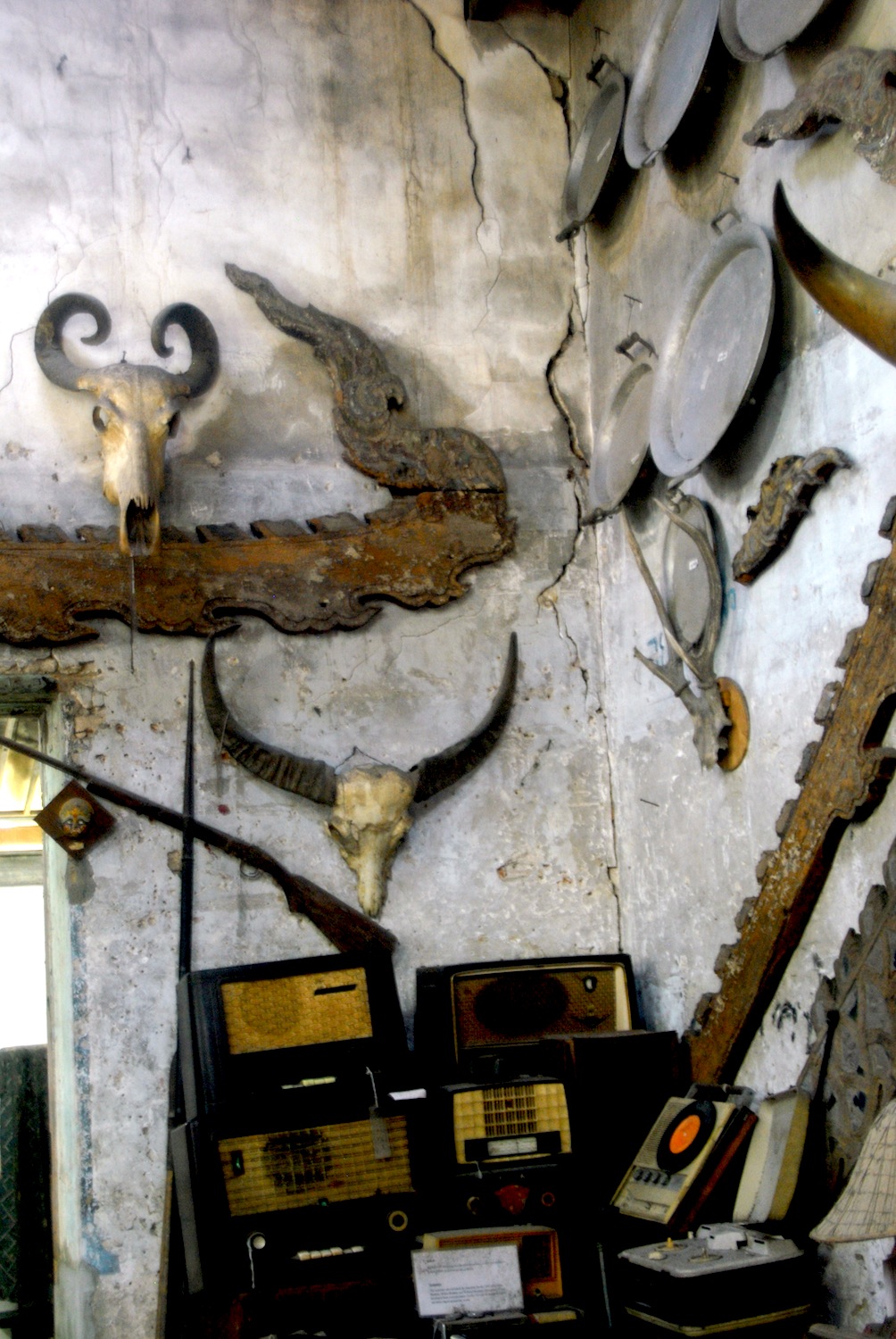
       For a look at the artifacts, crafts, photos and items of everyday use in this period one should visit Wat Ketkaram’s Museum, established around a century ago.  Many Lannna temples have museums, but this is the largest.  Furnishings, images, manuscripts and decorations from the original temple are on display, but the collection also includes a host of objects representing the secular life of the times.  These include baskets, musical instruments, leather cases, old typewriters, radios and phonographs, hunting and fishing gear, wooden animal head trophies, looms, thread winders, classic sarongs and festival rocket launchers.
a modern traditional style house in Watgate
       As the century progressed Watgate retained its importance to Chiang Mai’s educational program.  Dara Academy and Prince Royal’s College expanded into new buildings and today have a few thousand students.  Payap University, another Christian-sponsored institution, opened a campus opposite McCormick Hospital.  Facing Rattanakosin Road, in the rear of the campus, is the McGilvary Institute for religious studies.  Chiang Mai’s first church still stands, now called Chiang Mai Christian School Chapel, next to a Bible Study Institute.
       Besides the Christian schools, Watgate also has some language learning institutes.  The first was the British Council, on Bamrungrat Road, constructed in 1952, whose activities today are basically restricted to teaching English.  Besides English academies, there is also a center nearby for foreigners to learn Thai.
       From the late 90s tourism to Thailand accelerated and affected developments in Watgate.  New restaurants and nightclubs lined the riverbank between Charoen Muang and Kaew Nawarat.  Many of the fine old wooden houses were converted into hotels and art galleries.  The quiet end of Rattanakosin features several buffet grills, though customers are mostly Thai.
NcGilvary Academy, Payap University
       In fact, for all the foreigner presence in Watgate, the district’s residents are still predominantly Thai.  Several Buddhist temples have been built the last few decades, plus a crematorium at the end of Rattanakosin.  Typical of suburban Thai life is the warren of lanes behind this road.  Some of the houses are quite fancy, old or new, others very modest.  The residents include white-collar professionals and ordinary workers and traders, some of whom transport their goods in side carts attached to their motorbikes. Shops on the lanes cater to the neighborhood’s needs, including convenience stores, legal offices, realtors, beauty salons, food stores and small restaurants.
       Bars, karaoke clubs and snack and grill stands are just around the corner, opening in late afternoon.  People also gather at the tables in front of the small essentials shops to have a ‘sundowner’ beer or whisky.  It’s a quiet and convivial scene, far from city congestion and one of the delights of being a resident of Watgate.

Watgate riverside in May

                                                                          * * *           

Tuesday, July 30, 2019

Beyond Haripunchai—Excursions Out of Lamphun


                                      by Jim Goodman

ruins at Ko Klong, Chamadevi's birthplace
       The attractions that lure and enchant visitors to Chiang Mai—ancient monuments, old temples, mountains, caves, waterfalls, ethnic minority communities and craft villages—can also be enjoyed just south, on day excursions to Lamphun Province.  The two provincial capitals are only about 30 km apart and less than an hour’s travel time, whether by train or any of the three roads.  Lamphun’s old city is like a smaller version of Chiang Mai, surrounded by moats, and a river on one side, and bounded by remnants of old walls, with entry gates in the four directions.
Black Stone Buddha, Wat Mahawan
Ku Kai, the chedi for Chamadevi's  rooster
       The city is actually much older than Chiang Mai, founded as the capital of a Mon state in the 7th century and named Haripunchai.  Its first ruler was Queen Chamadevi, originally born near here, but later raised in the royal court of the Mon state of Lavo, today’s Lopburi.  Though Chamadevi was a real historical person, myth and legend have embellished the details of her life.  Her cult has persisted down to contemporary times and a visit to old Haripunchai largely consists of sites associated with the ancient queen.
ruined chedi at Wat Ko Klong
Wat Tan Kok, Wiang Tha Kan
       This includes Wat Haripunchai, originally built in 1044 on the grounds of Chamadevi’s former palace.  Its main gilded chedi was erected a century later, right over the queen’s bedroom.  Just outside the west gate of the old town, Wat Mahawan, a temple noted for its amulets, houses a black stone Buddha image the queen brought up from Lavo.  Further west lies Wat Chamadevi, (a.k.a. Wat Kukut) first constructed the same year, with its two early 13th century brick chedis still standing.  The smaller one contains Chamadevi’s ashes.  The new viharn features vivid wall murals of scenes from her life and times.
Wat Mae Klang Wiang, Wiang Tha Kan
       Elsewhere in Lamphun, the Chamadevi Park occupies the southwest corner of the old town.   North of the moats, a splendid mixture of styles marks the reconstructed Wat Sanpayangluang, her cremation site.  East of the old town, the interior walls of the ordination hall of Wat Prayeun, one of her favorite temples, are covered with paintings of events in Chamadevi ‘s life.  And northeast of the city are ancient chedis built to house the remains of Chamadevi’s elephant, horse, rooster and cat—a phenomenon unique in the country.
       Well, she was certainly a phenomenal woman, the most accomplished in Thailand’s history.  From Lavo, contingents of artisans, doctors, astrologers, merchants, teachers and 500 monks accompanied her.  She subdued the local Lawa, established a firm foundation for the state and in late middle age abdicated in favor of the elder of her twin sons.  The younger one then founded Lampang, northern Thailand’s second oldest city. 
Wat Ku Mai Dang, Wiang Tha Kan
       Her dynastic line died out in the early 11th century and a killer epidemic forced the population to relocate for several years in Lower Burma.  Upon their return, the new dynasty continued to honor Chamadevi and its first kings built Wats Haripunchai and Kukut.  The state repelled three Khmer invasions in the 12th century and remained at peace until finally subdued by Mengrai of Lanna in the late 13th century.
       Besides the ancient relics in and around Lamphun city, other vestiges of the Mon state are within the vicinity.  Chamadevi’s birthplace, Ko Klong village, is about ten km west of Pasang, the next town south of Lamphun.  Within the village’s temple grounds stand the ruins of three brick and laterite religious buildings, built in the 9th century and renovated 14th-15th centuries under the Kingdom of Lanna.  A bit of the stucco decoration remains, but none of the sculptures, nor the upper parts of the buildings, but each is in a different style.  Another one stands on an island in the middle of a pond outside the compound walls.  Originally it stood on a small mound next to the Ping River.  But centuries later the river changed course and left the monument surrounded by a pool.
Buddha image, Wat Mae Klang Wiang
Tai Yong temple--Wat Pasang Ngam
       There’s no building in the village claiming to be Chamadevi’s natal home.  The peculiarity of the village, though, is that its residents are Mon, not Thai, descendants of ancestors from the Haripunchai era.  And they use the Mon language when speaking at home and within the community,
winding thread in Don Luang
       A more impressive set of ruins from old Haripunchai lies west of Lamphun at the former satellite town of Wiang Tha Kan, over the boundary in Sanpatong district of Chiang Mai Province.  Founded over a thousand years ago and abandoned after the Burmese conquest of Lanna mid-16th century, the ruins are spread out over quiet rural neighborhoods.  A portion of the city moat remains. 
       Most of the ruins are just brick foundations, but a few have full sized chedis in fairly good condition.  The one at Wat Ku Mai Dang looks ready to topple over with the next earth tremor, though.  In front of one of the two chedis at Wat Mae Klang Wiang, a Buddha statue displays traits common to Mon-Khmer sculpture--very thick lips, for example, different from Thai Buddhas.  There’s an information center next to this site and a small museum with ceramics and other trade items from 13th-14th century China, indicating the town’s continuing prosperity after its absorption into the Kingdom of Lanna.
Don Luang house with loom
Don Luang street lamp
       By the time Mengrai learned of the existence of Haripunchai, its governing dynasty had changed.  Instead of Mon, the ruling family was from the Tai Yuan community, which had grown throughout the 13th century.  Mengrai was also Tai Yuan and thus had natural allies in the government.  They eventually invited him in, so Mengrai conquered the city by subterfuge rather than combat.
       It was a more sophisticated city than Mengrai had ever imagined.  He decided to make it his kingdom’s religious center and modeled his own capital Chiang Mai on the layout of Haripunchai.  He and his successors patronized the monks there and sponsored new temples and renovations of old ones.  With the conquest of Lanna in the mid-16th century Haripunchai lost its special status and became just another small town run by a Burmese vassal.
the Black Bridge in Lamphun
       When King Kawila of Lampang launched his campaign to evict the Burmese from northern Thailand, chaos soon swept the region.  Lamphun citizens joined sporadic rebellions against their Burmese overlords, but the latter responded by forcing people to leave the cities.  Kawila finally expelled the Burmese garrison from Chiang Mai in 1774, but by then it was a deserted city and would remain so for another two decades.
       In 1796, 500 years after Mengrai founded the city, Kawila officially re-established Chiang Mai as the capital of a resurrected Kingdom of Lanna, though as a vassal of Siam.  Burmese forces still controlled parts of the north and it took several years to kick them out completely.   Moreover, the re-born kingdom faced a severe under-population crisis.  People had fled the towns and villages and taken refuge in remote hills and forests.  Kawila had just settled people in Chiang Mai again, but Chiang Rai, Phayao, Fang and Lamphun were still empty.
       After Kawila’s forces had driven the Burmese out of Lanna territory entirely, he embarked on a new campaign to increase its population and make it an economically viable state.  Besides transferring people from Lampang and further south and enticing refugee farmers out of the hills and forests, he also organized raids into northeast Burma to capture people, not territory, and resettle them in Lanna.  Craft specialists were a high priority.
pasting gold leaf onto the Buddha's footprint
        The 1805 expedition targeted Muang Yong, a river town in northeast Burma’s Kengtung state.  Lanna forces removed 10,000 residents to relocate them in and around Lamphun.  The people were Tai Lu from Xishuangbanna, but after their removal became known as Tai Yong.  Linguistically and culturally they were similar to the Tai Yuan.  Their dialects, and that of the Tai Khoen in Kengtung, were close to the Kham Muang of Northern Thailand and used the same alphabet.  Their religious traditions were the same, as was their general way of life.  Their assimilation in their new home would prove easy.
       Nobody chronicled exactly how the Muang Yong operation proceeded.  Did Lanna soldiers round up the people at gunpoint, so to speak, and take them to Lanna as POW’s?  Or were they persuaded by arguments, promises or rewards?  The Tai Yong were able to bring their town’s guardian deity images with them and later install them in a temple in Pasang district.  So how do we label this episode, as abduction or as migration?
Wat Phra Phutthabat Tak Pha
       The Tai Yong live mostly in Pasang district, where they are famous as weavers, the skill that got them brought here originally.  Nowadays villages like Don Luang, four km south of Pasang, and Nong Ngeuak, a few km further, boast of a high reputation for their textiles, made on old-fashioned handlooms, mainly from locally cultivated cotton.  Both men and women are involved with the weaving process—spinning, winding thread and weaving.  Some produce silk cloth, with a unique pattern of small raised flowers on the surface of the fabric.
       Throughout the 19th century the market for Pasang textiles was largely confined to a few northern provinces.  With the construction of a railway line and highway connecting Bangkok to Chiang Mai in the early 1920s this expanded, first to Bangkok and eventually to other parts of the country.  Lamphun quickly became integrated with the country, while the burgeoning teak trade brought a new prosperity.  The Black Bridge, on the railway line just south of the Lamphun station, is the most visible vestige of that era.
Buddha images inside Tham Luang Pha Wiang
       A century later, good roads now connect Lamphun city with all of its rural attractions as well.  One of the most popular locally is Wat Phutthabat Tak Pha, about six km south of Pasang.  It lies in a quiet valley and marks the spot where the Buddha, on a mission with some of his followers to spread the new religion, allegedly stopped here to wash his robe.  A pair of his (larger than life) footprints marks the spot inside the temple erected over it.
       The temple buildings are 20th century constructions, but the site has been venerated since ancient times.  The monks and novices there now are from a Burmese Buddhist sect and wear red robes instead of yellow.  A gilded chedi stands atop the hill behind the compound, with a staircase in front of 467 steps.  But those who want to enjoy the mountain scenery have the option of taking a vehicle up the road to the summit.  Devotees come at any time to honor the footprints by sticking leaves of gold onto them.  The compound is especially crowded the 23rd day of the 8th lunar month, the festival for bathing the footprints.
at the mouth of Tham Luang Pha Wiang
       Further south down Highway 106, past the small town of Ban Hong, mountains dominate the landscape.  Chedis grace the crests of ridges and a turn 15 km past Ban Hong leads to Tham Luang Pha Wiang, the province’s best cave.  It contains several chambers with interesting stalactites and stalagmites.  The most impressive is the large stalagmite at the cave’s mouth, resembling a giant tooth.  A few small shrines and a bell are at the mouth as well, while the next chamber inside contains a row of Buddha images, for Thais traditionally consider natural caves holy places.
       Closer to Lamphun, to its southwest, on the summit of the hill Doi Tha Hin, is another rural attraction—the Golden Rock. .  It has the same name as the more famous one in southeast Myanmar and resembles it, but is actually two big gilded rocks on a cliff atop the hill, with a small chedi on top.  A couple of Buddha ‘footprints’ are in the vicinity, indicating a local belief that the Buddha passed this way. 
       Only a single monk lives there and it is several km from the nearest village.  Yet it is certainly worth a visit, especially in good weather.  The turnoff from the rural road is an easy ride of three km.  From the foot of the hill it’s 15 minutes walk to the summit.  The stairway is lined with statues of devotees and near the top are large statues of the 3rd century monk Upakhu, with his hand in his begging bowl, and a seated Buddha.  Around the corner is the shrine itself, the improbably balanced boulders and a broad view of the countryside.     
the Golden Rock on Doi Tha Hin
side view of the Golden Rock
     The Golden Rock is scarcely mentioned in Lamphun tourist literature, perhaps because, like Tham Luang Pha Wiang, it’s a little far for a quick excursion.  The same can be said for other more distant sights in the province, like the Karen village of Mae Khanat, the woodcarving village in Mae Tha district and the railway tunnel at Doi Khuntan.  But for anyone with the time and interest to discover the special features of northern Thailand history and culture, Chiang Mai is a good start, but not enough.  Lamphun’s culture was not only earlier, it laid the foundations of civilization for the entire north.

shrine of the Golden Rock, Doi Tha Hin

                                                                        * * *