Showing posts with label Ping RIver. Show all posts

Tuesday, February 27, 2018

Why Chiang Mai?


                                                                         by Jim Goodman

Chang Puak Gate and Doi Suthep
       Thirty years have passed since I decided to make Chiang Mai my home.  Of course the city is much bigger now, more congested, more polluted, but that’s true almost everywhere.  It swarms with tourists during the dry months and is still pretty crowded even in the rainy season.  But increasing tourism is a permanent phenomenon for any attractive destination and Chiang Mai gets such attention because it truly deserves it.  Its location, size, cultural features, religious and historical monuments all contribute to its popularity for travelers, and were precisely the characteristics that first enchanted me. 
the iron bridge across the Ping River
       The city lies on a broad plain between the mountain Doi Suthep to the west and the Ping River to the east.  With mountains on the horizon, especially north and west, towering trees both right inside the city and gracing the banks of the moats and the river, Chiang Mai is easy on the eyes. 
       Even with its expansion over the past three decades, it’s still a small city.  Traffic can be pretty heavy at times, yet if you’re on a motorbike instead of driving a car, even in rush hour you can be in the quiet, clean-air countryside in less than half an hour.  Most of the city traffic emanates from the business district near the river and the suburbs.  The old town, the main focus for tourists, experiences far less traffic.
Ku Ruang, the southwest bastion
       Chiang Mai dates its creation to 1296, founded by Mengrai, King of Lanna, a state that at its peak comprised most of the provinces of Northern Thailand.  Roughly square-shaped, 1.5 km per side, surrounded by moats, the city had five entry gates, bastions at the four corners and brick walls connecting them.  Mainly the extended royal family and some of the nobility lived within the walls, while commoners dwelt outside.  From its inception the city had many temples and another large portion of the city’s population were resident monks. 
       Today the old town has about forty temples within the moats and many more in the neighborhoods beyond them.  One cannot walk very far without passing by a temple compound and the high sloping roofs of the viharn, the main assembly building, and the spires of the chedi, the reliquary building shaped like an inverted bell that stands behind the viharn, are often taller than surrounding secular buildings.  Towering skyscrapers are absent from the old town, and much of the rest of the city as well, a factor adding to the pleasure of exploring it.
Wat Phra Singh compound
       In the early 90s, though, real estate speculation threatened to turn Chiang Mai into a Little Bangkok.  Condos and high-rise hotels began going up at a frantic pace.  Ownership changed hands several times before the building’s completion.   Meanwhile debris from the construction process fell into people’s yards and monastery compounds.
       By the mid-90s city residents were more than just annoyed.  Before work began on the Rimping Condominium next to the Nakhon Ping Bridge, angry neighbors called in monks to curse the ground.  Then they put up a banner just across the street announcing what they had done.  The condo went up anyway, but after its completion it was nearly three years before anyone moved into it.
ruins at Wat Chedi Luang
       The governor rebutted these complaints by stating that Chiang Mai needed development and that meant more condos and hotels.  But shortly after that an earthquake struck, cracking four of the condos.  Nobody was hurt and it fact it was a mild tremor, but it did scare people living near anything tall.  Then the governor himself died in a helicopter crash.  His successor reversed policy and limited new buildings within the city limits to six stories.  Those that had already begun construction were permitted to rise according to the original plan.  But since then, the six-story rule has held and all the tall buildings standing in the city today are at least twenty years old. 
sculpted horses at Wat Khun Kha Ma
       Thus Chiang Mai did not become Little Bangkok after all.  It retained its identity as a small, pedestrian-friendly city, full of historical and religious monuments, free of the hustle and bustle of a major metropolis, even though it’s Thailand’s second largest city.  There are no industrial complexes or big factories in the area and tourism, broadly defined, is the biggest industry. 
       Temples and the historical remnants are the main tourist attractions.  Temples all over Thailand feature ancient chedis, outstanding sculptures and so forth and so do various Chiang Mai temples.  The most famous chedi is that at Wat Chedi Luang, which in the 15th century stood 95 meters tall, truly the region’s first religious skyscraper.  A major earthquake in 1545 knocked down the upper part, never rebuilt.  What’s left of it still rises higher than all other buildings around it.
Tha Pae Gate
       Some temples are unique to Chiang Mai.  I include Wat Lamchang, Temple of the Tethered Elephants, erected on old Lanna’s royal elephant stable and full of elephant statues in the compound.  Not far away is Wat Khun Kha Ma, built on the former royal stables after an epidemic slew the horses and the distraught owner wanted to commemorate his beloved animals.  Finally, there is Wat Lokmolee, across the northeast side of the moat, which has a special shrine to Chiraprapha, the only Queen Regnant in Lanna history, who ruled briefly about a dozen years before the Burmese conquered the city in 1558.
       All these details became familiar to me the more I explored Chiang Mai, augmenting my appreciation of the city.  In 1996 the city celebrated its 700th anniversary by restoring some of the old temples and city walls.  Wat Lokmolee’s restoration came only this century, along with a few other temples.  This exemplified another notable feature of Chiang Mai.  Its people have a strong sense of their own separate cultural and historical development, without that sliding into nationalism or separatism, such as affects the Shan in Myanmar.  One manifestation of that is keeping their historical monuments in good shape and restoring whatever can be restored.
alms-giving in the old town
       When the Japanese occupied Chiang Mai they tore down the gates and walls to use the bricks to make new roads.  They left the four corner bastions standing though, but it was not until the late 1960s that the city got around to reconstructing the gates.  And only in the mid-90s were parts of the walls rebuilt.
       Of the city gates, the most important today is Tha Pae Gate, the eastern one, with a large plaza in front and the only one vehicular traffic cannot pass through.  It’s popular in the morning with tourists who want to pose for photos with the pigeons.  It is also the venue for special city events—beauty contests, stage shows, New Year’s countdown--and festival processions pass by here.  Opposite Chang Puak Gate, the northern one, and right next to Chiang Mai Gate, the southern one, food stalls open at night, with a variety of inexpensive meals on offer.
northern beauty on a Loy Krathong float
Flower Festival procession
       Another example of the Northern Thai people’s cultural consciousness is their enthusiastic celebration of the city’s festivals.  A majority of these are Buddhist events and largely restricted to gatherings at the temples, though one of them, Buddha’s birthday, includes a procession up Doi Suthep the night before.  Religion is still a major factor in local people’s lives and many Chiang Mai residents rise early to donate food, money and other daily necessities into the monks’ begging bowls when they make their morning rounds.
summer flowers on Rattanakosin Street
       Others are basically secular, even if they have accompanying rituals.  The most famous is Songkran, 13-15 April, marking the traditional Thai New Year.  It’s also known as the Water-Throwing Festival, after its primary activity—people throwing water on each other the whole day long for three days.  After one experience of it I have tended to avoid it over the years.
       The most attractive event is Loy Krathong, held for three days around the full moon of November.  People make krathongs—small boats made out of banana leaf, containing flowers, incense and a candle—and float them in the Ping River.  This is done to persuade the river goddess to cease the rain, for it’s harvest time soon, and take the waters back, by giving her a beautiful send-off.  Processions, fireworks, stage shows and thousands of floating lanterns wafting into the sky these nights make it the most spectacular and enjoyable public event of the year.
flowering trees on the northern moat
       The Tourism Authority of Thailand added another annual event to the calendar with the creation of the Flower Festival the first weekend of February.  Heavily decorated floats on flatbed trucks file in a procession from the train station all the way through downtown Chiang Mai to Buag Had Park in the southwest part of the old town.  Here they stay another day, while various food and commercial stalls set up on adjacent streets. 
       For a resident then, Chiang Mai has regular public events to punctuate the year.  Some are rather sedate temple affairs, but others, like Loy Krathong, are spectacles worth seeing every time they occur.  Loy Krathong occurs at the beginning of the cool, dry season, the most comfortable time of year.  Temperatures drop somewhat the next couple months, but not to the level of more northern countries.  It never snows here or at night gets colder than ten degrees Celsius. 
200 year-old tree at Wat Chedi Luang
sacred trees on the road to Lamphun
       From March through May is the hot, dry season, with temperatures reaching up to forty degrees Celsius in the daytime.  Yet the nights are pleasant and in compensation for the heat, tropical fruits abound in the market and flowers bloom on the trees along the moat and throughout the suburbs.  When the rains commence in June-July, the temperatures drop a bit and the rain comes mostly at night and rarely all day long.
monk procession on a Buddhist holy day
Lahu Shehleh in Warorot Market
     
Besides their colorful displays when they blossom, some of Chiang Mai’s trees are believed to be home to guardian spirits, like the towering dipterocarp planted by Kawila at Chedi Luang, after he resurrected Chiang Mai in 1796, following the expulsion of the Burmese.  The biggest trees in temple courtyards date from the compound’s original construction or a major renovation.  To honor the tree’s guardian spirit, devotees place poles at its base to prop it up and relieve the stress of its weight.  Other venerable trees feature shrines in front and the tall trees parallel to the old road south to Lamphun are wrapped in yellow robes to indicate their sanctity.  They make this route the most beautiful drive in any direction outside Chiang Mai.
street mural, Loi Kroa Road
       Modern Chiang Mai has its supermarkets and shopping malls, but the traditional markets, like Warorot and Muang Mai along the river, are still quite active, the latter all night long.  The scenes here are sometimes enhanced by visits of ethnic minorities from the mountains, dressed in their traditional clothing, especially Lahu Shehleh, Hmong, Akha and Palong, which adds an exotic, colorful aspect to the streets, yet another attraction of life in Chiang Mai. 
       Night markets are also popular, especially with tourists, both the Night Bazaar on Changklang Road and the ‘walking street’ weekend markets Saturday on Wualai Road, southeast of Chiang Mai Gate, and Sundays on the road between Tha Pae Gate and Wat Phra Singh.  Lanna handicrafts dominate the goods on sale, from hill tribe products to items from long-established specialty villages, like celadon wares from San Kamphaeng, umbrellas from Bor Sang, woodcarvings from Hangdong and silver and lacquer creations from Chiang Mai’s Haiya district.
       In addition to its traditional crafts, Chiang Mai is one of the country’s prime artistic centers, home to many modern artists.  The city has several galleries and art and photography exhibitions take place throughout the year.  Imaginative street artists have also covered bare compound walls with their works and when riding around familiar routes I often come across new murals that cause me to stop for a bit and appreciate.
rising of a 'super moon' over the banks of the Ping River
       Beyond the city’s assets, which I am constantly discovering the longer I stay here, Chiang Mai is close to other attractions in the region.  It is a short, pleasant drive to ancient Lamphun, whose moats, walls and religious architecture had a profound impact on Mengrai and his foundation of Chiang Mai.  The hills, valleys and gardens of Mae Rim are less than an hour away going north.  Hmong, Lahu and Karen villages are within easy reach, while Akha, Lisu, Palong and Yao villages are further on.  Forest parks and scenic reservoirs are also within easy access, while the Ping River itself is most attractive near the city and a great venue for sunset and moonrise viewing.
       All these features make the city increasingly popular with tourists, but they hardly ever get in my way.  Tourism development has basically meant more hotels and restaurants, so if I fancy a different meal than the local food that I ordinarily prefer, I can choose among a variety of Chinese, Vietnamese, Indian, German, French, American and Italian restaurants.  It’s obvious why Chiang Mai became a tourist hub, as well as a favorite place for retirees and pensioners.  They are all here for the same reasons that lured me to remain for three decades so far, with little inclination to seek anything conceivably better.
wooden foot-bridge over the northern moat
                                                                        * * *


Friday, November 17, 2017

Illuminated Nights--the Loy Krathong Festival


                                            by Jim Goodman

Big Krathong pr9cession 1993
       Most of the festivals in the Chiang Mai calendar year are primarily religious affairs.  They celebrate important Buddhist events like the Buddha’s first sermon, his birthday, the enrollment of boys in the monastery, the opening and closing of the retreat season.  The night before Buddha’s birthday devotees ascend on foot to Doi Suthep Mountain to be at the temple there to honor the Buddha when dawn arrives.  Otherwise the activity is mostly restricted to prayers and offerings at the temples.  Some stalls will offer food instead of flowers, candles and incense, and there may be traditional musicians playing a while in the compound.  In general, though, the atmosphere is reverent and sedate.
       The one festival in which the opposite mood rules is Songkran, held in mid-April at the peak of the hot season.  While the program has some religious elements, the general activity consists of three full riotous days of people throwing water on each other.  There are stage shows after dark, when the water-throwing is supposed to cease, though a lot of foreign tourists don’t seem to know that.
        In contrast to all the other annual events, the Loy Krathong Festival combines the religious and the secular, accented by spectacular evenings of lamps, lanterns, fireworks, stage shows and processions.  Held for three days and nights around the full moon in November, when the rains have practically ceased and evenings are refreshingly cool and everybody seems to be I a good mood.
making a krathoin
krathongs in the river
       A krathong is a little leaf boat, about 20 cm long, made by wrapping folded banana leaves around a section of the tree’s stalk.  As the festival arrives Chiang Mai people start making bunches of them for sale to participants.  When they have gotten all the leaves in place they add flowers, incense sticks and a candle.  Beginning the night before full moon and continuing through the night after full moon, people take the krathongs to the riverside, light the incense and candles and place them carefully in the water to join the succession of other krathongs floating down the Ping River
Loy Krathong nights on the river
       Thais believe that by doing this they send away all bad luck and disappointment of the year.  In Chiang Mai, Loy Krathong coincides with the city’s own Yi Peng Festival, which honors the river goddess.  Part of the motive in sending pretty little krathongs down the river is to beautify it and impress the river goddess.  At the same time they implore her to take the waters back, reduce their level, make the rains stop, it’s time for our harvest.  The krathongs, lanterns and the illuminated shore and sky are meant to be a proper send-off to the river goddess.
       Placating the river goddess is not a Buddhist concept, of course, but an animist one.  Yet Buddhism has never succeeded in eradicating superstitions or animist notions from the Thai psyche.  But more properly Buddhist activities are also part of the Loy Kratong program.  Some of these are part of every full moon day, which is a particularly auspicious day in the Buddhist year, along with new moon and the 8th day of the lunar month. 
       For Loy Krathong, however, the sermon for the occasion is one from the Jataka Tales, which narrates the lives of previous incarnations of the Buddha.  This one is about Prince Vessantara, who gradually gave away all of his possessions to the poor, exemplifying the virtue of selfless charity.  Thais know the story well.  It is also depicted on the wall murals of the viharn at Wat Bupharam.  Yet these Loy Krathong sermons are still well attended and the sermon, the krathongs on the river and the grand procession of decorated floats are the three parts of the festival program that have remained unchanged for the thirty years that I have been in Chiang Mai.
Loy Krathong boat races, 1990
       Every year city authorities publish the festival schedule of events.  In recent years, other than the Vessantara sermon in the temples, the activities are all at night.  When I first observed it in 1988 longboat races were held in the daytime, between the Nakorn Ping and Nawarat Bridges over the Ping River.  The long, narrow boats, with dragon-headed prows, held 23 rowers and another on the rudder.  After some rowing practice the crews paired off for a race that terminated north of the second bridge.  Winners paired off afterwards until a champion finally emerged.
       The other daytime event was the krathong contest held the first two days in the compound of the city’s Municipal Office, on the river next to the Muang Mai market and the American Consulate.  These krathongs were much bigger and more elaborate than the simple ones people bought to float on the river.  The awards were given the second afternoon because many of them would be carried as part of the second night’s Little Krathong procession.
women in the first night's procession
men in the first night's procession
       The boat races disappeared from the program in the late 90s, but the krathong contest continued longer.  The city scheduled one this year, but either it was canceled or nobody entered, for the Municipal Office lot was empty each day. 
       The festival always begins with an official ceremony and speeches and a classical Thai dance performance.  In the past this was held at Tha Pae Gate, though in recent years it has shifted to the square in front of the Three Kings monument.  Various kinds of lanterns, big and small, fill the area, in the shape of stars, begging bowls, baskets and wheels. 
women with krathoings, first night's procession
       Made of paper, but usually around a bamboo cylinder to protect them from igniting from the heat of the candle mounted within, they are also hung from posts along the procession route and strung across temple courtyards.  One type spins around from the generated heat, revealing portraits on its sides of the twelve zodiac animals or other pictures.
       In past years, the first night’s procession was on foot.  Participants dressed in classic Lanna clothing and some in each contingent carried tall poles with long, thin, woven cotton banners called tung in Thai, or brandished big lanterns.  The second night was the Little Krathong procession.  Back then it was hand-carried, even if it was so big several people were required to carry it.  The third night was the float procession, with men and women in traditional clothing and jewelry riding on spectacularly decorated floats on flatbed trucks.
lantern procession
       Participants in these processions marched in contingents representing various companies, banks, schools and other city organizations.  Most dressed in old-style Lanna clothing, the women wearing classic northern textile designs, like a parade of traditional fashions.  Their hair tied up in buns and decorated with jewelry, they carried krathongs or lanterns, while the men filed along hoisting the poles with the dangling tung banners.  A large, wheeled drum accompanied some groups, with shirtless men taking turns pounding it.
       Throughout the 90s the processions all began at Wat Phra Singh in the western part of the old town, advanced along Ratchadamnoen Road, passed through Tha Pae Gate and proceeded down Tha Pae Road to just before the bridge.  Here they turned left, passed along the river and terminated at the Municipal Office.  Nowadays they begin in front of Tha Pae Gate, but otherwise follow the same route.
Big Krathong rider, 1993
Big Krathong rider, 1990
       The first night’s procession did not involve any vehicles other than the drums on wheels.  Each contingent consisted of at least twenty men and women, all dressed their best for the occasion.  On the second night’s Little Krathong procession folks carried krathongs much bigger and more complex than the small ones sold by the riverbanks.  Some of these later wound up placed in the river.  As the years went on, though, people no longer carried them, but placed them in trucks.
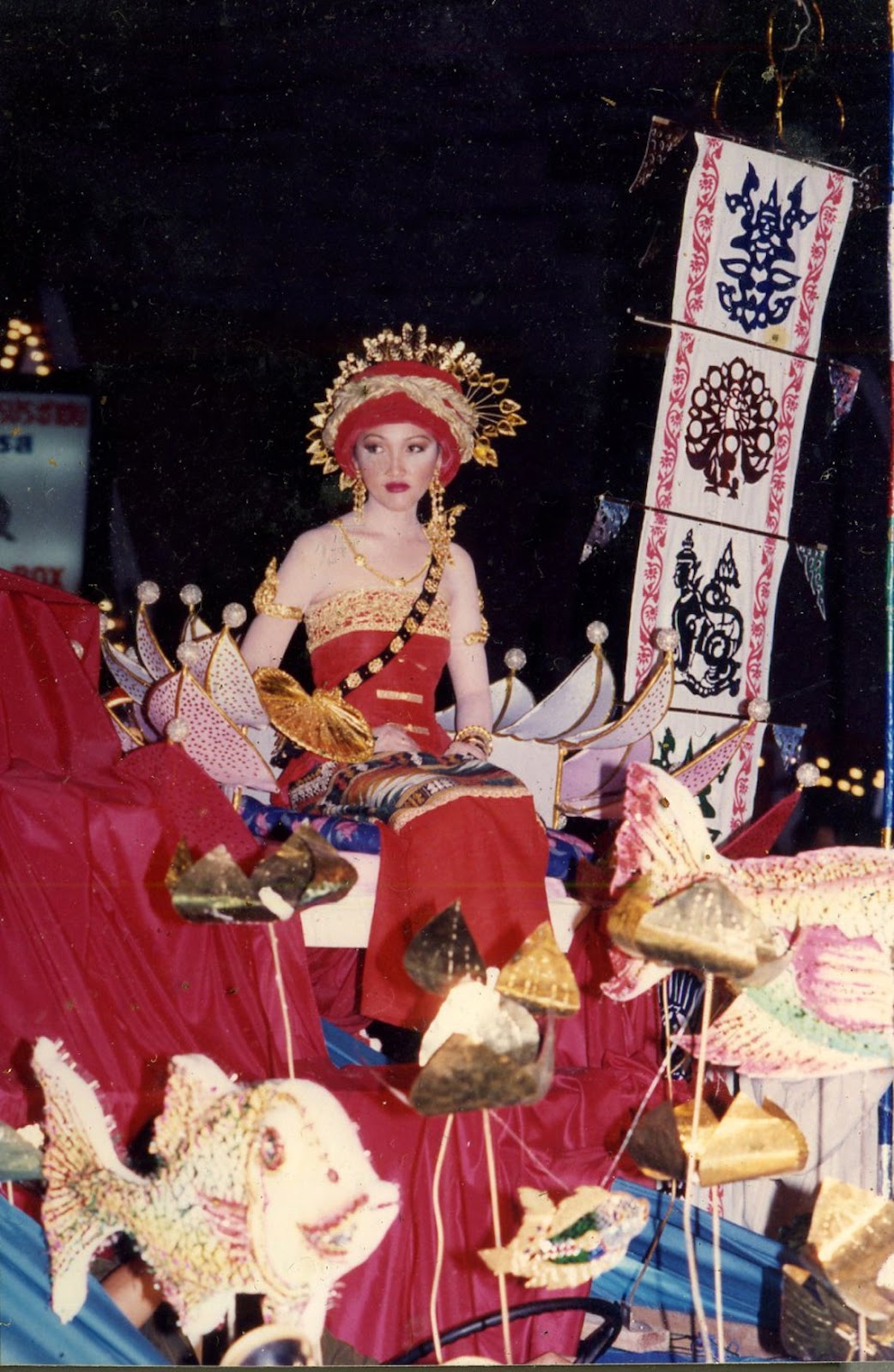
       The grandest procession was, and still is, that of the Big Krathongs, of huge, fanciful krathong displays mounted on long, flat truck trailers.  Both the men and women riding these dress in the most ornate costumes of all.  Some wear the garments of centuries ago, their hair buns adorned with crowns and tiaras, plus lots of rings, necklaces and bangles.  The floats feature sculptures of lotuses, nagas and other mythical creatures, demons, birds and elephants, sometimes with three heads.
Big Krathong procession, 2017
       This procession, usually of a couple dozen floats, could take hours to complete.  In the past, at the terminus of the route, people lifted two or three of these floats into the river.  They floated downstream, with the riders still aboard, only as far as the first bridge before hauled to the side.  But it was quite a climax to the procession.  Unfortunately, like the boat races, that was also dropped from the program long ago.
       At the turn of the century the city added another attraction to the festival by staging a ‘sound and light show’ on the riverbank opposite the Municipal Office.  The stage show featured skits of players in ancient costumes, carrying noble ladies in palanquins across the stage, classic dances and loud, recorded music.  Fireworks shot off behind the stage, but there were fireworks from other points all along the river as well.  The stage occupied the most popular area for launching krathongs, which sort of interrupted the main festival activity.  Besides, Loy Krathong already was a ‘sound and light show.’  After two years, with little attendance, the city dropped the show from the program.
       While the processions are in progress, now as in the past, other activities take place along the route and on the riverbanks.  The yard of the Governor’s Mansion, just before the bridge at the end of Tha Pae Road, is full of food stalls.  One can buy snacks, rice or noodle meals, grilled meat, dried fish, sushi and more exotic specialties like gilled chunks of goat, sheep, rabbit, wild boar, ostrich, deer, crocodile and scorpions.  Behind the stalls stands a Ferris wheel, just like at a circus.
Big Krathong on the Ping RIver 1990
Big Krathong on Tha Pae Road, 1993
       All along the river are piers from which people place their krathongs in the water.  Food, drink and snack stalls line the sidewalks.  In between the piers folks shoot off small fireworks or light sparklers, while on the third night a series of skyrockets burst into the sky in multiple colors.  And for about a dozen years now the illumination includes the addition of sky lanterns.
       More like a hot-air balloon in the way it operates, the sky lantern is a wire-frame paper cylinder about one meter high.  Fixed to the bottom is a small tray containing cotton soaked in kerosene.  The user lights the cotton and then holds the lantern steady while the flame heats it up, which normally takes about a minute.  When enough heat has been generated inside the lantern, the holder releases it and it goes floating high into the sky.
like a traditional fashion show
       Problems can arise, especially if a breeze suddenly comes along.  If the lantern is released too early, it could tilt and catch fire, slam into a tree or crash into the river.  But considering the thousands of people sending sky lanterns aloft, that doesn’t happen very often.  Most of them successfully join the other launched lanterns in a stream that speckles the heavens.
        The lanterns are usually white, which makes them pale orange in the sky.  A few are red or blue or have faces painted on them.  The best to watch are the ones that have a long tail of sparklers attached.  Once they ascend they start leaving a trail of glitter below them that follows them high into the night sky.
       The sky lanterns can also interfere with aircraft.  A few years after their introduction the city decided to restrict their use to two nights only and canceled all flights from 7 p.m.  When they burn out the lanterns fall back to the ground, on roads, in gardens and people’s yards and that has caused complaints.  This year the government announced the day before the festival that sky lanterns and fireworks of any kind were prohibited under pain of 60,000 baht fine and three years in jail.
sky lantern lift-off
sky lanterns along the river
       Either Chiang Mai got a special dispensation or the city simply ignored the decree.  Authorities had already canceled 78 flights.  To ‘uncancel’ them would have been just as much trouble, since the airlines had already readjusted.  Newspaper editorials denounced the sky lanterns as not being a traditional part of Loy Krathong and a nuisance.  They also slammed the post-festival rubbish problem in the rivers.
       I doubt that Chiang Mai people see it the same way.  This year the festival was as enthusiastic as ever.  Sky lanterns filled the sky for two nights and fireworks characterized the third night, though not as many as in the past, for it was individuals setting them off and not part of a city show.  And no one muttered about the mess to clean up next day.  That’s always been a familiar aftermath, one they’ve dealt with for centuries.  For local folks, Loy Krathong will always be worth the trouble.  It’s the most beautiful event of the year.
taking a break during a procession traffic jam,  2017
                                                                        * * *


Sunday, September 17, 2017

Lost and Found: Chiang Mai’s Predecessor


                                   by Jim Goodman

Wat That Kao in Wiang Kumkam
       In the late 13th century, a small Tai Yuan state in the far north of present-day Thailand, under the ambitious King Mengrai, began expanding south.  Assuming power in 1261 when he was just 22, the following year he moved his capital from Chiang Saen to a new city on the Kok River that he named after himself—Chiang Rai.  The new kingdom was Lanna, which translates as ‘a million rice fields.’  The next 15 years he spent consolidating and incrementally expanding his control over his neighbors.  Then at the end of the 1270s he heard about the wealth of Haripunchai, capital of a Mon kingdom in what is now Lamphun.
        After a carefully planned campaign of subterfuge carried out by a secret ally within Haripunchai, Mengrai captured it in 1281.  He stayed there for over a year, then traveled throughout his newly enlarged realm to oversee new fortifications and to endow monasteries. He did not intend to make Haripunchai his own capital, preferring to maintain it as a major Buddhist center.  Instead, in 1286 he ordered the construction of a new capital, on an existing Mon settlement, further north, at Wiang Kum Kam, a few km south of contemporary Chiang Mai.
the original foundations of Wat Chang Kam, from 1290
        Haripunchai was the most sophisticated place Mengrai had ever seen.  His capture of it involved no destruction at all and he seemed determined to preserve it as he found it. He definitely absorbed its influence and sought, by building a city on its model, next to a river, surrounded by walls and moats, to make something just as splendid.  Wiang Kumkam lay on the south side of a bend in the Ping River, and thus on the right bank, as Chiang Mai is today. 
       The location was prone to flooding, though, and after a few years Mengrai scouted the area for a new capital, founding Chiang Mai in 1296. Wiang Kumkam continued to exist as a kind of sister city and in fact, most of its ruins date from long after the transfer of the capital to Chiang Mai.  Sometime in the 17th century, however, the Ping River changed its course, forcing the evacuation of its population, burying most of the city under 1.8 meters of sediment, and leaving it on the river’s left bank.
votive tablets unearthed at Wat Chang Kam
         For many generations Wiang Kumkam was just a memory that grew into a legend.  It was the Lost City, the Lanna Atlantis, the underground metropolis.  But nobody knew where it was.  Then in 1984 farmers in the area, while plowing their fields, unearthed some ancient votive tablets.  They turned them over to the Fine Arts Department of Chiang Mai University, who subsequently began excavating on the site.  It turned out to be Wat Chang Kam, the second oldest extant ruins in Wiang Kumkam, originally built in 1290.
       Only the foundations remain, but success here prompted excavations and restorations throughout the area.  At many of these sites just the foundations, and maybe parts of the columns, have been reconstructed.  A few contain well preserved chedis as well, and at Wat That Kao, renovators have restored a prominent Buddha statue by following the remnants of a lime-plastered, brick original found during the excavation.
Chedi Liam, from the west bank of the Ping River
statue of King Mengrai, Wat Phra Singh
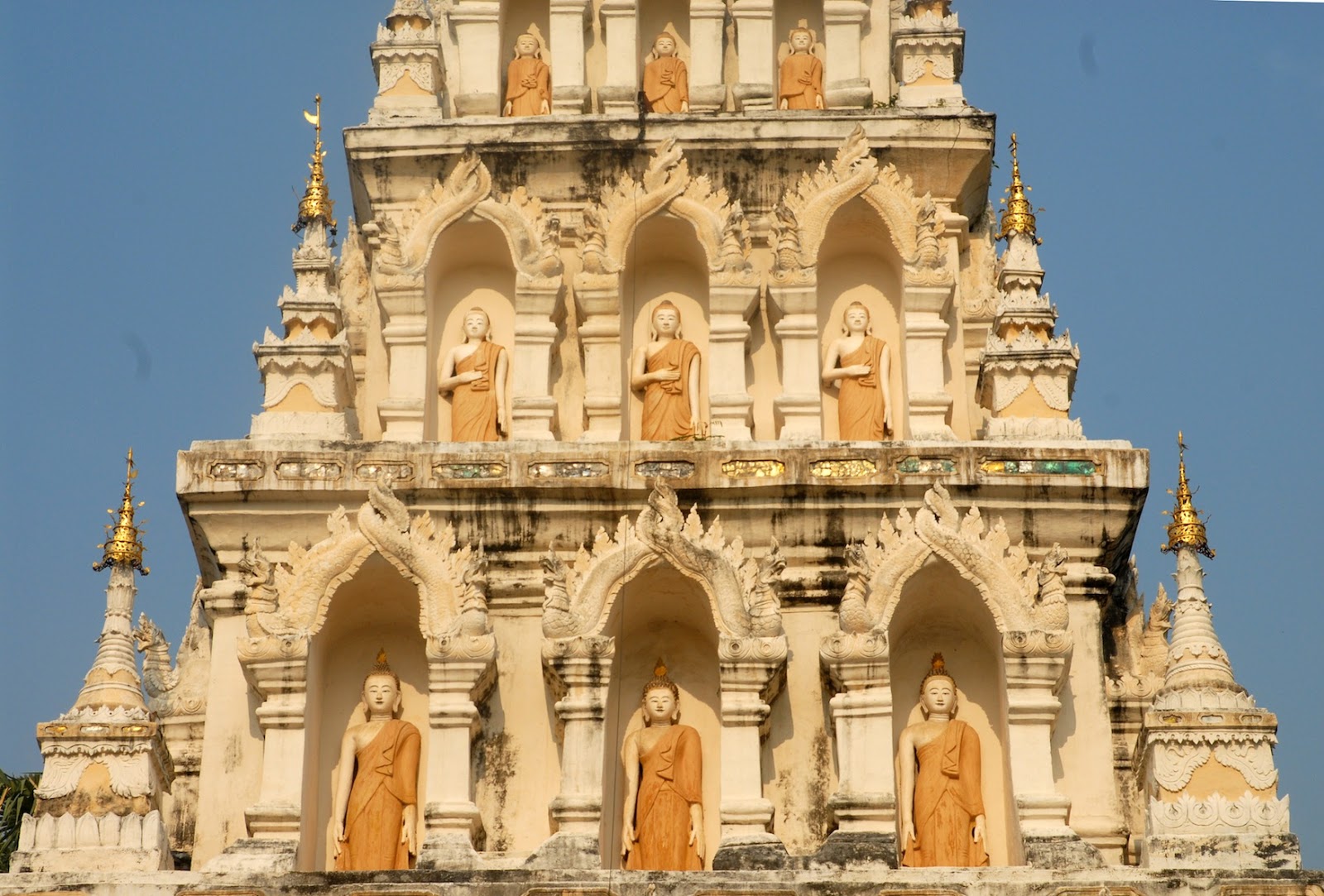
         The most attractive remnant of Wiang Kumkam is Chedi Liam, at the western en d of the old city near the river.  Built in 1288, the first monument in the city, it copies the style of the Mon chedi in Lamphun’s (Haripunchai’s) Wat Chamadevi, dedicated to the city’s 8th century founding queen.  Multi-tiered on a square base, with standing Buddha images in niches all around each level, it is unique to temple architecture around Chiang Mai.  The compound, like Wat Chang Kam, also has a new and active temple today, with resident monks.  Other buildings include the assembly hall, ordination hall and a shrine to the four-headed Erawan, the Thai equivalent of the Hindu Creator God Brahma.
Buddha images on Chedi Liam
       If Mengrai had a palace in Wiang Kumkam it hasn’t been discovered yet.  Because of the flooding, Mengrai soon sought a new site and didn’t sponsor any more construction other then Wat Chang Kam.  Always an astute politician, he had earlier in 1287 forged alliances with the rulers of the small state of Phayao and the much larger Kingdom of Sukhothai.  Ostensibly, this was a response to the establishment of the Mongol Yuan Dynasty in China, although the Mongols never did invade Thailand. 
the compound of Wat Chedi Liam
       The alliance did prove useful to Mengrai in another sense, for, when he sought to build a new capital, he solicited the advice of his allies.  He had already scouted the area and roughly selected a site between the mountain Doi Suthep and the Ping Rive.  It was to be set a little distant from the riverbank, but close to tits tributary he Nam Kha River and its natural reservoir, northeast of old Chiang Mai, which would supply water to the city and its moats.
       Wiang Kumkam was a rectangular city, measuring 800 meters by 600 meters.  Mengrai envisioned a much larger city for his new capital, but his allies recommended something a little smaller.  In the end Chiang Mai, which literally means “new city,” was nearly square, 1.2 kilometers by 1 kilometer.  Like Wiang Kumkam (and Haripunchai), moats and walls surrounded the city. 
Sriphum Corner, where construction of Chiang Mai began
       Geomancers and astrologers determined the date and place for starting construction, which began at the northeast Sriphum Corner on 18 April, 1296.  While workers were busy building the city, Mengrai stayed in what is now the compound of Wat Chiang Man, which later became Chiang Mai’s first temple.  Its construction began in 1296, the same year as the foundation of the city. 
         From 1296 Chiang Mai was the most important city in Mengrai’s Kingdom of Lanna.  He subsequently marched his army south against the Mon kingdom of Hanthawaddy, centered around Pegu (now called Bago) in Lower Burma, but the Mon king there offered submission and bestowed his daughter as Mengrai’s bride.  Campaigning next against Bagan, he secured their submission as well.  Back in Lanna, he promulgated a law code that served the country throughout its existence.
bronze Buddha head found in Wiang Kumkam
the reconstructed Buddha at Wat That Kao
       Mengrai died in 1317 when struck by a lightning bolt while in the market at what is now Chedi Luang, in the center of the city.  Lanna then extended from the northern border of Thailand down to Lampang, with allied states or vassals on its southern borders.  Mengrai’s dynastic successors continued to rule until after the Burmese conquest in the mid-16th century.
Wat E-Khang
       After his death, Mengrai became a kind of cult figure for the northern Thai, right down to contemporary times.  In Chiang Mai, the second oldest temple, now called Wat Mengrai, contains a tall standing Buddha whose face is allegedly modeled on that of Lanna’s first king.  A statue of him stands in the garden behind the temple.  Other Mengrai statues are in Wat Phra Singh and Wat Chedi Luang.  The latter compound also contains the City Pillar, supposedly erected on the spot where lightning struck the king.  As the building is not always open, city folk constructed a new shrine a block north, which is always loaded with flowers and other offerings.
       Venerated just as often is the Three Kings Monument, another block north of the shrine.  This sculpture commemorates the famed 1287 alliance and depicts Mengrai of Lanna, Ngam Mueang of Phayao and Ramkamhaeng of Sukhothai.  Elsewhere, Chiang Rai honors its founder with a huge statue of him in a popular park in the northern part of the city and a big new shrine has recently been built near the highway in Mae Chan district.  In Wiang Kumkam, Wat Phaya Mengrai, near Chedi Liam, is one of the excavated ruins, though only the foundations remain.  But at Wat Chang Kam, at the far end of the ruins, stands a shrine that claims to be the resting place of Mengrai’s spirit.  Thai tourists never fail to stop in to offer incense and prayers.
the chedi at Wat E-Khang
demon statue at Wat Ku Aisi
       Although after the founding of Chiang Mai Mengrai no longer paid attention to his former capital, Wiang Kumkam continued to exist as a kind of ‘sister city’ to Chiang Mai.  Members of the royal family had homes there and Mengrai even returned there for a while in 1311 to recover from an illness.  Royalty and nobility continued to sponsor the construction of more temples.  Its position on the river gave it good commercial connections and among the items excavated were Yuan and Ming Dynasty ceramics from China.  Even after the Burmese conquered Chiang Mai in 1558 Wiang Kumkam continued to function as a city.  Burmese policy at this time was to rule Lanna as a semi-autonomous vassal state and to respect local culture and patronize the religion, which was the same Theravada Buddhism of their own country. 
Wat Nanchang, the north-facing temple
       As a result, still more temples were erected in Wiang Kumkam in the 16th and 17th centuries until the Ping River suddenly changed course sometime in the mid-17th century, swerved west and inundated the city, forcing its abandonment.  All the residents moved far away and the area remained deserted until the beginning of the 19th century.  Wars with Burma had all but depopulated much of the north in the last decades of the 18th century.  After King Kawila from Lampang re-established Lanna in 1796, people began leaving their forest hideouts to make farms and villages again.  And those who settled in the Wiang Kumkam area had no idea an ancient city lay beneath their homes and fields until farmers found those ancient votive tablets in 1984.
Wat Huamong
       For the next twenty years archaeologists excavated and restored as much as possible in over two dozen sites.  Today it is an ever more popular tourist attraction in Chiang Mai, different from visiting ancient cities like Ayutthaya, Phimai or Sukhothai, where all the monuments are enclosed together.  At Wiang Kumkam the ruins lie scattered among village neighborhoods, with houses right next to them.
       The area is too big to cover on foot, so groups take tourist carts or buses and individuals explore by bicycle or motorbike.  Another option is to take a leisurely ride on a pony cart, which seats up to three and costs 300 baht (c. $9) for a tour around nine temples.  Traffic is very light throughout the area and various drink and snack shops exist along the roads and in the two new temple compounds at Chedi Liam and Wat Chang Kam. 
elephants at the base of a Wat Huanong chedi
       The pony carts start from the park’s official entrance, next to the highway around the corner from Wat Chang Kam. Those on bicycles or motorbikes, though, can also start from Chedi Liam and follow the signs indicating the name, direction and distance of the various ruins.  A section of the original moat and city wall remnants lie just east of Chedi Liam, with Wat Phaya Mengrai on the other side.  Further on the road passes Wat That Kao and its large reconstructed Buddha image.  It’s the only Buddha image in any of the sites, though bronze and stone sculptures have been excavated and are now displayed at Chiang Mai’s National Museum.
       The ruined chedi at Wat That Kao rises a little higher than its base, but two other sites a little north feature relatively intact, full-sized chedis,  They are in a different style than Chedi Liam and probably indicative of the type of chedis that used to stand in all the other excavated sites.  The older compound, Wat Pupia, holds the foundations of the viharn and ordination hall, a small water tank in front of the latter and the chedi towers behind the viharn.  The statues in the niches are gone, but some of the stucco sculpture around them remains. 
Wat Ku Magleua
       The other extant chedi is at Wat E-Khang, one of the last to be built in the city.  The original name has been lost, but because it was until recently a haunt of wild monkeys, local people began calling it E-Khang, after the Northern Thai word for monkey (khang). 
       Most of the ruins are just reconstructed brick foundations and the bases of vanished chedis, but even a few of these can be interesting.  Wat Nanchang is a rather large compound and, unusual for Thai temples, faced north, to the Ping River’s course at that time.  Wat Huanong, from the 15th-16th centuries, contains the foundations of several buildings, part of the entry gate and four extant elephant sculptures around the base of a chedi.  Wat Ku Aisi features a large demon statue.
       Other ruins, though without any sculpture or chedi, local people continue to venerate by adding  small modern sculptures and a makeshift altar.  At Wat Ku Khao, next to the tree-lined road to Lamphun, it’s a larger bronze seated Buddha.  For local people, they may not be very familiar with the ancient city’s history, but the excavators have uncovered many hitherto unknown holy places that they must recognize and venerate.  The buildings may be in ruins, but the gods are still there.

Wat Pupia
                                                                        * * *