Showing posts with label Wanding. Show all posts

Tuesday, November 7, 2017

The Frontier Peoples of Western Dehong


                                    by Jim Goodman

Dai farmer and his son riding buffaloes outside of Ruili
       Dehong in southwest Yunnan is an Autonomous Dai and Jingpo Prefecture.  Only about 20% of Dehong consists of plains and valleys.  The rest of the prefecture is hilly or mountainous and has a forest cover of around 60%, the highest rate in the province.  The population tops one million, with the Han a slight majority.  The Dai dominate the plains and valleys, while the Jingpo constitute the largest ethnic minority in the hills, especially in the western part of the prefecture.  Han Chinese only began migrating to Dehong after the eradication of malaria in the early 50s and largely, but not entirely, reside in the urban areas.
       The Dai are not the only indigenous folks in the plains, nor are the Jingpo the only hill people.  As for the Han, some also have farms in the plains, while others work in the coffee and tea plantations in the hills ,such as Dachang, east of Lianghe.  Such Dehong features become apparent when taking a trip from Tengchong, just north of Dehong in Baoshan Prefecture, to Ruili in southwest Dehong.
Nandin Xuanfu, the former palace in Lianghe
       Lianghe, the first city on the route, is an easy ride through the plains from Tengchong.  But even when I visited two decades ago the city was thoroughly modernized, almost entirely Han-inhabited.  The only Dai elements consisted of a couple small restaurants, a pagoda in the inverted bell shape built around 1980, and the palace of the former Dai ruler.
       This is the city’s main attraction, originally built in 1851, when Lianghe was known as Nandin.  The palace (Nandin Xuanfu) consists of seven connected courtyards, with gardens, pools and red brick buildings with dark gray, tiled roofs.  The doorways from one courtyard to another are circular or oval, a feature seen in many temples in the prefecture as well.  Here the district’s chaopha (Lord of the Sky in the Dai language) lived in sumptuous splendor, while lesser members of the aristocracy owned smaller houses, but still in marked contrast to the simple dwellings of the commoners.
Achang woman
Achang woman returning from the fields
       The Dai in Dehong speak a different dialect than the Dai further east and use a different alphabet than that used in Xishuangbanna.  They generally live in houses of gray-brown brick and tiled roofs that sit on the ground.  In rural villages some build homes, one or two stories, with walls of plaited split bamboo, with roofs of tin or thatch.  Like other Dai, they are accomplished rice farmers, with irrigation canals that intersect the fields and provide a source of fish.  Dehong rice is especially tasty and that grown in Zhefang district in Luxi County was one of the tribute items demanded by the imperial Qing Court.  The prefecture is also famous for its pineapples.
countryside near Yingjiang
       Dai villages lie west and south of Lianghe, but to the north and east lie settlements of the Achang minority nationality.  The Achang in Yunnan number a little over 40,000, nearly all of whom live in Dehong.  Another 2000 or so reside across the border in Myanmar.  Chinese historical records indicate the Achang were living in Dehong in the 13th century. 
       They speak a Tibeto-Burman language and under imperial China enjoyed a measure of autonomy.  But their chieftains were subordinate to the Dai chaopha, who could make tax and service demands on the Achang as he wished.  Consequently, Dai culture has had a strong influence on the Achang.  They live in the same kind of gray-brown brick houses, practice Theravada Buddhism, with a temple in each village, and dress similarly.
Yunyan Pagoda near Yingjiang
       The men wear a side-fastened, long-sleeved, dark jacket over trousers.  The married women dress in the same back sarong as the local Dai women, with a long-sleeved blue or black jacket, also similar to that of the Dai.  The main difference is the headgear—a tall, tubular, brimless black hat.  Unmarried girls wear no hat, but tie their braids over their heads.  They also wear trousers instead of sarongs.
       The other major Achang concentration is in Husa district, Longchuan County.  Besides boasting the finest Achang Buddhist temple, Husa is renowned for its swords.  The tradition is a very ancient one among the Achang and they are so skilled at it that other peoples around them rely on Achang swords rather than make their own.
De'ang woman
Burmese-style tiered pagoda near Yingjiang
    
 The sword is like a machete, used to chop bamboo and wood, in defense against wild animals and bandits and part of local military gear.  The Lisu use Husa swords in their Climbing the Sword Ladder festival.  And Jingpo men brandish them upright during the ceremonial dance of the Munao festival.
Three Elephants Pagoda, Zhangfeng
       The Lisu and Jingpo minorities are especially prominent in the mountains of Yingjiang County, the next one west of Lianghe.  Yingjiang city is 50 km distant, after crossing a mountain to get to it.  Like Lianghe, its population is manly a Han, but with some minority touches, like a Jingpo statue and Munao festival house and arena, Dai elephant sculptures and a few Dai restaurants.  Jingpo swarm into Yingjiang for the Munao events, but rarely otherwise.  The Lisu live in the northern mountains and seldom venture to the city.  Dai villages constitute the city suburbs, so they are often in town during the day, the women in black sarongs and carrying their goods in baskets at each end of a bamboo pole.
Guangmu Pagoda, Jinghan
       Yingjiang was built around a reservoir a few km west of the Daying River.  A long, straggling Dai village lies between the city and the river.  A path at the end of the cemetery (Dehong Dai bury their dead) leads to the Yunyan Pagoda.  Rising from a square base, it consists of a white mound, with brass spires, topped with filigreed silver crowns, the central pagoda towering above forty smaller ones.  A nearby temple features a modest assembly hall and a five-tiered, pale red pagoda in a very different style from Yunyanta.  The resident monks, as in Myanmar, wear red robes.
       The road from Yingjiang to Zhangfeng, the administrative seat for Longchuan County, measures 136 km.  It crosses the Daying River and runs along the eastern side until entering Longchuan County, crossing high mountains tp gradually descend into the plains and Zhangfeng, seven km from the border town of Laying.
       Longchuan is about the same size as Lianghe, but had more of a non-Han feel to it back then.  Foreigners could only stay in the Hongchuan Binguan, a few blocks from the central market, but sited alongside a plain with a good view of the mountains to the west.   Dai, Bai and Achang restaurants were nearby and at the latter I tried the Achang specialty—guoshou mixian (over-the-hand rice noodles). 
       The noodles are made from reddish hill rice, served with chopped and ground pork, peanuts, chili, coriander, sauce and soup.  Achang folks take a handful of noodles and add the other ingredients, which gives the dish its name.  I and other non-Achang diners however, preferred to use chopsticks.
Jingpo men in Zhangfeng on market day
       Also near the hotel stood the finest religious monument in Zhangfeng—the Dai-style Three Elephants Pagoda.   All white, its base sits on a small island underneath the sprawling branches of a huge pipal tree, with the central spire rising above the three sculptures of trumpeting elephants.   Other pagodas in the suburbs and beyond were the Burmese kind, with several tiers of tin roofs, each level smaller than the one below.
       Jinghan, 12 km  northeast of Zhangfeng  is a nondescript town that was formerly the county capital.  Just outside town is the hilltop Guangmu Pagoda, accessible by a flight of about 300 steps.  On a white mound with a bronze spire, its original construction dates to 1632 and marks the spot where Dehong Dai believe Buddhism was first established in the prefecture.
Lisu woman in Zhangfeng
Dai food stalls in the Zhangfeng market
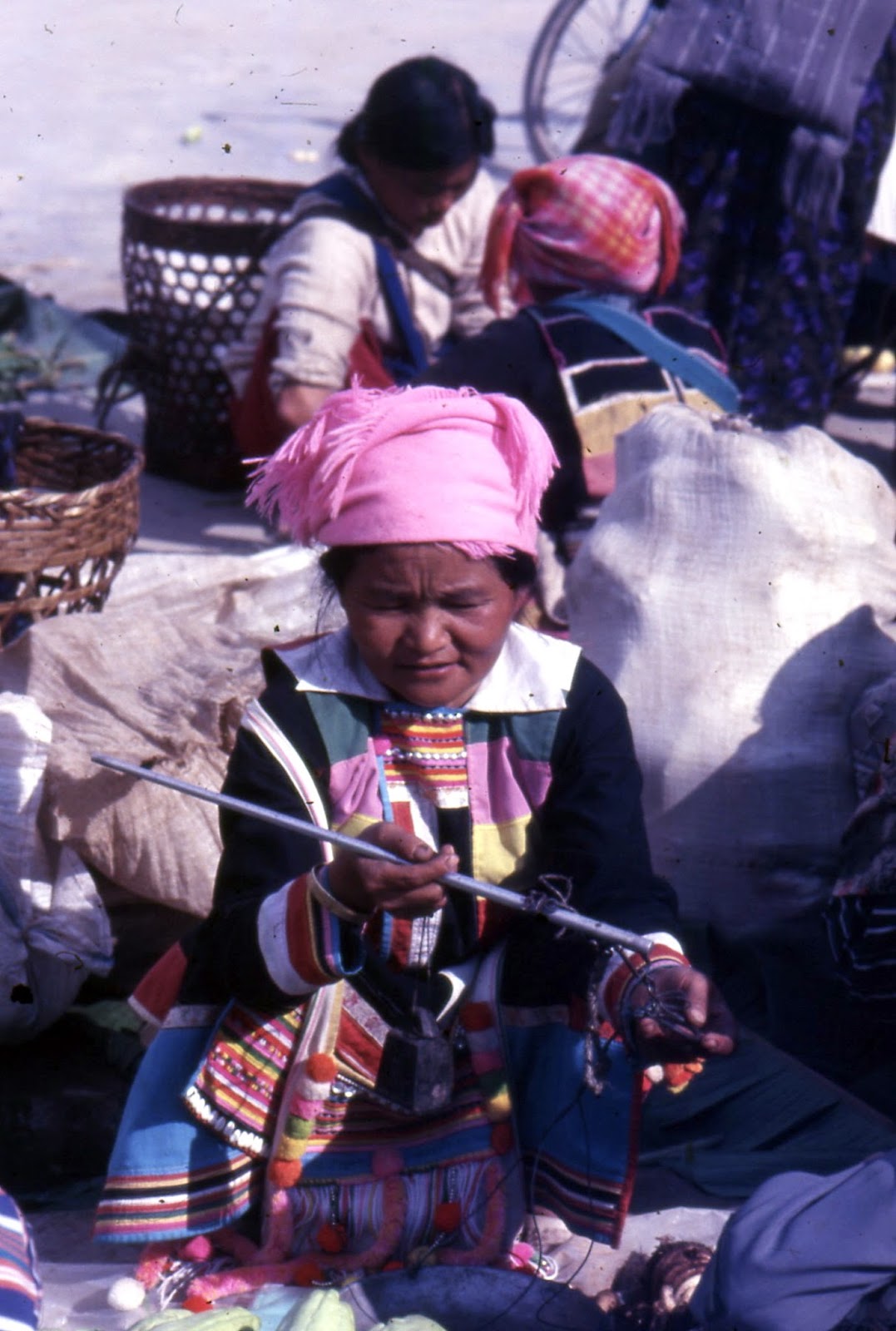
       Every five days Zhangfeng hosts open market day, attracting people from both sides of the border.  Besides the Dai, Jingpo and Lisu from the mountains to the northeast show up, hawking hill crops, deerskins, split-bamboo baskets and other items.  A few De’ang women may also turn up, recognizable by their bright, multi-colored jackets and headscarves, woolen tassel earrings, striped sarong and perhaps, like some Jingpo women, rattan rings around the hips.
rural Dai temple, Longchuan County
       From the Mon-Khmer linguistic group, the De’ang population is only half that of the Achang,.  A few scattered De’ang villages lie in the hills near the Myanmar border, but most of Dehong’s De’ang live in Santaishan district, especially in the hills south of the main road om the way up to the Buddhist cave temple at Sanjiaoyan.  They live in stilted wooden and bamboo houses with thatched roofs and, like their Dai neighbors, practice Theravada Buddhism.
       The last of western Dehong’s cities is Ruili, 37 km south of Zhangfeng, the largest of the four.  From the 8th-12th centuries it was the capital of Mengmao, the most powerful  kingdom in the immediate region.  The Mongols conquered it in the 13th century and the Ming Dynasty reasserted Chinese suzerainty in the 14th century.  It retained a measure of local autonomy until the 20th century and in recent decades has become important because of its commercial ties to neighboring Myanmar.
Dai women cycling home from the fields west of Ruili
       Ruili has all the hallmarks of a prosperous border town, with skyscrapers and expensive hotels towering above the rows of royal palm trees on the main streets.  It rises late, with few shops open before 10 a.m., and stays active late, with most people having dinner after dark and the warren of shops and stalls inside and outside the covered central market busy until midnight.  Many Burmese wander through town, including individual jade merchants hawking ornaments to Chinese tourists who came to Ruili specifically to buy jade.
       The other Ruili feature drawing Chinese tourists two decades ago was its proximity to the Myanmar border.  They could take a short trip from Ruili to Jiehao, step across the border to the other side and be able to say they’d been to a foreign country, even if but a few hours.  The main road, Highway 320, ran another 34 km southwest from Ruili to Nongdao, at the extreme end of the prefecture.
       The road ran more or less parallel to the Ruili River, a branch of the Nu River that, after crossing the boundary, becomes the Salween River.  The road runs in a straight line, but the river is somewhat winding, so that pieces of Myanmar territory lie between the river and the boundary line.  And at Jiehao, a chunk of Chinese territory lies south of the river.
the Snake Tree near Mengling
       The land is relatively flat on this route, featuring a succession of Dai towns, villages and farmlands, a rural relief after the bustle of Ruili.  Every Dai village has a temple, usually a modest wooden one, but occasionally grander, with multi-tiered pagodas in the Burmese style, flanked by tall bamboo poles with long, narrow cloth banners fluttering from the top and great banyan trees in the courtyards.  Hansha Temple, a few km from Ruili, and Leizhuangxiang, on a hill north of the highway and further down towards Nongdao, are two fine examples.
       The most famous is Dadenghan Temple, 20 km southwest of Ruili, near Jiexiang.  On stilts, with red wooden walls and silver-colored roofs and pagoda spires, with a covered entrance corridor, it is typical of the Dehong Dai Buddhist style.  It was built in the 18th century and is supposed to house bone relics of the Buddha.  According to local legend, the Buddha stopped for a night here on his mission to preach the religion throughout Asia.
Jiele Pagoda, Dehong's finest
       East of Ruili, Highway 320 runs 25 km to Wanding, the last major town before the boundary of Luxi County.  It’s not much to look at today, but from the hill behind it, especially from the Thousand Buddhas Temple on top, one has a commanding view of the city and Myanmar beyond the bridge.  Wanding had a brief flare of importance in the Second World War as the terminus of the Burma Road, established after the Japanese seized eastern China and the government removed to Chongqing.  Tons of supplies, food and weaponry crossed into Yunnan from the British colony of Burma, until the Japanese conquered Burma and closed the road.
       Returning to Ruili, I made two last stops at Mengling and Jiele.  The former town hosts a patch of old banyan trees, with multiple roots descending from their lower branches.  One is called the Snake Tree, similar to the Single Tree That Makes a Forest in another park in SE Yingjiang County, as well as the one of the same name in Daluo, Xishuangbanna. 
       Jiele’s attraction is its pagoda, the finest in Dehong, originally erected in 1500 and restored ten times since, most recently in the 1980s.  The central spire, rising above several subsidiary golden spires, stands on a white base with the top part covered in dark orange tiles, unique in the prefecture.  With views of Dai farmers riding their buffaloes on the way back to Ruili, it was a fitting way to close my exploration of Dehong, a day of history, culture and everyday rural Dai life.

Dadenghan Monastery
                                                                         ° ° °    


Saturday, May 7, 2016

At the End of the Burma Road: the Dai of Dehong


                                                     by Jim Goodman

Welcome to Dehong
       A few months after the outbreak of the Sino-Japanese War in 1937 the Japanese Army had succeeded in occupying eastern China, forced the Nationalist government to relocate to Chongqing and began blockading all goods shipments to western China.  The government response was to quickly begin building a new road over the ancient Southwest Silk Road from Kunming to Burma, then still a British colony, to facilitate the supply of essentials and war equipment.  Hundreds of conscripted laborers lost their lives to landslides and accidents as the route crossed many mountains and rivers on its way to the terminus at the newly established border town of Wanding, in sw Dehong prefecture.
       So long as the British held Burma, every day a mass of vehicles coming up from Bhamo and Lashio crossed the bridge into Wanding bringing tons of supplies.  After the Japanese conquered northern Burma they closed the entry points into Yunnan and the Allied supply efforts shifted to delivery by air.  Traffic on the Burma Road didn’t reach the level of the first few years of its existence until the 1990s.  And it was still a two-lane, cobblestone road hosting every kind of local traffic—private cars, public buses, big, slow logging trucks, tractor-trailers and pony carts.    
Mangshi's mascots
       A new four-lane super highway opened in the 21st century that ran roughly along the same route, but tunneled through the mountains instead, reducing the travel time from Kunming by over half.  Wanding was still a border crossing, but the highway stretched all the way to Ruili, a city that became a more important border post as trade with Myanmar dramatically increased.  But for non-business travelers just coming for a look at Dehong, the usual first stop is Luxi, the prefecture capital and largest city.
       Luxi is the Chinese name for the city and it means ‘west of the Nu (River).’  People in this part of Yunnan pronounce an initial n as l, which is why it is Luxi and not Nuxi.  The Dai name for it is Mangshi.   The modern city of Luxi was built on the western side of Mangshi, historically an important Dai administrative center, with authority over the plains and hills to the north and south.  The northern and eastern quarters of the city are still Dai neighborhoods and all the temples and pagodas lie east of the main business avenue.
       The city is the capital of a Dai and Jingpo Autonomous Prefecture, though, and so ethnic motifs influence the new city as well.  Many new buildings have Dai-style peaked roofs and Youyilu, the lane running from the main business street to the government guest house, features shop houses in individual Dai style, in various pastel colors.  The guest house itself is in a tasteful Dai style, in a quiet park near the Mangshi River. At the northern entrance to the city, on a tall, red pyramidal pedestal stand the golden sculptures of the Dai mascot peacocks.  One is crouching, the other raising its elongated neck into the sky; an unusual depiction for Dehong.
Mangshi's Dai quarters
       To publicize the multi-ethnic character of Dehong, the city removed its central market and built a park that features large stone statues of the men and women of the nationalities that reside in Dehong:  Dai, Jingpo, Achang, De’ang, Lisu and Han.  In the city’s southwest quarter is the Nationalities Park, with a garden, small zoo, a set of Jingpo painted Munao poles and a Dai village exhibition.  A few traditional Dai bamboo and thatch houses stand around a small pagoda and well and a staff of young men and women periodically practice or perform dances here.
shops on Youyilu
       Like their counterparts across the Myanmar border, the Dai in Dehong are Theravada Buddhists.  The oldest Buddhist monument in the city is Shubaota, the Tree-Wrapped Pagoda, in the compound of the No.1 Primary School in the southwest part of the old town.  Built in the mid-17th century, one of Dehong’s trees took root on the pagoda itself and over the centuries part of its trunk crawled over the surface of the monument, today almost completely covering it.
       Mangshi’s three historic temples lie northeast of Shubaota.  Puti Temple, on Guangnanlu, built in the late 17th century, is a red, wooden, wide, elevated structure with roofs of corrugated iron.  The entrance is circular, a feature common in Dehong temples.  Putisi is the most popular temple for local Dai Buddhists.  But just 150 meters down a side road the three-story, wooden Wu-in Temple, nearly as old, with tiled roofs, sits in a more attractive setting.  Towering tees flank the temple and an enshrined well lies in one corner of the large courtyard.  Within the temple the main image is of a crowned Buddha, in the style of a chakravartin (Universal Ruler).
dance rehearsal in Nationalities Park
the Tree-Wrapped Pagoda
       The third old temple in the vicinity is Foguangsi--Light of the Buddha Temple.  Erected in the 19th century, it looks a bit different, in a style closer to Han temples, with ornately carved struts and roof awnings.  This temple seems to attract Han devotees more than Dai, which is even truer of the new Guan Yin Temple in the city center, built recently at the turn of the century.
Puyi Temple
       The Dai in Dehong call themselves Dai Luang, or Dai Yai in their own language, the same appellation applied to their ethnic cousins in Myanmar and northwest Thailand.  To outsiders they are also known as Dai Neua and Dai Mao and more recently as Chinese Shans, closely related to the Shans across the border in Myanmar. They had an independent set of small states until the Ming Dynasty, becoming officially part of China in the 15th century, though remaining relatively autonomous under their own saopha rulers until the inauguration of New China in 1949.
       Dai sub-groups also live in other parts of Yunnan and those in the southern parts of Lincang and Pu’er Prefectures also call themselves Dai Neua, except in Menglian, home of the Dai Lem, and in Xishuangbanna, another Dai Autonomous Prefecture, who are mostly the Dai Lu, also Theravada Buddhist.  But the Dai dialects in Banna and Dehong are quite different, such that except for small talk, they are mutually unintelligible.  In fact, even the alphabets are different.
        Dehong Dai villages lie near streams, averaging 40-50 houses and one temple compound, with clumps of bamboo on their edges, but also magnificent peepul, banyan and other long-limbed shade trees.  Villagers take their rest breaks beneath their spreading branches.  Their houses sit on the ground and are made of drab-brown brick with tile roofs, sometimes enclosed by a walled compound.  Auxiliary buildings, and even the main houses of the less affluent, have walls of plaited bamboo and tin or thatched roofs.
Wu-in Temple
       Wells are housed in consecrated shrines, as in other Buddhist Dai areas, and the women carry water in buckets suspended at each end of a pole.  They use the same method to convey crops from the fields or goods from the markets, with woven baskets of split bamboo instead of buckets.
       Men dress like the Han, but are often shirtless in the fields.  Many tattoo their arms and chests.  In former times they completely tattooed their thighs as well.  Women wear the Dai sarong, usually black, with a long-sleeved, pale-colored, side-fastened jacket.  On special occasions they don a jacket of gold silk.  Girls and single women wear their hair loose, but married women tie their hair in a topknot and wrap it in a black silk, tubular turban or one of terry cloth in pastel colors.  Younger women may wear brighter colors and, like their counterparts across the border, apply thanaka powder, made from the soft outer bark of the tree of the same name, to their faces as a sunscreen and skin conditioner.  Some young women wear it all the time, streaking the edges of it at the cheekbones, giving a feline accent to their facial appearance.
Chakravartin Buddha
married Dai women
       The Dai are skillful farmers, blessed with good fertility, reliant and abundant rainfall every year.  They easily obtain two crops a year from their fields, in some places three, thanks to irrigation canals running alongside the fields.  The rice from the Zhefang area, about 40 km southwest, has a national reputation and used to be part of the tribute sent to the imperial court in Beijing.  The pineapples are the best tasting and most nutritious in the province.  Dai cuisine is similar to that in Banna, with the various dishes prepared in the restaurants in the morning and, when appropriate, reheated before being served.  Baked and sour foods are popular, spiced with chili, coriander, lemon grass, etc.
young Dai women in Mangshi
      Dehong was one of the first areas in Yunnan open to foreigners, but rarely received any, as most tourists preferred Dali and Lijiang and anyway, the road to Dehong was a long and rough ride in the 90s.  It seemed only people so fascinated with Yunnan that they wanted to see all of it, like myself, bothered to take the trouble.  In the trips I made there towards the end of the decade and beyond I never saw another foreigner.  I’m sure others came at other times and probably enjoyed it just as much, for Mangshi people seemed well prepared to make the foreign visitor’s stay a very pleasant one.
       Everyone everywhere was polite, smiling when greeting me, whether in a shop or a park.  At the Nationalities Park I arrived during a dance rehearsal and one of the staff members rushed a chair for me to sit and served me a cup of hot tea to enjoy while I observed the action.  When U visited temples the monks insisted I share tea and cigarettes.  If a ritual happened to take place when I was there, the devotees invited me to join them for a vegetarian picnic afterwards.  When I ate in Dai restaurants the owners brought me samples of other dishes than what I ordered, just to try.  Inevitably, of course, I wound up asking for a plate of one of these samples, either then or at the next meal.
traditional-style Dai village house
       Dehong Dai have tenaciously clung to their ethnic identity, even after government-sponsored Han immigration into the area in the 1950s, the depredations of the Cultural Revolution and the influence of rapid modernization in recent decades.  The preference among the women for traditional clothing, among all Dai for Dai-style cuisine, the maintenance of old customs and respectful social intercourse, the use of the Dai language at home and in the markets, as well as the continuation of religious practices all reflect this.
       The temples are most active on the 8th, 15th and 23rd days of the lunar month and especially at the annual festivals.  These include the Water-Sprinkling Festival in mid-April and activities associated with the opening and conclusion of the three-month Buddhist retreat season during the monsoon.  At any time of the year they may also be the venue for a poi, a local festival occurring at the dedication of a new image or the renovation of a temple.  In the past local rich patrons sponsored such events, partly for religion, partly for prestige.  Nowadays they are generally village communal affairs, everyone tithed for the costs.
ritual to the Land Spirit at Mukang village
       Buddhism came to Dehong only in the 17th century.  Some of the original animist beliefs are inevitably still part of local religious mentality.  This became apparent to me on a visit to Mukang, a Dai village 9 km north of Mangshi.  I arrived on a Buddhist holy day and peered through the round entrance while the congregation, divided by sex, recited sutras and kowtowed to the Buddha image.  Afterwards the women moved to the courtyard, carrying little bottles of water and rice liquor, crouched in ranks with their backs to the temple, and prayed while periodically pouring libations of water and rice liquor onto the ground to honor the Land Spirit.
       Dai culture in Dehong did not remain impervious to Han influence.  Weddings nowadays, with the bridal headdress, red candles and procession, are hardly distinguishable from Han weddings.  The Dai bury their dead, unlike most Buddhist Dai, who cremate the body.  Unlike other Dai, they have an opera tradition, too, like the Han, but though the singing style is similar, the Dai version eschews the elaborate make-up and the costumes are classic Dai style.  Yet in most other aspects the Dai continue to follow the cultural norms established centuries ago.  This includes mutual respect between the sexes, abstention from loud, boisterous, rude or impolite behavior and, good news for travelers, a warm and hospitable reception for guests.

rural landscape outside Mangshi
                                                                    * * *