Showing posts with label Wat Mae It. Show all posts

Thursday, January 28, 2021

Chiang Dao—the City of Stars


                                   by Jim Goodman


      Doi Chiang  Dao, Thailand’s third tallest mountain at 2225 meters, stands on a broad plain, overlooking a rolling, forested landscape, a few km from the town named after it.  Originally called Doi Piang Dao (“mountain at the level of the stars”), the town beside it became known as Chiang Dao (“the city of stars”) and the mountain became more commonly referred to by the same name.  About 80 km north of Chiang Mai, it is popular day excursion, primarily for the caves within the mountain, sometimes including a stop on the way at an elephant riding camp.

       The entrance to the caves lies near the foot of the mountain, with two passage ways inside.  The upper one runs about 200 meters, is illuminated and contains, besides the usual stalagmites and stalactites, a number of Buddhist shrines.  The lower passage way is 750 meters long, full of twists and turns, rugged and narrow, no shrines and no overhead lights.  Taking this route requires a guide and lamps.  Even with a powerful flashlight, the novice is unlikely to know which turn leads on to something attractive and which runs into a dead end wall of rock.

       The shorter upper cave is easily negotiable with enough illumination, and not overly bright, to see everything clearly and maintain the atmosphere.  The stalactites are usually walls of rock with vertical fluted indentations hanging down from the ceiling, some with very jagged pointed ends.  The stalagmites are less numerous, some in breast-shaped mounds lining a ledge, others resembling human heads.  None of the rock formations are particularly arresting, but they provide a nice backdrop to the shrines.

       The biggest one is not far from the entrance, featuring large seated Buddhas in a niche in the cave wall.  Further on are other seated Buddhas, big and small, in rows on ledges and a reclining Buddha in a space between two boulders.  Perhaps the most interesting image, towards the end of the upper trail and next to a large seated crowned Buddha, is of a bewhiskered, crowned figure, shirtless and wearing pants and what looks like royal jewelry, standing within the coils of a seven-headed naga (mythical serpent).

       Buddhist imagery also graces the area in front of the cave entrance.  Stone chedis stand along the shore of a clear and clean, turquoise-colored pond.   Small Buddha images sit in niches in the cliff behind, while a small chedi rests on a dragon-headed boat in the water next to the path.  To the right of the pond a regal gilded Buddha sits on the coils of a naga, while all around it are similarly sculpted Buddhas, all in white.  Another chedi tops a nearby mound.

       The settlement beside the cave is a typical northern village with mostly stilted houses, whose residents work as guides in the caves or up the mountain.  Some of the women are involved in basketry.  Several quiet guest houses also exist in the vicinity, as well as in the town.  While a visit to the cave will not take much time, some visitors come for a longer stay, for the town and district offer other attractions.

       Around three hundred species of tropical birds fly around the area.  Bird watchers can spot some of them on early morning hikes around the base of Doi Chiang Dao and lots more by trekking to the summit.  This requires a local guide, for the mountain is a national park, heavily forested and the trail is not so easily evident to one who’s never taken it.  It’s 7.5 kilometers to the top and the journey up and back normally takes about eight hours.  While it can be accomplished in a day, most hikers arrange to stay the night camping at the summit, in order to appreciate the night stars and the splendid, panoramic view of the sunrise.  And the tropical birds will be more active as the hikers then make their way through the trees down to the mountain’s base.

       A less taxing excursion is a visit to Wat Tham Pha Plong, two km north of the cave.  The temple is on top of a small hill, surrounded by the jungle, accessible by a staircase of 500 steps.  For nature lovers, continuing north in the district are more venues.  The Pha Daeng National Park extends over a thousand square kilometers, a landscape of rolling valleys and forested mountains and isolated clearings with villages of the Karen and Lisu minorities.

       Besides the birds and the scenery, the park contains other attractions like the Pong Arn hot springs, which offers tubs for visitors wishing to soak in the therapeutic waters.  Closer to the northern border with Myanmar is the Sri Songwan Waterfall, tumbling off a high cliff.  Like Doi Chiang Dao, the mountains in the park are part of the Darn Lao Range, running north on the east side of the Salween River through northeast Myanmar up to Yunnan.  Doi Angkhang, west of Fang and Thailand’s second highest peak, is also part of this range.  Doi Thoai, west of Sri Songwan, is the source of the Ping River, which flows past Chiang Mai.

       From the cave a road runs a few km directly to the market area on the northeast side of the city.  Next to the road just a couple blocks before the market is Chiang Dao’s most unusual temple—Wat Mae It.  It has the usual compound elements of assembly hall, monks’ quarters and ordination hall and a large image of Upakhu, a famous 3rd century Indian monk.  Its broad courtyard, though, features displays of the tortures of the Buddhist Hell. 

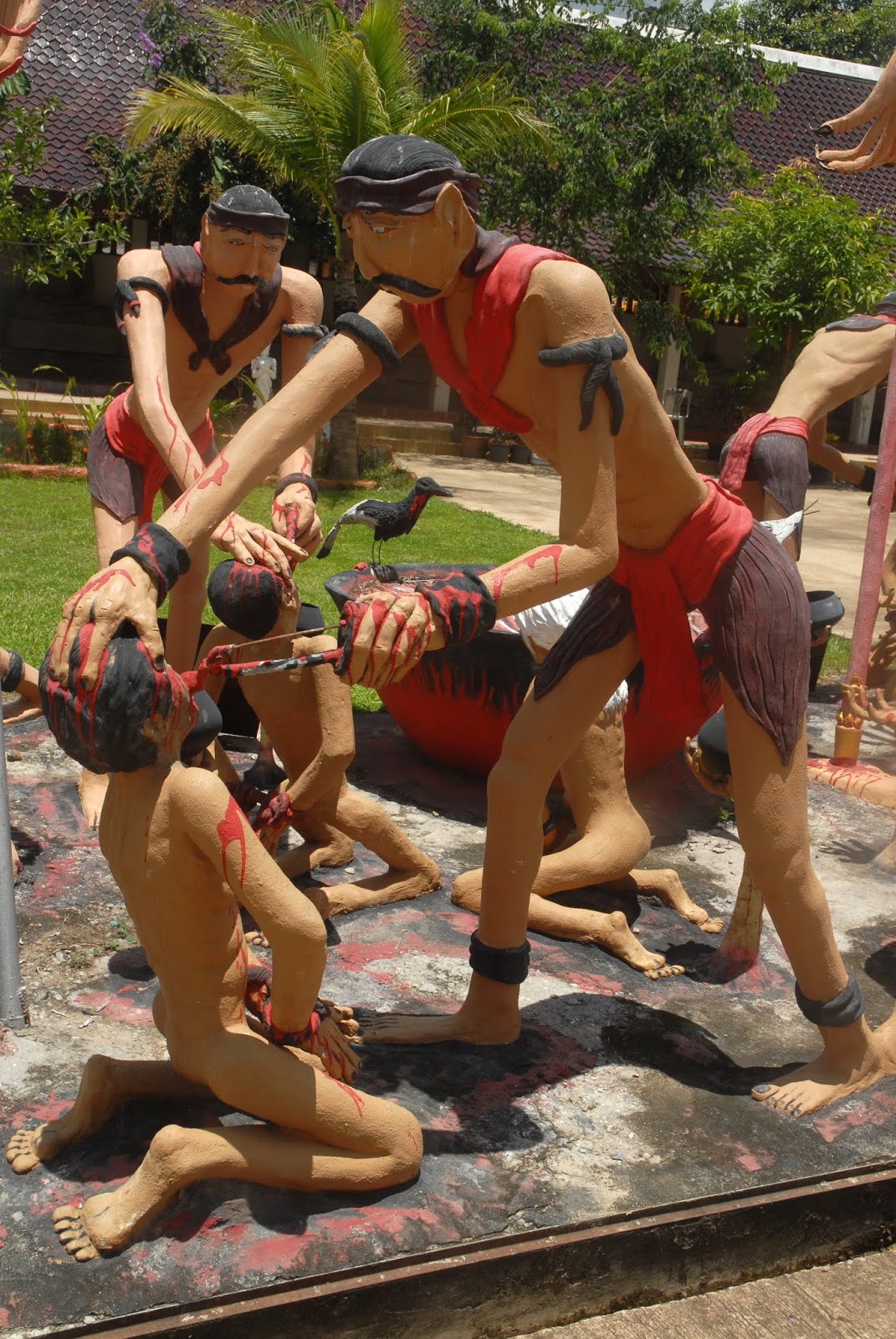
       Figures with abnormally stretched arms, torsos and legs stand in a line taller than the viharn.  Below them Hell’s demons exercise various forms of torture on sinners both male and female.  The demons saw bodies down the middle, slice open heads, rip out tongues, mutilate genitals, force naked bodies up thorn trees and other nefarious maneuvers. 

       According to the Buddhist doctrine the sinners will experience excruciating pain but not die.  The inflicted wounds will heal and then be reopened.  The torture will last x number of years and then the victims will be reborn for another round of life on earth.  The “Temple of Hell” concept is not unique to Chiang Dao, for several exist in other parts of Thailand, including a bigger, more elaborate one at Wat Mae Ket Noi near Mae Jo, not far from Chiang Mai.  The idea is to scare believers into being good by graphic exhibits of what happens to those who are bad.


   There’s not much else of interest in the town itself, with a population of about 15,000 and no relics from its establishment in the time of the Kingdom of Lanna.  The one major and colorful exception is the weekly Tuesday morning market, for it draws not only Thais from all over the district but also some of the hill tribes, as the ethnic minorities are called.  Stalls and stands start setting up from 6 a.m., while other sellers simply lay out their goods on the ground next to the main street.  Further back from the road more stalls occupy a big field that is otherwise empty every other day.  Goods on sale range from basic consumer items like shoes, clothing, sunglasses, tools and small appliances to every kind of agricultural product, plus various food stands offering snacks, drinks or noodle meals.

       A few Hmong women show up, probably coming from the Chiang Mai area, managing stalls selling Hmong jewelry, clothing and accessories.  They can be recognized by their pleated batik skirts and their hair tied in a bun.  Much more numerous are the Lisu and Palong, both of whom have several settlements in the district.  The Lisu have been here much longer, in some cases over a hundred years, while the Palong began arriving only in the early 1980s, escaping the ethnic insurgencies raging in Myanmar at the time.

       The Lisu are the fifth largest ethnic minority in the country, after the Karen, Hmong, Lahu and Akha, living mainly in the northern border provinces of Chiang Rai, Chiang Mai and Mae Hong Son.  Their language belongs to the Yi sub-group of the Tibeto-Burman linguistic family, related to Yi, Akha and Lahu.  Wooden houses, and more recently concrete ones, characterize the settlements, usually sited on the higher and steeper slopes of the hills.  As a result they were relatively isolated from life in the plains. 

       In the late 20th century their forested habitat became a target of the logging industry, which began cutting down most of the forests throughout Thailand, not just the north.  To save what remained, the government banned logging and turned several northern areas into national parks, where cutting trees and hunting were outlawed and ‘encroachers’ evicted.  Despite the fact the rate of deforestation was much lower in the north than the rest of Thailand, thanks to the hill tribes’ traditional skills of land management, the government continued to see them as a threat to conservation and periodically has launched campaigns to evict them.  Just seven years ago, for example, authorities demolished the century-old village of Laowo and forced the removal of its people.  Fortunately, things have simmered down since then.

       By now most villages have switched from growing rice in plots rotated by the slash-and-burn method to cash crops—vegetables, tea, coffee—in fixed fields.  While their material life has thus altered considerably, the Lisu still hold on to their other customs, like the traditional clothing.  Even the men often prefer to wear the Lisu trousers, loose and wide to the knees and tight around the calves, usually brown or blue, both at home and when visiting the towns. 

       The women dress much more colorfully.  Traditionally, over plain black trousers they donned a long-sleeved, side-fastened jacket in bright colors, slit on the sides and front and back panels reaching to the knees, with thin bands of appliqué around the shoulders and neck.  A couple decades ago the favored colors were red, blue and green.  But nowadays the apparent uniformity has given way to different colors on the sleeves and front fastening flap and even cut differently.  Nevertheless, the current style is still authentically Lisu and definitely stands out in the crowds.  No one else wears anything similar.

       The other minority attending market day, more numerous than the Lisu, is the Palong.  Being relatively recent residents, the Palong are not Thai citizens and are restricted from traveling outside their district.  A few may turn up in Chiang Mai, like for Shan festivals, as the Palong are also Buddhist.  Government publications do not even list the Palong as one of Thailand’s minorities, though with a population around 5000 they are larger than registered minorities like the Khamu, Htin and Mlabri.  Chiang Mai’s Hill Tribe Museum does not include any exhibit or mention of them, though they are invited to set up a booth when the museum hosts a fair or special exhibition.

       Thailand’s Palong came from Myanmar.  The Palong also live in southwestern Yunnan, China, where they are known as the De’ang.  Their language belongs to the Mon-Khmer linguistic family and is related to Wa and Bulang.  Like the latter, and some of the Wa, they are Theravada Buddhists, following the same religious calendar and activities as their Shan and Thai neighbors.  In a typical Palong village their homes are stilted houses of wooden poles and beams, split bamboo walls and balcony and thatched roofs.

       Besides rice and vegetables, the Palong also grow cotton, which the women spin and weave to make their clothing components, using a simple back-strap loom fixed to a pole underneath the house floor.  The basic women’s outfit is an ankle-length red tube skirt worn with a long-sleeved jacket.  The jacket color is black or blue, with a wide strip of red running vertically down the front.  A narrow strip of cloth, studded with small silver disks, surrounds each upper arm sleeve, with coins, bead strings or long tassels suspended from the lower edge.

       The red skirt has very thin horizontal stripes of blue, white or gray and folds in front at the waist.  Lacquered black rattan rings wrap around the waist to secure it.  Instead of rattan rings, or in addition to it, Palong women may wear a thick silver belt, about 5 cm wide.  The only other kind of ornamentation will be small earrings and silver bangles.

       Since the warfare over the border has much subsided, hill tribes crossing into Thailand to flee the violence has also sharply reduced.  As a result the Palong (Lisu as well) are under less government pressure and their lives have become more stable and secure, even while still officially ‘stateless’.  Their weaving skills have aroused the interest of tour agencies, who have been arranging groups to visit Palong villages set up to showcase their weaving, providing an extra income for the villagers.  Meanwhile, for foreign and domestic visitors, every Tuesday morning the Palong, like the Hmong and Lisu, are the stars of Chiang Dao.


      * * *                  


Tuesday, May 22, 2018

Wat Mae Kaet Noi—the Temple of Hell


                                   by Jim Goodman

sinners boiled in oil at Wat Mae Kaet Noi's Hell Garden
       Generally speaking, to visit a Buddhist temple compound in Thailand is to enter a zone of peace and piety.  Serenity reigns, from the expressions on the faces of the statues to the reverential attitude of the devotees.  Fierce warriors and lions stand at the compound gates and fanged, serpent-like nagas and lizard-like moms line the stairways to the temple buildings, but they are there to scare away evil spirits, not the worshipers.  Elsewhere the imagery, whether in sculptures or paintings, is all religious, designed to enhance an atmosphere of contemplation on Buddhist precepts and how to live a good life.
the Hell Garden at Wat Mae It, Chiang Dao
       The statues of Buddha, other deities, and revered monks serve to remind the people of exemplars of the holy life.  Paintings on the wall may depict famous scenes from the life of the Buddha, portraits of Heaven and its denizens, religious activities on Earth, festivals, seasonal work, handicraft production, daily chores and other village vignettes of olden times.  Together they reinforce the concept that the Buddhist religion is closely intertwined with ordinary human affairs.  In such surroundings the good Buddhist will renew vows to follow the Buddhist ethical code, exhibit compassion for all beings and make merit.
       What is usually missing from temple imagery is any representation of the consequences of not following the Buddhist ethical code.  This is the or else! side of  Buddhist teachings.  In this case it is Naraka, an underworld Hell where sinners undergo eons of gruesome punishments.  The Buddha himself gave sermons to his followers describing Naraka in detail.  Occasionally a temple wall mural will contain a scene of such suffering, but in general, the tortures of the damned is not a theme emphasized in the upbringing of children in Thai Buddhist families.
the punishment of liars, Wat Mae It
Phaya Yom, the God of Death
       Some monks think it should, though.  Among them was Phra Kru Vishanjalikon (the name means Clean Teacher Monk), abbot at Wat Mae Kaet Noi, three km east of Mae Jo, a half hour drive from the center of Chiang Mai.  About 28 years ago he had a troubling lucid dream of being in a desolate, scorching hot, pitch-black city.  A big red demon approached him and told him to go back to Earth and create a city like this for the edification of the people.
the classroom hall at Wat Mae Kaet Noi
       For the next twenty years the monk spent much of his time designing the city of his nightmares, raising funds (not very easy), hiring and directing sculptors and conceiving the horrific imagery that fills the area.  It opened as a separate park in the compound about eight years ago.  From then on Wat Mae Kaet Noi had a new nickname—Temple of Hell.
       It is not the only such temple compound in Thailand, for there are about twenty others scattered throughout the country.  It’s not the only one in the area, either, for another is Wat Mae It in Chiang Dao, on the edge of the town beside the road from the central market to the cave.  Instead of a Buddha, the big image in the courtyard, of a monk wearing a floppy hat and dipping his hand into a boil, is a rendition of Upakhu, the Thai name for Upagupta.  He was religious tutor to Emperor Ashoka in the 3rd century BCE, the ruler who patronized the spread of the Dharma (as Buddhism was called then) through most of the Indian sub-continent.
painting of a World War II bombing raid
       Wat Mae It’s Hell Garden is a long narrow area in front of the Upakhu statue, as if implying that the monk’s sermon is about Naraka.  Four stick figures, towering higher than the temple roofs behind them, stand in a line.  Below them demons work their punishments on the condemned sinners.  Adulterers are forced to climb a tree full of piercing thorns .  Demons skewer others on poles and pull the tongues out of liars.
       While it’s not very big, Wat Mae It’s Hell Garden is right inside the entrance to the compound.  The one at Wat Mae Kaet Noi is not so obvious, for it is off to the side.  Upon entry, the compound looks rather ordinary.  The viharn is in typical Thai style.  To its right is a long hall that serves as a classroom for children’s religious instruction.  Paintings decorate the walls, with scenes of life in pre-electricity years:  village parties, planting and harvesting, celebrating Loy Kratong, etc.  All the figures in the pictures wear traditional clothing and the settings and houses are all pre-modern.
demon raping a sinning woman
       On the back wall, though, are two paintings dealing with more recent times; namely, World War II.  They depict American B-24 Liberator planes dropping bombs on the northern Thailand countryside.  In 1942 Japanese forces were stationed in various places in northern Thailand, particularly Lampang and Chiang Mai, preparing their invasion of British Burma.  The painting scenes are not very accurate historically, for the bombing raids were closer to the cities, aiming at the railway stations and Japanese military camps in Haiya, south of Chiang Mai’s old city.  They did manage to disable the railway station, but also destroyed the viharn of Wat Srisuphan, which was next to the Japanese camp.    
cleaving a sinner's peis
       A little to the left of the viharn is the compound’s main feature—the Hell Garden.  Visitors insert a ten baht coin at the entry gate and proceed down a pathway.  On the left is the Heaven section and to the right lies the much larger Hell section.  Just inside the latter sits a sculpture of Phaya Yom (a.k.a. Yama), the God of Death and Lord of Naraka.  According to Buddhist belief, souls of the deceased must appear before Phaya Yom to be interrogated.  He already has a book recording the deeds on Earth of the interviewee.  He asks then whether they have broken any of the five main injunctions, if they are guilty of murder, stealing, sexual crimes, intoxication or lying.
intoxication punishment
demonic face in the Hell Garden
       For those who are guilty, Yama assigns the appropriate punishment.  In some cases it fits the crime.  Liars have their tongues ripped out.  Thieves get their hands amputated.  Sexual miscreants suffer mutilation of their genitals.  But there are obviously more sins punished than the five major transgressions Yama inquires about, for the Hell Garden exhibits include a host of victims skewered, crushed, ripped apart, boiled in a cauldron, shot or sawed in half. 
part of the abortion exhibit
       Those tortured don’t die, for souls are immortal.  They just feel continuous excruciating pain.  It won’t be forever, as in the Hell of Western religions, but not a whole lot less.  Depending on the sins, the ordeal can last from hundreds of thousands of years to hundreds of millions of years. 
       Besides the torture scenes, the Hell Garden also has a variety of ghouls and demons, male and female, some extremely tall, all extremely ugly and horrific.  Severed heads with their guts dangling below them hang from trees.  Sinners buried in the earth up to their waists scream through distorted faces and raise their arms in horror.  They often have weird cartoons painted on their chests.  Perhaps they have been cast into the hot Naraka, as opposed to the cold Naraka, and are screaming because of the heat.  Or they could be grotesque figures from Phra Kru Vishanjalikon’s lucid nightmare.
sinner trapped in the ground
the punishment for abortion
       The old Buddhist books describing Naraka reflect the ancient Indian propensity to exhaustive, minute classification of the various sections of both the hot Naraka and the cold Naraka on what punishments are inflicted at each section, for what sins and for what length of time.  Some of this information went into creating the exhibits, but other displays reflect the imagination of the garden’s creator, influenced by modern times.  Hence, we see giant demons in the robo-cop, wire-frame style and demons driving motorbikes with spiked wheels over the bodies of their victims.
students at their lesson
       One large section of the Hell Garden is devoted to abortion, considered a violation of the Buddhist concept of the sanctity of all life.  In addition to scenes of an abortion in progress, there are also sculptures of the distorted bodies of offending mothers and of transgressors skewered on a sharp pole.  Outside this section is a giant boiling cauldron with demons forcing sinners into it.  An enormous female demon with a grotesquely distorted body stands nearby, next to a display of demons sawing victims in half.  Visitors can drop a ten baht coin into one of the machines here and listen to the screaming of the victims or the ranting of the big female demon    
the punishment of wicked students
       Punishment for sexual crimes is a frequent theme.  As at Wat Mae It, adulterers are forced to climb up trees with big thorns that pierce t heir bodies.  Elsewhere, a group of smiling, seductive ladies rips apart a man’s genitals.  A demon thrusts a gigantic phallus into a terrified woman’s vagina.  A horrid, misshapen woman uses a knife to cleave a man’s outsized penis.  And another man agonizes as he drags around his preposterously sized penis and scrotum.
   The sin of intoxication is represented by a statue of a man with two heads.  One head is raised to drink from a bottle of spirits, while a syringe is plunged into his stomach.  The other head is vomiting.   Near it stands a statue of a grossly fat and ugly woman with a horrid, gaping mouth and protruding eyeballs.  Sin of vanity perhaps?   
Children Tree in the Heaven Garden
   Another unusual display is of a group of uniformed students listening to the lectures of a male and female in police uniforms.  Statues of benevolent gods stand in the vicinity.  Behind them, as if to remind the students of what happens if they don’t follow the rules they’re being taught, are several bloodied students hanging from meat hooks.
   Just past this classroom is the section of the Heaven Garden, dominated by statues of the Buddha, enlightened monks, other saints and deities and pious devotees.  After a walk through the much larger Hell Garden, it is almost anti-climactic.  There’s nothing horrific here.  A kneeling skeleton has its hands folded in prayer and the multi-headed figures with fierce faces are obviously guardians on the side of Heaven. 
   The one truly exotic exhibit in this garden is what might be called a Children Tree.  It rises several meters high, with big, serrated leaves resembling those of a banana tree.  Long, green, tendril-like vines hang down from various points on the trunk, with young boys and girls attached to the end, as if they were sprouting from the vines.  And inside one opening leaf is a newborn baby.  At the base of the tree are figures of fully dressed couples in traditional outfits, one pair dancing, one pair seated and exchanging food.
devotees in the Heaven Garden
   Clean Teacher Monk’s objective in constructing this elaborate Hell was to scare people, to instill in them a sense of shame regarding sinful deeds and a fear of their consequences.  It certainly makes an indelible impression on Thai visitors, who are already familiar with some of the dark themes of the place.  It may be just an imaginative version, but according to their religion, the garden is based on a Hell that is very real.
   It has already had one measurable effect.  Inspired by the abortion exhibit, some aborting women have left their dead fetuses beside one of the grosser statues in this section.  Rather than get rid of it on their own, as an act of repentance they deposit the fetus at Wat Mae Kaet Noi for a proper burial. 
preening in the Earth Garden
old-fashioned farmer types
   Although it is not high on the list of the Chiang Mai area’s tourist attractions, Wat Mae Kaet Noi has had a trickle of foreign visitors.  They do not particularly view the Hell Garden as a site for moral and religious instruction.  They are ore likely to see it as an excursion into Oriental creepiness.  But for Thai Buddhists, Hell Garden notwithstanding, Wat Mae Kaet Noi is still a Buddhist temple, and therefore a proper venue for celebrating birthdays, weddings and funerals.
couple smoking cheroots and a lounging, long-haired lady
   As if catering to this aspect of temple use, this year the wat opened a new exhibit on the opposite side of the compound from the Hell Garden.  This area features statues of ordinary rural Thai people, dressed in the same early 19th century attire as in the paintings on the interior walls of the adjacent classroom building.  A few are naked from the waist up—bare-breasted women and heavily tattooed men.  Others are engaged in daily chores.  There are statues of kick-boxers, dancers, a reclining woman with ankle-length hair, couples smoking Burmese cheroots, women preening with mirrors and monks meditating. 
    Surrounded by imagery of an idyllic earthly existence of a not-so-long-ago past, the Earth Garden here is probably a more appropriate spot for happy events like birthdays and weddings.   But perhaps a newlywed couple might take a stroll through the Hell Garden and see the adulterers impaled on the thorn tree and the tortures undergone for sexual crimes, intoxication or lying.  Or maybe parents will take their children on a walk through Hell for their birthday lesson on morality.  For the true believers, in terms of ethical influence, fear also works.

sleeping princess in the Heaven Garden
                                                                      * * *