Showing posts with label Dengchuan. Show all posts

Tuesday, October 4, 2016

Dali to Jianchuan: Other Lakes, Other Bai


                                               by Jim Goodman

kilns on the road above Dengchuan
       Of all the places inhabited by Yunnan’s Bai minority nationality, Dali draws by far the most attention.  An historic city itself, former capital of the ancient Kingdoms of Nanzhao and Dali,  it lies on a narrow, north-south plain, bound on the east by the 42 km-long Erhai Lake and on the west by the 19 peaks of the Azure Mountains.  Ancient pagodas and monuments, old temples, Bai-style architecture, traditional rural and lakeside villages and the superb scenery all entice one to extended exploration.  And travelers can easily observe traditional minority life just by wandering around in the Bai villages north of the old town.
West Lake, Eryuan County
       For most travelers, that’s about the only exposure they will have to Bai culture.  Their next stop north is Lijiang, via the new highway running NNE via Heqing.  A few may venture to Shaxi, in Jinachuan County, and take the old route to Lijiang directly north through Eryuan County.  But they will not stop at Eryuan city, for it is off the main road, and will dogleg south to Shaxi well before reaching Jianchuan city.  Thus, most of Eryuan and Jianchiuan Counties remains relatively unknown territory.
Bai villagers on the water at West Lake
       Admittedly, the scenery is not as spectacular, for none of the mountains to the west crest over 4000 meters, as a few near Dali do.   The lakes are smaller, mostly to the west of the road, and certainly not appropriate for the big tour boats that cruise on Erhai.  Because they are smaller, though, they are community lakes, used by the adjacent villages as fish sources.  With their fishing and farming, their market days and religious holidays, the Bai in these two counties practice a lifestyle every bit as traditional as the villages around Dali.
      The old route 214 north of Dali crosses into Eryuan County just before the northern tip of Erhai Lake.  The northernmost section of the lake, including Shuanglang on the other side and Shaping, the popular market day village, are part of this county.  Just beyond the lake the road dips into Dengchuan, known for the milk cows raised here.  Most of the milk goes to the Dengchuan Milk Powder Factory, which turns out a number of products, among them the popular snack called ‘cheese fan.’  Made from fermented milk, shaped like a fan about 18 cm long and 5 cm wide, dried and served crisp, it is sold on the streets of Dali and in the markets of Dengchuan, Eryuan and beyond.
Eryuan old quarter
       After crossing a stream in Dengchuan, the one running from West Lake to Erhai, the road rises again, passes a long line of kilns and moves into the countryside, flanking the Er River.  This river begins in the northwest part of the county (hence its name Eryuan—source of the Er) and is one of the main feeders of Erhai Lake.  A little further on is the town of Yousuo, where a dirt road to the left leads to West Lake, the first of the county’s three charming bodies of water.
       It’s about a 20-minute walk to the lake, across a flat plain of farms and villages, with mountains rising majestically behind.  The houses are in the Bai style common around Dali, likewise behind whitewashed walled compounds, and the women dress similarly.  West Lake village is on the northeast side of the lake and virtually every house has a small boat.  The lake is less than four square km and not very deep, averaging 1.5 meters.  Villagers paddle or pole themselves out onto the water to fish or to dip buckets to scoop up some of the lakebed mud to use as fertilizer for the fields.  They also gather water chestnuts and a kind of edible moss from the lake.
Eryuan Bai girl
       In recent years Dali entrepreneurs have set up West Lake as a day’s tourist excursion.  A ticket booth stands near the start of the village, with an entrance fee of 120 yuan.  But those not interested in a short boat ride, Dali Bai dance show or buying Dali handicrafts from the little market inside can walk past the ticket booth and stroll into the village instead.
       All the lanes seem to end in a lakeside house or go back out to the fields, though.  There doesn’t seem to be a way to circumambulate the lake on any kind of fixed path.  That could change, however, as a result of ‘tourism development.’
       Further up Route 214, but several kilometers off to the west, is Eryuan city, 73 km north of Dali, the biggest in the county, originally known as Jade Lake.  It lies in a partly secluded valley, hardly visible from the turn-off, backed by high mountains, with villages on all sides.  Though slightly higher and further north than Dali, it has a milder climate because the surrounding mountains shield Eryuan Valley from the cold winds coming down from the Azure Mountains.  Two decades ago traditional houses dominated, especially in the western part, where the weekly market day took place.  It has modernized quite a lot since then, but the villages are still mostly unaffected. 
Eryuan market day
       Bai women dress much the same as in Dali, with a side-fastened vest over a long-sleeved blouse, trousers, apron and bonnet.  The younger women don a different headdress, though, with an embroidered band across the front and pompoms tied to the top.  They also tend not to dress in white like the Dali girls, but wear red or green vests and dark aprons and trousers. 
       Besides the mountains, Eryuan’s main physical attraction is the small lake about two kilometers past the city’s northern suburbs.  About six km long and averaging two km in width and eleven meters in depth, its jade-green waters supposedly originated with a legendary visit by the Emperor Jianwen in the Ming Dynasty.  He was out on the lake in his boat, enjoying the mountain scenery all around, but disappointed in the muddy color of the lake’s water. 
Cibi Lake
       Then he heard the moving song of a Bai woman in her fishing boat.  Catching up to her in his own vessel, he asked her to sing again.  Equally affected by this second song, he decided to give her a souvenir of the occasion and removed a jade ornament from his fan.  But when he reached over to hand it to her he dropped it into the lake.  The waters suddenly frothed up and spewed and then settled, leaving the lake a clear, jade-green color.  It became known as Jade Lake or Green Lake afterwards.
       Nowadays it’s called Cibi Lake, after the cibi flower, a local species related to the water lily that grows in the shallower parts of the lake.  In the summer months it blooms and the white blossoms mottle the lake surface.  At other seasons other flowers lie in the offshore water.  A restaurant stands on the shore nearest the villages, but tour boats are rare, only local fishermen row out on the lake.  The shallowest part has been bordered by nets and turned into a fishpond.  A road runs around the perimeter of the lake, but it takes several hours to walk it.  
Haixihai Reservoir, Eryuan County
       Buge Mountain rises sharply to the west of Cibi Lake.  At the Longwang Temple at its base the Eryuan Bai celebrate a festival on the 23rd day of the 6th lunar month, the day before the Torch Festival in Dali.  They don’t celebrate that event themselves, but may visit Dali during its Third Month Fair and Shaping for the Mid-Autumn Festival.  The Bai in Eryuan have their own specific festivals, like the Farm Tool Fair the 15th day of the 2nd lunar month, as well as Yinyinwu, in Fengyu village the 5th day of the 1st lunar month.
       Yinyinwu is a festival designed to strengthen relationships between children and their elders.   Because this is a magical day, the older generation pays special attention to what the children say, for it might have some hidden significance.  Groups of children march around to the houses and the elders welcome them with firecrackers and send them off with gifts.
new Bai houses in Jianchuan
       Returning to Route 214, the road north continues along the same kind of landscape, with scattered villages in low, rolling hills, with higher mountains to the west than to the east.  In Niujie district, the last in the county, west of the road lies the picturesque Haixihai Reservoir.  A little larger than West Lake, it sprawls next to a gently rising hill, with a traditional village on its east bank.  Reservoirs are artificial creations, of course, but at least here the engineers picked a pretty location. 
       From here the road ascends into the hills again, enters Jianchuan County and then winds down to the town of Diannan and the Heihui River.  At a junction just past the town, one road follows the Heihui south to Shaxi, while the main route 214 branches north to Jianchuan.  This valley, the last major Bai population center along the route north of Dali, is at 2200 meters altitude, about 200 meters higher than Erhai Lake and subject to cold winds in the winter from the snow peaks northwest of the county.
       The name Jianchuan means Sword Plain, either after its general shape or because it was an ancient military camp.  In the 8th century the valley was the last refuge for people from further south who were resisting the expansion of the Nanzhao Kingdom, which finally conquered Jianchuan in 794.   The inhabitants today are predominantly Bai, but speak a dialect difficult for villagers around Erhai Lake to understand.  Like the Bai in Eryuan, the women dress slightly differently and the people celebrate a couple of their own unique festivals, both honoring children.
Jianfeng Pavilion
Jainchuan old quarter street
         On the 15th day of the first lunar month Jianchuan Bai honor a child-bride who drowned herself to avoid marriage.  Young girls parade behind her portrait, a reminder not to mistreat daughters.  On the 8th day of the 2nd moon they stage the Festival of Enhancing Children's Appetites.  This originated with a popular revolt against another custom long ago.  This was the day operas were staged at the Temple of the God of Letters.  The rich folks wielded whips to keep the children in line.  One year the parents refused to let their children attend.  Instead, as today, they prepared special food for them and dispatched them for a picnic in the woods.
       The other major festival specific to the county happens full moon day of the sixth lunar month at Sword Lake, close to Diannan.  This is the main natural attraction in the area, 15 km in circumference and about 8 square km in surface area.  Its depth averages four meters, but is quite shallow near the southern shore, where lines of nets stand in the water and fishermen pole their small boats to cast lines.  On this day people walk around the lake, or at least along part of it, meet friends and stop for picnics.  In the evening as the moon rises, young couples take boats out on the lake and the festival is also popularly known as Lovers’ Rendezvous.
Bai footwear stall on market day
Jianchuan Bai layered bonnet
      Jianchuan itself, 7 km further, was originally called Jinhua—Golden Flower—and was famous for its wooden furniture.  Skilled craftsmen produced elegant, carved pieces to supply the homes of the elite everywhere from Dali to Lijiang.  In the old days, before trucks, the Bai, both men and women, transported the tables, beds, cabinets, chests and so forth on foot, on their backs, supported by a head-strap.
       Local skills are still alive.  Homes in the old quarter exhibit numerous examples and shops in the northern neighborhoods still market furniture and statues.  Modern buildings fill the spaces beside the route through the city, but traditional houses characterize the western, older half.  Here are brick streets along a stream, stately old trees, an occasional pagoda and the lovely Jianfeng Temple, featuring a three-tiered, octagonal, Qing Dynasty pavilion.
copper ware for sale in Jianchuan
Jianchuan Bai woman in the market
       Jianchuan Bai women wear the same Bai vests, blouses, aprons and trousers as the Bai of Eryuan and Dali, but the bonnet is unique.  It has several layers of brightly colored stiff cloth comprising the lower half.  North of the city, closer to Lijiang Naxi Prefecture, some women dress in Bai outfits, but also don a Naxi-style women’s cape.  As with other Bai, the younger women tend to wear brighter vests of red or green and the older women prefer blue and black.
      Two years ago a new highway opened connecting Jianchuan to Dali and reducing the journey to less than two hours.  That puts the city in the range of a day-trip out of either Dali or Lijiang.  So now travelers are more frequently stopping there to enjoy its assets.  Hopefully, the increased attention and appreciation of Jianchuan’s special features will inspire its people to maintain them.
Sword Lake, Jianchuan County
                                                                   * * *      


Sunday, August 2, 2015

Flames on the Plains—the Torch Festival in Dali


                                                      by Jim Goodman

the Dali plains and Erhai Lake
       The Torch Festival is the best-known mid-summer event in Southwest China.  Several minority nationalities—the Yi, Naxi, Lisu, Bai and others—celebrate the festival on the 24th or 25th day of the 6th lunar month.  The programs may vary, depending both upon location and whether the occasion is backed by local government sponsorship.  In the latter case the program may include events like wrestling matches, musical performances, animal fights and dance shows by participating neighboring minorities.  The main features common to all observances of the festival, though, are the brandishing and parading of burning torches and ring dances around a bonfire.
Yi women hawking torches in Dali
       While they may all celebrate the occasion in similar fashion, the different minorities have separate origin stories as to why.  According to one Yi version, the hero Eqilaba was such an invincible wrestler he aroused the jealousy of a god in Heaven, who sent down his own wrestler to challenge him.  But Heaven’s champion suffered defeat and death.  The furious god then dispatched a swarm of insects to ravage the Yi people’s farms.  Eqilaba organized his people to cut clumps of bamboo and make torches to ward off the insects.  The festival marks this victory.
       In the Naxi story, the god Zilao Apu envied the happy life of people on earth and ordered his general to turn the world into ashes.  But in the general’s first contact with a man he was so impressed with his virtue that he instead told the people how to deceive the god.  They all lit torches in front of their houses, so when Zilao Apu looked down from Heaven and saw the fires blazing he was convinced his orders had been carried out and went to sleep, never to awaken.
Torch Festival tower in a Bai village
       The Lisu tie the festival to history, commemorating the arrival of Zhuge Liang’s army on the expedition into Yunnan during the 3rd century Three Kingdoms Era.  The Lisu say they welcomed the forces by waving torches to chase away the insects and animals in the troops’ way.
       The Bai in Dali also link the festival to history; in their case to the foundation of the Nanzhao Kingdom in the 8th century.  In 731 the area still comprised six separate zhao.  According to the Bai, Prince Piluoge of the zhao around today’s Weishan invited the other princes to an important ancestral ritual on the Dali plain a little northwest of what would eventually become the city of Dali.  The Prince of Dengchuan zhao was suspicious but agreed to attend.  His wife Queen Beijie was even more suspicious and bade him wear an iron bangle as an amulet against attacks by knife or sword.
       The ritual took place in Songming Tower, a pinewood enclosure erected especially for the occasion.  After concluding the ancestral rites Piluoge hosted a banquet for the princes and while they were getting drunk he slipped outside and his soldiers locked the exits and set fire to the tower.  Afterwards Piluoge informed the widows, who then came to collect the remains of their husbands.  But the corpses were nothing but ashes.  The wife of the Dengchuan prince, though, succeeded in locating the iron bangle around the remnant of an arm bone. 
erecting the tower in Xichou
       She returned to Dengchuan with this to make proper funeral services and resisted Piluoge’s attempts to make her his concubine.  Less than a month after the Songming Tower incident she died, by drowning herself, taking poison or starving, depending on the version.  As part of the activities traditionally part of the Torch Festival Bai women reddened their fingertips in memory of Queen Beijie, who burnt and scorched her fingers sifting through the ashes of Songming Tower.
       This is a well-known story, repeated in all the tour guidebooks, ethnologies and histories of the area, but it is not true.  Piluoge did indeed unite the separate zhao into one state with himself as king, but not by assassinating all his rivals at once.  It took several years actually, beginning with the annexation of neighboring zhao in Midu and Binchuan and only campaigning near and north of Erhai from 737.  And in the final stages he had help from Tang Dynasty forces, for the Tang Court viewed a unified Nanzhao state as a bulwark against Tibetan encroachment in the southwest.
decorations prepared for Xichou's tower
       Historical inaccuracies, however, are irrelevant to the Bai people celebrating in Dali.  The story is the excuse for the event, which is anyway infused with animist concepts about the purifying and cleansing power of fire, a vestige of the veneration of fire that was part of the culture of the most ancient human societies.  By parading fiery torches through the fields the people not only chase away the insects that are unhealthy for both man and his crops, they also ward off nefarious spirits, equally unhealthy for humans and farms.
       In Dali Prefecture, both the Bai and the Yi celebrate the Torch Festival on the 25th day of the 6th lunar month, one day after the event elsewhere in Yunnan.  In the days preceding the festival Yi women from the hills south of Dali bring bundles of pinewood staves, to be used for torches, to sell in the city.  On the day of the festival Bai villagers hold late afternoon family feasts and afterwards men gather in an open area away from the houses and build a wood and straw edifice, several meters high, to erect as a replica of the Songming Tower.
       In Xichou this will be at a square on the western outskirts of the town, next to a huge old tree that is the nesting area of dozens of egrets.  In Zhoucheng it will be in the market square at the lower end of the village, close to the main highway.  Elsewhere it will be just outside the villages.
Bai ring dance around the village tower
       Before standing the structure upright the Bai attach small pennants inscribed with Chinese characters signifying peace, good health, prosperity, long life, bumper harvests, increase in people and livestock and other such wishes, as well as seasonal fruits like apples and pomegranates.  To erect the tower requires the coordinated efforts of three or four  teams of men pulling on ropes fastened to the tower and another team to keep propping it up with long poles as it is lifted.
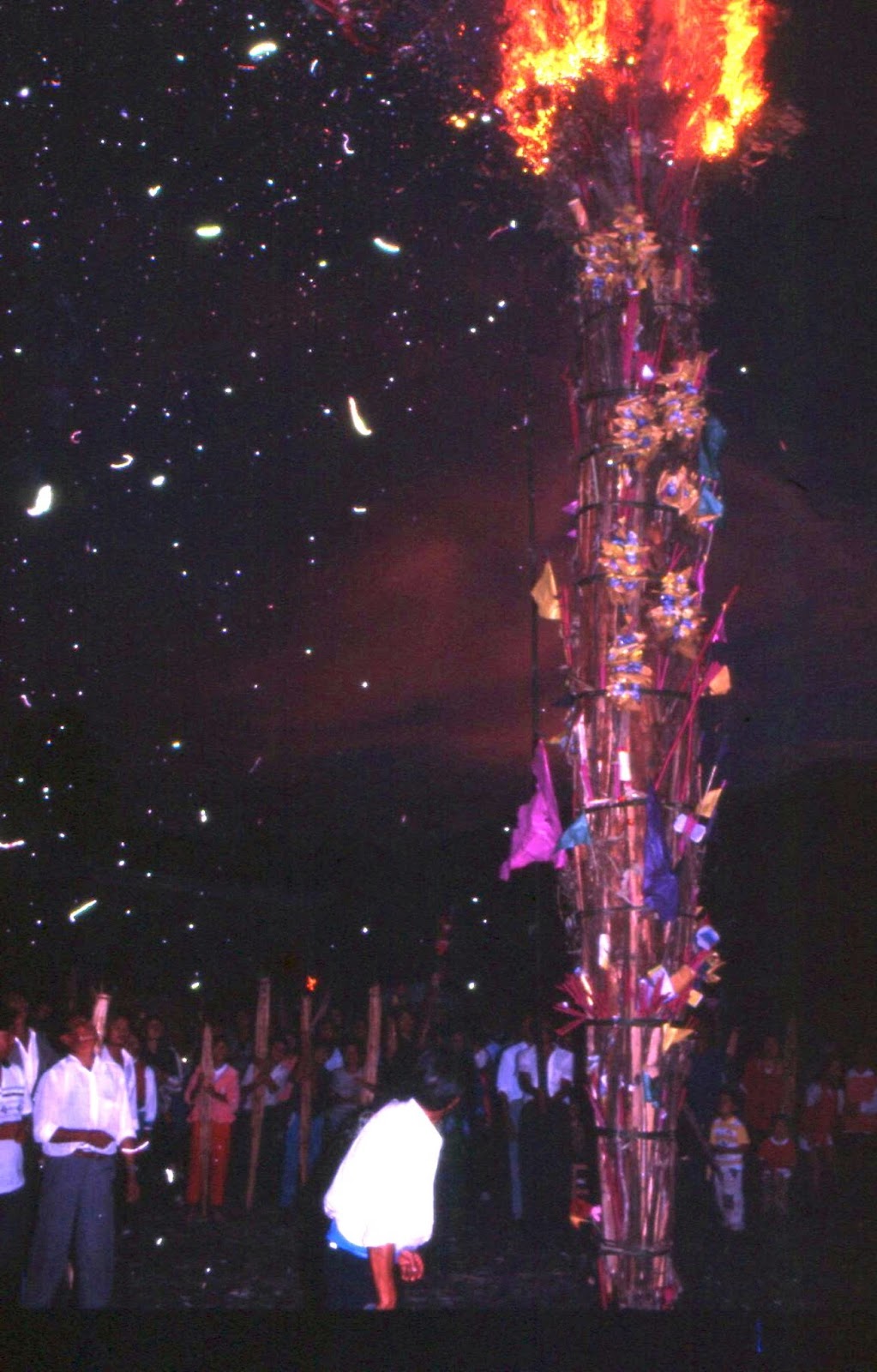
       While it is still part way up one man will climb along the length of it to install one final decoration near the top, a sort of scepter of attached pennants, paper lanterns and a flag.  According to local belief, when the tower is later ignited and the decorations begin falling off, whoever grabs the flag will, within a year, have a son as well as a financial windfall. Catching the pennants with Chinese characters on them is also good luck.  When it’s fully up folks place a small table next to it to leave offerings and burn incense.
the tower ablaze
child torch bearer
       Raising the tower is a tricky operation, however, and it may not always be initially successful.  On one of the occasions I witnessed the festival, in this instance in Xichou, a relatively prosperous town that used to be a major stop on the old Tea and Horses Road, the procedure failed.  After the one who inserted the last decoration in the tower had descended, the teams began pulling their ropes, but one side pulled too strongly.  The edifice wavered and finally toppled over and crashed on the ground.  Youths in the audience scrambled to snatch the decorations anyway, but the residents were now faced with the question of whether this was an ill omen that mitigated against the ordinary celebration of the festival or to take a pause and make another try.  With such a dejected atmosphere prevailing, I didn't linger to learn the final decision but left for dinner somewhere else.
lighting torches in Zhoucheng
       Ordinarily, with the final installation of the tower, just before dark when the sun has already descended below the crest of the Azure Mountains to the west, the villagers commence dancing around it.  Led by a male flautist, Bai girls in their best traditional outfits wave batons and perform energetic ring dances.  Meanwhile a man climbs up the tower, propped up on all sides by long poles, and lights the tower from the top, from where it will burn slowly, scattering the attachments for the crowd of onlookers to grab. 
       This carries on for a while until it’s completely dark.  Then from a nearby fire people light their bundles of pinewood staves and march along the fields brandishing their torches.   If you could take a balloon flight along the Dali plain at this time the long, flickering lines of lights would be pretty spectacular.  This is the last act of the program, while the tower slowly burns down completely.  But in Zhoucheng, advertised for tourists as the best venue to observe the Torch Festival, the events start and conclude a little later.
upper Zhoucheng street
lower Zhoucheng street
       Zhoucheng is a large and attractive Bai village of about 8000 inhabitants, lying on a slope of the Azure Mountains foothills next to the old highway north, about 23 km from Dali.  From here it’s a short walk to one of the most scenic portions of Erhai Lake.  Tour groups often make a sort stop here on their way to or from the popular Butterfly Spring, another kilometer up the road.  The town is famous for tie-dyed textiles in indigo and white and at any given time a visitor is likely to spot women, in the market square or in one of the lanes between the elegant stone houses that characterize the village architecture, tying up little portions of large white cloth to prepare the patterns for dyeing.   Zhoucheng women often wear headscarves and aprons of tie-dyed cloth, with a wide variety of patterns.
top of the Zhoucheng tower, with auspicious flag
       Zhoucheng Bai set up their tower, the tallest and sturdiest in the plains that night, in the market square at the bottom of the square-shaped village, beside the main north-south road.  The tower goes up around dusk, but the action pauses until well past dark and a good crowd has assembled in the square.  At a stage at one end a Bai orchestra plays classical music and provides backup for a troupe of middle-aged female dancers.  Younger women, dressed in their red and white traditional outfits and fancy headdresses, dance beside the tower.
       Eventually a man climbs up the tower with a flaming taper and sets the top of the tower on fire.  After his descent the activity picks up.  While the tower burns, youths dash around it in between the propping poles.  Ring dances form in one part of the square.  And over a small bonfire in another area near the tower people gather round and ignite their bundles of pinewood.  When their torches are ready they break away and run around the square waving them high and then dash down the streets adjacent to the market square.
resin powder igniting above a fire
       Around the tower a few women sell launching tubes for shooting little skyrockets at the burning tower and packets of resin to those wielding torches.  When the revelers toss this powder into their torches a myriad sparks fly up above the flames.  Those with torches do this everywhere this night, as often as possible.  There’s nothing hazardous about this, for the sparks burn out quickly and if they hit something the worse damage they can inflict is to singe a few leg hairs of the men wearing shorts. 
       Having started later than other villages, and with a tower that can take all night to burn down completely, Zhoucheng’s celebration can carry on past midnight, long after the rest of the plains has gone to sleep.  For most of the late-night revelers the Torch Festival is less a replay of history or an action to insure good health and bounteous harvests than it is a chance to enjoy a wild night playing with fire.  For the tradition-minded, however, a reminder comes the 23rd day of the following lunar month, when they perform rituals and hold a feast to honor Queen Beijie on the day of her death.  And probably they will be inspired to reminisce about what they did, just four weeks earlier, to mark the night the Songming Tower burnt to the ground.

Bai girls dancing in Zhoucheng's square
                                                                        * * *