Showing posts with label Piluoge. Show all posts

Sunday, August 2, 2015

Flames on the Plains—the Torch Festival in Dali


                                                      by Jim Goodman

the Dali plains and Erhai Lake
       The Torch Festival is the best-known mid-summer event in Southwest China.  Several minority nationalities—the Yi, Naxi, Lisu, Bai and others—celebrate the festival on the 24th or 25th day of the 6th lunar month.  The programs may vary, depending both upon location and whether the occasion is backed by local government sponsorship.  In the latter case the program may include events like wrestling matches, musical performances, animal fights and dance shows by participating neighboring minorities.  The main features common to all observances of the festival, though, are the brandishing and parading of burning torches and ring dances around a bonfire.
Yi women hawking torches in Dali
       While they may all celebrate the occasion in similar fashion, the different minorities have separate origin stories as to why.  According to one Yi version, the hero Eqilaba was such an invincible wrestler he aroused the jealousy of a god in Heaven, who sent down his own wrestler to challenge him.  But Heaven’s champion suffered defeat and death.  The furious god then dispatched a swarm of insects to ravage the Yi people’s farms.  Eqilaba organized his people to cut clumps of bamboo and make torches to ward off the insects.  The festival marks this victory.
       In the Naxi story, the god Zilao Apu envied the happy life of people on earth and ordered his general to turn the world into ashes.  But in the general’s first contact with a man he was so impressed with his virtue that he instead told the people how to deceive the god.  They all lit torches in front of their houses, so when Zilao Apu looked down from Heaven and saw the fires blazing he was convinced his orders had been carried out and went to sleep, never to awaken.
Torch Festival tower in a Bai village
       The Lisu tie the festival to history, commemorating the arrival of Zhuge Liang’s army on the expedition into Yunnan during the 3rd century Three Kingdoms Era.  The Lisu say they welcomed the forces by waving torches to chase away the insects and animals in the troops’ way.
       The Bai in Dali also link the festival to history; in their case to the foundation of the Nanzhao Kingdom in the 8th century.  In 731 the area still comprised six separate zhao.  According to the Bai, Prince Piluoge of the zhao around today’s Weishan invited the other princes to an important ancestral ritual on the Dali plain a little northwest of what would eventually become the city of Dali.  The Prince of Dengchuan zhao was suspicious but agreed to attend.  His wife Queen Beijie was even more suspicious and bade him wear an iron bangle as an amulet against attacks by knife or sword.
       The ritual took place in Songming Tower, a pinewood enclosure erected especially for the occasion.  After concluding the ancestral rites Piluoge hosted a banquet for the princes and while they were getting drunk he slipped outside and his soldiers locked the exits and set fire to the tower.  Afterwards Piluoge informed the widows, who then came to collect the remains of their husbands.  But the corpses were nothing but ashes.  The wife of the Dengchuan prince, though, succeeded in locating the iron bangle around the remnant of an arm bone. 
erecting the tower in Xichou
       She returned to Dengchuan with this to make proper funeral services and resisted Piluoge’s attempts to make her his concubine.  Less than a month after the Songming Tower incident she died, by drowning herself, taking poison or starving, depending on the version.  As part of the activities traditionally part of the Torch Festival Bai women reddened their fingertips in memory of Queen Beijie, who burnt and scorched her fingers sifting through the ashes of Songming Tower.
       This is a well-known story, repeated in all the tour guidebooks, ethnologies and histories of the area, but it is not true.  Piluoge did indeed unite the separate zhao into one state with himself as king, but not by assassinating all his rivals at once.  It took several years actually, beginning with the annexation of neighboring zhao in Midu and Binchuan and only campaigning near and north of Erhai from 737.  And in the final stages he had help from Tang Dynasty forces, for the Tang Court viewed a unified Nanzhao state as a bulwark against Tibetan encroachment in the southwest.
decorations prepared for Xichou's tower
       Historical inaccuracies, however, are irrelevant to the Bai people celebrating in Dali.  The story is the excuse for the event, which is anyway infused with animist concepts about the purifying and cleansing power of fire, a vestige of the veneration of fire that was part of the culture of the most ancient human societies.  By parading fiery torches through the fields the people not only chase away the insects that are unhealthy for both man and his crops, they also ward off nefarious spirits, equally unhealthy for humans and farms.
       In Dali Prefecture, both the Bai and the Yi celebrate the Torch Festival on the 25th day of the 6th lunar month, one day after the event elsewhere in Yunnan.  In the days preceding the festival Yi women from the hills south of Dali bring bundles of pinewood staves, to be used for torches, to sell in the city.  On the day of the festival Bai villagers hold late afternoon family feasts and afterwards men gather in an open area away from the houses and build a wood and straw edifice, several meters high, to erect as a replica of the Songming Tower.
       In Xichou this will be at a square on the western outskirts of the town, next to a huge old tree that is the nesting area of dozens of egrets.  In Zhoucheng it will be in the market square at the lower end of the village, close to the main highway.  Elsewhere it will be just outside the villages.
Bai ring dance around the village tower
       Before standing the structure upright the Bai attach small pennants inscribed with Chinese characters signifying peace, good health, prosperity, long life, bumper harvests, increase in people and livestock and other such wishes, as well as seasonal fruits like apples and pomegranates.  To erect the tower requires the coordinated efforts of three or four  teams of men pulling on ropes fastened to the tower and another team to keep propping it up with long poles as it is lifted.
       While it is still part way up one man will climb along the length of it to install one final decoration near the top, a sort of scepter of attached pennants, paper lanterns and a flag.  According to local belief, when the tower is later ignited and the decorations begin falling off, whoever grabs the flag will, within a year, have a son as well as a financial windfall. Catching the pennants with Chinese characters on them is also good luck.  When it’s fully up folks place a small table next to it to leave offerings and burn incense.
the tower ablaze
child torch bearer
       Raising the tower is a tricky operation, however, and it may not always be initially successful.  On one of the occasions I witnessed the festival, in this instance in Xichou, a relatively prosperous town that used to be a major stop on the old Tea and Horses Road, the procedure failed.  After the one who inserted the last decoration in the tower had descended, the teams began pulling their ropes, but one side pulled too strongly.  The edifice wavered and finally toppled over and crashed on the ground.  Youths in the audience scrambled to snatch the decorations anyway, but the residents were now faced with the question of whether this was an ill omen that mitigated against the ordinary celebration of the festival or to take a pause and make another try.  With such a dejected atmosphere prevailing, I didn't linger to learn the final decision but left for dinner somewhere else.
lighting torches in Zhoucheng
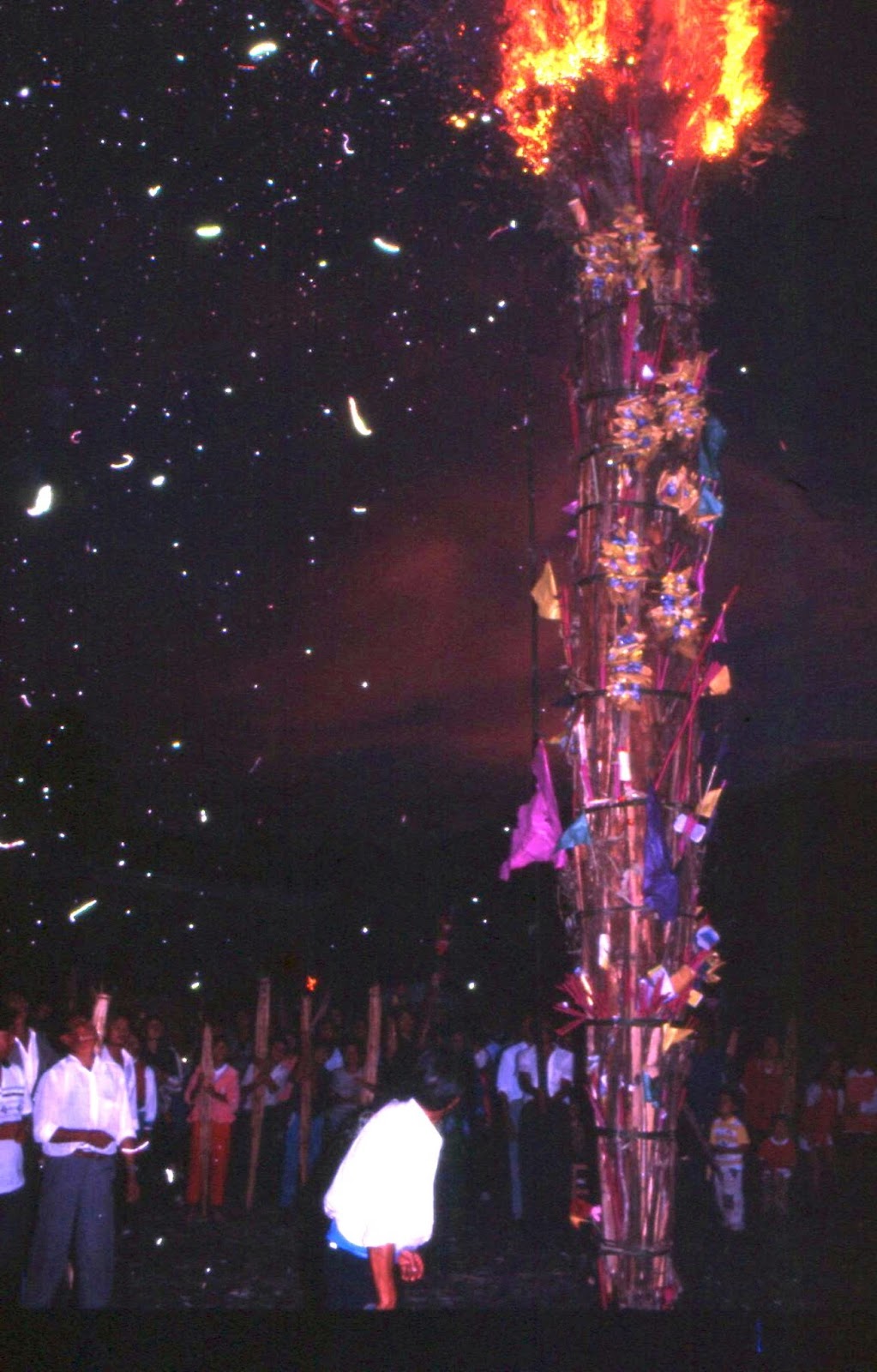
       Ordinarily, with the final installation of the tower, just before dark when the sun has already descended below the crest of the Azure Mountains to the west, the villagers commence dancing around it.  Led by a male flautist, Bai girls in their best traditional outfits wave batons and perform energetic ring dances.  Meanwhile a man climbs up the tower, propped up on all sides by long poles, and lights the tower from the top, from where it will burn slowly, scattering the attachments for the crowd of onlookers to grab. 
       This carries on for a while until it’s completely dark.  Then from a nearby fire people light their bundles of pinewood staves and march along the fields brandishing their torches.   If you could take a balloon flight along the Dali plain at this time the long, flickering lines of lights would be pretty spectacular.  This is the last act of the program, while the tower slowly burns down completely.  But in Zhoucheng, advertised for tourists as the best venue to observe the Torch Festival, the events start and conclude a little later.
upper Zhoucheng street
lower Zhoucheng street
       Zhoucheng is a large and attractive Bai village of about 8000 inhabitants, lying on a slope of the Azure Mountains foothills next to the old highway north, about 23 km from Dali.  From here it’s a short walk to one of the most scenic portions of Erhai Lake.  Tour groups often make a sort stop here on their way to or from the popular Butterfly Spring, another kilometer up the road.  The town is famous for tie-dyed textiles in indigo and white and at any given time a visitor is likely to spot women, in the market square or in one of the lanes between the elegant stone houses that characterize the village architecture, tying up little portions of large white cloth to prepare the patterns for dyeing.   Zhoucheng women often wear headscarves and aprons of tie-dyed cloth, with a wide variety of patterns.
top of the Zhoucheng tower, with auspicious flag
       Zhoucheng Bai set up their tower, the tallest and sturdiest in the plains that night, in the market square at the bottom of the square-shaped village, beside the main north-south road.  The tower goes up around dusk, but the action pauses until well past dark and a good crowd has assembled in the square.  At a stage at one end a Bai orchestra plays classical music and provides backup for a troupe of middle-aged female dancers.  Younger women, dressed in their red and white traditional outfits and fancy headdresses, dance beside the tower.
       Eventually a man climbs up the tower with a flaming taper and sets the top of the tower on fire.  After his descent the activity picks up.  While the tower burns, youths dash around it in between the propping poles.  Ring dances form in one part of the square.  And over a small bonfire in another area near the tower people gather round and ignite their bundles of pinewood.  When their torches are ready they break away and run around the square waving them high and then dash down the streets adjacent to the market square.
resin powder igniting above a fire
       Around the tower a few women sell launching tubes for shooting little skyrockets at the burning tower and packets of resin to those wielding torches.  When the revelers toss this powder into their torches a myriad sparks fly up above the flames.  Those with torches do this everywhere this night, as often as possible.  There’s nothing hazardous about this, for the sparks burn out quickly and if they hit something the worse damage they can inflict is to singe a few leg hairs of the men wearing shorts. 
       Having started later than other villages, and with a tower that can take all night to burn down completely, Zhoucheng’s celebration can carry on past midnight, long after the rest of the plains has gone to sleep.  For most of the late-night revelers the Torch Festival is less a replay of history or an action to insure good health and bounteous harvests than it is a chance to enjoy a wild night playing with fire.  For the tradition-minded, however, a reminder comes the 23rd day of the following lunar month, when they perform rituals and hold a feast to honor Queen Beijie on the day of her death.  And probably they will be inspired to reminisce about what they did, just four weeks earlier, to mark the night the Songming Tower burnt to the ground.

Bai girls dancing in Zhoucheng's square
                                                                        * * *      


Sunday, December 8, 2013

Weishan, Yunnan—Birthplace of an Ancient Native Kingdom


                                                             by Jim Goodman                    

    Lying in a broad and fertile plain 50 km south of Dali Prefecture’s Xiaguan in western Yunnan, boasting many Ming and Qing Dynasty structures and a preserved old quarter of traditional shop houses, Weishan is a charming, old-fashioned Chinese town that gets surprisingly little tourist traffic.  The few visitors are mainly Chinese families or couples from other parts of Yunnan.  Dali, just 18 km north of Xiaguan, is the main attraction for travelers in the area.  Tourists from all over China and beyond jam the old town streets, lined with overpriced souvenir, tea and jewelry shops, complain about the crowds, the prices and the commercialization of local culture but never venture to Weishan, an hour and a half away.  Yet in Weishan’s old town the shops on the streets sell items for the local population, merchants are laid back and friendly, it’s never crowded, always leisurely and the atmosphere of traditional urban China far more authentic than anywhere in Dali.
street in Weishan's old town
    Dali is more famous because it was long the capital of the Nanzhao Kingdom, Tang Dynasty China’s rival in the southwest, and its successor the Kingdom of Dali, which remained independent until overwhelmed by Kubilai Khan’s Mongols in 1253.  It is also near scenic Erhai Lake and mountains of 4000+ meters, which made it a prime destination from the very dawn of modern tourism.  Weishan is less well endowed physically and topographically, but did not undergo the commercial transformation of Dali, where now virtually every building caters to the tourist industry.  Weishan is still a slice of Old China, unique in western Yunnan.
    Moreover, it has its historical importance as well, for the Nanzhao Kingdom had its start right here, in the 7th century, when the town was known as Mengshe, the capital of one of the six native chiefdoms, or zhao, roughly in the area that is now Dali Prefecture.  Being in the most southern location of the six, the area around Mengshe was the Southern zhao—Nanzhao.  In 649 its ruler Xinuluo conquered a neighboring tribe in Midu and shortly after, when Tang Court officials were looking for an ally to secure their southwest frontier they chose Xinuluo’s state.
a Nanzhao king, from a Weibaoshan mural
    Four generations later Mengshe’s ruler Piluoge conquered the other five zhao.  In 738 the Tang conferred a royal title on him and recognized Nanzhao as a vassal state.  Piluoge’s own opinion, and that of his successors, was that Nanzhao was independent on a par with Tang China.  Until it fell in the early 10th century, shortly after the Tang regime’s own demise, Nanzhao fought both Tibet and China for control of the region, periodically launching invasions into Sichuan, defeating any invasion into its own realm.  But now that Piluoge’s success had made Nanzhao a bigger state, the capital shifted closer to Erhai Lake; first at Taihe, then Dali.
    Mengshe lost its political importance and had no impact on the history of the next several centuries.  Nanzhao expanded, contracted and imploded.  Its successor Dali lived in peace with Song Dynasty China until the Mongol conquest.  With the rise of the Ming Dynasty in the 14th century, the Mongols evacuated and the Ming Court began sending immigrants from eastern China into Yunnan to give it a more Chinese identity.  In the Dali area, from 1382 the Ming Court dispatched soldiers to both establish military garrisons and clear land to settle down on farms.
    At that time the overwhelming majority of the inhabitants of Yunnan were not Han Chinese but a mixture of many ethnic minorities.  In Dali Prefecture the dominant groups are the Bai and Yi.  Nanzhao’s ruling class was Yi or proto-Yi, while Dali’s kings were Bai.  Today the Bai constitute the largest ethnic minority in the prefecture and dominate the plains areas, while the hills are mostly inhabited by Yi. 
Bai shopkeepe in Weishan
    Because they are the largest community Dali is an Autonomous Bai Prefecture, where the top officials are Bai.  But the Yi and Hui outnumber the Bai in Weishan, so the latter is an Autonomous Yi and Hui County.   Some of the Hui are descendants of Kubilai Khan’s Central Asian Muslim allies, who stayed on to administer and garrison the province in the Yuan Dynasty.  Others came in after the Ming Dynasty evicted the Mongols and sponsored immigration.
    In the late 14th century the city underwent a major transformation, beginning with a name change from Mengshe to Weishan, apparently a contraction of Weibaoshan, a sacred mountain 18 km south of the city that would become home to many temples, mostly Taoist, over the next four centuries.  The mountain is swathed in thick forests of pine and cypress, the shrines and temples sited at intervals along roads and paths that ascend to the summit.
    The entrance to the area is about halfway up the mountain.  The first compound inside is dedicated to the Nanzhao kings.  Paintings or statues of them line the hallway on the upper level, with basic information about each posted on a signboard in Chinese, Yi and English.  The information is a bit biased, though, in the sense that an uninformed visitor would never get the idea that Nanzhao was actually an independent state, not just a vassal existing with imperial permission, but one that completely annihilated two large invading Tang armies. 
    The walls flanking the lower courtyard feature low-relief sculptures of life in Nanzhao times.   Vignettes depict soldiers marching to war, kings at the palace and scenes of daily life, as well as a Nanzhao-style standing Buddha with a seated Buddha on his head.
Nanzhao-style Buddha
    From here to the summit, up two separate roads, are fourteen temples in the classic Chinese style, surrounded by trees, built with brick and tile, embellished with courtyard gardens and ponds.  The most interesting of these is Wenyong Temple, in particular for the Dragon Pond in the upper courtyard.  An elegant pavilion stands in the middle of the pond, connected by a stone bridge to the courtyard walkway.  On its base just above the water is a famous mural of a circle of Yi dancing around a bonfire celebrating the Torch Festival.  Painted in the 18th century, reproduced in hotels and restaurants in Weishan, the top half is still sharp and vibrant, though the rest is faint and has lost most of its color.
Dragon Pond mural, Weibaoshan
    On the ride back down the mountain to the city are several spots with a broad view of the plain, its farms and villages and distant hills.  The modestly sized city of Weishan does not resemble a fast-growing modern metropolis, for very few tall buildings mark its skyline.  The city was not on the Tea and Horses Road and its prosperity basically derived from its fertile and fruitful land.  Even today, while connected by a good road to Xiaguan, it is not on the major provincial highways from Kunming to southwest Yunnan.
    As a result, development and expansion proceed much more slowly in Weishan than in those cities on the main commercial routes.  The atmosphere is never hectic, traffic jams unknown, the people relaxed and friendly.  At the edge of the city, on the way to the bus station, a large park serves as an outdoor tea center, where patrons sit in small stools at tables of woven split bamboo.  A short walk from this is a quiet park with several nice Qing Dynasty buildings.  A couple of blocks further up is the old town, where cars are banned.
    Dominating the preserved old quarter, erected by the first Ming administrators in 1397, is the very wide and imposing, 23.5 meter-high Gongchen Tower, which used to serve as the northern gate when Weishan was a walled city.   Urban planners at that time laid out the city in a chessboard grid, resembling the nearly square shape of an official seal.  Gongchen Tower was considered the handle.  Standing beside a large plaza, its rose-pink stone walls are topped by a two-tiered, red hardwood building with tiled roofs and upturned corners.  From its upper tiers observers can view the straight stone streets radiating in the four cardinal directions.
Xinggong Tower
    Originally, when it was a walled city, gates stood at the end of each street.  Today only one such street ends with a gate, called Xinggong Tower.  It was built around the same time as Gongchen Tower, rebuilt at the beginning of the Qing Dynasty, but it is narrower, only as wide as the street, with two tiers rising above the neighboring houses.  Both towers are illuminated at night, as are the main streets of the old town, or at least the sections closest to Gongchen Tower.
    The street running from Gongchen Tower to Xinggong Tower is lined on both sides with red wooden shop houses with tiled roofs and has the most traditional look and feel of any street in the city.  They are all modest buildings, with the goods stored in the room facing the street, which may also serve as a workshop, and the living quarters in the rear and in the attics.  There are a few shops selling antiques, plus one or two with ethnic clothing, though their customers are not tourists so much as local ethnic minority people who buy the items to wear.
old town street
    Other shops cater to the needs of local residents.  There are shops selling furniture and ornate bird cages, bolts of cloth, sandals made of cloth or straw, noodles, footwear, tie-dyed clothing, sitting stools and sundry other items.  Customers take their time examining the goods.  The patient shopkeeper never pesters, never urges them to buy this or that item, in fact never says anything until the customer is ready to ask a question.  The rule seems to be politeness before profit.
    Shops on the street continuing on the other side of Gongchen Tower are less oriented towards traditional items and more towards things like modern clothing, medicines, shoes, children’s toys, stationery etc., but the buildings are in the same classic traditional style.   Lanterns hang from the roofs of these and from the compound gates of houses on the side streets.  On some of the narrow lanes branching off one street or another farmers set up stalls to sell mushrooms, edible fungi, walnuts and fruits and, during festival times, decorations and items used in the events.
old-style sandals for sale
old town noodle factory
    Many more will join them during Weishan’s regular market days, held the 10th, 20th and 30th every month.  At that time the city fills with minorities from the vicinity—the Yi, Bai and Hui—dressed in their traditional clothing.  The Yi women, from the Tuli branch of the Yi minority, are particularly colorful, in bright shades of red and green and fancy headgear.   
 
Tuli Yi women, Dacan
                       
    local Hui girls, Dacang
    While Weishan’s market day draws a good proportion of Yi women, they come in even greater numbers to Dacang, a small, largely Hui town 35 km north.  Full of nondescript modern buildings, but with one small and attractive Buddhist temple, Dacang holds its market day the same dates as Weishan, as do a couple other villages in between Dacang and Weishan.   At the northern end of the Weishan valley, Dacang draws more Yi to its markets because it is closer to the hills where they live.
While minibuses ply the route from Weishan to Dacang and beyond, many people prefer the more leisurely journey by pony cart.  They can hold up to 12 people or so.  Weishan County is one of the very few places in the province where pony carts are still widely used.  As in Weishan, market day in Dacang is not confined to a single area or neighborhood, as country folk set up stalls in several separate venues. 
    Once in a while some folks might set up some entertainment spot at a market day, playing music or just singing songs.  Weishan itself has little in the way of entertainment at night.  Not many restaurants exist, although the number is steadily growing.  In an old house next to Gongchen Tower is a bar, but for socializing local folks take to one of the side alley grills for kebabs and cold beer with their friends.  The real entertainment in Weishan is not in the form of music and dance, not even ethnic music and dance (other than on big holidays).  It lies in appreciating the slower rhythms of traditional everyday life in a city with bilingual signboards that announce, “All of us are living images of Weishan.  Every household is a window into the culture of Weishan.”
Gongchen Tower


                                                                       * * *