Showing posts with label Flowery Hmông. Show all posts

Monday, January 7, 2019

Motorcycling Around Bắc Hà


                                   by Jim Goodman

Hmông women tending a stall in the Sín Chéng market
       At the turn of this century, when foreigners sought to explore the mountain scenery and ethnic variety of northern Vietnam, they went to Sapa.  With a full view of Phansipan, at 3143 meters Vietnam’s highest mountain, lots of Hmông and Dao minorities in town, especially Saturday market day, Sapa had already been popular since it was opened to tourists in the late 80s.  They could take treks around the area and stay in minority villages or climb up to the peak of Phansipan. 
       About the only excursion out of the district visitors might take was a trip to Bc Hà, about 100 km away on the other side of the Red River, for the Sunday market.  They arrived in late morning, when the town was full of Flowery Hmông, who dressed very differently from the Black Hmông around Sapa, and left mid-afternoon when the market action was receding.  Hardly anyone stayed the night there, or visited during the week.
hill scenery near Lùng Phìn
       As the years rolled on Sapa became very congested with tourists, foreign and domestic, who became subject to increasing commercial pressure from minority women and girls selling handicrafts.  Travelers then began paying more attention to Bắc Hà.  The town lay in a broad valley surrounded by hills, a picturesque setting even if not as dramatic as Sapa’s.  In 2006 the renovated colonial era palace re-opened and so the town now had an historical attraction.  Instead of a quick Sunday afternoon visit, people now stayed a night or two.
       In recent years, though, for the Sunday market day, often more foreigners are present than local people.  And a portion of the local Hmông have become like the minority merchants on the streets of Sapa, constantly importuning foreigners to buy something from them.  Bắc Hà’s hotels are full on weekends and home-stay options have cropped up all over the suburbs.  During the week the town is much quieter, yet that is a more interesting time to visit, for towns across the district have their own market days, where foreign visitors are too few to notice and no one pesters them to buy anything.
Hmông child in Sín Chéng
Hmông girl's ornamented turban
       With this in mind, my friend and I planned on exploring the district during the week and departing Sunday morning.  Arriving on a Tuesday evening, we rented motorbikes and set out early next morning for Sín Chéng’s market day, in the northwest part of Bắc Hà district.  The road ran north about 30 km to Simacai through lovely hills with terraced slopes and scattered villages.  From here we turned southwest, passing views of yet more terraced hills with even higher mountains as a backdrop.
       A small, narrow town, Sín Chéng lies on a high ridge.  For this Wednesday market stalls filled the lanes around its central intersection.  Just down the slope below them were the noodle shops and covered market lanes, mostly selling Hmông clothing.  In the field beside them was the livestock market.
Thu Lao woman in Sín Chéng
Tày women in Bản Liền
       About 90% of the people in Sín Chéng that day were Hmông, almost all women and all dressed in Hmông style.  This could vary, though.  Some wore the long bulky traditional Flowery Hmông skirt that was once the norm throughout the district.  On top they wore side-fastened jackets with thick bands of appliqué around the cuffs, sleeves and neckline.  Most women, of all ages, wore factory-produced skirts, knee-length, pleated and printed with innumerable kinds of patterns, some copying Hmông designs, some not. 
Bàn Liền market day
       The contemporary Flowery Hmông female outfit is not so uniform-like as before.  With the traditional look, the jacket’s background color would vary, but the bands of appliqué were always in the same places and in the same style, while the long and heavy skirt was covered with wide horizontal bands of appliqué with similar motifs. 
       Nowadays no two skirts are alike, just shaped the same and the jacket variety is enormous, especially among the young women.  They also go in more for sparkling decorations on the clothes and turbans, like filigreed silver, pendants, rings and discs.  It all looks very modern, but is still Hmông style.  No other minority women would dress like that.
waterfall near Tà Cù Tỳ
sign of a ritual location
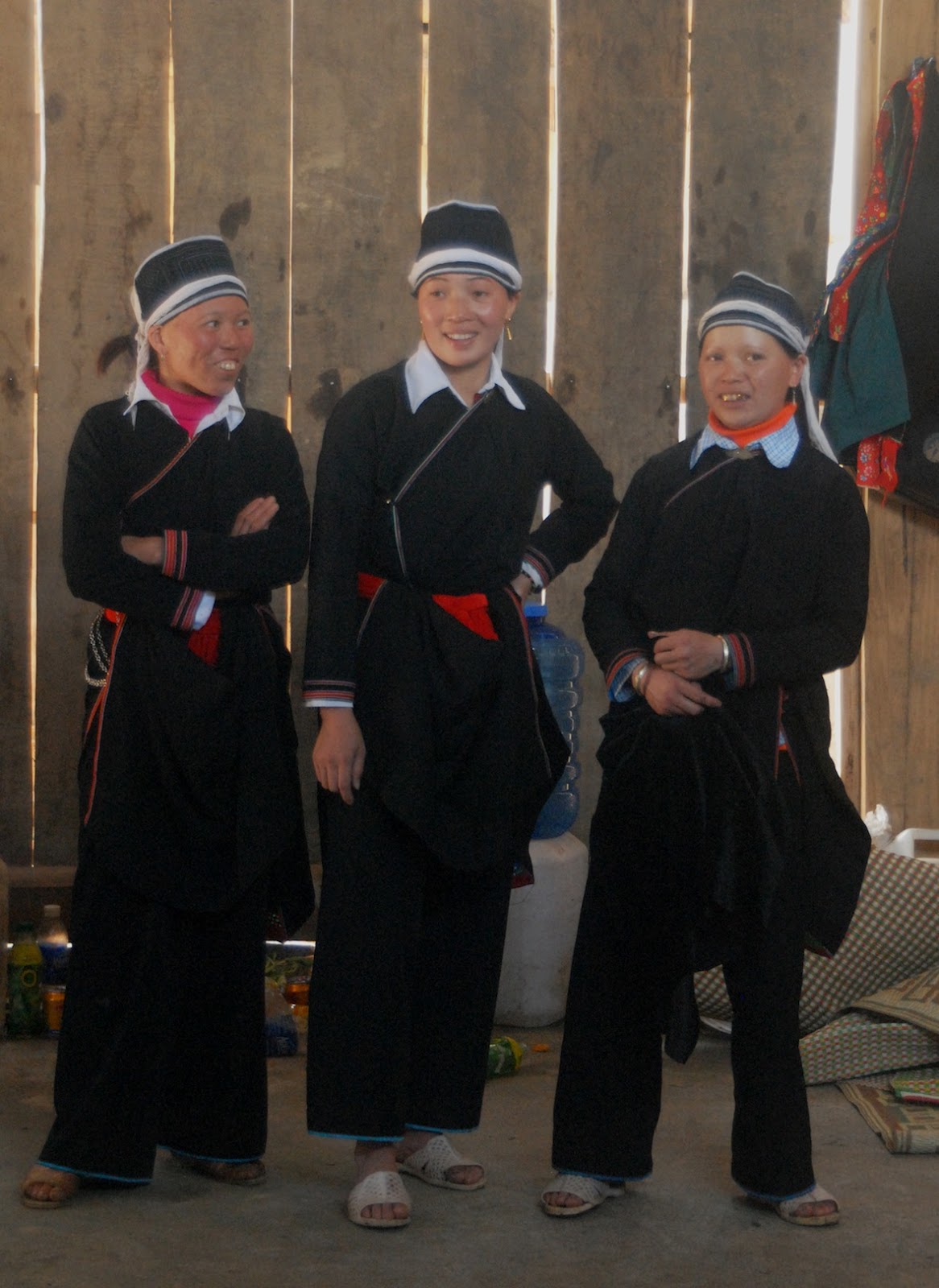
       Besides the Hmông, those in the Sín Chéng market included some Giấy and Thu Lao women, Vietnamese and six other foreigners, who like us were pretty much ignored.  The Giấy wore ordinary, side-fastened jackets in pastel colors, over plain black trousers.  The Thu Lao, a branch of the Tày, wore a collarless, long-sleeved jacket over an ankle-length skirt, all black except for colored bands around the sleeve cuffs.  They also wore a tall black turban with a small white tab protruding over the right eyebrow.
Black Dao ritual dance performers
       The market began closing down around one p.m., so after lunch we headed back going south through western Bấc Hà district.  The hills were never too steep for our motorbikes, the scenery excellent, accented by a small waterfall along the way.  We re-entered Bắc Hà town via the large Hmông village of Bản Phố above it.  The road down to town was lined with cherry trees in full blossom, with occasional fields of plum trees, also flowering, to the sides.  This was our longest ride of the week, but quite satisfactory. 
       Market day Thursday was at Bản Liền, a Tày village to the east, less than an hour’s ride through similar attractive scenery.  Tày hamlets start appearing after about halfway, characterized by stilted houses with thatched or tiled roofs standing right among the terraces.  Bản Liền’s market day is a very localized one that starts early.  Other than a handful of Hmông, everyone there was Tày, except us, plus a Frenchman and his Vietnamese guide.
writhing on the floor for the final dance
       Tày women wore knee-length, side-fastened black coats over black trousers.  The only color embellishment was a bright sash belt and a little trimming on the lapel, cuffs or hems.  They carried brightly embroidered shoulder bags, though, often featuring a triple fan motif.  The one baby we saw, carried by a Tày man, wore an embroidered cap with coins along the brim.  The market began shutting down around 10:30, a time for four Tày men to call me over to drink rice liquor with them.  I acquiesced and downed one shot with each of them, explained that was enough because I had to drive, and they didn’t persist, thanked me, shook my hand and wished me well.
       Our next destination was Tả Củ Tỷ, a Dao village (pronounced Zao) 30 km north.  The road passed by more Tày hamlets and stilted houses.  Then, a few km before Tả Củ Tỷ, the road dipped a little and passed by a waterfall.  Different from the long thin cataracts of the one we saw the day before, this one was shorter, swerved around a boulder in its path and plunged into the pool beside the road.  Tả Củ Tỷ was just around the bend and up the slope, the houses sitting on the ground and not stilted.
Dao shaman with scriptures and drum
young Dao women, Tà Cù Tỳ
       Tả Củ Tỷ’s residents are from the Black Dao sub-group, so named for the dominant color of their clothing.  Both men and women wear plain black, side-fastened, long-sleeved jackets over black trousers.  Women might add a thin band of blue or red on the jacket lapel, side hems and cuffs and white bands around the headscarf.  Men don a wide black turban.
mountain view in northern Bắc hà district
       In the yard of one of the first houses we passed stood a pair of crossed poles with streamers hanging down from various points.  This was a sign of some sort of ritual going on inside.  Those standing outside at once waved to us to stop and come inside.  The event was the second day of the three-day initiation rite for a young man into full adulthood.  And by a wonderful coincidence, we were just in time for the start of the ritual dances.  The host asked us each to contribute 20,000 đồng (about $1) to a tray full of money, presumably for expenses and the food afterwards.
       The room was decorated with flags, banners, paintings and paper cutout streamers, while several men made up the troupe.  Four of them wore long red robes and two of this group had pictures of Taoist deities affixed to their turbans.  The others wore a mixture of Dao and modern clothes.  Beside them sat the shaman, reading from a scriptural book and beating a drum.
traditional Hmông style in Cán Cấu
modern Hmông fashions in the Cán Cấu market
       The dances were slow in the beginning, mainly walking in a circle or standing and gesticulating.  Then the tempo increased and included hopping and knee bending.  For the finale, several of the men rolled wildly on the floor.  The show lasted about an hour, followed by a big feast and lots of rice liquor.  Before we left, our hosts invited us to return in the morning for the final rituals, though no one could tell us what time.
       We arrived at 8:00 next morning, but the main ritual, whatever it was, had finished.  All that remained was a shaman inside the door, reciting prayers while seated beside a round bamboo table full of ritual paraphernalia.  Everywhere else inside people were loading dishes onto long tables for the big feast and we were naturally invited to partake.
Flowery Hmông in the Cán Cấu market
       The repast was even more sumptuous than the one the day before, comprising several different preparations of pork and chicken, some vegetables, soup and lots of rice liquor.  Men and women ate at the same tables and the women, young and old, also indulged in the liquor.  Only after our leisurely meal did we learn Friday was Tả Củ Tỷ’s market day.  But we were too late already.  Like at Bản Liền, it finished early.  After a ride to a few scenic spots on the way west to Lùng Phìn, we turned south, took a longer pause among the cherry blossoms above Bấc Hà, and returned to our hotel.
       Our Saturday program was to head north to market day in Cán Cấu.  Since this town is on the way to Simacai, we rode across the same scenery as the other days.  So we decide to take the turnoff above Lùng Phìn to Cán Cấu Lake.  The road was cut into a very steep ridge for about five km to where we could view the lake below, small and placid, backed by high wooded mountains.
       We didn’t feel like hiking down to the shoreline and then back up again, especially since the morning fog hadn’t lifted completely.  But as we drove past the viewpoint the road suddenly began descending along a serpentine route to the valley far below.  After that the road turned east towards Cán Cấu, following a stream.  It was certainly a beautiful back way in to the town, but too strenuous to return the same way so we resolved to go back to Bắc Hà via the main road we were familiar with.
trying on a new Hmông outfit
little Hmông girl at Cán Cấu
       Cán Cấu lies further along this stream, a little bigger town than those we’d stopped in so far.  The market area lay beyond the town, with parking areas in front, behind and on one side.  The area was bigger than Sín Chéng’s market and, like the latter, had a livestock market, all buffaloes in this case, on the slope behind the covered stalls.
       The biggest difference between Cán Cấu and the other places we’d visited was the presence of foreigners.  The parking lot at the far end held several minibuses for foreigners who’d come from Sapa or Lào Cai on their way to Bắc Hà, where they would spend the night and observe the Sunday morning market scene.  Cán Cấu was supposed to be their preview and in general the groups only stayed for about an hour.
winter cherry blossoms on the road above Bấc Hà 
       Actually, it more resembled Bắc Hà’s market back in 2000.  The tourists did not interact with the Hmông, nor penetrate very far into the market grounds.  The Hmông were polite and friendly to those who did engage with them or buy something.  But except for a handful of Bắc Hà Hmông, who came with bags of trinkets and followed the groups around, the local Hmông ignored the foreigners.
       Stalls along the road offered vegetables, spices, herbs, bamboo items and other necessities.  Hmông people comprised the sellers and the buyers.  All the women dressed Hmông style, like at Sín Chéng, where a few wore the traditional bulky long skirt, while most favored the factory-made pleated and printed skirts.  Young women and children donned bright and flashy outfits accented by lots of silver jewelry and even the smallest wore silver ornaments and fancy headgear.  The many rows of stalls selling modern Hmông clothing were the busiest of the day.
       Cán Cấu’s market wound down mid-afternoon, long after the last tourist buses had departed.  With so much color and beauty constantly passing before our eyes, we stayed late to enjoy it all longer.  On our ride back to Bắc Hà, the late afternoon sun bathed the hills with a golden hue and illuminated for us once more the plum and cherry blossoms on the way.  It was a fitting conclusion to four days of fun and fascination.

Dao feast after the rituals atTảCủ Tỷ 

                                                                                 * * *    

                     Delta Tours Vietnam offers excursions to mountain destinations like Bắc Hà,                                            See https://www.deltatoursvietnam.com/other-tour-options

Sunday, December 24, 2017

Getting to Know Bắc Hà


                                                                  by Jim Goodman

Hmông handicrafts stalls in Bắc Hà, 2000
       Around the turn of the century, when Sapa had already established itself for several years as the leading destination in the mountains of northern Vietnam, Bc Hà was basically a sideshow.  Tour company posters advertised it as a ‘non-touristic destination’.  They basically touted it not as a separate area worth exploration, but as a particular event—the colorful Sunday market.  Buses packed with tourists left Sapa early Sunday morning for the 100-km ride and arrived just as the market was getting into full swing.  They left mid-afternoon for Lào Cai and an overnight train ride back to Hanoi.
Bắc Hà in 2000
       Having spent several days in Sapa on my first trip to Vietnam December 1999, on the next journey a couple months later, entering the country from China at Lào Cai, I made Bc Hà my first destination. .  Nestled in an 800-meter high valley, with modest mountains on all horizons, it is not as spectacularly sited as Sapa.  Nor does it have near as many guesthouses and restaurants.  No park exists in town, but the hilltop behind the market provides good views of the surrounding scenery. 
       The town then was rather small and quiet.  Most residents were ethnic Vietnamese (Kình), but the Hmông Hoa, who comprise 65% of the district’s population, live in the suburbs and nearby villages.  Villages of the Tày and Phù Lá minorities are within hiking distance, while the Dao live further away.  The ’downtown’ area, such as it was, featured buildings in the Franco-Vietnamese style, with a small Buddhist temple roughly in the center, opposite a colonial-era clock tower.
Hmông girls in Bắc Hà
Hmông girl in the Sunday market, 2000
       I arrived on an early bus from Lào Cai over an hour before the first tourists from Sapa.  Folks were already setting up stalls on the streets and mountain dwellers were arriving from several directions, mostly Hmông, but also some members of the Dao, Tày and Phù Lá ethnic minorities.  Just from their apparel, this was a very different scene than Sapa’s Saturday market.  The Hmông and the Dao also dominate Sapa, but their female counterparts in Bc Hà belong to different sub-groups and women  dress in completely different outfits. 
a busy Bắc Hà lane on market day, 2000
     
The Black Hmông of Sapa are called thus because the dominant color of their clothing components—jacket, cap, shirt, leggings and shorts—is black.  The women of the Flowery Hmông  (as it translates) don bulky, ankle-length, patterned blue skirts, lavishly embroidered and appliquéd, bright jackets, belts, leggings and aprons.  They embellish their outfits with heavy silver neck rings, chunky finger rings and necklaces and big round earrings.
       The Red Dao women around Sapa wear highly embroidered trousers and long-tailed jackets with bright red caps or turbans on the heads.  The Dao of Bc Hà are also a Red Dao sub-group, but wear outfits dominated by plain black, with no embroidery, with a wide vertical band of silver studs on the front of the jacket, colorful tassels attached at the bottom, and a round, mostly red-striped turban on the head.
young Red Dao woman
Red Dao women in Bắc Hà
       The Tày women dress in long black jackets and trousers, while the Phù Lá women wear a light or dark blue, side-fastened jacket, occasionally with a heavily embroidered bib over the front.  They are relatively few in the crowd, which is dominated by Hmông women as soon as they start to arrive.  Older women lead heavily laden ponies.  Young women carry woven pack baskets of split bamboo.  Some lead dogs on leashes.  Others bear pigs wrapped in a split bamboo harness and carried in the pack basket.  These they sell in the square at the end of the market street, while others set up stalls all along the way. 
group gardening in Bản Phố village
       By the time the tourist groups show up the streets are packed.  In 2000, though, the other notable difference from the Sapa market scene was the interaction between foreigners and locals.  Sapa’s Hmông and Dao women and girls were already the most aggressive souvenir and handicraft sellers one could encounter in Vietnam.  Bc Hà’s Hmông all but ignored the foreigners.  The handicraft and jewelry stalls they set up were for other Hmông and nobody pestered a foreigner to buy anything at all.  They just smiled for the photographs.
Hoàng A Tưởng Palace
       As for the tourists, they rarely initiated any interaction with the locals, except maybe to ask if it was OK to take a picture.  They stayed in their groups and all departed around 3, just as the market was winding down.  Only two other visitors stayed the night and we hiked together to the nearest hill for a view of the valley and the sunset.  But they left early next morning and for that day I was the only stranger in town.
       The nearest minority settlement is the Hmông village of Phố, 4 km up the mountain behind Bắc Hà. Not all the Hmông of Bác Hà live in big villages.  The path passes by hamlets of a handful of houses and occasionally a lone household off by itself next to newly cleared land.  The houses are sturdy, roomy, wooden structures of usually one story, with roofs of thatch or wood tiles.  Besides rice, corn and vegetables, they also raise ponies for transport and pigs and dogs for the market.
Hmông weaver at Hoàng A Tưỡng Palace 
       In the 90s the Hmômg began cultivating plums and other fruits in hillside orchards.  This brought them prosperity not yet experienced in Sapa, despite the tourist income there.  Bc Hà plums are now highly prized and locally eaten with salt, black pepper and chili.  The Bc Hà Hmông then lived in better houses, looked healthier and cleaner and their women had several sets of clothes.  They smiled politely when I passed by, invited me for tea when I stopped to photograph collective gardening and no one offered me anything for sale.
       I pressed on to other destinations next day and as years passed my research took me elsewhere in Vietnam.  But I kept hearing about changes in both Sapa and Bc Hà from friends in the motorcycle touring business.  The biggest change in Bc Hà came in 2006 with the opening of the renovated Hoàng A Tưởng Palace.  Now the town had a distinct historical relic of its own.
Tày woman and child
Tày woman, Bản Liền
       The palace sits on a mound one kilometer from the town center and dates its construction to 1914-1921.  The French colonialists appointed a local Tày chieftain, Hoàng Yến Chao, as ruler of the area and conscripted French and Chinese architects to design his palace.  The result was a very baroque combination of French and Oriental styles, occupying 4000 square meters, two stories high, mostly yellow walls, arched entries and a railed balcony, offering a view of the town and surroundings. 
painted rafters of a Tày house in Bản Liền
       The palace compound comprises the former residential palace, occupying 420 square meters, and subsidiary buildings on its wings.  These used to house a military detachment, but now the ground floor rooms are used to display local art works and Hmông handicrafts.  The upper floor rooms, of both the wings and the main house, were for private use and today hold furniture and old photographs.
       The palace was one of three the French commissioned for their allies in the northern hills.  The others were near Đồng Văn, Hà Giang, for the Hmông chieftain, and Mường Lay, Lai Châu, for the Thái chieftain.  So long as they kept the frontiers peaceful, these chieftains could rule without interference.  And in the case of Hoàng Yến Chao and his son and successor Hoàng A Tưởng, this meant unchecked exploitation of the people under their rule, as well as economic monopolies on all essentials of trade.
Tày stilted house in Trung Đô
       When the Việt Minh began seizing control of the northern mountains, Hoàng A Tưởng fled and subsequently disappeared from the history books.  The palace fell into disuse and disrepair until its 2006 restoration.  Now it is the most popular attraction in town after the Sunday market.  And there is no admission charge.
       By 2017, on my return to Bắc Hà, the nature of the Sunday market had come to resemble that in Sapa in the past.  Tourism has grown exponentially this century and nowadays foreigners may even outnumber locals in Bắc Hà on Sundays.  A much larger part of the market consists of souvenir handicrafts stalls, usually run by Vietnamese rather than Hmông, while the latter badger tourists in the lanes to buy whatever they are carrying.  In return, the tourists are more inclined to very intrusive photography, zeroing in for repeated close-ups of every lady with a wrinkled face and lots of silver jewelry.
       But they don’t all leave afterwards.  The district’s additional attractions, its ethnic mix and other market days, have recently inspired more travelers to schedule a longer stay.  The number of hotels is still small, but it’s still a very laid back town, without the plethora of handicraft shops and sellers that characterizes Sapa.  Visitors can take treks of two to four days in the mountains and see and stay in villages of the Hmông, Dao and Tày.  They can also opt for a home-stay visit to a single Hmông, Tày or Dao village.

planting rice in Trung Đô
     
One such Tày village is Bản Liền, 23 km southeast of Bắc Hà, lying in a valley backed by forested hills.  The Tày are Vietnam’s largest ethnic minority.  They are not colorful dressers, preferring plain black jackets and trousers, with a bit of blue trim on the jacket lapel and a blue belt for the women.  Yet they are still very traditional.  All Bản Liền families live in stilted wooden houses with angled roofs of thatch or tiles.  The rooms are spacious but sparsely furnished.  The rafters supporting the roof interior often feature painted designs of flowers, birds, butterflies, arabesques and other symbols.  They follow a kind of Buddhism mixed with animist practices, such as making caps for their babies with special protective medallions.
       Another popular Tày village is Trung Đô, about 15 km south of Bắc Hà, entered via a tree-lined road until the rice fields before the village.  A little larger than Bản Liền, with only about half the houses traditional stilted ones, it also features a fine old village temple and the remnants of the former chieftain’s residence.  Trung Đô lies close to the Chày River, where boats take passengers upriver to the market villages of Bảo Nhai and Cốc Ly.
buffalo market in Cốc Ly
       Bảo Nhai holds its weekly affair on Thursdays, in and around the covered market in the center.  Mainly Hmông, Tày and Vietnamese Kình attend, and once in a while a foreigner.  It’s rather small and caters strictly to locals, so free of the tourist-oriented products and stalls that dominate market days in Bắc Hà and, to a lesser extent, Cốc Ly.  It’s also an early riser market, which starts winding down by noon
       Market day at Cốc Ly, on the Chày River 20 km southwest of Bắc Hà, falls on Tuesdays.  The venue has two sections.  The stalls hawking the usual market goods sit on a mound on the east side of the road and the livestock market, mostly buffaloes, is in a shallow on the west side of the road.  The market stalls on the mound are mostly run by Hmông and Hmông are most of the shoppers as well. 
Hmông herbal medicine stall in Cốc Ly
       Because it’s just two days after the Bẵc Hà market day, some foreigners extend their stay to include witnessing this event--but a few dozen at most, not several hundred.  As a result, though, the market includes many stalls selling the kind of tourist souvenir handicrafts seen in Bẵc Hà now and Sapa, yet without the hard sell, pestering manners common to the other two places.  Still, other layouts are of more traditional Hmông products, from vegetables to medicinal herbs to homemade maize liquor.
       The maize liquor sold there could very well be from Bãn Phố, above Bắc Hà, which has a district-wide reputation for it.  One of their production centers is a short walk outside town, where visitors are given a tour of the processing methods and facilities and a sample of the liquor.
       North of Bắc Hà, Cán Cấu, a 20 km-ride through beautiful hills, has market day on Saturdays, drawing mostly Flowery Hmông, some Tày and hardly any foreigners.  Lùng Phìn, just 10 km north of Bắc Hà, holds its market day on Sundays, attracting Hmông and Phù Lá.  Other than the Lùng Phìn area, the easiest place to visit the Phù Lá is Chỉu Cái, a few km south of Bắc Hà.  Most houses have converted to modern style, but the females still wear the side-fastened traditional jacket, in pastel colors for the younger ones and darker shades for the older women.
Phù Lá woman in Bắc Hà, 2000 
Phù Lá woman, Chìu Cái, 2017
       In 2000 Bắc Hà’s reputation rested on the town’s market day.  The authenticity of that has eroded since then, but the result has been to find that authenticity elsewhere in the district, in far-flung market venues and remote ethnic minority villages.  For anyone looking for genuine traditional life styles, the district is worth an extended stay.
Hmông girls on the northern rim of Bắc Hà district
                                                                           * * *     
       Bắc Hà is one of the stops on Delta Tours Vietnam’s journey through the northern mountains.                 See the itinerary at https://www.deltatoursvietnam.com/other-tour-options