Showing posts with label Black Dao. Show all posts

Monday, January 7, 2019

Motorcycling Around Bắc Hà


                                   by Jim Goodman

Hmông women tending a stall in the Sín Chéng market
       At the turn of this century, when foreigners sought to explore the mountain scenery and ethnic variety of northern Vietnam, they went to Sapa.  With a full view of Phansipan, at 3143 meters Vietnam’s highest mountain, lots of Hmông and Dao minorities in town, especially Saturday market day, Sapa had already been popular since it was opened to tourists in the late 80s.  They could take treks around the area and stay in minority villages or climb up to the peak of Phansipan. 
       About the only excursion out of the district visitors might take was a trip to Bắc Hà, about 100 km away on the other side of the Red River, for the Sunday market.  They arrived in late morning, when the town was full of Flowery Hmông, who dressed very differently from the Black Hmông around Sapa, and left mid-afternoon when the market action was receding.  Hardly anyone stayed the night there, or visited during the week.
hill scenery near Lùng Phìn
       As the years rolled on Sapa became very congested with tourists, foreign and domestic, who became subject to increasing commercial pressure from minority women and girls selling handicrafts.  Travelers then began paying more attention to Bắc Hà.  The town lay in a broad valley surrounded by hills, a picturesque setting even if not as dramatic as Sapa’s.  In 2006 the renovated colonial era palace re-opened and so the town now had an historical attraction.  Instead of a quick Sunday afternoon visit, people now stayed a night or two.
       In recent years, though, for the Sunday market day, often more foreigners are present than local people.  And a portion of the local Hmông have become like the minority merchants on the streets of Sapa, constantly importuning foreigners to buy something from them.  Bắc Hà’s hotels are full on weekends and home-stay options have cropped up all over the suburbs.  During the week the town is much quieter, yet that is a more interesting time to visit, for towns across the district have their own market days, where foreign visitors are too few to notice and no one pesters them to buy anything.
Hmông child in Sín Chéng
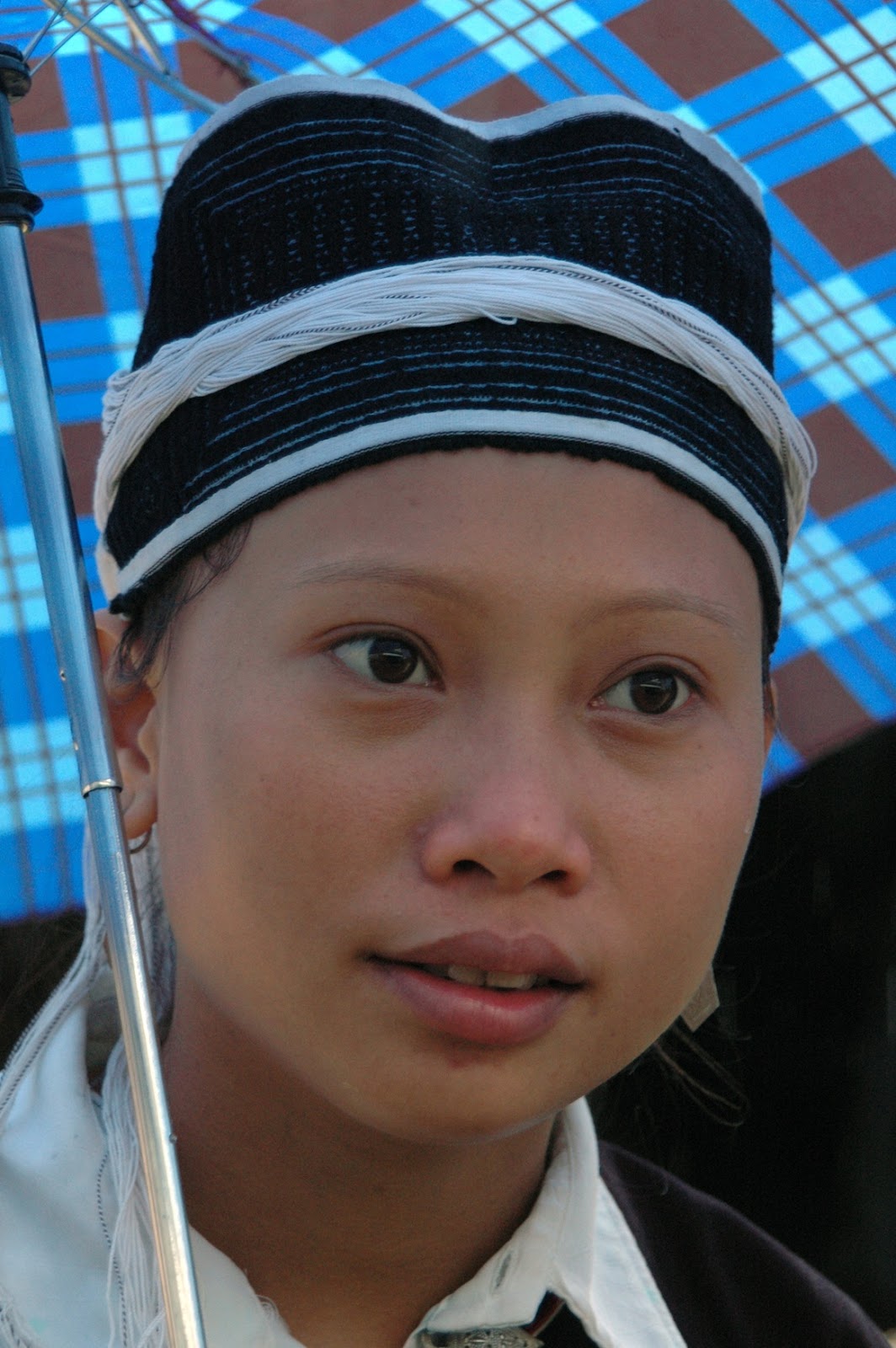
Hmông girl's ornamented turban
       With this in mind, my friend and I planned on exploring the district during the week and departing Sunday morning.  Arriving on a Tuesday evening, we rented motorbikes and set out early next morning for Sín Chéng’s market day, in the northwest part of Bắc Hà district.  The road ran north about 30 km to Simacai through lovely hills with terraced slopes and scattered villages.  From here we turned southwest, passing views of yet more terraced hills with even higher mountains as a backdrop.
       A small, narrow town, Sín Chéng lies on a high ridge.  For this Wednesday market stalls filled the lanes around its central intersection.  Just down the slope below them were the noodle shops and covered market lanes, mostly selling Hmông clothing.  In the field beside them was the livestock market.
Thu Lao woman in Sín Chéng
Tày women in Bản Liền
       About 90% of the people in Sín Chéng that day were Hmông, almost all women and all dressed in Hmông style.  This could vary, though.  Some wore the long bulky traditional Flowery Hmông skirt that was once the norm throughout the district.  On top they wore side-fastened jackets with thick bands of appliqué around the cuffs, sleeves and neckline.  Most women, of all ages, wore factory-produced skirts, knee-length, pleated and printed with innumerable kinds of patterns, some copying Hmông designs, some not. 
Bàn Liền market day
       The contemporary Flowery Hmông female outfit is not so uniform-like as before.  With the traditional look, the jacket’s background color would vary, but the bands of appliqué were always in the same places and in the same style, while the long and heavy skirt was covered with wide horizontal bands of appliqué with similar motifs. 
       Nowadays no two skirts are alike, just shaped the same and the jacket variety is enormous, especially among the young women.  They also go in more for sparkling decorations on the clothes and turbans, like filigreed silver, pendants, rings and discs.  It all looks very modern, but is still Hmông style.  No other minority women would dress like that.
waterfall near Tà Cù Tỳ
sign of a ritual location
       Besides the Hmông, those in the Sín Chéng market included some Giấy and Thu Lao women, Vietnamese and six other foreigners, who like us were pretty much ignored.  The Giấy wore ordinary, side-fastened jackets in pastel colors, over plain black trousers.  The Thu Lao, a branch of the Tày, wore a collarless, long-sleeved jacket over an ankle-length skirt, all black except for colored bands around the sleeve cuffs.  They also wore a tall black turban with a small white tab protruding over the right eyebrow.
Black Dao ritual dance performers
       The market began closing down around one p.m., so after lunch we headed back going south through western Bấc Hà district.  The hills were never too steep for our motorbikes, the scenery excellent, accented by a small waterfall along the way.  We re-entered Bắc Hà town via the large Hmông village of Bản Phố above it.  The road down to town was lined with cherry trees in full blossom, with occasional fields of plum trees, also flowering, to the sides.  This was our longest ride of the week, but quite satisfactory. 
       Market day Thursday was at Bản Liền, a Tày village to the east, less than an hour’s ride through similar attractive scenery.  Tày hamlets start appearing after about halfway, characterized by stilted houses with thatched or tiled roofs standing right among the terraces.  Bản Liền’s market day is a very localized one that starts early.  Other than a handful of Hmông, everyone there was Tày, except us, plus a Frenchman and his Vietnamese guide.
writhing on the floor for the final dance
       Tày women wore knee-length, side-fastened black coats over black trousers.  The only color embellishment was a bright sash belt and a little trimming on the lapel, cuffs or hems.  They carried brightly embroidered shoulder bags, though, often featuring a triple fan motif.  The one baby we saw, carried by a Tày man, wore an embroidered cap with coins along the brim.  The market began shutting down around 10:30, a time for four Tày men to call me over to drink rice liquor with them.  I acquiesced and downed one shot with each of them, explained that was enough because I had to drive, and they didn’t persist, thanked me, shook my hand and wished me well.
       Our next destination was Tả Củ Tỷ, a Dao village (pronounced Zao) 30 km north.  The road passed by more Tày hamlets and stilted houses.  Then, a few km before Tả Củ Tỷ, the road dipped a little and passed by a waterfall.  Different from the long thin cataracts of the one we saw the day before, this one was shorter, swerved around a boulder in its path and plunged into the pool beside the road.  Tả Củ Tỷ was just around the bend and up the slope, the houses sitting on the ground and not stilted.
Dao shaman with scriptures and drum
young Dao women, Tà Cù Tỳ
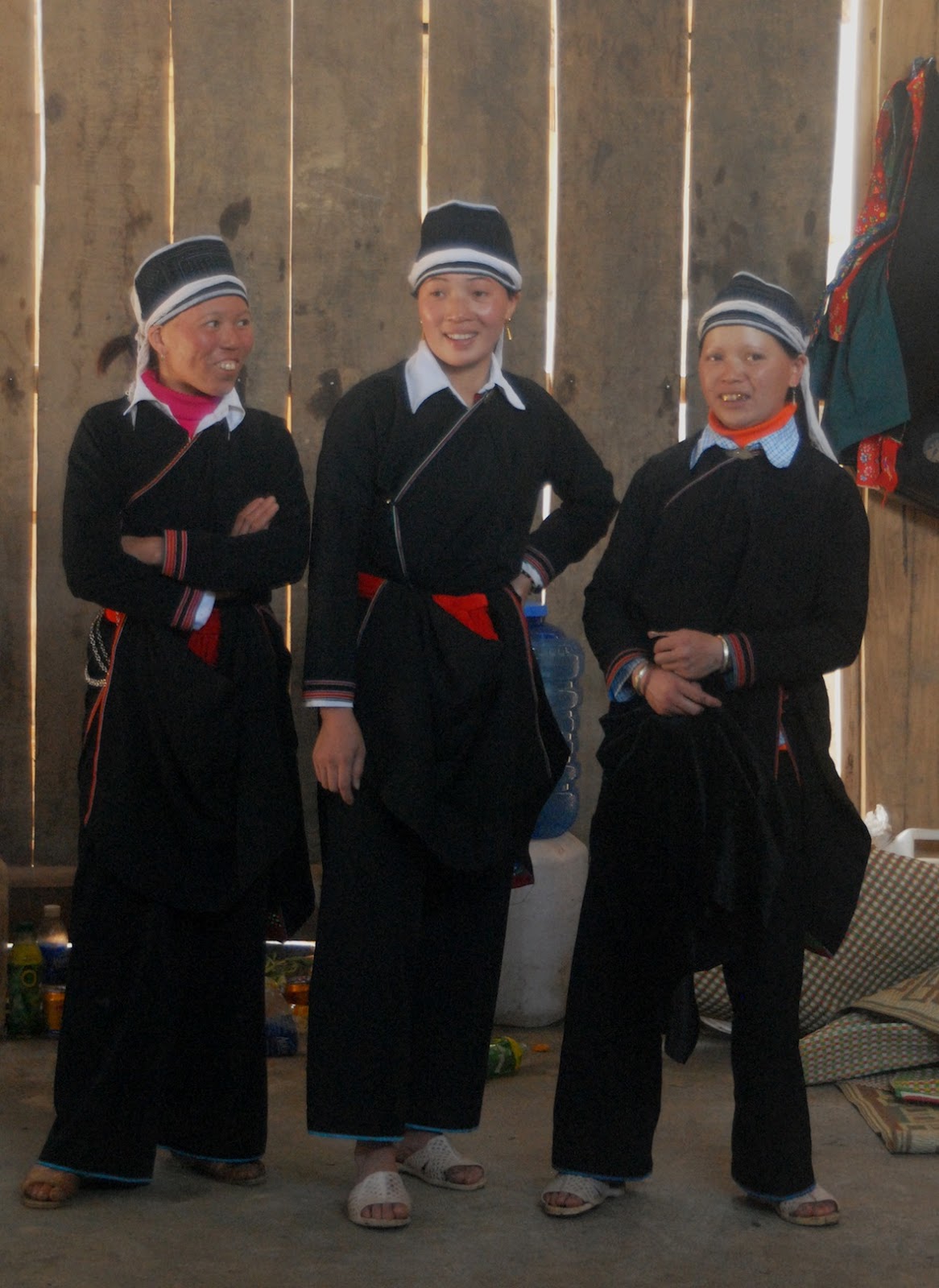
       Tả Củ Tỷ’s residents are from the Black Dao sub-group, so named for the dominant color of their clothing.  Both men and women wear plain black, side-fastened, long-sleeved jackets over black trousers.  Women might add a thin band of blue or red on the jacket lapel, side hems and cuffs and white bands around the headscarf.  Men don a wide black turban.
mountain view in northern Bắc hà district
       In the yard of one of the first houses we passed stood a pair of crossed poles with streamers hanging down from various points.  This was a sign of some sort of ritual going on inside.  Those standing outside at once waved to us to stop and come inside.  The event was the second day of the three-day initiation rite for a young man into full adulthood.  And by a wonderful coincidence, we were just in time for the start of the ritual dances.  The host asked us each to contribute 20,000 đồng (about $1) to a tray full of money, presumably for expenses and the food afterwards.
       The room was decorated with flags, banners, paintings and paper cutout streamers, while several men made up the troupe.  Four of them wore long red robes and two of this group had pictures of Taoist deities affixed to their turbans.  The others wore a mixture of Dao and modern clothes.  Beside them sat the shaman, reading from a scriptural book and beating a drum.
traditional Hmông style in Cán Cấu
modern Hmông fashions in the Cán Cấu market
       The dances were slow in the beginning, mainly walking in a circle or standing and gesticulating.  Then the tempo increased and included hopping and knee bending.  For the finale, several of the men rolled wildly on the floor.  The show lasted about an hour, followed by a big feast and lots of rice liquor.  Before we left, our hosts invited us to return in the morning for the final rituals, though no one could tell us what time.
       We arrived at 8:00 next morning, but the main ritual, whatever it was, had finished.  All that remained was a shaman inside the door, reciting prayers while seated beside a round bamboo table full of ritual paraphernalia.  Everywhere else inside people were loading dishes onto long tables for the big feast and we were naturally invited to partake.
Flowery Hmông in the Cán Cấu market
       The repast was even more sumptuous than the one the day before, comprising several different preparations of pork and chicken, some vegetables, soup and lots of rice liquor.  Men and women ate at the same tables and the women, young and old, also indulged in the liquor.  Only after our leisurely meal did we learn Friday was Tả Củ Tỷ’s market day.  But we were too late already.  Like at Bản Liền, it finished early.  After a ride to a few scenic spots on the way west to Lùng Phìn, we turned south, took a longer pause among the cherry blossoms above Bấc Hà, and returned to our hotel.
       Our Saturday program was to head north to market day in Cán Cấu.  Since this town is on the way to Simacai, we rode across the same scenery as the other days.  So we decide to take the turnoff above Lùng Phìn to Cán Cấu Lake.  The road was cut into a very steep ridge for about five km to where we could view the lake below, small and placid, backed by high wooded mountains.
       We didn’t feel like hiking down to the shoreline and then back up again, especially since the morning fog hadn’t lifted completely.  But as we drove past the viewpoint the road suddenly began descending along a serpentine route to the valley far below.  After that the road turned east towards Cán Cấu, following a stream.  It was certainly a beautiful back way in to the town, but too strenuous to return the same way so we resolved to go back to Bắc Hà via the main road we were familiar with.
trying on a new Hmông outfit
little Hmông girl at Cán Cấu
       Cán Cấu lies further along this stream, a little bigger town than those we’d stopped in so far.  The market area lay beyond the town, with parking areas in front, behind and on one side.  The area was bigger than Sín Chéng’s market and, like the latter, had a livestock market, all buffaloes in this case, on the slope behind the covered stalls.
       The biggest difference between Cán Cấu and the other places we’d visited was the presence of foreigners.  The parking lot at the far end held several minibuses for foreigners who’d come from Sapa or Lào Cai on their way to Bắc Hà, where they would spend the night and observe the Sunday morning market scene.  Cán Cấu was supposed to be their preview and in general the groups only stayed for about an hour.
winter cherry blossoms on the road above Bấc Hà 
       Actually, it more resembled Bắc Hà’s market back in 2000.  The tourists did not interact with the Hmông, nor penetrate very far into the market grounds.  The Hmông were polite and friendly to those who did engage with them or buy something.  But except for a handful of Bắc Hà Hmông, who came with bags of trinkets and followed the groups around, the local Hmông ignored the foreigners.
       Stalls along the road offered vegetables, spices, herbs, bamboo items and other necessities.  Hmông people comprised the sellers and the buyers.  All the women dressed Hmông style, like at Sín Chéng, where a few wore the traditional bulky long skirt, while most favored the factory-made pleated and printed skirts.  Young women and children donned bright and flashy outfits accented by lots of silver jewelry and even the smallest wore silver ornaments and fancy headgear.  The many rows of stalls selling modern Hmông clothing were the busiest of the day.
       Cán Cấu’s market wound down mid-afternoon, long after the last tourist buses had departed.  With so much color and beauty constantly passing before our eyes, we stayed late to enjoy it all longer.  On our ride back to Bắc Hà, the late afternoon sun bathed the hills with a golden hue and illuminated for us once more the plum and cherry blossoms on the way.  It was a fitting conclusion to four days of fun and fascination.

Dao feast after the rituals atTảCủ Tỷ 

                                                                                 * * *    

                     Delta Tours Vietnam offers excursions to mountain destinations like Bắc Hà,                                            See https://www.deltatoursvietnam.com/other-tour-options

Monday, June 6, 2016

Rainy Day Markets in NW Hà Giang


                                                       by Jim Goodman

Hmông women in Vĩnh Yên
       We were headed for nw Hà Giang, a province famous for its rugged mountain scenery and preponderance of ethnic minorities.  We didn’t have time for the more scenic parts of Hà Giang north of the capital city, so on the advice of friends in Hanoi familiar with the border areas, we opted for Xín Mân, in the northwest corner, assured that if we timed our arrival for a Saturday night, we could enjoy the weekly market the following day, a scene dominated by colorful minorities.
       Xín Mân was to be the last stop before crossing into Yunnan, China on a journey that began in Hồ Chí Minh City and had included stops in the Central Highlands, Hội An and Huế.  We’d had fairly good weather so far, but that ceased in heavily overcast Hanoi.  Then the day we were to take the night train to Lào Cai the city experienced its heaviest rainfall in many years.  Hoàn Kiếm Lake overflowed into the city streets, most of which were impassable by dark as we left for the train station.  After many detours, we had to walk the last few blocks in a downpour with water up to our knees.  Fortunately the train was delayed.  As it turned out, it was the last to depart before they had to close the train service for two days.
Giáy woman, Vĩnh Yên
       It wasn’t raining when we arrived in Lào Cai the next morning, but the driver we had arranged to meet us informed us that the short route to Xín Mân via Bắc Hà was blocked by landslides.  We would have to take a long detour, first south, then up through western Hả Giang to reach Xín Mân.  It would probably take all day.  Since we didn’t have another choice, off we went.
       The drive south along the eastern side of the Red River was not particularly interesting until we made a turn to the northeast and came to Vĩnh Yên, a village 20 km from the Lào Cai-Hà Giang provincial border.  It was just another plains village of no particular attraction.  But we happened to arrive on the day the international aid organization Oxfam was delivering supplies to the local people.  So an unusually large number of ethnic minorities were there to receive the handouts; Hmông, Nùng, Bố Y and Giáy.
       The Hmông belonged to the Hmông Hoa (Flowery Hmông) sub-group, so named for the bright, colorful jackets and skirts worn by the women.   Hmông women cover practically the entire surface of their long-sleeved, side-fastened jackets and bulky, calf-length pleated skirts with thin bands of appliqué and panels of embroidery, with red the color most employed.  The outfit takes several months to stitch together and women spend most of their free time working on it. 
Nùng women,VĨnhYên
       Younger women were bare-headed or wore headscarves.  Older ones wore headscarves or broad, circular hats.  And all ages wore typical Hmông ornaments like silver neck rings and big round earrings loaded with little pendants.  The Hmông Hoa are the dominant Hmông sub-group in western Hà Giang, eastern Lào Cai and northern Lai Châu provinces and we would meet them again in Xín Mân.
       In stark contrast to the resplendent Hmông clothing, the outfits worn by Nùng women were almost somber.  They comprised a black turban with one end falling to the shoulders, a long black coat and black trousers.  Besides a blue sash belt and a couple of red tassels on the turban end, they display a heavy dose of multiple colors on their embroidered and fringed shoulder bags.
colorful Nùng shoulder bag
       Like the Tày and the Thái further west, the Nùng are part of the Tai-Kedai linguistic group.  Like them, they are also wet-rice cultivators living in the valleys.  They were the nearest residents to Vĩnh Yên and we passed several Nùng villages in the area, with their sturdy, stilted wooden houses with tiled or thatched roofs.
       The Tai-Kedai group also includes the Giáy and Bộ Y minorities, generally living on the lower slopes of the hills.  Giáy women wear black or blue side-fastened, long-sleeved jackets over plain black trousers, headscarves and little or no jewelry.  They trim the jacket with bands of contrasting colors around the cuffs, the upper arms and lapel.  Bố Y women wore similar jackets but usually with the addition of a large black bib in front that hung to the hips, the edges trimmed in blue and a few flowers embroidered on the front.  They braided their hair, coiled it around the top of the head and wore a silver-studded band beneath.
Giãy people receiving the Oxfam handouts
       The sign Oxfam put up at Vĩnh Yên announced the event as flood and storm relief aid.  The items distributed, however, seemed out of synch with that theme.  Each recipient got a rubber-plastic basin, towels, soap, toothbrush and other toiletries, as if Oxfam wanted these uncouth minorities to clean up, wash their faces, brush their teeth and get civilized.
       I don’t know if any of the beneficiaries pondered the nature of the handouts.  They were probably just happy to get anything useful for free.  They were certainly in a good mood and quite friendly towards us.  Vĩnh Yên does not have a regular market day and is not near any tourist trekking route.  From the surprised, delighted, inquisitive expressions on their faces, we had the feeling we were the first foreigners they encountered in the flesh.  They posed proudly and happily, as if being photographed was a form of flattery—a mutually exciting encounter.
typical traditional house in western Hà Giang
       After an hour the activity began to dissolve and we departed with a farewell wave from a group of Giáy women and headed for Hà Giang.  After Việt Giang we turned north and drove along a high road flanking the valleys, passing settlements of the Red Dao, another very traditional minority group, virtually all of whom we saw dressed in traditional clothing. 
       In the late afternoon it began raining again.  By the time we reached Hoàng Su Phì it was already dark and we got stuck in the mud a few km west of the town and had to get a passing truck to pull us loose.  Another such patch of slippery mud confronted us just short of Xín Mân.  Fortunately, this time the driver negotiated the vehicle successfully through, thereby saving us from the 200.000 đồng fee (about ten dollars) he said Xín Mân drivers charged to pull vehicles out of the muck.
Xín Mân market day in the rain
       We arrived in Xín Mân early evening.  The rain ceased for a while, but resumed late at night and was forecasted to continue, at varying levels of intensity, all day Sunday, Xín Mân’s market day.  Landslides in the hills had also blocked access to Xín Mân for many villages, so attendance would be reduced.
       Xín Mân is a mountain town lying along and above the Chảy River, surrounded by coruscating hills and backed by two towering peaks.  We had a few breaks in the clouds Sunday that gave us an opportunity to appreciate the setting.  We could also see how steep the hills were and how easily a landslide could temporarily shut a village off from the outside world.  In this modest-sized town, Vietnamese run the commercial establishments and dominate its population.  Villages in the vicinity are home to Hmông, Dao (pronounced Zao) and two small Tai-Kedai minorities—La Chí and Bố Y, the former residing here a long time, the latter, part of China’s Bouyei nationality, settling here in the mid-19th century.
Bố Y woman, Xín Mân
Hmông Hoa in Xín Mân
   
Like the Nùng we met in Vĩnh Yên, La Chí women dressed in long black coats over black trousers, without the blue sash belt, but with colored trim on the cuffs and coat hems and a row of silver buttons down the front of the coat.  They bundled their hair into a black cap and most wrapped a colored scarf around it.  The Bố Y dressed in a similar fashion to what we saw among the few Bố Y at Vĩnh Yên, but without the embroidered bib over the jacket.
mountain stream after a heavy rain
       The Dao villages must have been the ones cut off by landslides, for no one from that community turned up that day.  The majority of the folks who braved the slippery trails were Hmông Hoa, mostly dressed like we’d seen in Vỉnh Yên, with perhaps the addition of a long rectangular apron in front.  But apparently a branch of this sub-group also lives around here, for some of the Hmông women wore the same style jackets and bulky pleated skirts, but with light blue the dominant color rather than red, plus plain hoop earrings without the filigreed pendants.         
       Considering the continuous rain, it was remarkable how crowded and active the market scene was.  Some of the sellers huddled under roofs or awnings of shops along the main street.  Others set up small stalls with canvas coverings overhead.  Still others, especially the Hmông, operated under umbrellas, wearing raincoats and laying out their goods on the sidewalk, just a few cm above the street, which was flush with running water.  Buyers had to stand in ankle-deep water to inspect the vegetables on offer.  Next to them might be a Bố Y or La Chí woman standing with one hand holding an umbrella and the other hand a silver necklace.
       Xín Mân is a popular stop for motorcycling tourists, so the market crowd was used to the presence of foreigners.  People were friendly and polite, but without the looks of astonishment we witnessed in Vĩnh Yên.  Ordinarily, travelers on market day would spend time examining the products for sale, walking out to scenic viewpoints or trying to strike up conversations with the locals.  But with water running down the street, plastic coverings obscuring the goods and clouds covering the hills most of the time, the first two options were out.  And the pattering of heavy raindrops against rooftops, tent flaps and umbrellas made ordinary conversation difficult, too.
La Chí and Hmông in Hoàng Su Phì
       Fearing worsening road conditions, we left Xín Mân just before noon, when the market was at its most active.  We headed back to Hoàng Su Phì, 30 km away, this time in the daylight, with views of the muddy swollen streams that tumbled down the hillsides and flooded the road.  We got through them safely as well as the two problematic spots of the night before, for they had mostly drained away.  When we arrived in Hoàng Su Phì it was the peak hours of its own market day.
       Hoàng Su Phì is a little larger than Xín Mân.  As in the latter, Vietnamese dominate the town’s population, while ethnic minorities reside in all the nearby villages.  The Hmông Hoa were again the largest contingent.  Besides hawking herbs and vegetables, they also ran stalls in the only indoor venue, selling Hmông clothing components, jewelry and accessories to other Hmông.
Hmông clothing market, Hoàng Su Phì
      Many more La Chí women turned up here than in Xin Mân, crouched over their herbs and vegetables under the awnings of shops.  Many Dao women were also wandering the streets, a branch of what Vietnamese identify as the Black Dao. Their rather plain black clothing was very different from the almost flamboyant, heavily embroidered apparel of the Red Dao we’d seen north of Việt Quang. 
       They wore a loose, side-fastened black jacket that hung to the hips, trimmed with a thin red band along the lapel and sides, and black trousers.  They tied their hair in a bun and covered the front part with a black cap tied with a braid of light blue woolen thread.  Despite their very dissimilar appearance, the Black Dao speak the same dialect, follow the same religion, customs and social organization and live in the same manner as the Red Dao or any other branch of the Dao.
       The same holds true for the Hmông sub-groups, where the outfits worn by Black Hmông around Sapa contrast so sharply with those of the Hmông Hoa in Lào Cai and Hà Giang.  It’s easy to understand how customs and traditions can remain intact after sub-groups split off and move elsewhere to live.  Living in the same conditions in the new location, they follow the ways that have served them in the past.
young Dao woman, Hoàng Su Phì
older Dao woman, Hoàng Su Phì
       But what accounts for the great diversity in apparel, not only within a single ethnic group, but also within sub-groups?  They live in similar environments and yet the cut, shape, color and types of embellishment, like embroidery, appliqué and ornaments, of their clothing components and accessories can differ enormously, even when the sub-groups live next to each other.  How did that come about?
       So the mystery of ethnic fashion remains unsolved.  Perhaps nw Hà Giang might be a good place to research this.  There’s plenty of ethnic variety, warm and friendly people, great mountain scenery and it would be an enjoyable type of research.  It would be worth going there again.  But next time I better do it in the dry season.

Hmông girl,  Xín Mân market
                                                                    * * *