Showing posts with label Nùng. Show all posts

Monday, June 6, 2016

Rainy Day Markets in NW Hà Giang


                                                       by Jim Goodman

Hmông women in Vĩnh Yên
       We were headed for nw Hà Giang, a province famous for its rugged mountain scenery and preponderance of ethnic minorities.  We didn’t have time for the more scenic parts of Hà Giang north of the capital city, so on the advice of friends in Hanoi familiar with the border areas, we opted for Xín Mân, in the northwest corner, assured that if we timed our arrival for a Saturday night, we could enjoy the weekly market the following day, a scene dominated by colorful minorities.
       Xín Mân was to be the last stop before crossing into Yunnan, China on a journey that began in Hồ Chí Minh City and had included stops in the Central Highlands, Hội An and Huế.  We’d had fairly good weather so far, but that ceased in heavily overcast Hanoi.  Then the day we were to take the night train to Lào Cai the city experienced its heaviest rainfall in many years.  Hoàn Kiếm Lake overflowed into the city streets, most of which were impassable by dark as we left for the train station.  After many detours, we had to walk the last few blocks in a downpour with water up to our knees.  Fortunately the train was delayed.  As it turned out, it was the last to depart before they had to close the train service for two days.
Giáy woman, Vĩnh Yên
       It wasn’t raining when we arrived in Lào Cai the next morning, but the driver we had arranged to meet us informed us that the short route to Xín Mân via Bắc Hà was blocked by landslides.  We would have to take a long detour, first south, then up through western Hả Giang to reach Xín Mân.  It would probably take all day.  Since we didn’t have another choice, off we went.
       The drive south along the eastern side of the Red River was not particularly interesting until we made a turn to the northeast and came to Vĩnh Yên, a village 20 km from the Lào Cai-Hà Giang provincial border.  It was just another plains village of no particular attraction.  But we happened to arrive on the day the international aid organization Oxfam was delivering supplies to the local people.  So an unusually large number of ethnic minorities were there to receive the handouts; Hmông, Nùng, Bố Y and Giáy.
       The Hmông belonged to the Hmông Hoa (Flowery Hmông) sub-group, so named for the bright, colorful jackets and skirts worn by the women.   Hmông women cover practically the entire surface of their long-sleeved, side-fastened jackets and bulky, calf-length pleated skirts with thin bands of appliqué and panels of embroidery, with red the color most employed.  The outfit takes several months to stitch together and women spend most of their free time working on it. 
Nùng women,VĨnhYên
       Younger women were bare-headed or wore headscarves.  Older ones wore headscarves or broad, circular hats.  And all ages wore typical Hmông ornaments like silver neck rings and big round earrings loaded with little pendants.  The Hmông Hoa are the dominant Hmông sub-group in western Hà Giang, eastern Lào Cai and northern Lai Châu provinces and we would meet them again in Xín Mân.
       In stark contrast to the resplendent Hmông clothing, the outfits worn by Nùng women were almost somber.  They comprised a black turban with one end falling to the shoulders, a long black coat and black trousers.  Besides a blue sash belt and a couple of red tassels on the turban end, they display a heavy dose of multiple colors on their embroidered and fringed shoulder bags.
colorful Nùng shoulder bag
       Like the Tày and the Thái further west, the Nùng are part of the Tai-Kedai linguistic group.  Like them, they are also wet-rice cultivators living in the valleys.  They were the nearest residents to Vĩnh Yên and we passed several Nùng villages in the area, with their sturdy, stilted wooden houses with tiled or thatched roofs.
       The Tai-Kedai group also includes the Giáy and Bộ Y minorities, generally living on the lower slopes of the hills.  Giáy women wear black or blue side-fastened, long-sleeved jackets over plain black trousers, headscarves and little or no jewelry.  They trim the jacket with bands of contrasting colors around the cuffs, the upper arms and lapel.  Bố Y women wore similar jackets but usually with the addition of a large black bib in front that hung to the hips, the edges trimmed in blue and a few flowers embroidered on the front.  They braided their hair, coiled it around the top of the head and wore a silver-studded band beneath.
Giãy people receiving the Oxfam handouts
       The sign Oxfam put up at Vĩnh Yên announced the event as flood and storm relief aid.  The items distributed, however, seemed out of synch with that theme.  Each recipient got a rubber-plastic basin, towels, soap, toothbrush and other toiletries, as if Oxfam wanted these uncouth minorities to clean up, wash their faces, brush their teeth and get civilized.
       I don’t know if any of the beneficiaries pondered the nature of the handouts.  They were probably just happy to get anything useful for free.  They were certainly in a good mood and quite friendly towards us.  Vĩnh Yên does not have a regular market day and is not near any tourist trekking route.  From the surprised, delighted, inquisitive expressions on their faces, we had the feeling we were the first foreigners they encountered in the flesh.  They posed proudly and happily, as if being photographed was a form of flattery—a mutually exciting encounter.
typical traditional house in western Hà Giang
       After an hour the activity began to dissolve and we departed with a farewell wave from a group of Giáy women and headed for Hà Giang.  After Việt Giang we turned north and drove along a high road flanking the valleys, passing settlements of the Red Dao, another very traditional minority group, virtually all of whom we saw dressed in traditional clothing. 
       In the late afternoon it began raining again.  By the time we reached Hoàng Su Phì it was already dark and we got stuck in the mud a few km west of the town and had to get a passing truck to pull us loose.  Another such patch of slippery mud confronted us just short of Xín Mân.  Fortunately, this time the driver negotiated the vehicle successfully through, thereby saving us from the 200.000 đồng fee (about ten dollars) he said Xín Mân drivers charged to pull vehicles out of the muck.
Xín Mân market day in the rain
       We arrived in Xín Mân early evening.  The rain ceased for a while, but resumed late at night and was forecasted to continue, at varying levels of intensity, all day Sunday, Xín Mân’s market day.  Landslides in the hills had also blocked access to Xín Mân for many villages, so attendance would be reduced.
       Xín Mân is a mountain town lying along and above the Chảy River, surrounded by coruscating hills and backed by two towering peaks.  We had a few breaks in the clouds Sunday that gave us an opportunity to appreciate the setting.  We could also see how steep the hills were and how easily a landslide could temporarily shut a village off from the outside world.  In this modest-sized town, Vietnamese run the commercial establishments and dominate its population.  Villages in the vicinity are home to Hmông, Dao (pronounced Zao) and two small Tai-Kedai minorities—La Chí and Bố Y, the former residing here a long time, the latter, part of China’s Bouyei nationality, settling here in the mid-19th century.
Bố Y woman, Xín Mân
Hmông Hoa in Xín Mân
   
Like the Nùng we met in Vĩnh Yên, La Chí women dressed in long black coats over black trousers, without the blue sash belt, but with colored trim on the cuffs and coat hems and a row of silver buttons down the front of the coat.  They bundled their hair into a black cap and most wrapped a colored scarf around it.  The Bố Y dressed in a similar fashion to what we saw among the few Bố Y at Vĩnh Yên, but without the embroidered bib over the jacket.
mountain stream after a heavy rain
       The Dao villages must have been the ones cut off by landslides, for no one from that community turned up that day.  The majority of the folks who braved the slippery trails were Hmông Hoa, mostly dressed like we’d seen in Vỉnh Yên, with perhaps the addition of a long rectangular apron in front.  But apparently a branch of this sub-group also lives around here, for some of the Hmông women wore the same style jackets and bulky pleated skirts, but with light blue the dominant color rather than red, plus plain hoop earrings without the filigreed pendants.         
       Considering the continuous rain, it was remarkable how crowded and active the market scene was.  Some of the sellers huddled under roofs or awnings of shops along the main street.  Others set up small stalls with canvas coverings overhead.  Still others, especially the Hmông, operated under umbrellas, wearing raincoats and laying out their goods on the sidewalk, just a few cm above the street, which was flush with running water.  Buyers had to stand in ankle-deep water to inspect the vegetables on offer.  Next to them might be a Bố Y or La Chí woman standing with one hand holding an umbrella and the other hand a silver necklace.
       Xín Mân is a popular stop for motorcycling tourists, so the market crowd was used to the presence of foreigners.  People were friendly and polite, but without the looks of astonishment we witnessed in Vĩnh Yên.  Ordinarily, travelers on market day would spend time examining the products for sale, walking out to scenic viewpoints or trying to strike up conversations with the locals.  But with water running down the street, plastic coverings obscuring the goods and clouds covering the hills most of the time, the first two options were out.  And the pattering of heavy raindrops against rooftops, tent flaps and umbrellas made ordinary conversation difficult, too.
La Chí and Hmông in Hoàng Su Phì
       Fearing worsening road conditions, we left Xín Mân just before noon, when the market was at its most active.  We headed back to Hoàng Su Phì, 30 km away, this time in the daylight, with views of the muddy swollen streams that tumbled down the hillsides and flooded the road.  We got through them safely as well as the two problematic spots of the night before, for they had mostly drained away.  When we arrived in Hoàng Su Phì it was the peak hours of its own market day.
       Hoàng Su Phì is a little larger than Xín Mân.  As in the latter, Vietnamese dominate the town’s population, while ethnic minorities reside in all the nearby villages.  The Hmông Hoa were again the largest contingent.  Besides hawking herbs and vegetables, they also ran stalls in the only indoor venue, selling Hmông clothing components, jewelry and accessories to other Hmông.
Hmông clothing market, Hoàng Su Phì
      Many more La Chí women turned up here than in Xin Mân, crouched over their herbs and vegetables under the awnings of shops.  Many Dao women were also wandering the streets, a branch of what Vietnamese identify as the Black Dao. Their rather plain black clothing was very different from the almost flamboyant, heavily embroidered apparel of the Red Dao we’d seen north of Việt Quang. 
       They wore a loose, side-fastened black jacket that hung to the hips, trimmed with a thin red band along the lapel and sides, and black trousers.  They tied their hair in a bun and covered the front part with a black cap tied with a braid of light blue woolen thread.  Despite their very dissimilar appearance, the Black Dao speak the same dialect, follow the same religion, customs and social organization and live in the same manner as the Red Dao or any other branch of the Dao.
       The same holds true for the Hmông sub-groups, where the outfits worn by Black Hmông around Sapa contrast so sharply with those of the Hmông Hoa in Lào Cai and Hà Giang.  It’s easy to understand how customs and traditions can remain intact after sub-groups split off and move elsewhere to live.  Living in the same conditions in the new location, they follow the ways that have served them in the past.
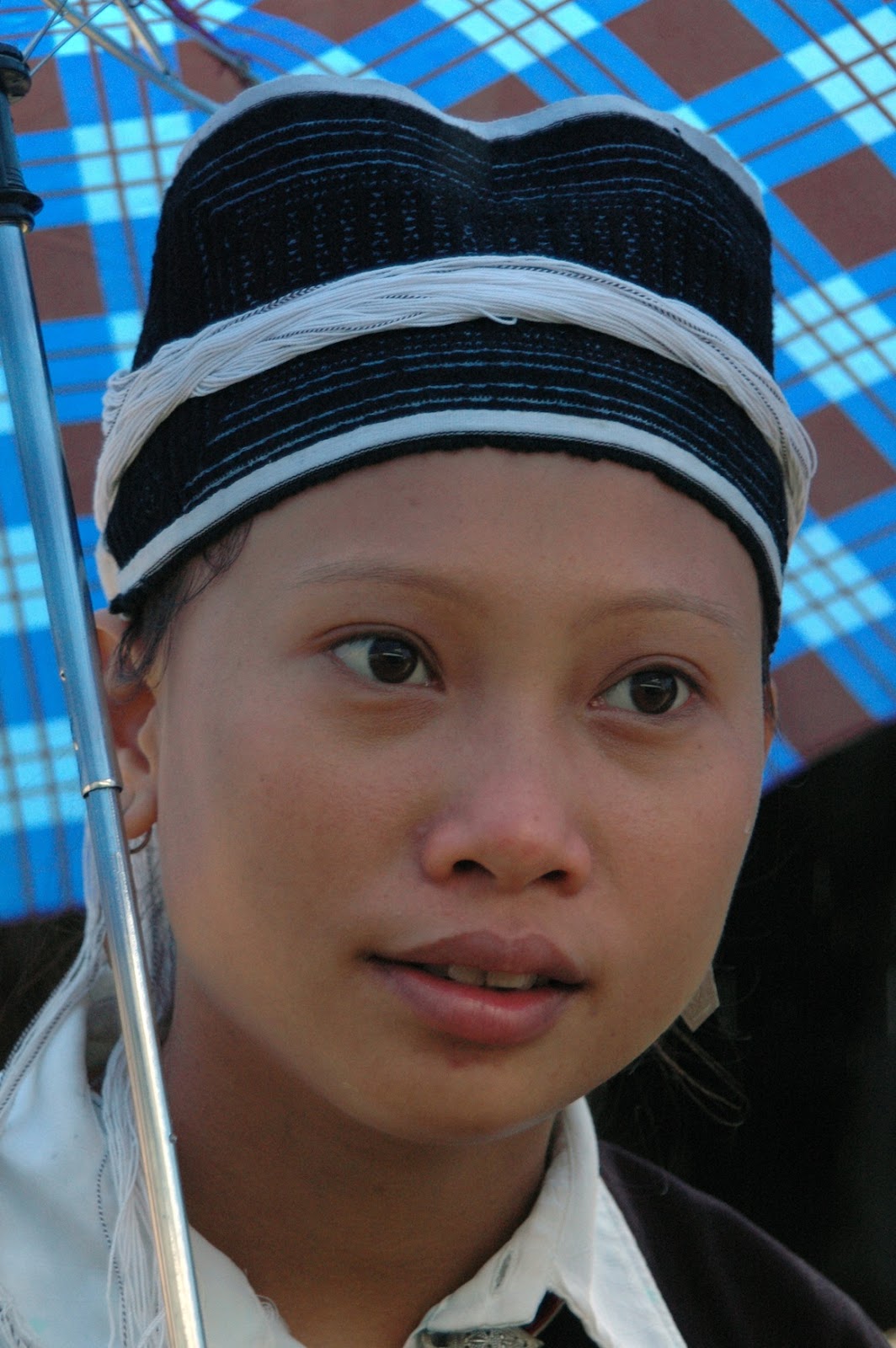
young Dao woman, Hoàng Su Phì
older Dao woman, Hoàng Su Phì
       But what accounts for the great diversity in apparel, not only within a single ethnic group, but also within sub-groups?  They live in similar environments and yet the cut, shape, color and types of embellishment, like embroidery, appliqué and ornaments, of their clothing components and accessories can differ enormously, even when the sub-groups live next to each other.  How did that come about?
       So the mystery of ethnic fashion remains unsolved.  Perhaps nw Hà Giang might be a good place to research this.  There’s plenty of ethnic variety, warm and friendly people, great mountain scenery and it would be an enjoyable type of research.  It would be worth going there again.  But next time I better do it in the dry season.

Hmông girl,  Xín Mân market
                                                                    * * *                    


Wednesday, April 1, 2015

Lạng Sơn, Vietnam’s Gateway to China


                                                               by Jim Goodman

the city of Lạng Sơn
       Of northeastern Vietnam’s three border provinces, Lạng Sơn is the most easily accessible and least appreciated.  Just 154 km from Hanoi, on a good level road, the trip to Lạng Sơn city takes just over two hours.   The last hour or so the road flanks picturesque hills, but nowhere in the province do these hills rise to heights like its neighbor provinces Hà Giang and Cao Bằng.  Thus, guidebooks downplay Lạng Sơn, giving it little attention other than as a city on the way to the border crossing into China, which is just 18 km away near Đồng Đăng.  But the city and its environs offer enough attractions to make it worth a stopover or even a separate excursion out of Hanoi when you’re not crossing the border.
         Thanks to cross-border trade, Lạng Sơn has thrived since the normalization of relations between China and Vietnam.   Chinese goods dominate the markets and virtually all of its buildings date from after the 1979 conflict, which resulted in the destruction of nearly every building in the city.  Only the remnant of one of the old Nguyễn Dynasty city gates remains at the south end.  Lying along a bend of the Kỳ Cùng River, most of the commercial and residential quarters lie north of the bend, while administrative buildings are largely south.  The old French quarter used to lie here, but it was destroyed in 1979.   A couple of hills jut up from the flat land of the city while bigger hills dominate the surroundings.
phallic stalagmite in Tam Thanh Cave
altar to Quan Âm and other deities
       The city basically lies on a north-south axis, with its main market, Kỳ Lừa, lying in the northern quarter. In its northwest suburb, behind a fancy entrance gate, is the Tam Thanh cave, the biggest of three in the vicinity, with an elaborate altar to Quan Âm and other deities just inside the mouth.  Several paths from here lead to other small shrines inside niches of the cave walls.  One path leads to an opening with a view of the countryside, another to a pavilion on the slope of the mountain and all of them converge at an underground pool, featuring a very phallic stalagmite jutting up from the dark water.  Another cave, Nhị Thanh, lies just south and is even more impressive, featuring a 600-meter walk along a subterranean stream.  Stalactites force a lot of ducking and dodging along the route, which is also graced by a 20-meter high waterfall.
NàngTô Thị Waiting for Her Husband
     
Outside Tam Thanh cave a path leads to the top of Thô Thị Hill, affording a great view of the city and the red roofs of its buildings. The hill gets its name from the interesting rock formation called Nàng Thô Thị Waiting for her Husband, which resembles a woman carrying her baby, standing alone on the ridge.  Lạng Sơn residents venerate this rock by leaving offerings of flowers and incense.  Perhaps they identify with the theme suggested by the rock.  For devotees it symbolizes all the women who have waited for husbands to return from one of the many wars that have plagued the country’s history.
       On another section of the same hill lie the remnants of a 16th century Mạc Dynasty citadel, one of the few physical vestiges in the country of a little-known period of Vietnamese history.  In 1428, following final success in expelling Chinese forces after a twenty-year occupation of Vietnam, Lê Lợi, a Thanh Hoá landowner who led the insurrection, founded the Lê Dynasty.  Though it was to be the longest running dynasty in the country’s history, not officially ended until 1787, its kings were rarely in control.  Lê Lợi died five years after establishing it.  His successor was just ten years old at his accession and died in mysterious circumstances nine years later.  The next king was barely a year old when crowned and when he reached 17 his brother murdered him and usurped the throne.  He in turn lasted but eight months and then the last of Lê Lợi’s veterans overthrew him and installed Lê Thánh Tông as king.
remains of a Mạc Dynasty citadel above Lạng Sơn
       He proved to be the most successful monarch in the entire Lê Dynasty.  Taking over in 1460 at the age of 18, he led the conquest of the Chăm state of Vijaya, opening the way for Vietnamese migration to south central Vietnam.  A dedicated Confucian, he promulgated a law code that was to survive until the early Nguyễn Dynasty replaced it, held regular examinations aimed at recruiting government officials, promoted literature and commissioned national histories. 
       Unfortunately, kings in those times rarely lived to an advanced age.  Perhaps because he worked himself too hard, Lê Thánh Tông died in 1497 at the age of 57.  His very capable son Lê Hiến Tông ruled but six years and died when just 43.  After his demise the Dynasty basically ran out of good rulers, doomed by the fatal flaw underlying all dynastic successions—that the son is not always the equal of the father.  His own son and successor died after six months and the next four monarchs were depraved, capricious, murderous teenaged tyrants with, thanks to Lê Thánh Tông’s centralization, absolute power.  All of them suffered violent deaths as factions at Court, basically pitting the Red River Delta officials against the Thanh Hoá families that had supported Lê Lợi, worked behind the scenes to promote their favorites.
Thất Khê
     
One of these schemers was Mạc Đặng Dung, from a village in Hải Dương, who won appointment to the Royal Guards under one of these young kings and rose steadily in the hierarchy while remaining keenly aware of the scandals at Court and the subsequent deterioration of conditions in the countryside.  In 1527 he decided the country had had enough of Lê Court shenanigans, arrested the current king and founded his own dynasty.  Those Lê family members he could not capture escaped to Laos with their Thanh Hoá supporters, primarily the Trịnh and Nguyễn clans, to plot their return to power.
       The Mạc Dynasty ruled until 1592, when the Lê loyalists captured the capital and the reigning Mạc king.  Though the victors reinstated the Lê king’s legitimacy, they did not yet wipe out the Mạc.  The latter maintained its own claimants to the throne and remained strong in the east and northeast.  It was around this time that the Mạc regime constructed the citadel in Lạng Sơn.  Later in the 17th century they lost Lạng Sơn and retreated to Cao Bằng, where they survived until 1677.
gate to the Holy Mothers temple in Đồng Đăng
       Lạng Sơn residents are unlikely to know anything about the Mạc period of the city’s history, but are well aware of 20th century Lạng Sơn history.  The road to Cao Bằng is the famous Highway 4, site of the first significant Việt Minh advances against the French colonialists.   The French had built a fort at Đông Khê, south of Cao Bằng and north of the Lạng Sơn provincial border.  In September 1950 the Việt Minh captured it, prompting a French evacuation from Cao Bằng province.  Shortly afterwards they also captured Thất Khê, inside Lạng Sơn province and used it as a base of operations for expelling the French from this province as well.
Tày ethnic minority
       The first stop north of Lạng Sơn on Highway 4 is the border town of Đồng Đăng, a prosperous-looking place with new buildings in the Franco-Viet style and a large and lavishly decorated temple to the Holy Mothers.  It’s not the actual crossing point, which is eight km northeast at Tôn Thanh, a nondescript place with a big entry gate and the adjacent Friendship Village, basically rows of tents hawking Chinese goods like clothing, utensils, kitchen ware, appliances, cell phones, DVD players, radios, etc.
       Just at the northern edge of Đồng Đăng, though, a sign reading “Border Zone” points to a path between the hills flanking the road that leads to another post, hidden behind the promontories, with big warehouses and Chinese signs.  Vietnamese porters pick up large packages here and carry them down the rocky paths to the road, where motorcycles wait to take the goods into town. 
Nùng in the countryside
        The road north passes by steep limestone hills on its eastern side and the gently flowing Kỳ Cùng River on the western side, featuring a number of water wheels along the banks.  The towns and most of the roadside villages along this and other provincial highways are Vietnamese, but the province is also home to the Dao ethnic minority in the hills and Tày and Nùng in the valleys.  The Dao are rather exclusive, rarely venturing into the cities, even at festival time or market days.  The Tày and the Nùng are both members of the Tai-Kedai linguistic group and in China are considered sub-groups of the Zhuang. 
       Tày and Nùng dialects are similar, as are their lifestyles.  They differ in various domestic and religious customs and especially in appearance.  The Tày women dress in dark colors, mostly black, with little or no embellishments like embroidery or jewelry.  Nùng women wear black trousers, with a thin white strip along the sides, but their jackets are quite colorful, with checked and plaid patterns, side-fastened and long-sleeved, similar in style but no two jackets exactly alike.  The same is true of their headscarves:  tied in the same manner but always with individual cloth patterns.
Nùng in the city
       The jacket material they buy in the market and stitch together back home.  They live in single story houses on the ground of mud-brick walls and tiled roofs.  The interiors are full of split-bamboo storage baskets, spinning wheels, thread winders and a four-shaft loom.  Winter is the weaving season, when women make cloth for their trousers, bags, pillowcases and blankets.
       Nùng villages lie just several kilometers east of Lạng Sơn in Cao Lộc district, in valleys among the rolling hills.  Being so close, the Nùng are frequent visitors to the city, especially on market days, held every fifth day.  They comprise a noticeable percentage of both buyers and sellers, generally hawking crops grown on their farms and purchasing household goods and maybe grain.  And when they’re not shopping they’re window-shopping and exploring the city, not confining themselves to the immediate market areas.
bringing in baskets for sale at market day
     
Market day begins early and is not entirely confined to Kỳ Lừa, for the city has two other, smaller venues.  Kỳ Lừa is the most crowded, though, and the first stop for ethnic minorities in attendance.  The activity only begins to subside in late afternoon and the presence of so many Nùng women, often in groups of three to six, makes it a memorable day.  For a traveler, the only occasion more interesting is Lạng Sơn’s annual Kỳ Lừa Festival.
       Beginning the 22nd day of the first lunar month and running six days, the festival honors Thân Công Tài, the 17th century Lê military officer who founded Kỳ Lừa market.  The main venues are the Tả Phù Temple behind the market, dedicated to this man, and Kỳ Cùng Temple, sited at the bend in the river that divides the northern and southern sections of the city.  Devotees begin bringing offerings, like trays of glazed roast pig, to these temples the day before the festival starts.
food offering at Kỳ Cùng Temple 
       Besides religious activities, the festival’s highlights are the processions between Tả Phủ and Kỳ Cùng Temples and the costumed dances in the streets and squares along the route.  Elaborately carved red and gold sedan chairs carry the temple deities from one temple to another, borne by both Vietnamese and Nùng men, dressed in ceremonial silk garments.  Preceding them are lines of women holding the sacred guardian weapons that normally stand inside the temples in front of the altars.  Others hoist Buddhist flags.  And at the very front a band of musicians playing drums, gongs, cymbals, lutes and viols leads the line, their volume augmented by an amplifier and speakers mounted on a bike pushed alongside them.
Tày and Nùng performers at Kỳ Lừa market
       On the first day the gods of Tả Phủ go to visit Kỳ Cùng Temple, while on the last day the Kỳ Cùng deities return the call with a procession to Tả Phủ.  Near the temple before the processions begin, and at various places on the route, traditional dance performances entertain the crowds.  Nùng men put on a show with three dancers wearing fierce red demon masks. Tày men follow with lion dances and a Vietnamese troupe performs a dragon dance. 
       Besides the dances, the procession itself is entertainment, with participants dressed in utterly gorgeous clothes.  Proceeding normally in a stately manner, at major intersections the line breaks into a quick-time figure-8 loop and then resumes its ordinary pace.  All along the way shopkeepers have erected candlelit altars with burning incense, laden with offerings to the passing deities.  These are mainly liquor and food items, cooked, raw and packaged.  The gods bless these offerings, as they did the roast pigs, fruits and glutinous rice cakes presented at their altars, and return the offerings to the people.  And when the processions are over and the dance costumes put away the celebrants are then free to indulge in the last act of the festival program—enjoying the blessings of the deities in the form of a big feast and a fine round of drinks.
the annual Kỳ Lừa Festival procession

                                                                                * * *