Showing posts with label Gengma. Show all posts

Monday, April 13, 2015

When It’s Market Day in Yunnan


                                                           by Jim Goodman 

Hani villagers en route to Majie market day, Yuanyang County
       The problem with most towns in the southern half of Yunnan is that they are basically uninteresting in themselves, consisting primarily of drab, box-like, concrete buildings.  They may have an attractive park or temple, and perhaps an old-fashioned Dai neighborhood to wander through, but not much else to maintain interest. But on market day everything changes.  The otherwise boring town bubbles with excitement.
       Market day (gangai or ganji in the Yunnan dialect) is a periodic event common to most county seats, as well as many townships up in the hills.  Some places host them weekly, others every four, five or six days.  (Check the link to yunnanexplorer.com for a complete schedule.)  At such times not only does the central market fill with buyers and sellers, the commercial activity spills out into the adjacent streets and lanes.  In some small towns market day stalls fill the only road going through, resulting in an often incredible traffic jam all afternoon.
Miao examining batik cloth
Laomeng Sunday market
       Villagers from the surrounding plains and nearest mountain ranges swarm into town, some leaving their homes at sunrise in order to arrive at mid-morning, when everything's still fresh.  They carry their goods, perhaps including their afternoon rice, in baskets of split bamboo, suspended on a carrying pole, if Dai, or slung on the back, if from the hills.  Others lead ponies or mules laden with full saddle baskets.  Unless they rent space in the central marketplace, they will look for a convenient empty spot on a nearby lane, drop their loads and set up shop.  Most markets, though, do have designated areas for the poultry, the pigs, for keeping the ponies, etc.  The rest of the streets are open for any kind of business.
Wa women in Gengma
       The phenomenon is not restricted to the southern counties of the province.  Some in the north, such as the ones around Dali, have long been tourist attractions.  Generally speaking, though, market days in the northern counties attract only one, at most two, ethnic minorities.  Bai dominate around Dali Prefecture and further north, Yi in Chuxiong Prefecture, Lisu in upper Nujiang, Naxi in Lijiang and Weixi. 
       In contrast, the populations in the south, particularly along the international boundaries, are ethnically more mixed, thus making market day more interesting and colorful, for the crowds, mostly women, tend more often to wear their ethnic clothing.  Zhangfeng's market in Dehong, for instance, draws Dai, Jingpo, De'ang, Lisu and Burmese.  At the other end of Yunnan in Jinping, market day attracts Hani, two kinds of Yao, Miao, Dai and Yi, plus Vietnamese, Yao and Giay from over the border.
Dai woman embroidering in Gengma market 
     
Yunnan has long had the market day tradition.  19th century French explorers made use of it to replenish their provisions as they trekked across the province.  The practice fell into abeyance after 1949, but its revival was encouraged from the onset of the Reform Era in 1979.  Farmers now had the incentive to produce surpluses.  And as agricultural production has expanded in the time since, so has the rural transportation network.  Mountain roads are constantly being improved.  Minibuses add new shuttle routes every year.  And more farmers own tractor-trailers, used to haul people as well as goods to the market.
       Trade is the primary attraction.  People pile their garden produce, jungle herbs, grain, firewood, animal parts, costume components or whatever into their baskets and take the sometimes long and hilly trail to town, hoping to sell the contents and replace them with something unavailable or out of stock at home.  But that may not be their only activity.  If they sell out early they will take time looking around, checking what else is for sale, at what price, especially if it's something they might be able to grow, make or find themselves.  Some even walk all that way precisely to just look around, bearing no load of goods to sell and bringing no money to purchase anything.  They hadn't anything special to do back in the village, they can get some ideas for their future maybe, and anyway market day is always pleasantly diverting.
checking deerskins in Zhangfeng, Dehong
       Certainly socializing is part of the action. Relatives and old friends from outlying villages may meet, take a break from shopping, and dine together at one of the noodle stands.  Or they could make new friends by taking an empty seat at a table with other diners or joining the drinkers at one of the places selling liquor.  Neighbors make the journey in groups.  Young men scout the scene for attractive young women, for courtship in village societies often begins with an introduction at the market.
       Aware of this, the young women dress their best.  Dai girls pin flowers to their hair.  Miao girls wear newly embroidered clothes.  Yao girls don their heavy silver jewelry.  For most minority women in the southern counties aesthetic standards are still within the tribal parameters.  They feel the most attractive outfit they can wear is their finest traditional costume.  At many of these market venues ethnic minority women set up stalls selling traditional jewelry, materials for making ethnic apparel, components or even whole outfits, for those too busy to make their own.
medicinal herbs in Yuanyang
     
For the visitor this is a bonus and makes the day replete with color and beauty.  Yet it is also an indicator of the strength of local custom and conservatism in the particular minority concerned.  Nowadays one shouldn't expect too many men to dress in ethnic style.  Except for Tibetans in the northwest, some Hua or Black Lisu in the west, older Jingpo and Wa men in the southwest, Aini in Menglian and Yao in the southeast, men tend to favor urban styles or military surplus. 
       In traditional societies the men are more in contact with the outside world, more likely to be influenced by the opinions they hear as a result, and more likely to want to move anonymously in unfamiliar environments, not calling attention to themselves by, for instance, wearing ethnic clothing.  The women, by contrast, move out of their immediate environment far less often and so are more likely to retain their traditional esthetic sense.
Lahu girls in Menglian
Hani girl in Jinping
     
Clues to the strength of tradition then will come from the women.  In relatively old-fashioned villages the middle-aged and older women will dress ethnic style, as will perhaps a good portion of the younger married women.  Mothers carry their babies on their backs in cloth harnesses (sometimes elaborately embroidered), with the child in a traditional baby's cap.  But the true indicator is how young the females are who dress in the ethnic style.  The stronger the ethnic tradition is, the more teen-aged and primary school girls will put on their traditional costumes.  And the more local minorities prefer their ethnic style the more likely market day will feature tables and stalls run by minority women selling traditional costumes, components and jewelry.  If they are selling other kinds of goods they may engage in embroidery work or spinning thread while they tend their stalls.
Yi clothing stall in Yuanyang
       With this in mind, a traveler can choose which minority seems to be the most interesting, find out who they are and where they live.  In some cases you won’t learn by asking the minority women themselves, for they may not speak Chinese.  But the shopkeepers and minibus drivers probably know or can find out for you.  There may be mini-buses going to the places they come from and you can decide when to pay a call.  Or if they came to market day on foot they may live close enough to the town that you need but a short hike to visit them.  They may even invite you themselves (which has happened to me quite a lot) for your own personal encounter, particularly if you are alone, to enjoy the conviviality of a new friendship at their home.
       Much can be deduced about the area's economy by observing market day activity.  Urban vendors sell prepared food, ready-made clothing, metal containers, farm tools and other items not produced in the countryside.  What the rural folks bring to sell tells the visitor something of their lifestyle and their role in the local economy.  The vegetables mountain folk offer may differ from those grown in the valleys.  If only the hill people are hawking firewood, bamboo, jungle herbs, etc., that means valley people depend on them for such items.  If the hill folks are buying rice in autumn or winter, it means they don't cultivate it.  If they are selling rice, that means they’ve produced a surplus.  If they've walked all this way to sell something that costs but a few yuan for the entire contents of their baskets, they are obviously poor people.
Yao and Hani in the Jinping market
     
Ethnic diversity is the most attractive feature of market days for a visiting traveler.  In the south and southwest, besides the Han, the Dai populate the plains, while in the southeast the Zhuang replace the Dai.  Two or more sub-groups of colorful Miao and black-clad Yao, plus the nearest branch of Yi, attend the markets in Wenshan prefecture, mainly selling vegetables and jungle produce.  The Zhuang sell vegetables, grain, fish and fish traps.
       In the south and southwest the Dai are the grain merchants and run most food stalls.  Xishuangbanna has three weekly markets; Thursdays in Xiding, drawing mainly Aini and Bulang, and Sundays in Menghun, with local Dai joined by Aini, Ake (a colorful sub-branch), Bulang and Lahu from the hills, and Mengman in the west, with mainly Dai and Aini.  Menglian's market day attracts very traditional and colorful Lahu, Aini and Wa from the hills, while Menga's, on the Myanmar border two days later, draws the same folks, except Aini, from both sides.  In Gengma, one of the largest markets in the southwest, Dai and Han join Wa, Yi and Lahu, where all but the Han dress traditional style.  And in Mengding, Wa and De’ang join two kinds of Dai.
Hani in Yuanyang for market day
       In lower Ailaoshan, the four counties--Honghe, Luchun, Yuanyang and Jinping--between the Red River and the Vietnam border, the institution of market day is at its most developed.  Yuanyang hosts it every four days, the other three county seats every six days.  In addition, every major township holds its own market day and by now enjoys regular minibus service to and from the county seat. 
       The Hani are the dominant mountain people, with a dozen or more sub-groups.  Branches of the Yi, Miao and Yao are next most common, while the Zhuang and Dai here are largely terrace-farmers, too.  Ailaoshan Dai are animist, not Buddhist, except for a small group in Jinping County, and often travel from the plains up into the mountains for market day activities.  Successful surplus production and improved transportation links make market day in this area a real spectacle.  And at every venue several stalls will sell Hani or Yi jackets, trousers, embroidered belts, sashes, silver jewelry, Miao batik cloth, etc., for most Ailaoshan minority women own several traditional outfits.
Yi on guitar in Yuanyang
       Certain Ailaoshan residents, mostly men, have become professional market-goers.  Familiar with the buying and selling prices of commodities from one venue to another, they tour the townships every week, buying from one and selling for a profit at another a day or two later.  Others, often women, sell the same product moving from one market day venue to the next.  In Jinping County, for example, Hongtou Yao women start at Adebo’s market day, north of Jinping city, move next day to Jinping, the following day to Mengla and the fourth day to Nafa, on the Vietnam border.
       For the rural folks of southern Yunnan, market day gets better every year. No wonder it’s still a popular institution   It’s like a regular working holiday, with lots to see, much to learn, many items to trade, sometimes music to hear as stall-tenders bring along a flute or guitar to play while they are there, or a drunken lute-player wanders through the crowd.  There are old friends to meet and new friends and contacts to make.  Even the younger generation is enthusiastic and youth make up a large proportion of those in attendance.  For not only can they make a little money through their participation, they may even find a suitable marriage partner, one with whom to set up house and field, produce more than the family can consume, and take the surplus to town on market day, where their new life actually began.
.
going home after market day in Yuanyang

                                                                      * * *
            for more on Ailaoshan markets and people se my e-book The Terrace Builders


Monday, February 16, 2015

Going Remote for New Year—Celebrating on the Nanding River


                                                  by Jim Goodman

Junzhai 
       As Lunar New Year approaches in Yunnan travelers there, like anywhere else in China at that time, have to make up their minds where they intend to spend the next several days.  Plane, train and bus ticket possibilities shrink hourly.  Restaurants start locking up for the holidays and I’ve spent New Year in cities where the only place open to eat was a single noodles stall.  Hotels in popular New Year getaway destinations in Yunnan jack up the price for rooms and services, 500% in Jinghong, for example, compared to ‘only’ 300% for the Water-Sprinkling Festival in April.
       I faced this problem one February when I was in Xishuangbanna to see the Jinuo Temaoke Festival.  Being a solar calendar event, that year the festival took place several days before New Year.  But I didn’t want to pay the extra price for staying in Jinghong, with nothing particularly interesting scheduled for the holidays anyway.  So I decided to explore some place where I’d never been and settled on Junzhai, in Lincang Prefecture, on the right bank of the Nanding River, about 25 kilometers upriver from Mengding.
       This city I knew from a visit over a decade earlier, dominated by the Dai nationality, with a few De’ang and Wa villages in the hills.  I hadn’t crossed the river then, but it looked similar to the landscape on the Mengding side—rice fields and rubber tree plantations, backed by hills.   On the map Junzhai is identified as a Wa, Lahu, Lisu and De’ang autonomous district. Surely one of these minorities will be doing something for New Year, I reckoned. 
Dai woman,Junzhai
elderly Dai woman, Junzhai
       An old friend and veteran Yunnan traveler joined me for this excursion and we took the long and sometimes grueling bus ride to Gengma, stayed the night and left for the Nanding River in the morning.  We continued to Mengding to take a look, found it full of new buildings, all with Dai-style angled roofs, fancy hotels and only one restaurant still open.  Well, it was just two days before New Year.  We arrived at noon in Junzhai, basically a one-street town, found a simple guesthouse and three small restaurants still open, so for sure we could eat this night.  Whether they would close from tomorrow we didn't know yet, but I’d brought a duty-free bottle of 18-year-old Chivas, so if the drink shops were going to close, too, we anyway had decent liquor to enjoy for the holiday.
planting winter rice near Junzhai
       Most of Junzhai’s inhabitants are Dai and some of them were busy planting the winter rice crop.  We walked out of the town on the road going upriver and passed two rather uninteresting De’ang villages.  Their houses were modern ones of brick and concrete, without any temple, and only a few women wore De’ang style clothing, usually just the distinctive short jacket over a sarong.
       At the end of Dabao, the second village, a banner strung across the road welcomed everyone to the New Year celebration ground.  The venue was a slope that stretched down to the riverside, where a wooden swing had been erected and children were taking turns on it.  Some tables had been set up between the swing and the stage a little ways up the slope, but vendors hadn’t started laying out their goods yet.  The stage arrangements hadn’t been finished yet, but one of the men overseeing the work hailed us over, introduced himself and invited us to have dinner with them the following two evenings.  Well that solved the food problem we might have had.
Junzhai rubber worker
       Returning to Junzhai, we walked out the other end and down the road past the turn-off to Mengding and came to a side road leading uphill.  A wooden gate straddled this road, with a buffalo skull mounted on the overhead crossbeam.  Got to be a Wa village, we guessed, and headed up the hill.  Fortunately, the climb was neither strenuous nor very long.  Unfortunately, the village wasn’t Wa.  It was Han and the villagers were rubber plantation workers. 
       So much for our exploration that day, but the following morning we discovered it was Junzhai’s market day, which ought to attract some ethnic minority visitors, we assumed.  Dai women tended most of the stalls, the younger ones in modern clothes, the older ones in pale blouses and sarongs and big black or white turbans.  Vegetables, grains, fruits, shoes and sandals, cheap clothing, New Year gift packages and calendars were their wares.
       A few De’ang women set up stalls, but we didn’t see any Lahu, Wa or Lisu, or at least not anyone wearing anything ethnic-style beyond the Dai and De’ang women.  The latter we could recognize by their waist-length jackets, with a little embroidery enhancing the back, but none seemed particularly dressed up.  No jewelry and nobody wearing the rattan waistbands I’d witnessed on De’ang women in the Mengding market years ago.  They were very friendly, however, probably meeting foreigners for the first time ever.  Couldn’t speak much Chinese, though.
De'ang vendor
       The market began shutting down early afternoon, so we walked to Dabao next.  The fairground there was all set up, vendors stocking goods on their tables, rows of chairs in place in front of the stage, the swing by the riverside active again.  On the slope above the stage were several food stalls, with small tables and stools at each, serving ordinary meat, vegetable and rice meals, as well as such exotic dishes as deer, dog and wildcat.  More food stalls, run by Dai vendors, lay beyond the rows of seats in front of the stage.  Beverages of various kinds were also on sale here, plus a couple stalls offering games of chance, like trying to loop bottles of beer with a small hoop tossed from ten meters away.
       After a late afternoon stroll along the river we returned to the fairgrounds to see the man who invited us the day before striding down the slope to greet us, his hands outstretched in welcome as he happily escorted us to his table.  We shared an opening round of drinks with him and his other guests while waiting for the cooks to bring the ingredients of our meal.  They seemed quite pleased to have foreigner guests, obviously for the first time and all confessed they had never met or even seen Americans or Germans before. 
       Junzhai’s not exactly on the usual tourist trail in Yunnan and none of our fellow diners had ever been further than Mengding or Gengma.  And on any given day, actually, neither Mengding nor Gengma is likely to have any Americans or Germans in the city.  What they know about either country is whatever they have derived from state-run television.  Other than both countries were rich, they didn’t have a clear impression.  Nor did they attempt to make up for that by asking a lot of questions about our countries.
De'ang woman
De'ang women in Junzhai
       Instead, we talked about things that mattered more to them—rice, rubber, floods—and what brought us to Junzhai.  Never been here, so curious.  Where have you been?  Well, Mengding, Gengma, for starts, as well as De’ang villages in Dehong, where they live in stilted houses.  And a host of other places in the province.  So we could discuss Yunnan and that’s something we both knew about.  Yes, wonderful Yunnan, they assented, with mountains and valleys and ethnic minorities like our own De’ang right here in good old Dabao, which may not seem like much to seasoned Yunnan explorers but was going to be real special tonight and tomorrow night because it is our New Year and we take it seriously.      
The show began with a Tibetan dance.
        So they were very moderate in refilling our liquor cups, lest we get too drunk to enjoy the show.  A little after dark the seats began filling with spectators, fresh from their own banquets at home.  As special guests we were escorted to the middle of the front row.  After a short speech by a district Party official the show commenced.
       Performed by local troupes and district villagers, consisting of several costumed dances interspersed with solo performances, the show was remarkable for having not a single De’ang dance or song, though the host village was De’ang.  The first act was a Tibetan dance, with girls wearing blouses with extra-long sleeves that they waved through the air.  Next came a Uygur number from Xinjiang, the first of three throughout the night, with men in long caftans and women in billowing pants and matching, bare-midriff blouses.
Uygur dance performer
Disco dances were part of the show.
       Other Tibetan dances, with leaping men in off-the-shoulder coats, a Nosuo Yi dance from nw Yunnan, solo singers and instrumentalists and a couple of modern disco numbers comprised the rest of the night’s program.   The show concluded long before midnight, but as no fireworks were scheduled the fairground stalls began closing down shortly after the show’s end.  We returned with the crowd to Junzhai and opened my bottle of 18-year-old Chivas to toast the New Year with a tumbler of whiskey each. 
       To our mild surprise the next morning, the official New Year day, most of the small shops, including the little restaurants, were open for business, even if customers were very few.  We took a leisurely walk upriver to Dabao, arriving just after mid-day.  The hike made us hungry, but the fairground stalls were all open, including the food stalls with the exotic menus.  Not getting this opportunity very often anymore, I couldn’t resist having a meal of grilled deer and wildcat.  The other stalls offered pork and chicken, but we would get that in the evening anyway.
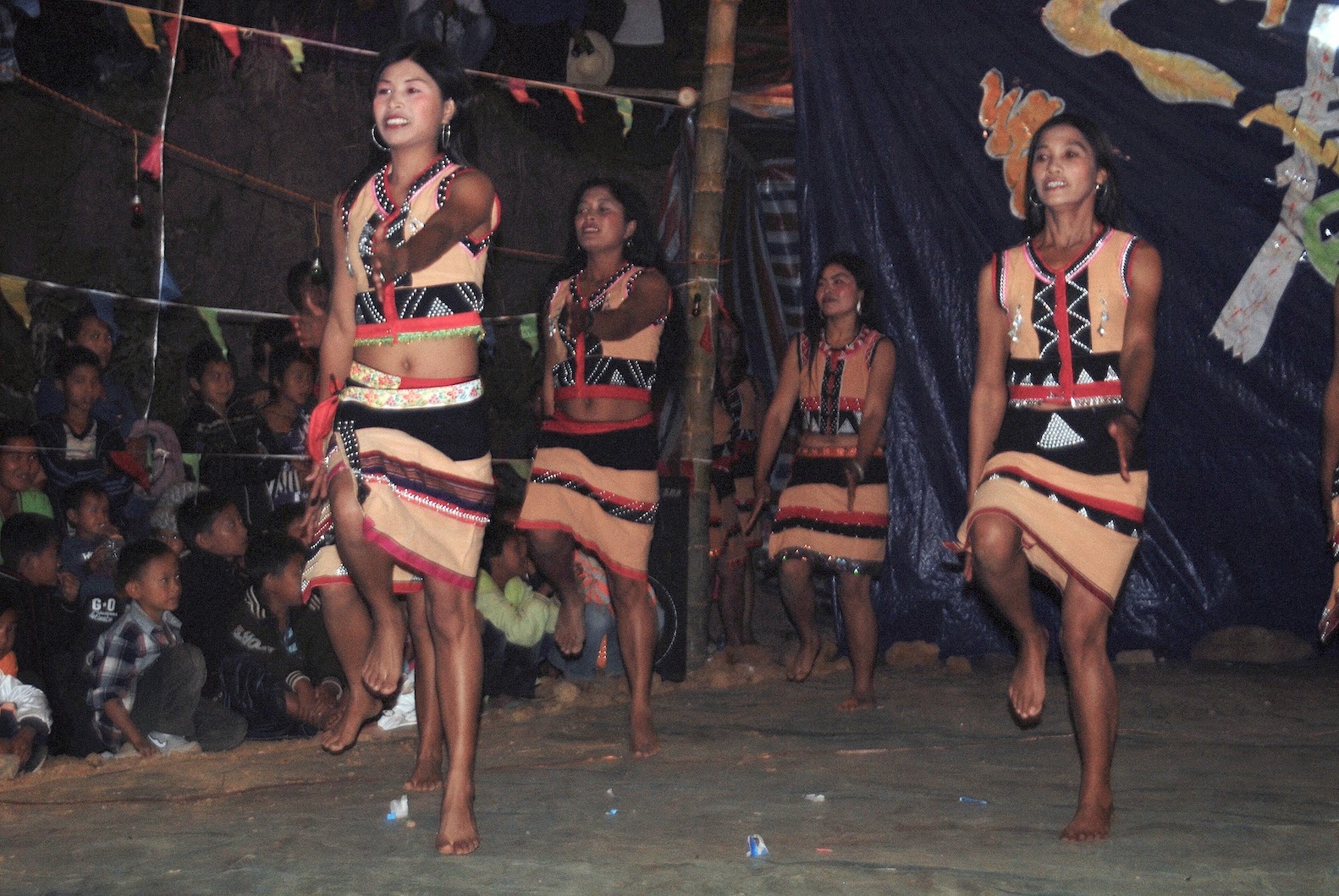
Wa dancers performed the second night.
       That we did, as our hosts graciously plied us with one dish after another of various parts of these animals, punctuated with cups of rice liquor and convivial conversation.  How did we like the show last night?  Wonderful.  It was totally unexpected, meaning, they thought, we didn’t expect a show at all before we came, and meaning, as we thought, we didn’t expect a show in Junzhai to be dominated by dances from Tibet and Xinjiang.   And tonight?  Tonight was going to feature a Wa troupe, not from Junzhai district, but from the mountains near Gengma.
       Once again, after the meal we were seated in the middle of the front row.  Six district Party officials sat on one side of the stage and rose when the young female emcee for the night introduced them to the audience.  Then she introduced their American and German guests and we had to stand and make a slight bow to acknowledge the polite applause around us.  Then the show could begin.
       It was a lot better than the night before.  The various Wa troupes--young female, young male, older female—were better coordinated, more practiced, more exuberant, too.  Aside from occasional solo singers (including the emcee herself) the performances were all Wa, even the instrumental soloists.  The young Wa women, in their traditional, hand-woven, wraparound skirts and blouses, stole the show with their energetic choreography, incorporating bits of the Hair Dance in most numbers.
      About two-thirds of the way through the show the emcee grabbed the microphone in between sets to tell the audience that life in Junzhai district was getting better every year.  There was cleaner water, greater prosperity, etc.  “Do you know why?” she asked the crowd.  Nobody responded.  “Do you know why?” she repeated, looking around at the people.  Still silence.  “Because of the Communist Party!” she shouted.  At that the Party officials seated on the side of the stage stood up and vigorously applauded.
energetic Wa dance troupe
       No one else did.  The emcee looked a little embarrassed but the officials sat back down and the show resumed.  Lethargic audience?  No, for after another sight of Wa girls tossing their long black manes around in another sprightly dance the crowd applauded loud and long.  After the last act the audience rose from their seats and joined the performers in a ring dance, led by musicians on lutes and gourd-pipes.
       The crowd broke up after about a half hour and we joined the walk back to Junzhai.  Back in our lodge we uncorked the whiskey and drank toasts to our holiday good luck--a New Year venue where we paid no surcharge for the hotel, better meals than we had imagined, genuine rural hospitality where strangers become honored guests, an unexpected small town public celebration and the bonus of a stunning performance of wonderful Wa dance troupes.  Happy New Year indeed.
children enjoying the New Year swing

                                                                        * * *

Sunday, September 15, 2013

Calling on the Wa in China


                                                        by Jim Goodman

    The easiest place to meet China’s fascinating Wa minority is the southwestern Yunnan county of Menglian, just west of Xishuangbanna.  The county capital itself, pleasantly sited astride the Bin River, hosts its regular open market every five days.  Wa villagers, mostly women, from hills in all directions stream into town with baskets of mountain herbs and vegetables to sell, joining their hill neighbors the Lahu and Aini, as well as local Dai and Han.  If they haven’t rented one of the stalls in the official market square they simply set up shop under a shady tree somewhere between the river and the market square, or anywhere along a street, if it’s not raining.  They still prefer their traditional hand-woven wraparound, striped cotton skirt, heavy on the red and black, along with chunky silver jewelry, shoulder bags studded with Job’s tear seeds, and peaked cotton caps held down by multiple strands of silver.  Aini and Lahu women also don colorful traditional outfits and ornaments for market day.
Wa woman,Menglian County
 
Wa in Menglian on market day
     For eye-catching jewelry, though, it’s hard to beat the Wa earplugs, intricately designed silver crowns on tubes about 3 cm in diameter, inserted through enlarged holes in the ear lobes.  It takes over a month to gradually expand the original hole by inserting another toothpick-sized bamboo splinter every two or three days.  Women also wear inscribed silver disc-pendants, strings of beads, several bangles each wrist, and wide bead belts.  Long-stemmed silver pipes, which women of all ages seem to favor, serve as ornaments when not in use, as they are then tucked in the cap or belt.
   
Wa jewelry in Menglian
Wa smoker in Gengma
    Townships to the north and west, mostly Wa-inhabited, can be reached by regular mini-vans out of Menglian town.  The Wa traditionally live in houses of bamboo and wood, on stilts, with roofs of thatch and an adjoining open balcony.  Women often hook up their looms on this balcony, especially in the dry season, and are oblivious to the stranger’s fascination with the process of weaving.
    Menglian’s Wa are quick to welcome the rare foreigner who wanders into their villages.  I could hardly walk a hundred paces without hearing friendly greetings, sometimes even in English, nor be more than five minutes into my exploration without someone inviting me inside for tea.  In one village my excursion coincided with a wedding.
Ximeng County Wa girl
    Between the harvest and Lunar New Year is the Wa wedding season.  In a large village marriages occur almost daily and, buoyed by the joy of the occasion, the people are especially hospitable.  No grand ceremony or dance takes place, just a bit of divination with the thighbones of the sacrificial chicken.  But as Wa youth choose their own partners, Wa custom is not to allow a negative prognosis to overrule affairs of the heart.  They just slay another chicken (or more, if need be!) until the thighbone reading is favorable.  Following this comes a grand celebratory feast, with lots of pork and rice-liquor.  And the stranger is the guest of honor, with whom everybody wants to share a personal, bottoms-up toast.
    The first words I learn to say in Wa were nyu bre—drink liquor.  Now, inspired by the alcohol, I asked my hosts for more words and phrases, jotted them down, and soon had enough to try speaking with the nearest unmarried Wa girl in her own language.  “How are you?  Are you enjoying yourself today?  What’s your name?  Don’t be shy.  I love you.”  My hosts, and the girl as well, found this uproariously amusing.  When shortly afterwards it was time to return to Menglian, half the village came out to see me off.
     Yes, a foreigner wanders alone freely and safely through remote Wa villages nowadays.  Two or three generations ago, travelers needed armed escorts.  The villages were very large, stockaded settlements, fortified all around, with a single entry passage via a tunnel through thick thorn bushes, which ended at a heavy gate.  The Wa were notorious head-hunters until the mid-1950’s, when the government finally launched a campaign to eradicate the practice.
    Spring was the prime head-hunting season, for the Wa believed the head contained the human soul-force needed to provide spiritual protection for the rice crop about to be planted.  One or two fresh skulls were required every year or two, mounted on tall poles on the village perimeter, replaced and buried when their soul-force was considered depleted.  Wa warriors generally took heads from relatively distant villages, so that the soul-force within the skull would not wander off, trying to find its way back home.  Non-Wa strangers were thus also vulnerable, and in general steered clear of the Wa-inhabited areas.
old village in Awashan
    Life wasn’t much more secure for the Wa themselves, as the system inherently generated blood feuds among villages.  Hence, villages were huge, containing sometimes over 300 households, for it was safer to live in big, defensible settlements.  The whole area, loosely called Awashan, or the Wa Hills, was so insecure for so long in its history that the border between Burma and China was not fully demarcated until the 1960’s.
    Most of Yunnans’ 350,000+ Wa live in one or another mountain range along the Burmese border in Pu’er and Lincang Prefectures.  In Ximeng and Cangyuan they are the majority ethnic group, far outnumbering the Dai and Han.  How long they have resided in Yunnan is unknown, for the Wa have no written history.  But cliff paintings of typically Wa activities like hunting, festival dances and buffalo sacrifices, which contemporary Wa claim to be the work of their ancestors, adorn a cliff face at Ai Hua, near Menglai township in Cangyuan County.  They are said to be 2000 years old.
    Not all Wa in the old days were headhunters.  Outsiders used to classify them as Wild Wa and Tame Wa, both in China and Burma.  The former were the true warrior societies, who took heads regularly and were much feared by people in the plains.  The Tame Wa either purchased heads from Wild Wa warriors or substituted wild animal or buffalo skulls instead.
    A turning point in Wa history came with the British annexation of Upper Burma in 1881.  British expeditions into the hills close to China were taken to establish administrative control and pacify as much of the area as could render ordinary commerce possible.  The proportion of Tame Wa began to grow, especially in those areas close to major routes.  Christian missionaries, mainly Baptist, penetrated the Wild Wa domain in Ximeng and Lancang Counties in the first decades of the 20th century, as I was to discover exploring the Wa area around Ankang district, in Lancang County.
Ai Hua rock paintings
   Ankang proper is disappointing:  all buildings concrete, nobody in Wa clothing and the only sign of a typically Wa connection with nature was a huge moth mounted on the door of an apartment.  Everyone there was Christian.  One of the villagers invited me to see their church, in a slightly more picturesque village halfway down the mountain. It was a simple, long wooden building on stilts, with virtually no interior decorations, other than a picture of Jesus, remarkably similar to those one might find in Tennessee or Kentucky.  I arrived just before their late afternoon services. 
    Perhaps as many as half the adults in the village started streaming into the church.  I was not the first foreigner they had ever met, just the first non-missionary.  The village was converted about 80 years ago and had resident foreign missionaries until 1949.  Besides a new religion, they also introduced Ankang’s Wa to another Western tradition—shaking hands upon making acquaintance.
    As soon as villagers saw me in the church they came up to shake my hand.  This was interrupted by the services, but resumed afterwards, continuing until the moment our tractor-trailer left at dusk.  The services themselves were short, comprising a brief sermon by one of the men, followed by the singing of two hymns.  As many men as women attended, the latter mostly dressed in Wa costume, here mainly black garments and big turbans.  Both used hymnals with the lyrics translated into Wa, using a Romanized script devised by missionaries in Burma during its colonial days.
Christian Wa services
    Christian Wa had already been the tamest of the Tame Wa before the Chinese government in 1956 established authority in the last of the Wild Wa areas and decided it was time to tame them as well.  The last recorded headhunting incident occurred in 1958, motivated by a feud and not a desire to protect the rice crop.  It was resolved in the traditional Wa way—by compensation rather than incarceration.  But the system, even the belief that sponsored it, was dead, and as a result Wa villages dismantled their fortifications.
    In some villages in southern Gengma and western Cangyuan counties, the Wa became Buddhist.  Getting off the bus at Ban Hong, 45 km northwest of Cangyuan town, I discovered monks walking around, and young Wa novices in yellow robes playing in the courtyard of a temple in the Wa style, with two roofs like Dai village temples, but covered in thatch.  Near the center of the village stood a small shed housing the sacred village pillar, modeled on those in Buddhist Dai villages in the plains.
Buddhist Wa temple in Ban Hong district
    Stopping at the village temple to chat with the head monk, I was importuned to have lunch.  As one might expect, it was a vegetarian meal, served with tea and not rice-beer, consumed inside the temple proper.  When the monks learned I lived in Thailand they nodded, yes, a Buddhist country.  Their own quarters were in a single-roofed adjoining building.  The Wa of western Cangyuan and southern Gengma Counties became Buddhist after the eradication of headhunting.  Dai monks then campaigned in the hills and quickly converted scores of villages.
    In the hills east of Gengma, as well as east of Cangyuan and south along the border to Menglian County, Wa villages gave up head-hunting, but retained other aspects of their culture and animist religion. Wa traditions, minus the bloodthirsty ones, still animate the lives of a good portion of the Wa population.  Many of the old festivals survive, or in some cases were revived.  But no general rule exists on such a phenomenon.  What survived in one area lapsed in another.  What was revived in one county was ignored in the next.  Only in recent years, influenced by the revivalism affecting most Yunnan ethnic minorities, have the Wa begun relating more to each other, seeking common cultural denominators among the Wa sub-groups or, in the case of the traditional and exuberant Hair Dance, adopting new ones.  Other affinities will be found in the domestic lifestyle and village architecture.
    From various vantage points on the road from Mengsheng south to Cangyuan one can easily see traditional Wa villages on slopes of the nearest hills, their antiquity evident by their great size—like rural metropolises.  Very few modern buildings mar the otherwise uniform pattern of peaked, thatched roofs that reach nearly to the ground.  A niche-like opening cut into the thatch enables one to ascend the small staircase in front and enter.  Interiors are dark, with a central hearth.  Houses in the western part of Wa-inhabited areas do not have the adjoining balcony, though some have a crude raised porch in the yard.
Wa woman in Zuodou
    Looking for a typical traditional Wa village near Xuelin, in northwestern Lancang County, I was advised to go to Zuodou, 17 km by winding road, but only half that by a short-cut, w-like trail.  Zuodou lies high in the hills.  Its few modern buildings—school and administrative offices—stand on flat land beside the road, several Wa homes to their side.  But walk past these and the old and (relatively) new parts of Zuodou sprawl across the hilly terrain.  Perhaps 300 or more households make up Zuodou: houses close together, elevated slightly, with steeply-sided roofs, a few in corrugated iron or asbestos, all the rest in thatch.  Villagers grow rice, maize and vegetables on dry terraces, supplementing this by hunting with crossbows and long-barreled rifles, trapping, and the gathering of wild edibles and medicinal plants. 
    Cotton is another local crop, used for spinning thread to weave their wraparound skirts and the cloth for their jackets and turbans.  In the dry season women are often at work in cloth production, by spinning, dyeing or winding thread and by weaving on simple back-strap looms that can be hooked up anywhere.  Unlike Xuelin, where modern styles are the rule, Zuodou women mostly prefer their traditional clothes.  Whether walking around in the thatched neighborhoods or sitting outside at the loom, they give Zuodou an almost timeless atmosphere.   
    I arrived with a Chinese friend on what I expected to be an ordinary winter morning. Instead, with the first invitation to come inside and have a drink, I became acquainted with a Wa custom I didn’t know existed, as well as the proper way to quaff rice-beer.  My host family was in the process of celebrating the castration of their buffalo that morning.
    The Wa here castrate the buffalo when it has reached 14 years of age, though on no particular day in the lunar calendar.  The deed is done to render the animal gentler and easier to handle, as its prime reproductive days are over.  Yet it’s an important occasion, for the family that carries it out then must invite the heads of all families in the same clan to a feast featuring several pork dishes and an abundance of rice-beer.
older woman in Zuodou
    The castration took place shortly after sunrise.  As the other guests arrived and the women prepared the food, the men gathered around the hearth inside the house and commenced drinking rice-beer.  Now this is not a particularly potent drink but the men began drinking quite early this day and by the mid-morning meal a degree of intoxication was affecting every one of them.  Some were singing old Wa songs, but independently of each other, while those next to them paid no attention and just upped the volume of their conversations.
    Meanwhile, as fresh guests we were given a few preliminary, pre-dinner drinks and then, after the meal, most of the beer in the single communal mug was served to us, as if they wanted us to catch up to their level of inebriation.  The rice-beer is stored in a large ceramic pot and the host ladles it into a large bamboo mug, without handles, and, holding the mug with both hands, gives it to the guest.  Taking it with both hands, the guest drinks a little bit of the brew then, again, always, with two hands, passes it back to the host.  He takes it, with both hands, has a small drink and gives it back to the guest.  This custom is designed for the guest to show respect to the host.  After receiving the mug again the guest may drink the rest of the contents, or just a portion and offer the mug to another guest.
    This is a slow but steady way to get drunk.  The cacophony of the party hardly abated the next hour or more while our host served us mug after mug.  We toasted everyone and everything that came to mind and finally persuaded them to cease serving us beer so that I could photograph them.  So we finally made it outside, took portraits, wrote down their address to post them the results, and departed for other quarters of Zuodou.  And while I have my photos, as well as a couple of nice Wa shoulder bags, my favorite souvenir of the Wa Hills will be my memory of the Wa way of drinking.

Wa village, Cangyuan County
                                                                      * * *