Showing posts with label back-strap loom. Show all posts

Sunday, February 2, 2020

Between the Mountains and Plains: the Karen of Northern Thailand


                                                                 by Jim Goodman

weaving on the back-strap loom and dressed in traditional style
       The highlands of Northern Thailand are home to several ethnic minorities, collectively known as the ’hill tribes’—the Hmong, Lahu, Akha, Yao, Lisu and Karen.  The Thai never settled there, preferring the plains and valleys.  In fact, until the early 19th century, when the Karen began settling in the lowlands along the western border with Burma, the northern highlands were virtually uninhabited.  A century ago only a handful of villages of the other hill tribes existed in the far north.
       The major impetus for migration came in the 1960s, when various ethnic minorities in Myanmar began armed struggles against the government.  The resulting chaos of armies contesting control of villages led many hill residents to flee the country and settle in the remote mountains of northern Thailand to live a peaceful existence far from the insurgencies. 
old-fashioned houses in a Karen village
       As the wars in Myanmar gradually wound down (though still not entirely) migration into northern Thailand eased.  The hill tribe population today is nearly a million, half of them Karen, and the mountains are the site of so many settlements that the traditional slash-and-burn agricultural system is no longer viable.  Most farmers now rely on cash crops like cabbages, tea and coffee that don’t require new fields every two years.
       As recently as the early 1980s many mountain villages also cultivated opium.  Tourist literature promoted visits to the hills to meet minorities and see the opium fields.  By the late 80s, thanks to new roads cut into the hills and aerial surveys, the government had eradicated all but the smallest private fields. 
Karen village in Mae Satiang province
       The Karen in Thailand were not involved in commercial opium cultivation.   For one thing, they occupied the foothills, rarely as high as 1000 meters altitude, and opium only grows successfully here above 1000 meters.  Opium was not part of traditional culture.  Families living higher up above 1000 meters might grow a little for medicinal use, but rare was the Karen addict.
       Like the other hill tribes, the Karen originated from remote mountainous regions north of Thailand and Myanmar.  They migrated into Myanmar at least 800 years ago, settling along the Salween River and the border areas next to Thailand.  The dialects of their language are part of the Karenni group, but linguists debate whether Karen dialects should be included in the Tibeto-Burman group of Sino-Tibetan languages or classified as a separate group of their own.
elderly Pwo Karen woman
Karen man and his pipe 
       Karen dialects are not mutually intelligible, a factor in their development as relatively autonomous villages that were not linked in anything resembling a unified state.  Just as the Karen never had hereditary kings, it had no nobility or privileged class.  It was an egalitarian society.  Even the family inheritance was divided equally among the surviving children.
at ease at home in Mae Khanat, Lamphun province
       A headman assisted by a Council of Elders managed village affairs.  The council was all male, but women had a high status.  When they married, instead of all their children becoming part of the husband’s line,  only the males did.  The daughters became part of the matrilineal line.  Important annual rituals were jointly conducted by the headman and the senior woman of the oldest matrilineal line.
       Their religion was animist, accented by strong notions of omens, propitiatory rites and the dangers of unknown spirits.  Very early in their history they adopted the use of bronze drums.  These were very large, over a meter diameter, with the top inscribed with concentric designs and often decorated with animal figures, especially frogs, on the rim.
       During the height of the dry season people beat the drums to summon the monsoon rains.  The sound resembled thunder and aroused the frogs, also associated with rain, and thus encouraged the rain to come.  They also beat them at important ceremonies to frighten off nefarious spirits.
Karen girl, Mae Sariang province
Pwo Karen girls dressed in their best 
       When they migrated into eastern Burma the choicest plains locations were already occupied by Burmese or Mon.  So they settled away from these areas to the far edges of the plains and into the lower slopes of the hills.  Those on the plains grew wet rice, tobacco, betel, and various fruits.  Those higher up grew dry rice, yams, tea, chili, vegetables and cotton.
mahout directing an elephant's work on the Salween River, 1977
       In the surrounding forests men hunted boar, deer, squirrel and lizard.  Women and children gathered frogs, mushrooms, insects and larvae, honey, field crabs and medicinal herbs.  The village goal was self-sufficiency.  That was nearly impossible to fully achieve, but they relied on the market for very little of their everyday needs.
       They stayed as isolated as possible from Burmese administration, carried on feuds with each other, making raids and counter-raids, and periodic conflicts with their neighbors the Lawa.  Changes came with the British colonial period in the early 19th century.   In terms of taxation and corvée labor, the Karen found the British much less demanding than the Burmese and did not resist the new system.  The British sent missionaries into the Karen villages and because the Biblical stories and Christian precepts often coincided with some of their own ancient legends and traditional values, many Karen villages quickly converted.
Ruammit, the Karen village for riding elephants
       Some missionaries, upon discovering these similarities, began persuading the Karen that they were one of the lost tribes of ancient Israel.  They may even have believed it themselves and outlined a migration route from Israel after the Roman conquest, up through the Caucasus, across central Asia, the Gobi Desert, then down through the snow-capped mountains of southwest China and Tibet and finally into Lower Burma.       
       The Christian British also treated their Karen subjects the same way they did their Burmese subjects, an equality imposed by colonialism.  This also influenced the decision to convert.  Later on the British introduced schools, educating both men and women.  This had an unintended effect of stimulating pan-Karen nationalist sentiment.  When the British prepared to withdraw, Karen nationalists were ready to campaign for a high degree of autonomy within the coming independent state of Burma, if not their own separate state entirely.
Karen mahout near Samoeng
feeding the elephants near Samoeng
       Supposedly the Burmese leader Aung San was sympathetic to their demands.  But after his assassination the new government refused to consider Karen autonomy.  War broke out between the two sides.  Many of the Karen fighters had served in the British army during the war with Japan, so their officers were just as experienced as those on the Burmese side.  In the beginning the Karen occupied the Ayeyarwaddy Delta and nearly captured Yangon.  But the Burmese regrouped, drove the Karen out of the Delta and carried the war to Karen territory.
weaving in Mae Khanat, Lamphun province
       They never fully subjugated all of the Karen lands, though gradually pacified most of them.  The intensity of the conflict subsided over the decades, yet the insurgency has still not ended.  The war drove many Karen refugees across the border, living in camps until they could find a place to settle.  The fact that they had fled into what was already territory occupied by Karen migrants for several generations certainly eased their assimilation.
       Most of the Karen in Thailand belong to two groups—the Sgaw and the Pwo.  They live the same way, but speak mutually unintelligible, separate dialects. Both Sgaw and Pwo Karen women provide their families’ garments by weaving bolts of cotton cloth on a back-strap loom.  They used to grow and spin their own cotton, but in recent decades they have opted for buying machine-made thread in the markets. 
       Nevertheless, the rest of the process still follows the traditional procedures.  They wind the thread into balls and then prepare the warp threads by winding them out around pairs of bamboo sticks, changing colors where necessary.  When that’s done they mount the warp threads on the loom by tying them around end sticks, separating every other thread with a continuous, single-thread heddle, and attaching the near end stick to a strap that wraps around the waist while they are seated.  The far end stick they fasten to a house post, back of a trailer or anything strong and immovable.
marketing Karen textiles, Li district, Lamphun
       The weaver leans forward to loosen the tension on the warp threads, lifts the heddle stick to separate the warp set and create a ‘shed.’  Through this opening she tosses the shuttle with the weft thread.  She then leans back to tighten the tension and knocks the weft thread into place with a wooden beating sword.  She then repeats the process, but tosses the weft shuttle in the opposite direction. As the web of cloth gets bigger she may add patterns onto the surface by inserting what’s called ‘supplementary weft.’  These are often done using woolen thread to make them stand out more.
       The result is a tightly bound, strong and durable strip of cloth 50 cm wide and up to four or five meters long.  They stitch sections together for various articles of clothing.  The most common is the shirt, worn by both sexes, though with different patterns for each.  The head fits through an opening at the top and the sides and hem may be fringed.  The long dress that young women favor is a longer version of the shirt, reaching to the shins.  Usually it’s basically white.  Sgaw girls add some fringe on the sides and over the front.  Pwo girls fringe the top and decorate the section below the knees with bright red pile embroidery patterns.
       Most of the rest of the cloth goes to make sarongs, the everyday garment for women.   Another portion is for shoulder bags and the rest for blankets and cloth for swaddling babies.  With the onset of tourism and Karen involvement in the trade, the women now have incentives to produce traditional textiles for new, non-Karen customers.
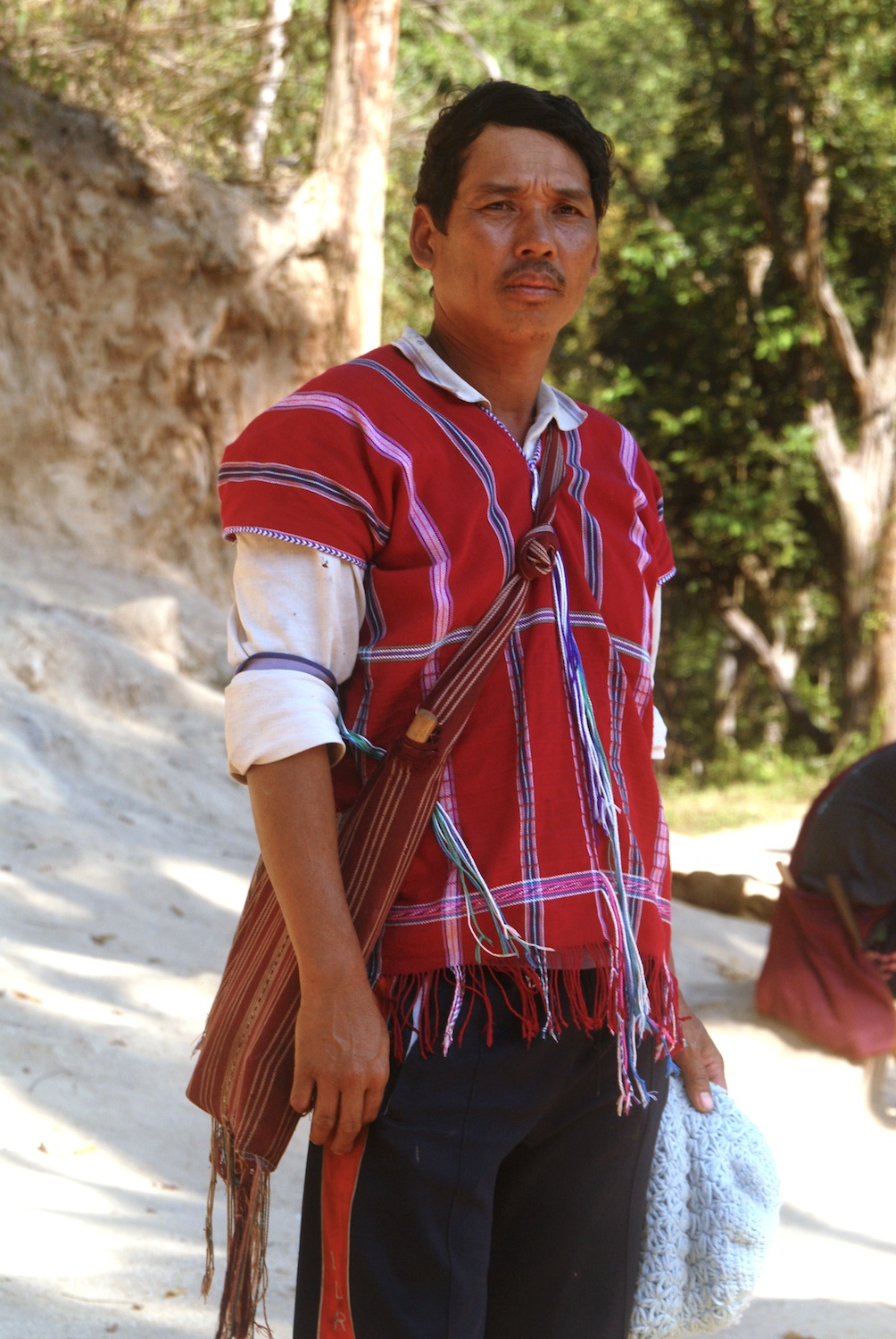
young Karen man, Li district
elderly weaver near Mae Sariang
       With new roads connecting Karen villages with the outside world, the youth have been migrating out for education, jobs and new trades.  Modernization also means that seasonal labor or temporary work on construction projects is also possible.  Some Karen became successful tour guides, for the average trek of three to five days included at least one night in a Karen village and the customers usually preferred ethnic minority guides for visiting hill tribe villages.
still using mortar and pestle to pound rice
       In the 20th century many Karen men worked in the logging industry, particularly in Mae Hong Son and Mae Sariang provinces.  They were the mahouts, the elephant handlers who trained the animals to haul logs out of the forest and assemble them into rafts to float downriver.  Towards the end of the century the government, in response to rapidly shrinking forests, banned logging.
       Throughout the 90s tourism began growing fast and the industry found a new use for the Karen mahouts and their animals.  Riding elephants became one of the things most tourists had to experience while in the north.  They had the option of the elephant show at Mae Rim, less than an hour north of Chiang Mai, where short rides were possible. 
Karen woman from Mae Sariang province
Karen woman, Mae Khanat, Lamphun
       If they had the time, though, they preferred going further away, somewhere looking less touristy and more authentic, even though it was set up for tourists.   One early popular excursion was the Karen elephant village Ruammit, on the banks of the Kok River west of Chiang Rai.  Not only did the ride take place in a genuine rural environment, customers also enjoyed the one-hour boat journey from Chiang Rai through the rural scenery, passing villages, temples, farms and other boats.
       Other riding centers sprang up in the forests near Mae Taeng, the remote streams of Mae Wang district and the hills above Samoeng.  Some camps also educate their customers on caring for elephants and learning about their nature.  The Karen have been involved with elephants for many centuries and certainly know them intimately.
Karen women at Chiang Mai's Tribal Life Festival
       Despite the changes of the last few decades, the Karen still live mostly according to traditions.  Historically a shy people, they have managed to stay aloof and largely unaffected the modernizing world.  Though about 15% are Christian, and a smaller percentage still animist, the majority are Buddhist, influenced by their long proximity to the Burmese Buddhists.  And like their Burmese (and Thai) neighbors, they never really abandoned animist beliefs, like the dangerous presence of bad spirits that must be placated.
       Their material life blends their tradition with the influence of neighbors.   When they build something to replace their bamboo and thatch house, it’s a stilted wooden house, like those of their northern Thai neighbors.   They use electricity instead of oil lamps now, but still pound rice the old way.  They might buy modern jackets in the city markets to don in cold weather, but still prefer, the women especially, their traditional, hand-woven clothing, as well as ornaments like the many brass and silver bangles around their arms. .
       They are also very community-conscious.  Family and kin are especially important.  While they devoutly observe religious holidays, special family occasions, especially weddings, are events demanding gusto and exuberance.  At such times drinks flow, frivolity follows, jokes and laughter fill the room and the normally hidden gregariousness of the Karen people puts on a full display.

conviviality at a Karen party

                                                                        * * *    

Sunday, September 15, 2013

Calling on the Wa in China


                                                        by Jim Goodman

    The easiest place to meet China’s fascinating Wa minority is the southwestern Yunnan county of Menglian, just west of Xishuangbanna.  The county capital itself, pleasantly sited astride the Bin River, hosts its regular open market every five days.  Wa villagers, mostly women, from hills in all directions stream into town with baskets of mountain herbs and vegetables to sell, joining their hill neighbors the Lahu and Aini, as well as local Dai and Han.  If they haven’t rented one of the stalls in the official market square they simply set up shop under a shady tree somewhere between the river and the market square, or anywhere along a street, if it’s not raining.  They still prefer their traditional hand-woven wraparound, striped cotton skirt, heavy on the red and black, along with chunky silver jewelry, shoulder bags studded with Job’s tear seeds, and peaked cotton caps held down by multiple strands of silver.  Aini and Lahu women also don colorful traditional outfits and ornaments for market day.
Wa woman,Menglian County
 
Wa in Menglian on market day
     For eye-catching jewelry, though, it’s hard to beat the Wa earplugs, intricately designed silver crowns on tubes about 3 cm in diameter, inserted through enlarged holes in the ear lobes.  It takes over a month to gradually expand the original hole by inserting another toothpick-sized bamboo splinter every two or three days.  Women also wear inscribed silver disc-pendants, strings of beads, several bangles each wrist, and wide bead belts.  Long-stemmed silver pipes, which women of all ages seem to favor, serve as ornaments when not in use, as they are then tucked in the cap or belt.
   
Wa jewelry in Menglian
Wa smoker in Gengma
    Townships to the north and west, mostly Wa-inhabited, can be reached by regular mini-vans out of Menglian town.  The Wa traditionally live in houses of bamboo and wood, on stilts, with roofs of thatch and an adjoining open balcony.  Women often hook up their looms on this balcony, especially in the dry season, and are oblivious to the stranger’s fascination with the process of weaving.
    Menglian’s Wa are quick to welcome the rare foreigner who wanders into their villages.  I could hardly walk a hundred paces without hearing friendly greetings, sometimes even in English, nor be more than five minutes into my exploration without someone inviting me inside for tea.  In one village my excursion coincided with a wedding.
Ximeng County Wa girl
    Between the harvest and Lunar New Year is the Wa wedding season.  In a large village marriages occur almost daily and, buoyed by the joy of the occasion, the people are especially hospitable.  No grand ceremony or dance takes place, just a bit of divination with the thighbones of the sacrificial chicken.  But as Wa youth choose their own partners, Wa custom is not to allow a negative prognosis to overrule affairs of the heart.  They just slay another chicken (or more, if need be!) until the thighbone reading is favorable.  Following this comes a grand celebratory feast, with lots of pork and rice-liquor.  And the stranger is the guest of honor, with whom everybody wants to share a personal, bottoms-up toast.
    The first words I learn to say in Wa were nyu bre—drink liquor.  Now, inspired by the alcohol, I asked my hosts for more words and phrases, jotted them down, and soon had enough to try speaking with the nearest unmarried Wa girl in her own language.  “How are you?  Are you enjoying yourself today?  What’s your name?  Don’t be shy.  I love you.”  My hosts, and the girl as well, found this uproariously amusing.  When shortly afterwards it was time to return to Menglian, half the village came out to see me off.
     Yes, a foreigner wanders alone freely and safely through remote Wa villages nowadays.  Two or three generations ago, travelers needed armed escorts.  The villages were very large, stockaded settlements, fortified all around, with a single entry passage via a tunnel through thick thorn bushes, which ended at a heavy gate.  The Wa were notorious head-hunters until the mid-1950’s, when the government finally launched a campaign to eradicate the practice.
    Spring was the prime head-hunting season, for the Wa believed the head contained the human soul-force needed to provide spiritual protection for the rice crop about to be planted.  One or two fresh skulls were required every year or two, mounted on tall poles on the village perimeter, replaced and buried when their soul-force was considered depleted.  Wa warriors generally took heads from relatively distant villages, so that the soul-force within the skull would not wander off, trying to find its way back home.  Non-Wa strangers were thus also vulnerable, and in general steered clear of the Wa-inhabited areas.
old village in Awashan
    Life wasn’t much more secure for the Wa themselves, as the system inherently generated blood feuds among villages.  Hence, villages were huge, containing sometimes over 300 households, for it was safer to live in big, defensible settlements.  The whole area, loosely called Awashan, or the Wa Hills, was so insecure for so long in its history that the border between Burma and China was not fully demarcated until the 1960’s.
    Most of Yunnans’ 350,000+ Wa live in one or another mountain range along the Burmese border in Pu’er and Lincang Prefectures.  In Ximeng and Cangyuan they are the majority ethnic group, far outnumbering the Dai and Han.  How long they have resided in Yunnan is unknown, for the Wa have no written history.  But cliff paintings of typically Wa activities like hunting, festival dances and buffalo sacrifices, which contemporary Wa claim to be the work of their ancestors, adorn a cliff face at Ai Hua, near Menglai township in Cangyuan County.  They are said to be 2000 years old.
    Not all Wa in the old days were headhunters.  Outsiders used to classify them as Wild Wa and Tame Wa, both in China and Burma.  The former were the true warrior societies, who took heads regularly and were much feared by people in the plains.  The Tame Wa either purchased heads from Wild Wa warriors or substituted wild animal or buffalo skulls instead.
    A turning point in Wa history came with the British annexation of Upper Burma in 1881.  British expeditions into the hills close to China were taken to establish administrative control and pacify as much of the area as could render ordinary commerce possible.  The proportion of Tame Wa began to grow, especially in those areas close to major routes.  Christian missionaries, mainly Baptist, penetrated the Wild Wa domain in Ximeng and Lancang Counties in the first decades of the 20th century, as I was to discover exploring the Wa area around Ankang district, in Lancang County.
Ai Hua rock paintings
   Ankang proper is disappointing:  all buildings concrete, nobody in Wa clothing and the only sign of a typically Wa connection with nature was a huge moth mounted on the door of an apartment.  Everyone there was Christian.  One of the villagers invited me to see their church, in a slightly more picturesque village halfway down the mountain. It was a simple, long wooden building on stilts, with virtually no interior decorations, other than a picture of Jesus, remarkably similar to those one might find in Tennessee or Kentucky.  I arrived just before their late afternoon services. 
    Perhaps as many as half the adults in the village started streaming into the church.  I was not the first foreigner they had ever met, just the first non-missionary.  The village was converted about 80 years ago and had resident foreign missionaries until 1949.  Besides a new religion, they also introduced Ankang’s Wa to another Western tradition—shaking hands upon making acquaintance.
    As soon as villagers saw me in the church they came up to shake my hand.  This was interrupted by the services, but resumed afterwards, continuing until the moment our tractor-trailer left at dusk.  The services themselves were short, comprising a brief sermon by one of the men, followed by the singing of two hymns.  As many men as women attended, the latter mostly dressed in Wa costume, here mainly black garments and big turbans.  Both used hymnals with the lyrics translated into Wa, using a Romanized script devised by missionaries in Burma during its colonial days.
Christian Wa services
    Christian Wa had already been the tamest of the Tame Wa before the Chinese government in 1956 established authority in the last of the Wild Wa areas and decided it was time to tame them as well.  The last recorded headhunting incident occurred in 1958, motivated by a feud and not a desire to protect the rice crop.  It was resolved in the traditional Wa way—by compensation rather than incarceration.  But the system, even the belief that sponsored it, was dead, and as a result Wa villages dismantled their fortifications.
    In some villages in southern Gengma and western Cangyuan counties, the Wa became Buddhist.  Getting off the bus at Ban Hong, 45 km northwest of Cangyuan town, I discovered monks walking around, and young Wa novices in yellow robes playing in the courtyard of a temple in the Wa style, with two roofs like Dai village temples, but covered in thatch.  Near the center of the village stood a small shed housing the sacred village pillar, modeled on those in Buddhist Dai villages in the plains.
Buddhist Wa temple in Ban Hong district
    Stopping at the village temple to chat with the head monk, I was importuned to have lunch.  As one might expect, it was a vegetarian meal, served with tea and not rice-beer, consumed inside the temple proper.  When the monks learned I lived in Thailand they nodded, yes, a Buddhist country.  Their own quarters were in a single-roofed adjoining building.  The Wa of western Cangyuan and southern Gengma Counties became Buddhist after the eradication of headhunting.  Dai monks then campaigned in the hills and quickly converted scores of villages.
    In the hills east of Gengma, as well as east of Cangyuan and south along the border to Menglian County, Wa villages gave up head-hunting, but retained other aspects of their culture and animist religion. Wa traditions, minus the bloodthirsty ones, still animate the lives of a good portion of the Wa population.  Many of the old festivals survive, or in some cases were revived.  But no general rule exists on such a phenomenon.  What survived in one area lapsed in another.  What was revived in one county was ignored in the next.  Only in recent years, influenced by the revivalism affecting most Yunnan ethnic minorities, have the Wa begun relating more to each other, seeking common cultural denominators among the Wa sub-groups or, in the case of the traditional and exuberant Hair Dance, adopting new ones.  Other affinities will be found in the domestic lifestyle and village architecture.
    From various vantage points on the road from Mengsheng south to Cangyuan one can easily see traditional Wa villages on slopes of the nearest hills, their antiquity evident by their great size—like rural metropolises.  Very few modern buildings mar the otherwise uniform pattern of peaked, thatched roofs that reach nearly to the ground.  A niche-like opening cut into the thatch enables one to ascend the small staircase in front and enter.  Interiors are dark, with a central hearth.  Houses in the western part of Wa-inhabited areas do not have the adjoining balcony, though some have a crude raised porch in the yard.
Wa woman in Zuodou
    Looking for a typical traditional Wa village near Xuelin, in northwestern Lancang County, I was advised to go to Zuodou, 17 km by winding road, but only half that by a short-cut, w-like trail.  Zuodou lies high in the hills.  Its few modern buildings—school and administrative offices—stand on flat land beside the road, several Wa homes to their side.  But walk past these and the old and (relatively) new parts of Zuodou sprawl across the hilly terrain.  Perhaps 300 or more households make up Zuodou: houses close together, elevated slightly, with steeply-sided roofs, a few in corrugated iron or asbestos, all the rest in thatch.  Villagers grow rice, maize and vegetables on dry terraces, supplementing this by hunting with crossbows and long-barreled rifles, trapping, and the gathering of wild edibles and medicinal plants. 
    Cotton is another local crop, used for spinning thread to weave their wraparound skirts and the cloth for their jackets and turbans.  In the dry season women are often at work in cloth production, by spinning, dyeing or winding thread and by weaving on simple back-strap looms that can be hooked up anywhere.  Unlike Xuelin, where modern styles are the rule, Zuodou women mostly prefer their traditional clothes.  Whether walking around in the thatched neighborhoods or sitting outside at the loom, they give Zuodou an almost timeless atmosphere.   
    I arrived with a Chinese friend on what I expected to be an ordinary winter morning. Instead, with the first invitation to come inside and have a drink, I became acquainted with a Wa custom I didn’t know existed, as well as the proper way to quaff rice-beer.  My host family was in the process of celebrating the castration of their buffalo that morning.
    The Wa here castrate the buffalo when it has reached 14 years of age, though on no particular day in the lunar calendar.  The deed is done to render the animal gentler and easier to handle, as its prime reproductive days are over.  Yet it’s an important occasion, for the family that carries it out then must invite the heads of all families in the same clan to a feast featuring several pork dishes and an abundance of rice-beer.
older woman in Zuodou
    The castration took place shortly after sunrise.  As the other guests arrived and the women prepared the food, the men gathered around the hearth inside the house and commenced drinking rice-beer.  Now this is not a particularly potent drink but the men began drinking quite early this day and by the mid-morning meal a degree of intoxication was affecting every one of them.  Some were singing old Wa songs, but independently of each other, while those next to them paid no attention and just upped the volume of their conversations.
    Meanwhile, as fresh guests we were given a few preliminary, pre-dinner drinks and then, after the meal, most of the beer in the single communal mug was served to us, as if they wanted us to catch up to their level of inebriation.  The rice-beer is stored in a large ceramic pot and the host ladles it into a large bamboo mug, without handles, and, holding the mug with both hands, gives it to the guest.  Taking it with both hands, the guest drinks a little bit of the brew then, again, always, with two hands, passes it back to the host.  He takes it, with both hands, has a small drink and gives it back to the guest.  This custom is designed for the guest to show respect to the host.  After receiving the mug again the guest may drink the rest of the contents, or just a portion and offer the mug to another guest.
    This is a slow but steady way to get drunk.  The cacophony of the party hardly abated the next hour or more while our host served us mug after mug.  We toasted everyone and everything that came to mind and finally persuaded them to cease serving us beer so that I could photograph them.  So we finally made it outside, took portraits, wrote down their address to post them the results, and departed for other quarters of Zuodou.  And while I have my photos, as well as a couple of nice Wa shoulder bags, my favorite souvenir of the Wa Hills will be my memory of the Wa way of drinking.

Wa village, Cangyuan County
                                                                      * * *