Showing posts with label missionaries in Burma. Show all posts

Sunday, February 2, 2020

Between the Mountains and Plains: the Karen of Northern Thailand


                                                                 by Jim Goodman

weaving on the back-strap loom and dressed in traditional style
       The highlands of Northern Thailand are home to several ethnic minorities, collectively known as the ’hill tribes’—the Hmong, Lahu, Akha, Yao, Lisu and Karen.  The Thai never settled there, preferring the plains and valleys.  In fact, until the early 19th century, when the Karen began settling in the lowlands along the western border with Burma, the northern highlands were virtually uninhabited.  A century ago only a handful of villages of the other hill tribes existed in the far north.
       The major impetus for migration came in the 1960s, when various ethnic minorities in Myanmar began armed struggles against the government.  The resulting chaos of armies contesting control of villages led many hill residents to flee the country and settle in the remote mountains of northern Thailand to live a peaceful existence far from the insurgencies. 
old-fashioned houses in a Karen village
       As the wars in Myanmar gradually wound down (though still not entirely) migration into northern Thailand eased.  The hill tribe population today is nearly a million, half of them Karen, and the mountains are the site of so many settlements that the traditional slash-and-burn agricultural system is no longer viable.  Most farmers now rely on cash crops like cabbages, tea and coffee that don’t require new fields every two years.
       As recently as the early 1980s many mountain villages also cultivated opium.  Tourist literature promoted visits to the hills to meet minorities and see the opium fields.  By the late 80s, thanks to new roads cut into the hills and aerial surveys, the government had eradicated all but the smallest private fields. 
Karen village in Mae Satiang province
       The Karen in Thailand were not involved in commercial opium cultivation.   For one thing, they occupied the foothills, rarely as high as 1000 meters altitude, and opium only grows successfully here above 1000 meters.  Opium was not part of traditional culture.  Families living higher up above 1000 meters might grow a little for medicinal use, but rare was the Karen addict.
       Like the other hill tribes, the Karen originated from remote mountainous regions north of Thailand and Myanmar.  They migrated into Myanmar at least 800 years ago, settling along the Salween River and the border areas next to Thailand.  The dialects of their language are part of the Karenni group, but linguists debate whether Karen dialects should be included in the Tibeto-Burman group of Sino-Tibetan languages or classified as a separate group of their own.
elderly Pwo Karen woman
Karen man and his pipe 
       Karen dialects are not mutually intelligible, a factor in their development as relatively autonomous villages that were not linked in anything resembling a unified state.  Just as the Karen never had hereditary kings, it had no nobility or privileged class.  It was an egalitarian society.  Even the family inheritance was divided equally among the surviving children.
at ease at home in Mae Khanat, Lamphun province
       A headman assisted by a Council of Elders managed village affairs.  The council was all male, but women had a high status.  When they married, instead of all their children becoming part of the husband’s line,  only the males did.  The daughters became part of the matrilineal line.  Important annual rituals were jointly conducted by the headman and the senior woman of the oldest matrilineal line.
       Their religion was animist, accented by strong notions of omens, propitiatory rites and the dangers of unknown spirits.  Very early in their history they adopted the use of bronze drums.  These were very large, over a meter diameter, with the top inscribed with concentric designs and often decorated with animal figures, especially frogs, on the rim.
       During the height of the dry season people beat the drums to summon the monsoon rains.  The sound resembled thunder and aroused the frogs, also associated with rain, and thus encouraged the rain to come.  They also beat them at important ceremonies to frighten off nefarious spirits.
Karen girl, Mae Sariang province
Pwo Karen girls dressed in their best 
       When they migrated into eastern Burma the choicest plains locations were already occupied by Burmese or Mon.  So they settled away from these areas to the far edges of the plains and into the lower slopes of the hills.  Those on the plains grew wet rice, tobacco, betel, and various fruits.  Those higher up grew dry rice, yams, tea, chili, vegetables and cotton.
mahout directing an elephant's work on the Salween River, 1977
       In the surrounding forests men hunted boar, deer, squirrel and lizard.  Women and children gathered frogs, mushrooms, insects and larvae, honey, field crabs and medicinal herbs.  The village goal was self-sufficiency.  That was nearly impossible to fully achieve, but they relied on the market for very little of their everyday needs.
       They stayed as isolated as possible from Burmese administration, carried on feuds with each other, making raids and counter-raids, and periodic conflicts with their neighbors the Lawa.  Changes came with the British colonial period in the early 19th century.   In terms of taxation and corvée labor, the Karen found the British much less demanding than the Burmese and did not resist the new system.  The British sent missionaries into the Karen villages and because the Biblical stories and Christian precepts often coincided with some of their own ancient legends and traditional values, many Karen villages quickly converted.
Ruammit, the Karen village for riding elephants
       Some missionaries, upon discovering these similarities, began persuading the Karen that they were one of the lost tribes of ancient Israel.  They may even have believed it themselves and outlined a migration route from Israel after the Roman conquest, up through the Caucasus, across central Asia, the Gobi Desert, then down through the snow-capped mountains of southwest China and Tibet and finally into Lower Burma.       
       The Christian British also treated their Karen subjects the same way they did their Burmese subjects, an equality imposed by colonialism.  This also influenced the decision to convert.  Later on the British introduced schools, educating both men and women.  This had an unintended effect of stimulating pan-Karen nationalist sentiment.  When the British prepared to withdraw, Karen nationalists were ready to campaign for a high degree of autonomy within the coming independent state of Burma, if not their own separate state entirely.
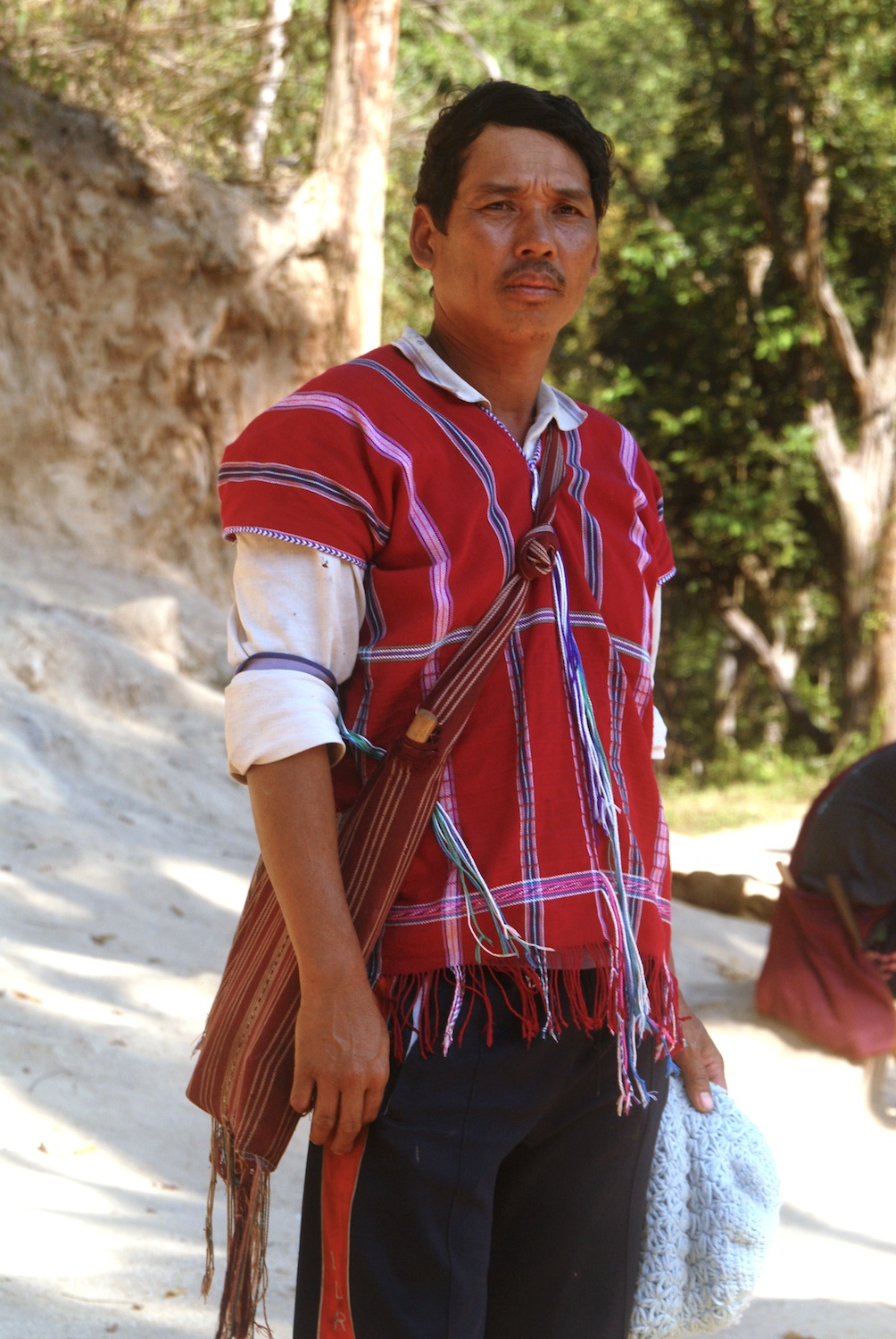
Karen mahout near Samoeng
feeding the elephants near Samoeng
       Supposedly the Burmese leader Aung San was sympathetic to their demands.  But after his assassination the new government refused to consider Karen autonomy.  War broke out between the two sides.  Many of the Karen fighters had served in the British army during the war with Japan, so their officers were just as experienced as those on the Burmese side.  In the beginning the Karen occupied the Ayeyarwaddy Delta and nearly captured Yangon.  But the Burmese regrouped, drove the Karen out of the Delta and carried the war to Karen territory.
weaving in Mae Khanat, Lamphun province
       They never fully subjugated all of the Karen lands, though gradually pacified most of them.  The intensity of the conflict subsided over the decades, yet the insurgency has still not ended.  The war drove many Karen refugees across the border, living in camps until they could find a place to settle.  The fact that they had fled into what was already territory occupied by Karen migrants for several generations certainly eased their assimilation.
       Most of the Karen in Thailand belong to two groups—the Sgaw and the Pwo.  They live the same way, but speak mutually unintelligible, separate dialects. Both Sgaw and Pwo Karen women provide their families’ garments by weaving bolts of cotton cloth on a back-strap loom.  They used to grow and spin their own cotton, but in recent decades they have opted for buying machine-made thread in the markets. 
       Nevertheless, the rest of the process still follows the traditional procedures.  They wind the thread into balls and then prepare the warp threads by winding them out around pairs of bamboo sticks, changing colors where necessary.  When that’s done they mount the warp threads on the loom by tying them around end sticks, separating every other thread with a continuous, single-thread heddle, and attaching the near end stick to a strap that wraps around the waist while they are seated.  The far end stick they fasten to a house post, back of a trailer or anything strong and immovable.
marketing Karen textiles, Li district, Lamphun
       The weaver leans forward to loosen the tension on the warp threads, lifts the heddle stick to separate the warp set and create a ‘shed.’  Through this opening she tosses the shuttle with the weft thread.  She then leans back to tighten the tension and knocks the weft thread into place with a wooden beating sword.  She then repeats the process, but tosses the weft shuttle in the opposite direction. As the web of cloth gets bigger she may add patterns onto the surface by inserting what’s called ‘supplementary weft.’  These are often done using woolen thread to make them stand out more.
       The result is a tightly bound, strong and durable strip of cloth 50 cm wide and up to four or five meters long.  They stitch sections together for various articles of clothing.  The most common is the shirt, worn by both sexes, though with different patterns for each.  The head fits through an opening at the top and the sides and hem may be fringed.  The long dress that young women favor is a longer version of the shirt, reaching to the shins.  Usually it’s basically white.  Sgaw girls add some fringe on the sides and over the front.  Pwo girls fringe the top and decorate the section below the knees with bright red pile embroidery patterns.
       Most of the rest of the cloth goes to make sarongs, the everyday garment for women.   Another portion is for shoulder bags and the rest for blankets and cloth for swaddling babies.  With the onset of tourism and Karen involvement in the trade, the women now have incentives to produce traditional textiles for new, non-Karen customers.
young Karen man, Li district
elderly weaver near Mae Sariang
       With new roads connecting Karen villages with the outside world, the youth have been migrating out for education, jobs and new trades.  Modernization also means that seasonal labor or temporary work on construction projects is also possible.  Some Karen became successful tour guides, for the average trek of three to five days included at least one night in a Karen village and the customers usually preferred ethnic minority guides for visiting hill tribe villages.
still using mortar and pestle to pound rice
       In the 20th century many Karen men worked in the logging industry, particularly in Mae Hong Son and Mae Sariang provinces.  They were the mahouts, the elephant handlers who trained the animals to haul logs out of the forest and assemble them into rafts to float downriver.  Towards the end of the century the government, in response to rapidly shrinking forests, banned logging.
       Throughout the 90s tourism began growing fast and the industry found a new use for the Karen mahouts and their animals.  Riding elephants became one of the things most tourists had to experience while in the north.  They had the option of the elephant show at Mae Rim, less than an hour north of Chiang Mai, where short rides were possible. 
Karen woman from Mae Sariang province
Karen woman, Mae Khanat, Lamphun
       If they had the time, though, they preferred going further away, somewhere looking less touristy and more authentic, even though it was set up for tourists.   One early popular excursion was the Karen elephant village Ruammit, on the banks of the Kok River west of Chiang Rai.  Not only did the ride take place in a genuine rural environment, customers also enjoyed the one-hour boat journey from Chiang Rai through the rural scenery, passing villages, temples, farms and other boats.
       Other riding centers sprang up in the forests near Mae Taeng, the remote streams of Mae Wang district and the hills above Samoeng.  Some camps also educate their customers on caring for elephants and learning about their nature.  The Karen have been involved with elephants for many centuries and certainly know them intimately.
Karen women at Chiang Mai's Tribal Life Festival
       Despite the changes of the last few decades, the Karen still live mostly according to traditions.  Historically a shy people, they have managed to stay aloof and largely unaffected the modernizing world.  Though about 15% are Christian, and a smaller percentage still animist, the majority are Buddhist, influenced by their long proximity to the Burmese Buddhists.  And like their Burmese (and Thai) neighbors, they never really abandoned animist beliefs, like the dangerous presence of bad spirits that must be placated.
       Their material life blends their tradition with the influence of neighbors.   When they build something to replace their bamboo and thatch house, it’s a stilted wooden house, like those of their northern Thai neighbors.   They use electricity instead of oil lamps now, but still pound rice the old way.  They might buy modern jackets in the city markets to don in cold weather, but still prefer, the women especially, their traditional, hand-woven clothing, as well as ornaments like the many brass and silver bangles around their arms. .
       They are also very community-conscious.  Family and kin are especially important.  While they devoutly observe religious holidays, special family occasions, especially weddings, are events demanding gusto and exuberance.  At such times drinks flow, frivolity follows, jokes and laughter fill the room and the normally hidden gregariousness of the Karen people puts on a full display.

conviviality at a Karen party

                                                                        * * *    

Sunday, January 29, 2017

Return to Kengtung—Luxury-Style


                                                  by Jim Goodman

Naungtong Lake, 1998
       Kengtung, in northeast Myanmar, is one of the least visited cities in the country.  Tourists generally stick to the main sites in central Myanmar.  They don’t have the time for a place so far from the popular destinations.  In fact, most travelers who venture as far as Kengtung do so from Mae Sai, Thailand, where they can obtain a special permit, in lieu of a Myanmar visa, valid for Kengtung. 
       Since the bulk of its visitors come in from Thailand and not other parts of Myanmar, tourism promotion concentrates on publicity in Thailand.  To that end, in January this year the city’s largest luxury hotel, the Amazing Kengtung Resort, sponsored a group of ten writers based in Thailand for a stay at the hotel and a tour of the sights.  I was fortunate to be included and looked forward both to seeing a city again that I was already fond of and discovering what a luxury tour is like.
one of Kengtung's many temples
       I had been there twice in 1998, when doing research for a book on the Akha ethnic minority.  I hired a motorcycle driver to take me to Akha and Palong villages in the vicinity, but also spent some time exploring the city, which I found very pleasant.  Kengtung dates its founding to 1267, when King Mengrai of the newly established state of Lanna, its capital in Chiang Rai northern Thailand, drove out the Wa inhabitants and established a city.  He left his younger brother to rule as king and ever since then Kengtung has been regarded in Thailand as Chiang Mai’s Younger Brother, even though Chiang Mai was not founded until 1292.  Same dynasty, though, so technically it should be Lanna’s Younger Brother.
the central market in 1998
       Anyway, the main implication is the close cultural connections between the two.  The inhabitants of Kengtung are mostly Tai Khoen, closely related to the Tai Yuan of northern Thailand and the Tai Lu of Xishuangbanna, Yunnan, China.  Their dialects are mutually intelligible.  They use the same alphabet as old Lanna and share the same monastic traditions.
       Kengtung, therefore, resembled cities in northern Thailand, but as they existed twenty or thirty years ago.  The temples and chedis featured similar architecture.  The residential houses were stilted, as in northern Thailand, and the women dressed in old-fashioned blouses and sarongs.  The morning market revealed the ethnic diversity of the area, as shoppers from several minorities showed up, both men and women dressed in their ethnic clothing—Palong, Lahu, Lisu, Wa and five sub-groups of Akha.
Palong woman and her silver belts
       The city lies on gently sloping hills, so that when walking around it’s never tiring and there’s always a good view, since chedis and temples proliferate in every direction.  The most attractive spot is Naungtong Lake, with chedis, temples and other fine buildings lining its shores.  Back in 1998, electricity ran only two hours a night, from 6 to 8, and nightlife was severely restricted.  At Nauntong Lake, however, there was a floating disco, with its own generator.
       This was the weirdest disco scene imaginable.   A dozen or more pretty girls in white sweaters and red miniskirts worked as hostesses.  To dance with them the boys bought tickets.  One ticket paid for one session, which lasted about a minute and a half.  Then loud whistles interrupted the music, signaling it was time to turn over another ticket to continue dancing.  Thanks to its generator, the disco stayed open a few hours longer than other public places, its raucous music and incessant whistles audible for blocks away.
Buddhist ritual, Wat Jong Kham
       Nine years later I made a third trip to the city.  Fortunately, a new road connected Tachilek with Kengtung, paved all the way, and it only took three and a half hours by bus.  In 1998 the road was only paved in the few towns along the way, full of dirt ruts in between and there were no buses.  I rode in an old station wagon and it took eight hours to cover the 165 kilometers.  A few months later I only decided to make a second trip because I could get a round-trip airplane ticket.
       The city was slightly bigger, but not any busier.  Now it had lighting throughout the evenings, even some dim public streetlights.  The disco was gone, though, and the only available nightlife was sitting with friends in a coffee shop or lakeside bar.  The morning market was as active as ever, but scarcely any women from the hills dressed in traditional clothes.  A few temples had been recently renovated and formerly white chedis were now completely gilded.
Loi woman, central market
Akha woman, Wanpin village
      The most prominent new structure in town since my 1998 visits was the large standing Buddha on a hill across the lake, pointing to the center of the city and its most prominent chedi.  It’s modeled on the original on Mandalay Hill and is a peculiarly Burmese type of Buddha.  The local Tai Khoen never had that kind of image, but now it’s the biggest in town.
planting rice outside Kengtung
       In a way, the Buddha also points to the Amazing Kengtung Resort.  It stands on what used to be the site of the local ruler’s palace, built in 1905 in Imperial Indian style.  He abdicated in 1959 and left for another residence.  The Ne Win government ended Kengtung’s autonomy and the palace began to decay.  Rather than renovate it, the government demolished it in 1992 and authorized the construction of the hotel, in line with its new policy to promote tourism.
       For this trip, my fourth to Kengtung, the hotel sent a comfortable van down to Tachilek for us and one of the staff to take care of the paperwork at the border and at the checkpoints along the way.  We all got spacious, well provided rooms with views of the pool and garden and excellent service.  Our multi-course dinners were fabulous, with mutton, prawns, beef, pork, fish head soup, chicken and local specialties like a kind of rice pancake.  We also dined as sumptuously on our afternoon meals our two days on the road.  Well, on a luxury tour you’re supposed to eat well.
Ann woman, Ban Lea village
the jewelry of an Ann woman
       But what was going to be the Kengtung they were going to show us for two days?  Since the capacious central market is most active in the morning, we naturally started there.  Our guide was quite informative, especially since only two of us had ever been to Kengtung.  He pointed out Loi women standing in the lanes waiting for work as porters, a few Akha women in their ethnic attire, odd foods like buffalo skin, bamboo grubs and other edible insects, and a girl inserting hot coals into an old-fashioned, non-electric iron for pressing clothes.
three generations, Ban Lea village
       We next drove to Naungtong Lake for a view of the prettiest part of the city.  More buildings had gone up since my last look, but all of them attractive.  It was a sunny day and great photo-op, though actually a better view could be had from the balcony at the end of the upper floor hallway of our hotel.
       After a brief look at an abandoned colonial-era residence, we made stops at two temples:  Wat Jong Kham and Wat In.  The compound of the former includes the biggest chedi in the city, while the interior walls of the viharn, the main assembly hall, feature a fascinating array of murals.  In golden yellow on maroon backgrounds, they depict various vignettes of everyday life along with Buddhist motifs and mythology.  Wat In is notable for its Buddha sculptures, elegant chedi and unusual brick book depository.
cherry tree blossoming near Loimwe
       Kengtung has many attractive temples with pretty much the same features.  These two were certainly representative and well worth a look.  So far the tour was going fine.  But then we spent the afternoon in the countryside, our ultimate destination being two ethnic minority villages in the hills an hour so away.  Getting there was pleasant, passing villages and their temples with the characteristic tiered steeples and people planting rice.
       Then we climbed slightly above the plain and arrived at Wanpin Akha village.  I had been in many Akha villages already, in four different countries, on countless excursions in the course of my work and my research, but never with ten people along.  I was wearing an Akha jacket, made by the same sub-group we were visiting, and could converse in their language. 
       That made my encounter different from that of the others in the group.  It meant that I could at least deflect the conversation away from what they were trying to sell me.  The others could not.  We had stopped next to a shop full of handicrafts for sale and a couple stalls just outside marketing the same.  Taking a couple of our group down a village path, hoping to show them the traditional Akha gate and swing, I learned that the village didn’t have either.  They were Christian.  Gave it all up.
Kengtung family on a picnic at Loimwe Lake
       We didn’t stay long, and next headed up the mountain to Pan  Lea, a village of the Ann people, a sub-group of the Wa, an animist group famous for their black teeth.  It’s the result of chewing betel, believed to strengthen the teeth.  They’re not the only people to do so.  We would see Akha, Lahu and Wa with black teeth as well, but they’re the only folks advertised by the tour agencies as the ‘black teeth tribe.’
       The village lies on a rather steep slope, full of traditional stilted houses, with bamboo aqueducts funneling water through the settled areas.  Most everyone dressed in their traditional clothing, mainly black garments.  Older women wore turbans with cowry shells attached and big silver earplugs festooned with colored braided threads.
Italian-built Catholic Church at Loimwe
       Villagers saw us coming up the road and so when we arrived we were all but surrounded by smiling women, some with babies on their backs, offering us various handicrafts—scarves, jewelry, bags, purses and other trinkets, some made by the Akha down the mountain.  Our guide gave a short introduction to the Ann, mostly about the black teeth and a fertility festival in which two men, one dressed as a woman, simulate the sexual act.
       Interesting people, certainly, but our experience was limited to a balcony of a house, with the eager sellers following us, and a look inside.  It’s not that the women were particularly pushy.  They were polite and they did get a few sales from our group.  They were just particularly numerous.  It was not, and could never be, an authentic cultural encounter.
       We left for a stopover at a plains village producing rice spirits for the entire region, enjoyed a few samples, and then returned to Kengtung.  Our destination the next day was Loimwe, a hill station 30 km east, at 1600 meters altitude, 700 meters higher than Kengtung, set up in colonial days as a British retreat.  We had glorious weather, good long-range views of Kengtung and its mountainous setting and the treat of wild cherry trees in full blossom.
fruit wines for sale at Loimwe
       Loimwe’s main attraction is its artificial lake and on weekends Kengtung residents flock here for picnics and visits to colonial houses and the Italian-built Catholic Church.  The area abounds in fruit orchards and shops in the town beside the lake sell wines made from cherry, peach, crabapple and other fruits.  Menus can be a little exotic, too, and our meal here included fried shredded venison.
       The mountain people around Loimwe, mostly Lahu and Wa, are all Christian.  Missionaries were encouraged in colonial days.  The American Baptist Paul Lewis set up the Lahu Theological Seminary near Loimwe in the late 1940s and it's still going strong.  Christian villages aren’t so interesting for potential tourists, though.  The people are polite, but don’t dress in their ethnic clothing because the missionaries persuaded them all that traditional stuff came from the Devil and had to stop.
village temple outside Kengtung
       Besides the Ann village, several animist settlements of Akha, Palong, Lisu and others lie within reach of Kengtung.  Unfortunately, government policy has never permitted foreigners to stay overnight outside the city.  Trekking can never offer much insight into mountain culture if trekkers have to leave the village before dark.  They miss the dinner arrangements, who cooks what, how the family eats, who goes to sleep first and awakes first and what is the first task of the day.  That’s the core of the traditional lifestyle and it won’t be revealed on a brief visit.
       It’s not the fault of the Akha and Ann villagers that their encounter with us was so distressingly commercial.  Regulations determined the circumstances and they were no more allowed a normal experience with us than we were with them.  The government cites security concerns, but the last lingering embers of the Shan insurgency burn a long distance from the Kengtung area. 
       Kengtung is a nice place to visit for its temples, scenery, lake and ponds, interesting walks, sparse traffic, special cuisine and friendly people.  Yet it could offer so much more, specifically authentic encounters with traditional ethnic minorities, the full spectrum cultural experience, just like its Elder Brother Chiang Mai.  But the first requirement is a new law on trekking.
view of Naungtong Lake from the balcony of Amazing Kengtung Resort
                                                                        * * *