by Jim Goodman
After my first journey to Yunnan in 1992, I wanted to see every
prefecture in Yunnan and eventually visited Nujiang in the summer of 1998. Gongshan County was still closed to
foreigners, so after a brief stay in Liuku I spent several days in Fugong
County. The mountain scenery along the
river kept getting more beautiful further north. Snow-capped peaks of over 4000 meters were
already visible before Fugong city, even though it was the warmest month of the
year. Steep slopes on either side were lined
with terraces and settlements speckled the hillsides. Thick forests swathed the tops and some areas
between the villages.
I had good weather on my arrival and the enchanting landscape provoked
me to vow to come again at different seasons.
But by the time I departed I had other reasons.
Nujiang was not on the usual tourist trail
and I didn’t know anyone in Yunnan who had been there.
It was an Autonomous Lisu Prefecture because
the Lisu made up the majority of the population.
So what would be the Lisu reaction to a
Western visitor?
Would they ignore
me?
Be too shy? Feel intruded upon by my
camera?
Well, as it turned out they were
quite friendly, easy to engage with, and only initially shy.
They were as curious about me as I was about
them.
The other attraction of Fugong that reinforced my desire to return was
the very visible presence of traditional Lisu culture. A large portion of the women, young and old,
dressed in Lisu style, with long skirts white, blue, black or pinstriped gray,
a side-fastened vest over a long-sleeved blouse, a beaded cap and ornaments of
beads and shell disks. Some of the men wore the traditional front-fastened shirt
of pinstriped gray, often with black cuffs and collar. And both sexes carried the Lisu-style
shoulder bag, even when they wore all modern clothes.
Fugong stages market day every five days and it’s the most interesting
in the whole prefecture both for the show of traditional garments and the range
of products on sale.
Women run stalls
selling Lisu skirts or jackets, others display ornaments, but besides the usual
cosmetics, toiletries, shoes and such, other traditional Lisu products were
also available.
These included an array
of bamboo cups, beer mugs, spoons, ladles, smoking pipes and bongs.
Others sold baskets of split bamboo and there
were several places to buy crossbows, crossbow bolts and bearskin quivers.
You could also buy crossbow victims, like the
carcasses of flying squirrels and field rats, along with other animal parts—hooves,
antlers, turtle shells--used as medicine.
Crossbows are one of the salient traditions characterizing the culture
of Nujiang. Men took them to the fields
just in case some edible prey appeared and carried them from their villages
down to the city on market day, where the stalls selling them were busy with
potential customers. Nujiang is not the
only place with crossbows. They are
popular in the Wa Hills, too. But
nowhere else are they so widely in use.
I also spotted men with crossbows while taking a taxi north to Nujiang’s
most famous mountain, called the Stone Moon after the big oval hole just below
the peak.
The road rose above the river
to provide a suitable viewpoint, as well as a tavern where the driver and I
could share a couple drinks. I paid a hundred
yuan for the excursion and
the next day hired him for fifty
yuan to take me to Dapuluo, a village
north of Fugong that according to the map looked close to the main road.
The map was deceptive. The
village lay up a steep slope. The driver
took me to the junction and informed me he could not take his vehicle up to
Dapuluo but promised to come back to pick me up when I returned. The road uphill was more like a wide dirt
path, only suitable for tractor-trailers, and so rutted I preferred to walk
anyway, which took an hour. The houses,
mostly wooden with slate roofs, lay in a cluster surrounded by rice
fields. It was planting time so most
villagers were at their farms.
After wandering around taking pictures, it was time to go back down and
meet the driver, who was already waiting for me.
Before taking me back to Fugong he wanted me
to have a meal at his home first.
Maybe
he felt guilty about charging me so much just to go several km to the Dapuluo
junction.
It was a lavish and leisurely
chicken dinner, washed down with rice liquor, with conversations about my life
in northern Thailand, the Akha and Lisu there, my research in Yunnan and me
learning how to say things in the local Lisu dialect.
My new friend later spread the news about me,
for the following morning during market day in Fugong I overheard men speaking
about the American from Thailand researching ethnic minorities.
A few introduced themselves and asked me to
compare Yunnan and northern Thailand.
Well, it was going to be easy to make friends here, so two years later,
after Gongshan County was open to foreigners, I decided to make Nujiang the
primary focus of my Yunnan research.
I
started with a few days in Gongshan, including Bingzhongluo and the First Turn
of the Nu River.
On the long bus ride to
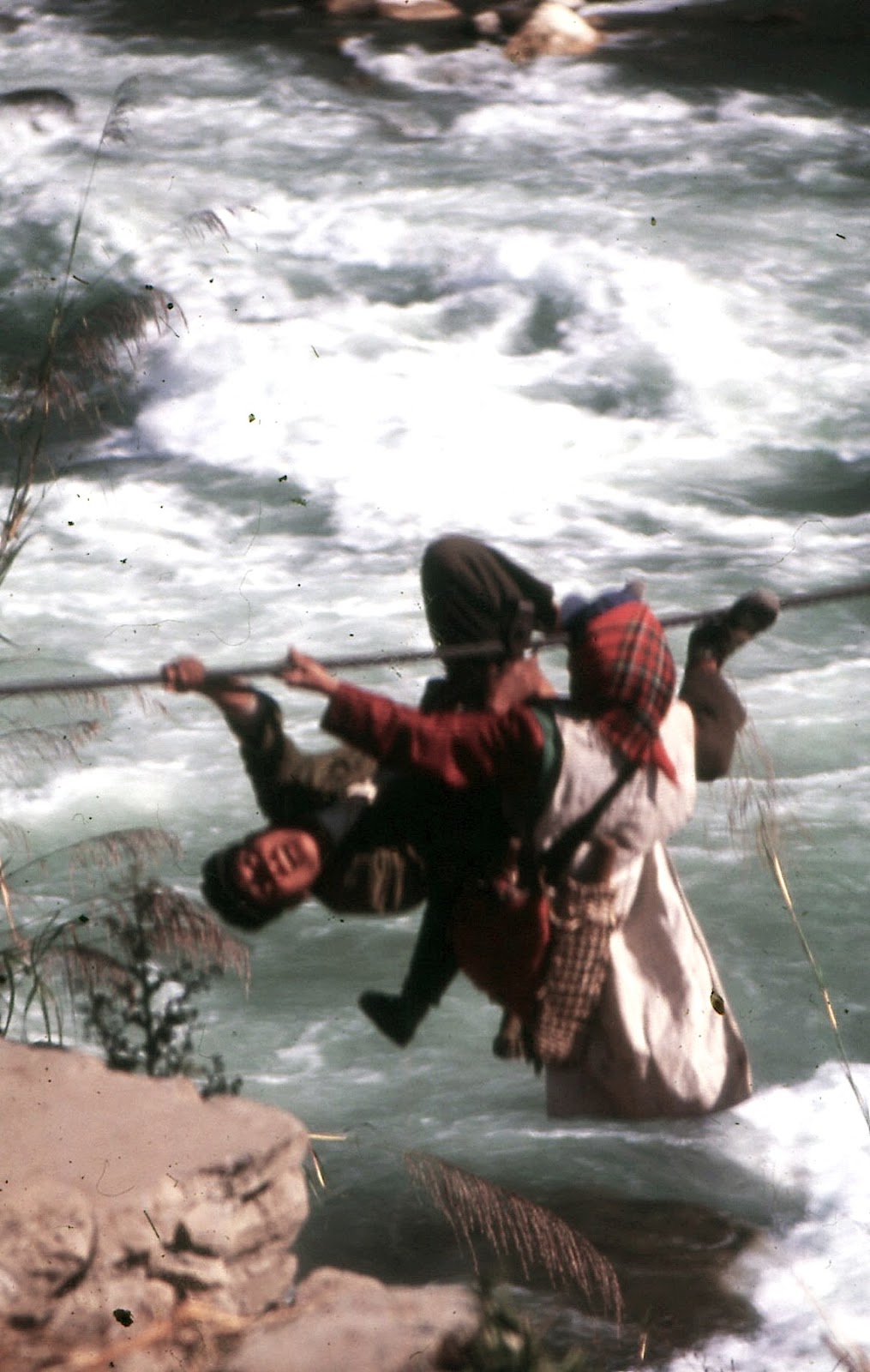
Gongshan I became familiar with another major feature of the Nujiang
canyon—rope-bridges crossing the river.
Formerly made of split bamboo, which required changing after a while,
now they were wound steel cables, almost all in pairs, and still in regular
use, especially those near market day venues.
Leaving Gongshan, I opted to spend a night In Lishadi, in Fugong County
north of the Stone Moon, a picturesque town with tall pointed peaks right next
to it.
After arriving I headed for the
rope-bridge just north of the town that connected the riverbank to the Lisu
village of Heizao.
From a distance I
observed two men crossing over to the other side, but they were long gone by
the time I reached the hook-up point.
However,
after a few minutes four little girls came to the other side, hitched up with
two harnesses on single cable hooks and then, without parental/adult
supervision, the two pairs crossed and re-crossed the swirling river several
times.
Witnessing this I deduced 1) it
can’t be dangerous and 2) it must be fun.
On the way back to Lishadi I stopped at a small sewing shop because a
beautiful young Lisu woman in full traditional clothing and ornaments was
inside visiting her friend the owner.
I
took the opportunity to try using the Lisu language small talk I had picked up
so far.
She was surprised, of course,
and blushed a lot, but the short conversation was successful.
She was from Heizao so I asked her if she
rode the rope-bridge.
By way of
answering she reached into her pack-basket and pulled up her rope harness and
cable hook.
Everyone who lived there had
their own gear.

So the next time I visited Fugong I asked a Lisu woman I knew running a
handicrafts shop to purchase a harness and cable hook for me.
But the nearest rope-bridge was one of the
rare single cable types, where I would have to pull myself over from halfway
across the river.
A Lisu man in the area
came over and I explained, in simple Chinese, what I wanted to do and why here
was not the right spot.
He offered to
take me to Damedi, several km south, with its ordinary sloping pair of
rope-bridges.
And there I experienced my
first crossing of the Nu River in the time-honored traditional way.

My next ambition was to use the Lishadi rope bridge with the excuse to deliver
photos of the kids I had watched the previous trip.
It was market day but still early and a young
man had just crossed when I arrived at the hook-up point.
He offered to take me to the village.
He left his own cable hook behind and hitched
his simpler belt harness to my hook.
We
failed to locate the girl I met in the shop but we did find the little
girls.
My new friend kept repeating how
delighted the girls were with their photos, while the parents plied us with
steamed buns and cups of rice liquor.
Rope-bridges are not unique to Nujiang.
I saw my first one in use near Qiaotou on the way to Shangrila. And there are still some along the upper
Lancangjiang. But, like the crossbows,
only in Nujiang are they so widely in use.
I took my harness and cable hook with me on several subsequent
excursions to Nujiang. I counted 28
rope-bridges in the canyon, two of them single cables and the rest in
pairs. I rode across the Nu River at
eight locations, some more than once. It
was a great way to make a favorable impression on the local people, especially
those who had never ridden one themselves.
It helped make new friends, too.
I carried the cable hook and rope harness in a shoulder bag so part of
it was visible and recognizable to people in, for example, Lumadeng on market
day.
Very quickly a Lisu man approached,
guessed why I had such gear and offered to take me to the rope-bridge a few km
north of the town.
He took his own gear
along, made sure I tied up correctly and we rode across in tandem and
back.
After that it was off to his house
for snacks and beers, where his wife happened to be weaving at the time.
That was a skill I knew well and had even
picked up a lot of the Lisu vocabulary about it, enabling me to make a few
relevant comments to her and compare her narrow loom to similar Akha looms in
Thailand.
I returned to both Lishadi and Lumadeng a few times over the years, both
for the rope-bridges and the colorful market days, where most Lisu dressed in
traditional style.
They each had areas
for drinking local maize beer and rice liquor.
Villages on the slopes were fun to visit because most were
non-Christian, unable to pass up a chance to meet their first foreign guest and
eager to demonstrate their hospitality by getting that guest pretty
inebriated.
Their houses were usually
wooden, stilted when on steep gradients, with thatch or tile roofs, simple
interiors and minimal furniture.
The
hearth was in the center with a bamboo tray suspended above where they stored
bamboo baskets and vessels, which would be cured by the smoke from the cooking
fire. Hunting trophies, like horned heads of barking deer, they might also mount
above the hearth. Big ovens and storage containers flanked the rear wall.
South of Fugong the houses are usually on stone foundations and most are
Christian.
They are just as friendly and
hospitable and eager to impress a guest.
They serve tea, though, not alcohol, because Christians, the sect here
anyway, don’t drink or smoke.
They could
make exceptions, however, as I found out on a trip to Anicha, a Christian Lisu
village high up in the Gaoligong Mountains a little south of Fugong, site of a
Dulong Cattle ranch.
Dulong Cattle are raised for their meat and never used as traction
animals. They are easy to manage and would provide an extra income for the
village. The project was started by
Bobby Morse from Chiang Mai, whose family had been Protestant missionaries in
Nujiang before 1949. His Fugong manager
took me up there. As our hosts prepared
our dinner they asked me if I drink liquor with my meal. “Sometimes,” I answered, not to obligate
them. But perhaps it did, for they went
out and fetched a ‘lax’ Christian villager to bring a bottle of corn liquor and
drink with me. I had my alcohol and a
companion to converse with
My final trip to Nujiang coincided with the Mid-Autumn
Festival. But aside from moon cakes in the Fugong
market there was no sign of the celebration.
The Christians don’t mark it and neither, apparently, do the
animists. Told of a traditional village
high up the slope not far from the city, I hiked there hoping for good
news. Alas, more than one resident
informed me nothing was scheduled. It began to drizzle so a family invited me
into their house.
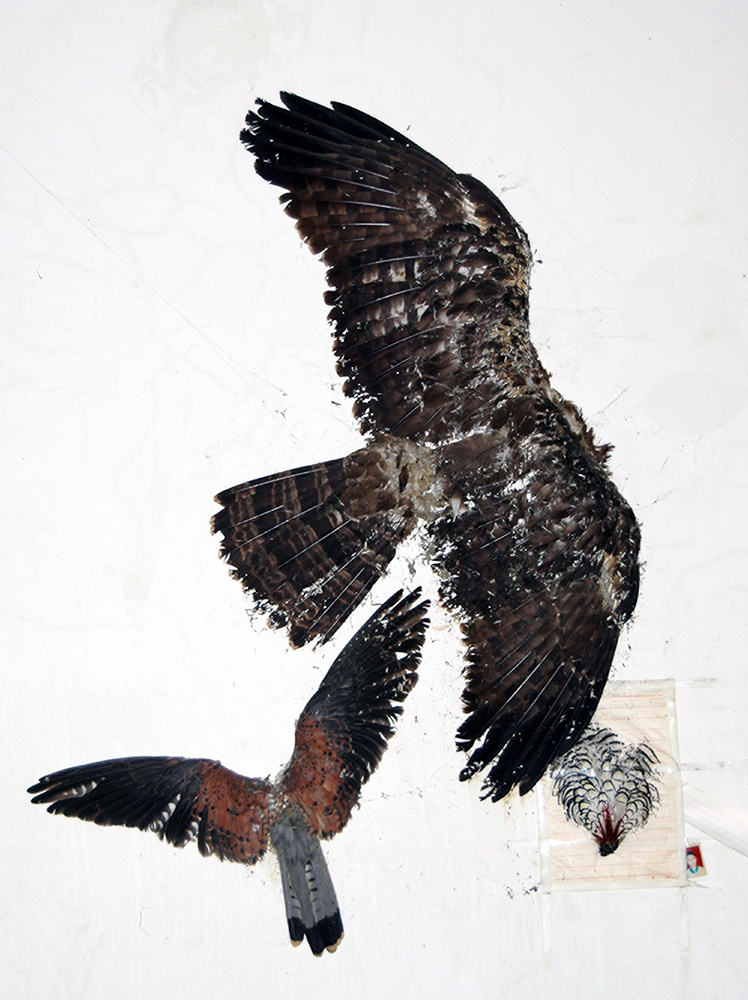
Inside I spotted a crossbow in the corner and two trophies, an eagle and
a pheasant, mounted on the wall. Both
were headless, probably because their heads were inserted into bottles of
home-made liquor, like I’d seen among the Yi of Ninglang. They also had a loom that was used for making
straw floor mats, with stones tied to weight the heddle threads. Hadn’t seen that before.
The rain stopped before I got too drunk.
I thanked the family for their hospitality and thanked the rain for
delaying my departure and enabling me to learn about one more aspect of Nujiang
culture.
If I ever make it back, I’m
sure there is more to discover.
All I
need to do is make new friends—easy among the Lisu of Nujiang.
***


 So the next time I visited Fugong I asked a Lisu woman I knew running a
handicrafts shop to purchase a harness and cable hook for me. But the nearest rope-bridge was one of the
rare single cable types, where I would have to pull myself over from halfway
across the river. A Lisu man in the area
came over and I explained, in simple Chinese, what I wanted to do and why here
was not the right spot. He offered to
take me to Damedi, several km south, with its ordinary sloping pair of
rope-bridges. And there I experienced my
first crossing of the Nu River in the time-honored traditional way.
So the next time I visited Fugong I asked a Lisu woman I knew running a
handicrafts shop to purchase a harness and cable hook for me. But the nearest rope-bridge was one of the
rare single cable types, where I would have to pull myself over from halfway
across the river. A Lisu man in the area
came over and I explained, in simple Chinese, what I wanted to do and why here
was not the right spot. He offered to
take me to Damedi, several km south, with its ordinary sloping pair of
rope-bridges. And there I experienced my
first crossing of the Nu River in the time-honored traditional way. My next ambition was to use the Lishadi rope bridge with the excuse to deliver
photos of the kids I had watched the previous trip. It was market day but still early and a young
man had just crossed when I arrived at the hook-up point. He offered to take me to the village. He left his own cable hook behind and hitched
his simpler belt harness to my hook. We
failed to locate the girl I met in the shop but we did find the little
girls. My new friend kept repeating how
delighted the girls were with their photos, while the parents plied us with
steamed buns and cups of rice liquor.
My next ambition was to use the Lishadi rope bridge with the excuse to deliver
photos of the kids I had watched the previous trip. It was market day but still early and a young
man had just crossed when I arrived at the hook-up point. He offered to take me to the village. He left his own cable hook behind and hitched
his simpler belt harness to my hook. We
failed to locate the girl I met in the shop but we did find the little
girls. My new friend kept repeating how
delighted the girls were with their photos, while the parents plied us with
steamed buns and cups of rice liquor.