Showing posts with label Xiaoweixi. Show all posts

Sunday, November 27, 2016

Wandering Around Weixi County


                                              by Jim Goodman

Tacheng TIbetan neighborhood
       Anyone wishing to meet or research Tibetans in Yunnan goes to Diqing Tibetan Autonomous Prefecture in the northwest.  Tibetan villages lie all over the high plateau and rolling hills of Shangrila County and speckle the steep hills of the more rugged Diqing County, backed by the highest mountains in the province.  Most of Yunnan’s Tibetans live in these two counties, but some also inhabit nearby districts in Weixi, the prefecture’s other county, a Lisu Autonomous County, where Tibetans are a minority and Lisu constitute over 60 % of the population.
       Nevertheless, two important old Tibetan monasteries have existed in the county since the 17th century.  One is a cave temple in Tacheng district, several km west of the Jinshajiang, the river that divides Weixi and Shangrila Counties.  Known as Damosi, it lies high up near the summit of the mountain, with a few monks’ quarters built next to the mouth of the cave containing the main shrine.  It was named after Damo, an Indian disciple of Siddartha, who is said to have spent ten years in the cave on this mountain and achieved Enlightenment there.
Damosi cave temple
       According to Buddhist lore, the surroundings are imbued with religious symbolism.  Damo is supposed to have left his footprints in the stone here. The mountain 18 kilometers distant from the cave shrine is said to resemble an elephant kneeling before Damo's feet.  The Lapu River running along the southern base of the mountain is like a khada—the ceremonial silk scarf.  West of the elephant's trunk is Damoshan, shaped like a seated Buddha.  The temple was constructed at the mouth of the cave in 1662 and restored in 1984.
       Further west along the Lapu River is the town of Tacheng.  The houses are old-fashioned, tile-roofed types common to rural Yunnan, with modern buildings, and not too high, in the town business district.  A modest new Tibetan temple stands on the eastern side of town.  The town’s population, besides Tibetans, includes Han, Naxi, Lisu and Bai.  But when Tacheng hosts dance troupes for major festivals and other events, most of the performers are Tibetan.
TIbetan dancers in Tacheng
       The show takes place in the main square, graced by a chorten—Tibetan pagoda.  More such chortens can be seen in nearby villages on the road south along the river to Weixi city.  But after that the villages on the hills flanking the river are Lisu, while those alongside it tend to be Naxi.  Some have covered bridges crossing the river, but with unattractive corrugated iron roofs. 
       After a journey of a few hours the road bends away from the river and eventually ends up at the northern end of Weixi, a city bounded by scenic high mountains that climbs up the hill behind the bus station.  Some of the business district buildings still have wooden facades with blocks of tiny windows, just like the old days.  Traditional style houses characterize most of the residential neighborhoods, largely Lisu, where the people still keep ponies to carry goods to and from the market.  Their farms are right next to the suburbs and, like the Lisu in Nujiang, they plow their fields with a pair of oxen, with one man guiding the animals and one man working the plow.
lower Weixi
Lisu in Weixi
       As this is a Lisu Autonomous County, signs on government building gates are in both the Chinese and Lisu languages.  The Lisu language is not written in the government-devised system using Latin letters and letters to represent tones, as on signs in Nujiang.  In Weixi they use the Fraser alphabet, created by an American missionary, using Latin letters, but adding backwards or upside-down letters for special sounds in Lisu.
Lisu on the way to Weixi's market day
       The Lisu accent continues in the artistic plaques erected in the city’s small stadium.  Low-relief sculptures depict Lisu dances, of course, but also hunting with crossbows, spearing buffaloes and planting rice. 
       Compared to the Lisu of Nujiang or southwest Yunnan, the Lisu sub-group around Weixi, and in villages up the Lancangjiang (the Chinese portion of the Mekong), do not dress so splendidly.  The women’s outfit is closer to that of the Naxi, with a back apron and side-fastened jacket over plain trousers or a black skirt.  Market day is not as colorful as elsewhere in western Yunnan, but it will include a few Tibetans selling medicinal herbs and a large section for orchids, which is almost a cult thing in western Yunnan, some of them selling for very high prices.  
central Weixi business district
       While Weixi city doesn’t have any temples, it does have a Christian church atop a ridge just west of the city.  It has a three-tiered steeple, more in the Chinese style than Western, but a long, Western church-style nave.  On Sundays several dozen Weixi devotees, mostly Lisu, come to hear the minister’s sermon.
       The Protestant congregation here is the legacy of American missionaries of the Republic of China era.  But they were not the first Western proselytizers in the area.  French Lazarist missionaries arrived in the region in the 1860s.  In 1867 they established their first Catholic church at Cikou, in southern Diqing County, and in 1870 a second church at Xiaoweixi, northwest of Weixi, 12 km north of the junction of the Yongchun River with the Lancangjiang. 
village above the Yongchun RIver
       Both these churches were built in a style resembling that of Buddhist temples.  The one in Cikou was later destroyed and a new one, looking different, replaced it at CIzhong, a few km upriver.  Xiaoweixi’s church survived intact, though for some years it was converted to a school and then a storage house until the post-Mao era, when worship was permitted again and the church resumed its original function.
       The French established their church at a time when most of the province was experiencing the convulsions of the Muslim Rebellion, which didn’t end until 1879.  It must have been a lonely outpost for the missionaries.  But in 1892 they got a visit from a few of their fellow countrymen when the exploring expedition under the Prince d’Orléans passed through here on their way to search for the sources of the Irrawaddy River. 
Xiaoweixi Catholic Church, built in 1870
       While the scenery along the Yongchun River is quite pleasant, that changes dramatically once the road turns north along the Lancangjiang.  Now it’s high mountains along the river, especially the western side, and beyond them even higher mountains, often with perennially snow-capped peaks.  Lisu villages lie high up near the snow line and streams coming down from Biluoshan, the mountain range on the western side, cut deep gorges as they reach to the river. 
       From Kangpu, one of the larger towns on the route, the mountains are also quite steep on the eastern side of the river and the landscape resembles that in the Nujiang canyon.  Augmenting this notion is the presence of three pairs of rope-bridges between Kangpu and Yezhi. 
Shouguosi
       The highland area is mostly Lisu territory, but the riverside towns like Kangp;u and Yezhi are Naxi.  During the Ming Dynasty, the government of the Naxi chieftain of Lijiang was responsible for frontier security.  As a result, Naxi garrison towns began appearing on the upper reaches of the Lancangjiang, even north of Diqing.
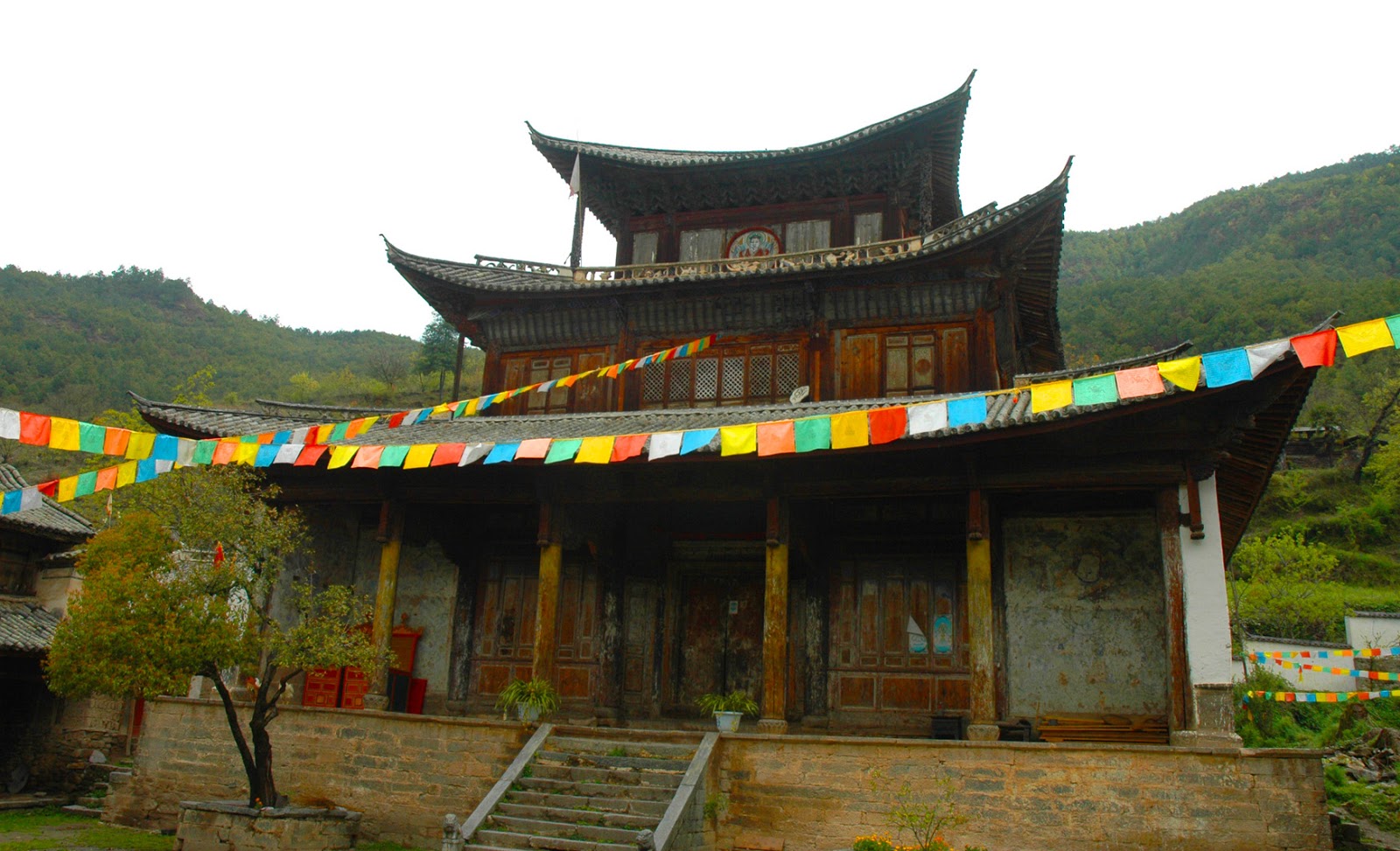
       Badi district, north of Yezhi, is the other major area besides Tacheng with substantial numbers of Tibetan residents.  Yet in the mountains above Kangpu, far even from Badi, is the county’s other major Tibetan temple.  Called Shouguosi, it was founded in the late Ming Dynasty by monks of the Karmapa (Black Hat) sect of eastern Tibet.  The same sect later sponsored construction of a subsidiary monastery at Puhua, near Bingzhongluo in upper Nujiang.
decorated roof at the temple entrance
       Shouguosi sits on a hill about 350 meters above the riverside town of Kangpu.  The road to get there is beyond Kangpu, about six km south of Yezhi, where it zigzags up the forested hill four km and ends at the village.  A mixed population of Naxi, Tibetan, Lisu and Han occupy about 30-40 houses, mostly in the Naxi style, including the traditional pair of wooden fish suspended from the apex of the roof, representing water as a defense against fire and lightning.
        Strings of prayer flags span the lanes leading to the temple, which sits above the back end of the village.  Unusually, it faces west, towards the Biluo Mountains and Tibet itself.  The temple is an elegant old redwood building, with three tiers and gray tiled roofs.  The top tier was added in the mid-Qing Dynasty and elegantly carved posts support the four corners of the roof. 
Bhairab wall mural outside the entrance
       The building has not been renovated since and while some of the exterior color decoration has faded, the carvings on the brackets, of animals and vegetation, are in good condition.  A wall mural of the fierce deity Bhairab near the entry door is mostly intact. And the rows of diamond vignettes of religious symbols that fill the space under the roof at the entrance are unscathed by time.
       In contrast to the muted tones of the exterior, inside the temple is a whirl of color.  Long tubular pendants, covered with flaps of different bright colors, drop down from the ceiling.  New thangkas (religious paintings) and long, narrow pennants hang from the brackets.  Most of the wall murals, generally featuring forms of Bhairab, have been repainted, though a few original, partly faded sections remain.  Gilded bronze statues of Buddha, Avalokitesvar, Padmapani and Tara decorate the altar area. 
       Like the thangkas, these look like recent works and probably donations from outside the immediate area, since there are no nearby Tibetan villages.  From eight to ten monks and novices live there and the village is very religious-minded.  That’s not surprising, since the four different nationalities that live there do so because of their common faith.  Shouguosi monks are very proud of their temple and their tradition and welcome the rare visitor with tea and a khada—ceremonial white scarf.
central market square of Yezhi, old yamen on the right
       Views from around here, and glimpses west through openings in the forest cover on the way back down to the riverside road, reveal steep gorges and high mountains with large swathes of woodlands.  Weixi County still enjoys 36% forest cover, giving it a rich variety of biological resources.  Besides being home to such rare animals as the takin, clouded leopard, pangolin, red goral, golden cat and the snub-nosed monkey, the province’s official mascot, the forests abound in medicinal herbs and plants, edible wild fungi and ornamental flowers like orchids.  Weixi city hosts a trade fair every year to market the county’s medicinal plants, drawing buyers from across the province and beyond.
       Just past the turnoff up to Shouguosi, the road passes between high cliffs that squeeze the river and turn it into raging rapids comparable to those on the Nu River over the Biluo Mountains.  Then a few km later the landscape changes.  The mountains on the east bank stand further away from the river.  A broad tableland spreads out down from their gentle slopes and the town of Yezhi lies at the end of it, just above the river.
Naxi at the Yezhi shops
       A bi-lingual sign at the southern entrance identifies Yezhi as the “Hometown of Lisu Culture.”  Actually, like Kangpu 16 km south, it is mainly a Naxi town and the most impressive old building in the town center is the original Qing Dynasty administrative residence (yamen) of the former Naxi chieftain.  Not in use today, it stands next to the central market square. 
       Naxi women in Yezhi dress very much like those in Lijiang County, minus the ‘seven-starred cape:’ side=fastened jacket in maroon, blue or black, plain trousers and a long black apron.  Occasionally Lisu women turn up in town, usually in modern clothes, but recognizable by their fringed white shoulder bags.  The next village north of Yezhi, on the west bank, is also Naxi, but the settlements above the river, on the edges of high ridges and the slopes of the western mountains, are all Lisu.
       In the 1930s the Morses, an American Protestant missionary family, set up a base in Yezhi.  For several years they evangelized among the then poor, downtrodden, exploited Lisu villages and had great success.  Eventually they moved on to Gongshan County in Nujiang, with similar results, until forced to flee to Burma in 1949.  Today most Lisu in western Weixi County are Christian.
Lisu village near Yezhi
Naxi woman in Yezhi
       Perhaps that’s why they don’t favor their full ethnic outfit for everyday wear anymore.  Some missionary groups sought to eradicate the custom because it pre-dated the arrival of the Word of God.  The Morses’ sect did not make such demands, but at any rate the Weixi Lisu did not abandon it completely.  They still don it for the big Christian festivals, for while Christianity is part of their tradition now, so is their original Lisu identity.

the Lancangjiang in Weixi County
                                                                   * * *   
               for more on the Tibetans in Yunnan, see my e-book Living in Shangrila
                           on the Naxi, see my e-book Children of the Jade Dragon


Friday, February 6, 2015

New Gods for Frontier Peoples: Missionaries in NW Yunnan


                                                               by Jim Goodman

Lancang River Valley south of Diqing
       In recent years adventurous travelers in NW Yunnan have been trekking over the Biluo Mountains from the Lancangjiang Valley to Nujiang.  The route connects the village of Cizhong in Diqing County with Baihanluo and Dimaluo in Gongshan County, Nujiang.  It is roughly the same route taken by the French Irrawaddy Expedition in 1895 and early 20th century explorers like F. Kingdon Ward and Joseph Rock.   The unusual aspect of this journey is that whether it begins from CIzhong or from Dimaluo, it runs from one Christian settlement to another, the legacy of intrepid 19th century French Lazarist missionaries.
       The pioneer figure in this story was Père Charles Renou, who arrived in Yunnan in 1852 and headed at once for the northwest.  Intending to proselytize among Tibetans, he first had to learn the local dialect.  Posing as a Chinese merchant, he stopped at Dongzhulin Monastery, southeast of Diqing, befriended the lamas and learned the Tibetan language.  Two years later he crossed the Biluo Mountains and ended up in Bingzhongluo. 
TIbetan wearing a crucifix
       Cognizant of power politics in the area, Renou befriended the richest landowner and secured a fief from him in Bonga Valley, just over the Yunnan border inside Tibet.  His first Catholic converts were the slaves he purchased and emancipated from the landowner.  He augmented this number over the next three years with more purchases of mainly orphans and children sold by heavily indebted Nu families.  After baptizing them he enrolled them in a school, run by an ex-monk, to learn to read and pray in Tibetan. 
       Bonga Valley was practically uninhabited when Renou arrived.  The local Nu people believed it was the abode of malevolent tree spirits and feared angering them by cutting down the spirits’ homes.  Renou instructed them to keep uttering the names of God and the Virgin Mary to repel the spirits.  He was taking a chance, for if anything bad happened after the villagers cleared the woods the mission’s reputation would plummet.  Nothing did, however, so now the villagers reckoned the priests were more powerful than the local land spirits.
Nu Catholic, Shuangla
Pengda church, Gongshan County
       By 1858 the mission staff had expanded to five priests and the Christian community was growing so fast it frightened local authorities, including the landlord who had given Renou the fief and now wanted it back.  He took his case to the abbot of Menkong and then organized a gang that attacked the missionaries’ residence and burned down all their buildings, belongings and the documents concerning the rental of the fief.  The missionaries fled south to Puhua Monastery, where the local abbot gave them sanctuary.
Xiaoweixi Catholic Church, built in 1870
       That same year, though, China signed the Treaty of Tianjin, which gave Western missionaries the right to work in the interior.  It took nearly four years, but Renou won his case at Menkong, got his fief back and from then on paid rent to Menkong Monastery instead.  With this verdict the prestige of the foreign missionaries soared.  Nu villagers, whether animist or Buddhist, chafing under the harsh tax demands of their Tibetan overlords, now saw the missionaries as potential protectors against local authorities.  They also found the missionaries, many of whom had prior medical training, far more efficient dealing with illness than their own shamans.  They began converting en masse.
       By 1863 the mission seemed to be on a firm trajectory for future success.  Renou handed over management of it to his staff and trekked over the mountains to the Lancang River valley, the Upper Mekong.  Setting up in Cikou village, a mostly Tibetan settlement south of Diqing, after his long and patient efforts, in 1867 the villagers replaced their Buddhist monastery with a Catholic church.  Three years later, having been joined by other Lazarist missionaries, who began working further downriver, a second Catholic church went up in the Naxi village of Xiaoweixi.
       Both the Cikou church and the one in Xiaoweixi were built in classical Chinese style and resembled modest, Mayahana Buddhist, walled temple compounds.  The Xiaoweixi church is still the original building, two stories high, tiled roofs, with an added, triangular roof on top, with upturned corners and a cross at the apex.  A rather simple altar stands inside at the other end of the entrance and the flanking walls feature posters of the Stations of the Cross.
Baihanluo Catholic Church
       Back in Bonga Valley, however, mission affairs suddenly took a turn for the worst.  Nu converts assumed they no longer had to pay taxes and land rent to the Tibetan overlords.  Ecclesiastical authorities in Menkong forbade conversions, ordered Christians to renounce the new faith and forced villagers to pay tax and debt bills.  Those who refused were killed or ran away further south.  Raiding parties burnt everything in Bonga Valley. 
       Because of the ongoing Muslim Revolt in Yunnan, the French Legation in Kunming could not get the government to do anything and advised the Nujiang priests to abandon their efforts north of the Yunnan border and lay low for a while.  In the Lancang River Valley, however, the Lazarist missionaries expanded their activities north and established churches in Diqing, Yanjing, Batang and Kangding.  With the end of the Muslim Revolt in 1873, French priests were able to join their compatriots in the new missions.
       However loyal their flocks might be, beyond the parishes the priests faced the very secular dangers of banditry and ethnic nationalism.  Unknown assailants murdered Yanjing’s Père Brueux in 1881.  Six years later an armed Tibetan uprising provoked the burning of the churches in Diqing, Yanjing and Batang and the desecration of Brueux’s grave.  The missions in Nujiang were unmolested at this time and in 1882 priests began proselytizing in Baihanluo, in the Biluo Mountains south of Bingzhongluo.
Dimaluo on a Sunday morning
       In 1904 French priests erected a church in Baihanluo, in a style that resembled a Tibetan dzong, the kind of building used by nobles and high-ranking lamas.  Converts saw it as a Catholic dzong, with the implications of an authority greater than that of local officials.  Though they may not have seen its establishment as a political challenge, the current group of French missionaries was an entirely different set than their predecessors in Bonga Valley.  So were the lamas of Puhua in Bingzhongluo.  The friendly relations between the two that had marked Renou’s time had turned hostile. 
       That same year witnessed the Younghusband Expedition, when British military units from India marched into Tibet and occupied Lhasa in August, forcing the Dalai Lama to flee to Mongolia.  Poorly armed Tibetans suffered heavy casualties opposing them.  After imposing a trade treaty on Lhasa, the British returned to India and the Dalai Lama returned.  But resentment over the Expedition, especially in the eastern, Kamba-inhabited part of Tibet, combined with fury over the foreigners’ burgeoning influence on people who were so recently subservient to Kamba lords and lamas, burst into violence. 
CIzhong Catholic Church
       Aroused by lamas in Diqing and further north, armed Tibetan gangs attacked the Christian communities, killed Cikou’s two priests and burned down its church, as well as the rebuilt churches in Diqing, Yanjing and Batang.  Egged on by lamas in Menkong, Puhua monks joined the rebellion and organized an attack that destroyed the Baihanluo church.  Kamba warriors also attacked Chinese posts up and down the Lancangjiang Valley, prompting the Qing government to dispatch troops to restore law and order.  The government campaign took two years to quell the rebellion.  Control of Diqing changed hands twice, resulting in mass revenge killings by both sides.  In Nujiang Qing forces crossed the mountains to Baihanluo, marched on Bingzhongluo and burnt down the Puhua Monastery.  The revolt in Nujiang subsided quickly, but the government stationed a garrison in Baihanluo to watch over the peace.
Pengdang Catholic Church interior
       Having survived the mayhem, the missionaries rebuilt their church, but in a different style, less resembling a dzong.  The new wooden building was narrower, with folding screened shutters in front, painted archway and belfry façade, a single two-story tower over the entrance, with upturned roof corners and a white cross mounted on top.  Recently renovated with freshly painted exterior frescoes, it still stands there today.  In the valley below, the church at the mixed Tibetan-Nu-Lisu village of Dimaluo, built several years later, features the same style of construction.
       Over the next couple of decades, as more French missionaries augmented the existing band of priests, the growing Christian Nu community built churches at Qiunatong, Pengda, Pengdang, Shuangla and Cikai.  These were more in a kind of Sino-European style, with square bell-towers, columned fronts and lavishly painted interiors.  The former animosity that characterized Nu-Tibetan relations faded away and converted Catholic villages like Qiunatong and Dimaluo had both Tibetan and Nu residents.
Tibetans leaving Cizhoing church on Sunday
       A few years after the suppression of the Kamba revolt in the Lancangjiang Valley, French missionaries returned to Cikou and called on their congregation to construct a new church, this time in stone, in the village of Cizhong, a few kilometers upriver. The new building looked more like a rural French church, except for its Chinese-style belfry tower.  Over 20 meters tall, the tower is twice as high as the nave, while both feature narrow, European-style, arched windows on their sides.  Engraved on the arch above the church entrance is a New Testament Latin quotation, calling upon the suffering laborers in the world to seek refuge in the Lord.
       Within the nave, arched columns left and right of the entrance divide the interior into three sections.  At the end of the columns the main altar honors Jesus and smaller ones left and right are dedicated to the Madonna and Child and St. Joseph.  The walls display illustrations of the Way of the Cross and the spaces above them, as well as the ceiling, feature Tibetan-style paintings of pheasants, clouds, lotuses, yin-yang symbols and very Oriental dragons.  Construction concluded in 1921 and the government garrisoned thirty soldiers there to protect it from marauders.
       In the following years, while Civil War raged across most of China, the mission continued its life undisturbed.  Besides religious and architectural concepts, French priests also introduced the very European practice of grape cultivation and wine production, both in Cizhong and downriver in Xiaoweixi.   They also accumulated a large library of books in both French and Chinese.
reading prayers outside the Dimaluo church
       With the proclamation of the People’s Republic of China in 1949, missionaries anywhere in Yunnan were forced to evacuate.  Protestant missionaries in Nujiang took some of their converts with them when they fled into Burma, but the Catholics tended to remain when their priests departed.  The new government proved to be less iconoclastic out on this far frontier than was expected, even during the turbulent years of the Cultural Revolution, and the small Christian communities carried on as best they could without their priests and ministers.
       The inauguration of the Reform Era and the opening of China to the outside world, including tourists, did not mean the return of the foreign missionaries to Cizhong and Nujiang.  Their Sunday services continued without their presence, as they had for decades.  Rather than a Mass, though, these consisted of listening to spoken or recorded sermons and collective praying and singing. 
hymnal salvaged from the Cikou fire
       At Cizhong for example, the only ecclesiastical official was a rector, who was not permitted to hold Mass.  So the congregation assembled inside, men on one side, women and children on the other, and sang hymns, using partially burnt manuscripts, salvaged from the Cikou fire, like the Book of Psalms, De Profundis and Cantique au Sacré Coeur, translated into Tibetan.  The congregation alternately sang and chanted the verses, sometimes sounding like a row of monks at prayer time, sometimes like a medieval European choir.
       The place has also recently attracted a greater number of tourists.  It’s certainly an attractive village, at the base of high mountains beside the roaring Lancang River.  About 75% of its residents are Tibetan, 20% Naxi and 5% Han.  Naxi architecture, rather than Tibetan, dominates the house designs.  One of its characteristics is to suspend a carved fish beneath the apex of the roof at each end, which symbolized the element of water as a protective device against the element of fire, as in a lightning bolt striking the house.  Christian house owners have replaced this with a carving picturing a dove, the Catholic symbol of the Holy Spirit, their own protector.
dove on a  Christian house in Cizhong
       Guesthouses may have arisen, and trekking parties are stopping here on their way to and from Dimaluo, but this new attention is not likely to affect the traditional influence of Christianity on Cizhong’s mostly Christian population.  They have a resident priest now, who arrived from Inner Mongolia a couple years ago, to hold Mass and make the exercise of their religion more authentic.  They hold fond memories of the missionaries, influencing their hospitable receptions of Western visitors.  And they still cultivate grapes and make wine, a secular legacy of the French priests, and something they can share with their Western guests.
riverside Nu CatholicChurch at Pengdang
                                                                      * * *                                                     
                      for more on DIqing's TIbetans, see my e-book Living in Shangrila