Showing posts with label Đông Kinh. Show all posts

Sunday, October 27, 2019

Hanoi’s Old Quarter


                                            by Jim Goodman

clean and orderly--the Old Quarter after French renovation
       In 1010 Lý Thái Tổ, founder of the new Lý Dynasty, moved the capital of Đại Việt from Hoa Lư, in present-day Ninh Bình province, to the abandoned former Chinese administrative center on the Red River.  After a vision he had when arriving at the site, he called his new city Thăng Long (Rising Dragon), today’s Hanoi.  In designing its layout he divided the area into two parts:  Hoàng Thành, the Royal City, and Kinh Thành, the Commoner’s City.  Throughout the city’s ups and downs, this partition persisted until modern times.
Bạch Mã Temple, the first temple in the Old Quarter
       A sprawling walled compound comprised Hoàng Thành, featuring many royal palaces, administrative buildings, ponds, groves and gardens.  High-ranking mandarins, royal family relatives and military officers lived just outside the Citadel.  Kinh Thành included everything between the Citadel’s eastern gate and the Red River.  It soon drew a host of migrants, largely crafts workers and others employed by the palace, and in later times new residents to provide services to the growing population. 
       The Kinh Thành area--Hanoi’s contemporary Old Quarter--had a very different landscape a thousand years ago.  The Tố Lịch River, which ran along the northern wall of the Royal City, flowed through the northern side of Kinh Thành and into the Red River at today’s Chợ Gạo..  On the southeastern side, the water of what is now Hoàn Kiếm Lake was connected to the Red River.  The residential area in between was a partly reclaimed marsh with many ponds.
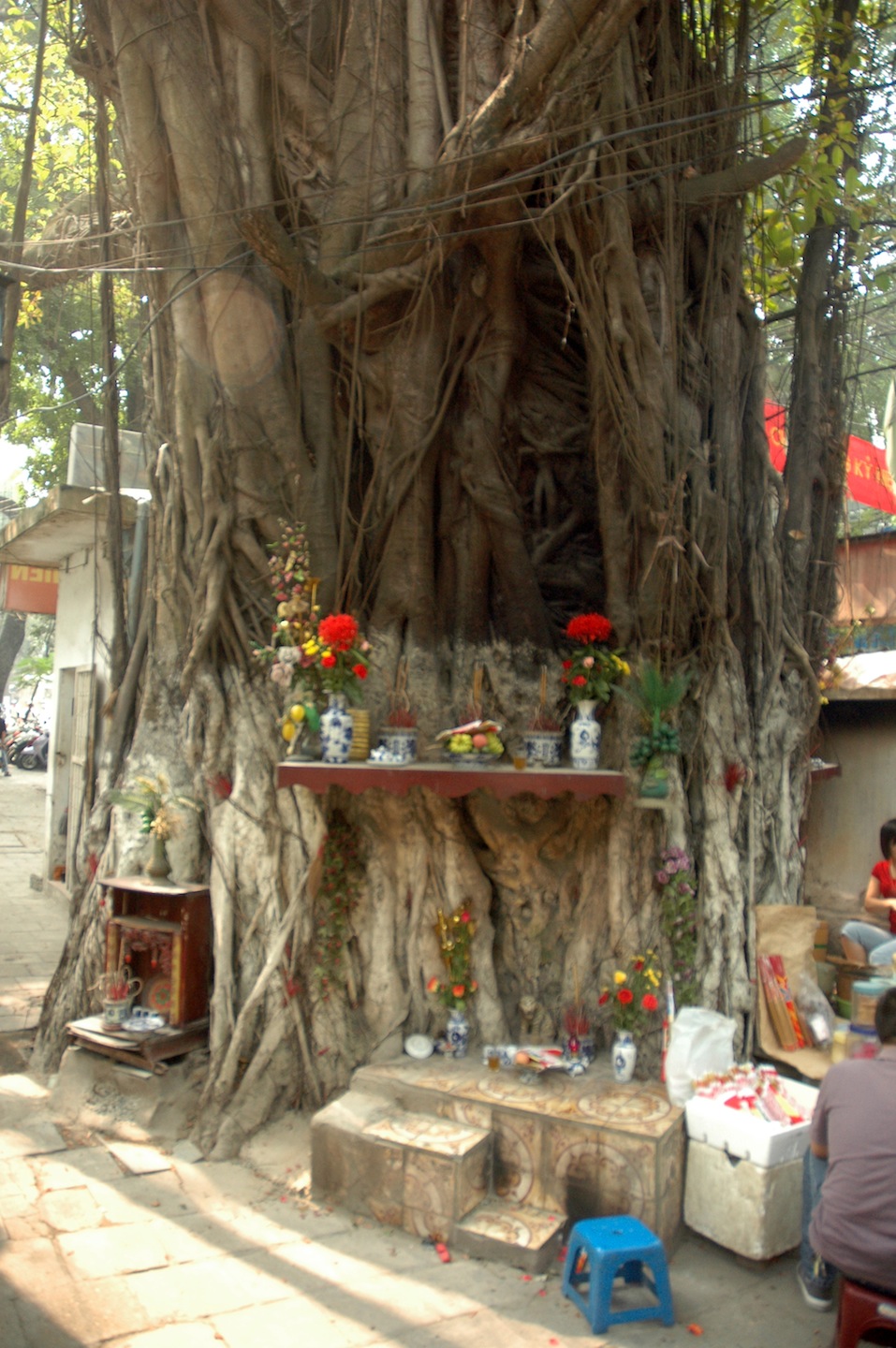
tree shrinn--an ancient custom still alive
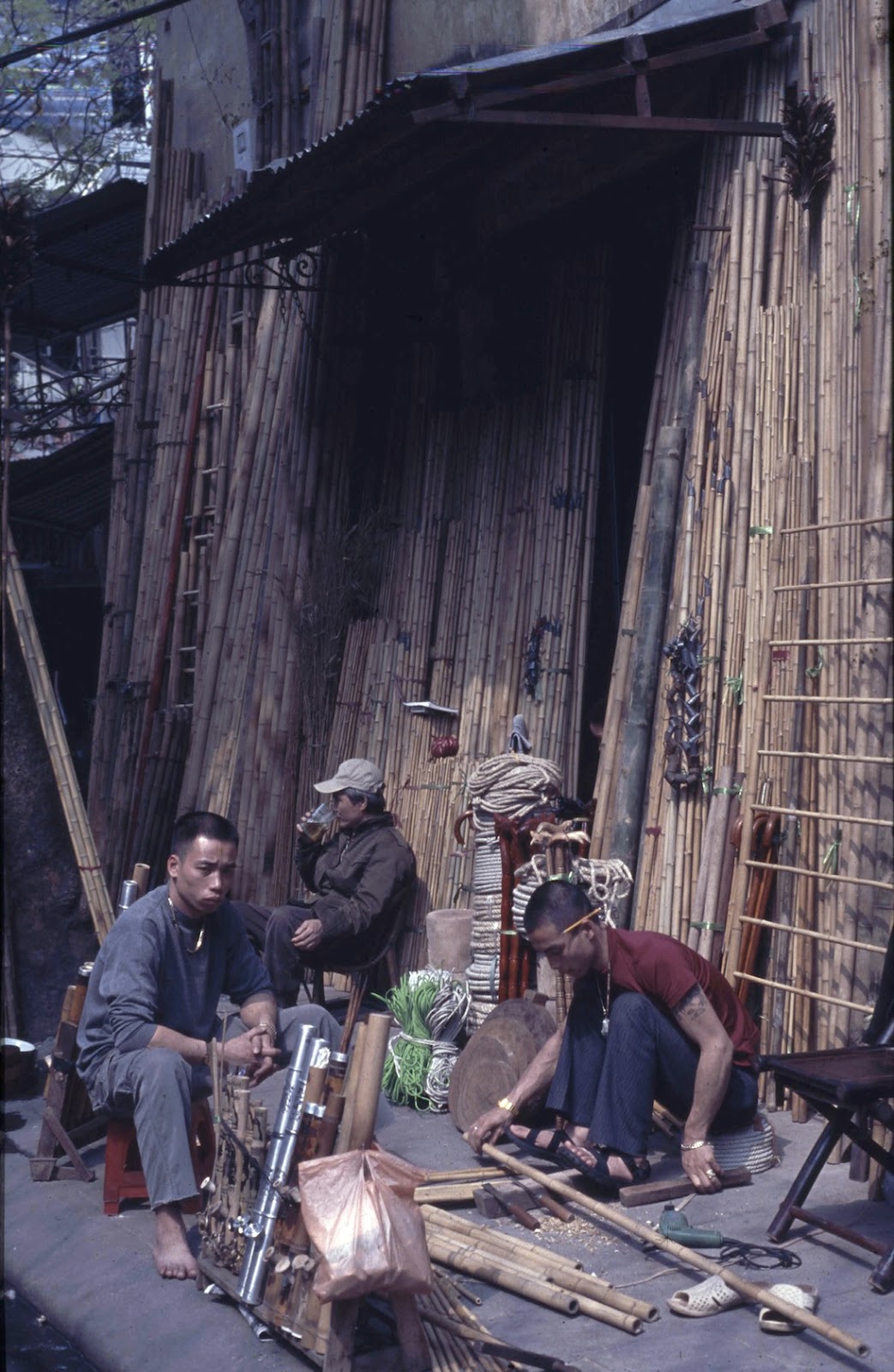
bamboo work outside on HàngVải, like the old days
       It was not very crowded back then.  Households had plenty of space for a house, workshop, garden and pond or well within their compounds.  They built stilted wooden and bamboo houses.  They became organized into craft guilds whose members lived on the same street.  Houses could not rise higher than a royal palace and they could not have an upper story window facing the street, from where a commoner (or assassin) could look down on the king if he passed through the city.  Another regulation limited how wide they could be.  Thus, when families expanded their buildings they did it lengthwise, back into the courtyard, instead of upward.  This was the origin of-the ’tube house’ style that came to characterize the city’s architecture.
lacquer workers, centuries ago
       The typical craft guild membership all came from the same village.  Some of these might also erect a small communal house (đình) to service their community or a modest temple honoring their village tutelary deity.  Besides the Bạch Mã Temple on Hàng Buồm, the oldest in the city, and Báo Thiên Pagoda, where the cathedral now stands, the city’s other temples were outside the main settled area.  From the survival of the custom evident in Hanoi today, one could assume Kinh Thành also had shrines to the spirits of particularly impressive old trees.
       No major transformations took place when the Trần Dynasty took over in 1238.  Growth affected the rural areas more than the city.  Princes and high mandarins had their estates in the countryside and hosted an assignment of soldiers.  Three times that century Mongol armies invaded Đại Việt.  Facing overwhelming numbers, the Vietnamese adopted the strategy of evacuating villages and removing all the food supplies—‘empty houses and gardens’.  Occupying a deserted capital and unsuccessful at foraging for food, the Mongols had to depart and Vietnamese guerrillas slaughtered them on their way out.
neighborhood temple on Bát Đân street
      Thăng Long residents rebuilt their city after each invasion, but in the late 14th century their Chăm rivals in south central Vietnam attacked and sacked Thăng Long three times.  The city revived, but the dynasty did not.  The ambitious official Hồ Quý Ly moved the capital to his home district in Thanh Hóa, 160 km south, slaughtered the extended royal family members and proclaimed a new Hồ Dynasty in 1400.  Two Trần princes escaped and appealed to China for help.  The Chinese invaded in 1407, captured Hồ Qúy Ly, but did not restore the Trân. Instead they took over administration and ruled for twenty harsh years before a native uprising, led by Lê Lợi from Thanh Họa, expelled them.
early 20th century house
one of a few remaining old houses
       Unlike its predecessors, the Lê Court required its officials to live permanently in the capital, now renamed Đông Kinh.  The new neighborhoods were clustered around the southeastern side of the Citadel, while more village migrants came to live in the Old Quarter, where the government filled in more of the marshes.  Most of the work produced in the city was on contract.  The idea of stocking non-contracted goods in a shop didn’t take hold for another century or two. 
mandarin being carried into the Old Quarter
       Đông Kinh faced no external threats for the next few centuries.  The Old Quarter staged a market day the 1st and 15th of the lunar month, when villagers flocked to town.  Every few years the government hosted the examinations, drawing hundreds of scholars and enlivening the city’s atmosphere.  In general, life in the commoners’ city was not affected by political developments, like the coup against the Lê regime and establishment of the Mạc Dynasty (1527-1592).  When civil war broke out the battlefields were far away and until Lê forces captured Đông Kinh in 1592 the war did not affect the capital.
beer break late 19th century
       The victors did nit sack the city after evicting Mạc forces.  Peace, order and ordinary commerce returned so quickly that the Lê commander Trịnh Tùng ordered the city walls completely leveled.  He also took absolute control of the government, keeping the restored Lê emperor as a figurehead confined to the Citadel.  His successors got caught up in a violent quarrel with their erstwhile allies the Nguyển family, whose lords ruled the southern provinces while the Trịnh ruled the north.
typical ward gate
       Intermittent wars failed to change anything, so the two sides signed a truce in 1670.  The result in Đông Kinh was a century of growth and prosperity.  All the marshland of the Old Quarter was filled in by now, though several ponds remained, used as food sources.  River commerce thrived.  The two main ports were the confluence of the Tố Lịch and Red River at Chơ Gạo and Tây Lường Gate, where the Hoàn Kiếm Lake channel entered the Red River.
       Though the city walls were gone, new walls and gates began to separate the wards. These were locked and guarded at night, isolating the separate neighborhoods.  No one could pass through the gate without being examined by the watchmen, who were armed with thick staves.  Without an acceptable excuse, people could not enter these guarded neighborhoods after dark anyway. 
city wall and entrance gate, 19th century
       Most were just doorways in a high earthen wall that stretched across the lane.  Wealthier neighborhoods like Hàng Ngang had fancier gates, protruding from the wall, with an entrance surmounted by a tiled roof with upturned corners, supported by wooden pillars.
       Most streets in the commercial quarter were wider than nowadays, and paved with rectangular stones with slightly curved surfaces that facilitated water run-off in the rains.  But the lanes that twisted around the city’s ponds and connected the main streets were themselves narrower, mostly unpaved, quite muddy in the rains and never very clean when dry.  Sanitation was a low priority in Đông Kinh,, with no unit assigned by the government to keep the city clean.
Hàng Khay, 19th century
       Mid-18th century, the city’s population exceeded 100,000, making it one of the biggest and most densely populated in East Asia.  Political developments threatened its future, though.  In 1749 Trịnh Doanh rebuilt the city walls as a defense against rural insurrections.  The walls had 21 entrance gates, locked and guarded at night.
       Rebels never breached these walls, but the Trịnh regime was in decline.  So was the Nguyễn Lords realm in the south.  In the late 18th century armies of the Tây Sơn Revolt from south central Vietnam deposed the Nguyễn regime and later swept north, captured Đong Kinh in 1786, ended the Trinh Lords’ rule, restored the Lê emperor’s authority, then returned to their base around Huệ. 
      The aging emperor died soon after and his son Lê Chiêu Thống, in his first act as an independent emperor, ordered all the Trịnh palaces around Hoàn Kiếm Lake to be burned to the ground.  Unfortunately, the fire spread to the Old Quarter and consumed three-fourths of the houses.  Two years later he called on the Chinese to buttress his authority against the Tây Sơn, provoking the latter to march on the capital, drive out the Chinese, terminate the Lê Dynasty and set up their own.  It lasted until 1802, when Nguyễn Ánh’s army conquered the city and founded the Nguyễn Dynasty.
       Assuming the royal name Gia Long, the Nguyển emperor demolished the old citadel and replaced it with a smaller one and filled in the estuary connecting Hoàn Kiếm Lake with the Red River.  He made Huế his national capital and rarely visited the north.  He renamed the city Thăng Long, but with a different character for Long, rendering it Rising Prosperity.  It must have sounded overly optimistic to its residents.  The chaos of the last two decades had reduced the population to about 15,000, while official neglect of its infrastructure left nearly everything in need of repair and restoration.
\streetcar, early 20th century
       Nevertheless, under energetic and competent local administrators, by 1831, when Gia Long’s successor Minh Mạng renamed the city Hanoi, prosperity had returned and the city now had over 50,000 residents.  The Old Quarter streets were repaved with brick, new craft guilds set up residence and popular subscription enabled the renovation of old temples and the construction of new ones.  The city still had its walls and gates, locked at night, but at a later hour, allowing for the first stirrings of nightlife, with theaters and song cafés.  
       As the Nguyễn Dynasty fell into decline, by the 1880s French armies were fighting for control of the north.  Some of these battles took place in the Old Quarter, but by 1885 the French had won.  Two years later they made Hanoi the capital of the French Indochina Union.  Drastic changes ensued.  They immediately demolished the Lý Dynasty temple Chùa Bạo Thiên to erect St. Joseph’s Cathedral, created a French Quarter of European-style mansions for its colonists south of Hoàn Kiếm Lake and opulent administrative buildings near the Citadel.  
French postcard of Hàng Nóm
       They didn’t move into the Old Quarter, but remade it.  They filled in the ponds and the part of the Tố Lịch flowing through its northern side.  All the ward gates and city walls and gates came down except for one—Ô Quang Chướng.  They widened the streets and realigned the houses evenly.  They renovated the dikes, sharply reducing the flood threats, and in the early 20th century installed gas lighting on the streets, a huge water storage tower at the top of Hàng Giấy and eventually a streetcar route through the city. 
       Life improved, the city grew and bustled and then, with the end of World War II, disaster struck again.  Chinese Guomindang troops entered the city, ostensibly to receive the Japanese surrender, and ransacked it.  The new Provisional Revolutionary Government was forced to allow French forces to re-enter Hanoi in return for the Guomindang evacuation.  Shortly afterwards fighting broke out between the French and Việt Minh soldiers.  Most of this took place in the Old Quarter.  By the time the Việt Minh withdrew and the French took full control, only about 10,000 were left in the city.
copper and bronze ware, Hàng Đồng
tin workshop, Hàng Thiếc 
       Many returned, though, and built new houses of brick and wood, without stilts, and the wealthier families added stories to make them higher, since there were no laws restricting size anymore.  The Việt Minh campaign for independence continued, but the battles were far from the capital.  The final battle took place in Điếnbiếnphủ in the northwest, sparing Hanoi of any further damage.
reed mats, Hàng Chiếu
       After 1954 developments in Hanoi were slow.  While American planes bombed parts of the city during the American War, the Old Quarter, having no strategic value, wasn’t targeted.  After the war, Vietnam remained relatively isolated until the late 1980s, when the đổi mới (renovation) policies commenced and the country integrated with the global economy.  By the 21st century, Vietnam had become a popular tourist destination.
       The Old Quarter was one of the major attractions.  Increasing prosperity had resulted in many changes, like new buildings of four and five stories and the gradual disappearance of classic wooden, tile-roofed houses.  But the layout remained constant.  Some of the streets were still dominated by the craft they were named after, like Hàng Thiếc’s tin workshops and Hàng Bạc’s silver jewelry shops.  Others were partly so, as bamboo blinds were still available on Hàng Mành, reed mats on Hàng Chiếu and copperware on Hàng Đồng.  Its temples, shrines and đìnhs also still existed.
       Hanoi is not likely to suffer future bombings or invasions. Nor will the Old Quarter change its basic form.  Tourists appreciate it as the liveliest and most interesting part of Hanoi, largely unaware of its long and checkered history.  Local Vietnamese are quite conscious of that, though, and revere it for that reason.  The Old Quarter is the heart of their ancient capital, so often destroyed and always reviving—truly a phoenix city.

basket shop on Nguyễn Siêu street, built over the filled in Tố Lịch River

                                                                               * * *   

Monday, March 12, 2018

Hanoi’s Shrinking Waters


                                    by Jim Goodman

Hoàn Kiếm Lake 
       What distinguishes Hanoi from other cities in the region is the large amount of water within its urban boundaries.  Every visitor knows picturesque Hoàn Kiếm Lake in the center of the old city, and probably the much bigger West Lake, and its subsidiary Trúc Bạch.  But the city has many more lakes, plus innumerable scattered ponds.  Altogether, Hanoi has more water than any city east of Venice.
        It used to have much more.  West Lake began as a lagoon of the Red River until the early Lý Dynasty, when a landfill separated it.  Hoàn Kiếm Lake was connected to the Red River until the beginning of the 19th century.  Hồ Bẩy Mẫu sprawled all the way to the southern wall of the Lý Citadel.  Other lakes, long since vanished, occupied most of what are now the city suburbs.  Many ponds lay within the old town environs until the French began filling them in. 
the Red River at Hanoi
       In prehistoric times the site of Hanoi was a lagoon within a gulf that lay at the confluence of the Red and Đuống Rivers.  Over countless eons the gulf receded, disappearing under the layers of silt deposited by the two rivers.  The lagoon turned into a swamp with channels, lakes and densely forested islands.  The first pioneers arrived during the Bronze Age, settling on the islands and along the banks of the Tô Lịch and Nhuệ Rivers, which are now in the western part of metropolitan Hanoi, grew rice, vegetables and fruits on small plots and supplemented this with hunting and fishing.
houseboats on the Red River near Long Biên Bridge
       Nobody knows the original village name, though in later centuries it became identified as Long Đỗ--“dragon’s navel.”  Near the Tô Lịch River stood a small hillock, which the villagers believed was linked to the center of the earth by a long hole within the hillock.  The village continued to grow during the Chinese occupation, and when the Tang Dynasty came to power the Chinese shifted their administrative center from east of the Red River to Long Đỗ, which was becoming a more concentrated population and commercial center in the Delta.  In 621 they constructed a small citadel, of 1600 meters length, beside the Tô Lịch.
West Lake, formerly Foggy Lake, in its usual weather conditions
       Chinese rule was never very secure, subjected to periodic local revolts and clashes with their rival Nanzhao, a kingdom in what is today Yunnan.  In the late 9th century the Chinese enlarged their citadel, renamed it Đai La and built a protective dike along the Red River.  But the Tang Dynasty fell in the early 10th century and in 938 Ngô Quyền captured Đai La, expelled the Chinese and re-established Vietnam’s independence. 
       Ngô Quyền made Cổ Loa, the last capital of Vietnam before the Chinese conquest, the capital of his new state Đại Cồ Viêt.  Đai La’s citadel fell into ruins, and some of the population moved to Cổ Loa, but many residents remained.  The town was still inhabited when King Lý Thái Tô journeyed from Hoa Lư, the country’s capital since 968, to visit the site in 1010 and decided to transfer the capital.  According to legends, the king witnessed a dragon rising over the ruined citadel upon his arrival and so named the city Thăng Long—Rising Dragon.
preserved Hoàn Kiếm Lake turtle
       The new citadel, like Đai La, lay just south of West Lake, with the Tô Lịch River serving as its northern moat.  Another large and long lake lay just west of the citadel.  The royal family, retainers, guards and high nobles all lived within its walls, while the commoners, mostly craftsmen and traders who served the palace, lived between the eastern wall and the Red River--the nucleus of what would later be the Old Town.  Stilted houses were still the norm and every house likely had a boat.  And some folks probably lived along the rivers in floating houses, a feature that has persisted down to the present on the western side of the Red River.
earliest map of Hanoi
       Lý Thái Tô’s successors created West Lake with a landfill to cut it off from the Red River.  Until 1547 it was called Hồ Dâm Dàm—Foggy Lake—after its usual misty weather conditions.  Royalty rode pleasure boats on the lake and the earliest recorded water-puppet performance took place on the southern shore in the 11th century.  They also established the Temple of Literature on an island near the citadel in Hồ Bẩy Mẫu, extended the dikes and built canals.  
       Because most nobles lived on estates far from the city, Thăng Long did not become very large during the Lý Dynasty, nor in the Trần Dynasty that followed.   Mongol invaders destroyed it three times in the 13th century and Chăm armies sacked it thrice in the 14th century.  Ming Dynasty Chinese occupied it 1408-28.  Only after their expulsion, and the foundation of the Lê Dynasty, did the city, now called Đông Kinh—the Eastern Capital—finally develop. 
Bẩy Mẫu Lake today
       The Lê Court demanded officials live in the city.  They mostly resided near the citadel, but the old town grew with guilds set up to service the palace and its government personnel.  Many ponds still existed in the old town, the Tô Lịch River, wider and deeper than the scraggly creek that’s left of it today, was a prime transport artery from the city to the countryside and the body of water beside the old quarter, still connected to the Red River, changed its name from Lục Thuỷ--Green Lake—to Hồ Hoàn Kiếm—Lake of the Restored Sword, after a legend about the dynasty’s founder Lê Lợi.
Đông Kinh (Hanoi) riverfront, 1679
       A nobleman from Thanh Hoá province, he is supposed to have visited the lake when contemplating launching a rebellion against the predatory Chinese occupiers.  Casting his net for fish, he instead caught a magic sword and used it during the insurrection.  When he finally expelled the Chinese in 1428 he took a boat out onto the lake and a huge turtle, for which the lake had long been famous, emerged from the water and took the sword from his hand.  Mission accomplished, the sword had to be returned.
Hanoi in the late Lê Dynasty
       A specimen of one of these turtles, over a meter long, has been preserved at the temple on Ngọc Sơn Island at the top end of the lake.  For centuries Hanoi residents kept their eyes open for a glimpse of one of these turtles whenever they walked along the lake. Their sight of it would be brief, as the turtle sucked up some air and plunged back beneath the surface.  Never a favorable environment for them after it was blocked from the river, the last turtle died just two years ago.  But before that, at the lakeside opening ceremony for Hanoi’s millennium celebrations in October 2010, the Hoàn Kiếm turtle popped his head above the water in full view of thousands.
Trấn Quốc Pagoda
       In the early 16th century, after a succession of four weak, incompetent, teenaged Lê emperors, Mạc Đăng Dung seized the throne and founded a new dynasty.  Some of the Lê family escaped to Thanh Hoá and, backed by the powerful Trịnh and Nguyễn families, eventually waged a long war against the Mạc and in 1592 captured Đông Kinh and restored the Lê Dynasty.  However, the victors had a falling out and another civil war resulted, this time pitting partisans of the Trịnh and Nguyển against each other.  The Nguyển wound up with autonomy over the south, while the Trịnh ruled the north.  The Lê emperor was just a figurehead for both sides.
Trúc Bạch Lake
      The warfare, sporadic anyway, did not affect Đông Kinh.  The old town continued to get more congested, while migrants filled in parts of the big lakes and made farms and villages on the outskirts of the city.  The long lake just west of the citadel was filled in and organized into an area known as the Thirteen Farms.  Immigrants from the countryside filled in parts of Bẩy Mẫu Lake, separating it from the Kim Ngưu River.
       Within the city itself, the Lê emperor and his entourage stayed inside a smaller, rebuilt citadel.  The Trịnh Lords set up their palaces near Hoàn Kiếm Lake, including one on Ngọc Sơn Island.  From here they would observe naval maneuvers on the lake, the boats sailing in from the Red River.  In the 18th century the palace was replaced first by a Buddhist pagoda, then temples to the god of war Quan Công and the spirits of literature and the soil.  In the early Nguyễn Dynasty a temple to Trần Hưng Đạo, hero of the Mongol Wars, also went up on the island. 
fishing at Bẩy Mẫu Lake
       At West Lake, in 1600 one of the city’s most venerable temples, Chùa Khai Quốc—Establishing the Nation Pagoda—was removed to an island in the southwest part of the lake. Originally built along the Red River in the 6th century, soil erosion threatened its stability.  In its new location it was renamed Chùa Trấn Quốc—Defending the Nation Pagoda.  In 1619 local residents built a causeway alongside it, which gave it easier access and also created Truc Bạch Lake beside it, which was used to breed fish.
       In the late 18th century, the city experienced another round of turmoil with the collapse of the Trịnh Lords regime, a brief occupation by the Chinese, the Tây Sơn Revolt and the capture of the city by Nguyễn Ánh in 1802.  Founding a new dynasty, he moved the national capital to Huế and ordered the old citadel demolished, a new one made and landfills to separate the Red River from Hoàn Kiếm, now truly a lake.
June flowers on the lake
Thê Húc Bridge
       More changes in the city’s water ratio ensued in the next few decades.  By the time Emperor Minh Mạng changed the city’s name to Hanoi in 1831, the big lakes that had sprawled over the southern and western parts of the area were much reduced.  Bẩy Mẫu split twice, with reclaimed land now separating it from its western half, creating Hồ Giảng Võ, and a road running directly south bisecting the eastern part. And the Temple of Literature was no longer on an island, though a small lake survived just across the street from the compound, where scholars still went for quiet study.
Tháp Rùa--the Turtle Tower
       More drastic changes occurred as soon as the French took over.  They began filling in the ponds in and around the old town and the lower part of the Tô Lịch where it ran into the Red River.  No ponds exist in the old town today, but the memory of them is still sharp.  The street Cấu Gỗ (wooden bridge) got its name from the bridge that crossed the stream coming from Hồ Thái Cực (Lake of Abundant Fish) next to it to Hoàn Kiếm Lake.  The next street up, Gia Ngu, means ‘fish market’ in literary Sino-Vietnamese.  The streets branching off Hạng Bông--Hàng Mành and Hàng Hòm--run slightly downhill, because there used to be a pond at the end.
Hanoi,1924
       Before this development, in 1886 a Vietnamese mandarin working for the French persuaded authorities to allow him to build a tower on an islet in the middle of Hoàn Kiếm Lake, where the turtles used to bask in the sun and lay their eggs.  Called Tháp Rùa (Turtle Tower), it honors the magic turtle that seized Lê Lợi’s sword.  The mandarin who built it intended to lay the remains of his father there, but local people objected and removed the body. 
       The tower remained, though, and in later years the French added a statue on top similar to the Statue of Liberty in New York.  The Vietnamese official the Japanese installed during their occupation removed the statue in 1945.  Ever since, the tower has become the best-known monument in Hanoi.
B-52 wreckage in a Ba Đình  pond
       When the French finally departed from Hanoi in 1954 the city core was rather densely populated, but vast areas of farms and pastures still surrounded the settled area.  This situation continued until the late 1980s, when the new renovation policy (đôi mới) inaugurated rapid development of the city.  The rural belt around Hanoi quickly filled in with roads and buildings and in a few years a quarter of the city’s water area disappeared.  West Lake lost twenty percent of its water before the government stepped in to halt further encroachment.  Other lakes in the city, like Giảng Võ and Bẩy Mẫu also shrank considerably, while a quarter of the lakes existing a decade earlier completely disappeared. 
Triiều Khúc Pagoda and its pond
       The smaller ponds largely survived because they were often part of temple compounds.  One pond in Ba Đình district became a monument to the America War because it contains the wreckage of a B-52 bomber.  Currently, it seems likely that the size of the remaining lakes and ponds will remain constant.  After all, they do add to the city’s beauty, for the buildings around them that reflect in the water and the careful, harmonious layout of the ponds.  Like the beautiful, mid-19th century red wooden bridge to Ngọc Sơn Island, called Cấu Thê Húc (Morning Sunlight Bridge), they represent a prominent cultural characteristic and artistic achievement of Old Hanoi—the aesthetic marriage of architecture and water.

summer flowers at Hoàn Kiếm Lake
                                                                              * * *    

Hanoi and its lakes are part of Delta Tours Vietnam’s cultural-historical journey through Vietnam.  See the schedule at https://deltatoursvietnam.com