Showing posts with label Gia Long. Show all posts

Sunday, October 27, 2019

Hanoi’s Old Quarter


                                            by Jim Goodman

clean and orderly--the Old Quarter after French renovation
       In 1010 Lý Thái T, founder of the new Lý Dynasty, moved the capital of Đi Vit from Hoa Lư, in present-day Ninh Bình province, to the abandoned former Chinese administrative center on the Red River.  After a vision he had when arriving at the site, he called his new city Thăng Long (Rising Dragon), today’s Hanoi.  In designing its layout he divided the area into two parts:  Hoàng Thành, the Royal City, and Kinh Thành, the Commoner’s City.  Throughout the city’s ups and downs, this partition persisted until modern times.
Bạch Mã Temple, the first temple in the Old Quarter
       A sprawling walled compound comprised Hoàng Thành, featuring many royal palaces, administrative buildings, ponds, groves and gardens.  High-ranking mandarins, royal family relatives and military officers lived just outside the Citadel.  Kinh Thành included everything between the Citadel’s eastern gate and the Red River.  It soon drew a host of migrants, largely crafts workers and others employed by the palace, and in later times new residents to provide services to the growing population. 
       The Kinh Thành area--Hanoi’s contemporary Old Quarter--had a very different landscape a thousand years ago.  The Tố Lịch River, which ran along the northern wall of the Royal City, flowed through the northern side of Kinh Thành and into the Red River at today’s Chợ Gạo..  On the southeastern side, the water of what is now Hoàn Kiếm Lake was connected to the Red River.  The residential area in between was a partly reclaimed marsh with many ponds.
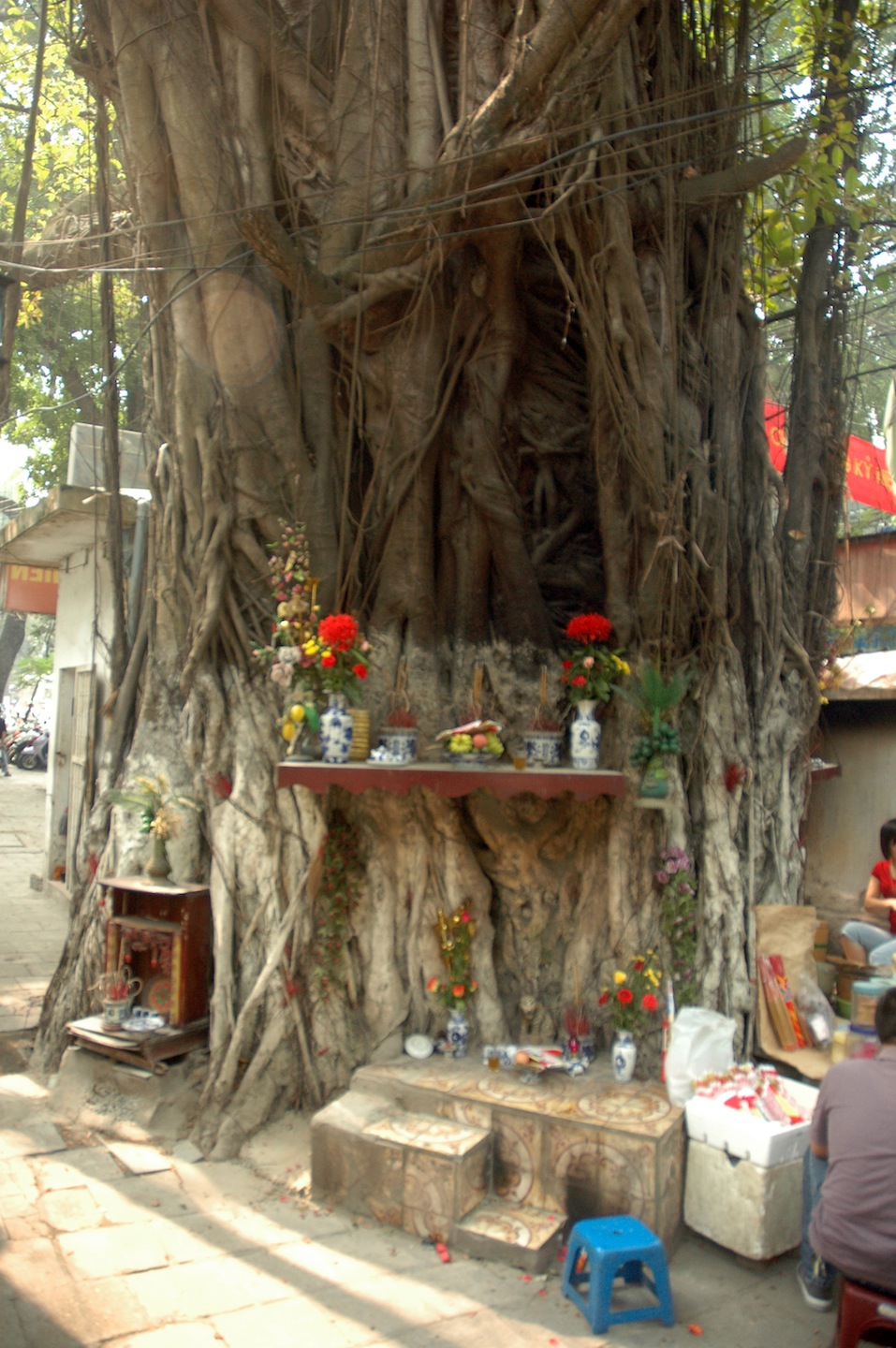
tree shrinn--an ancient custom still alive
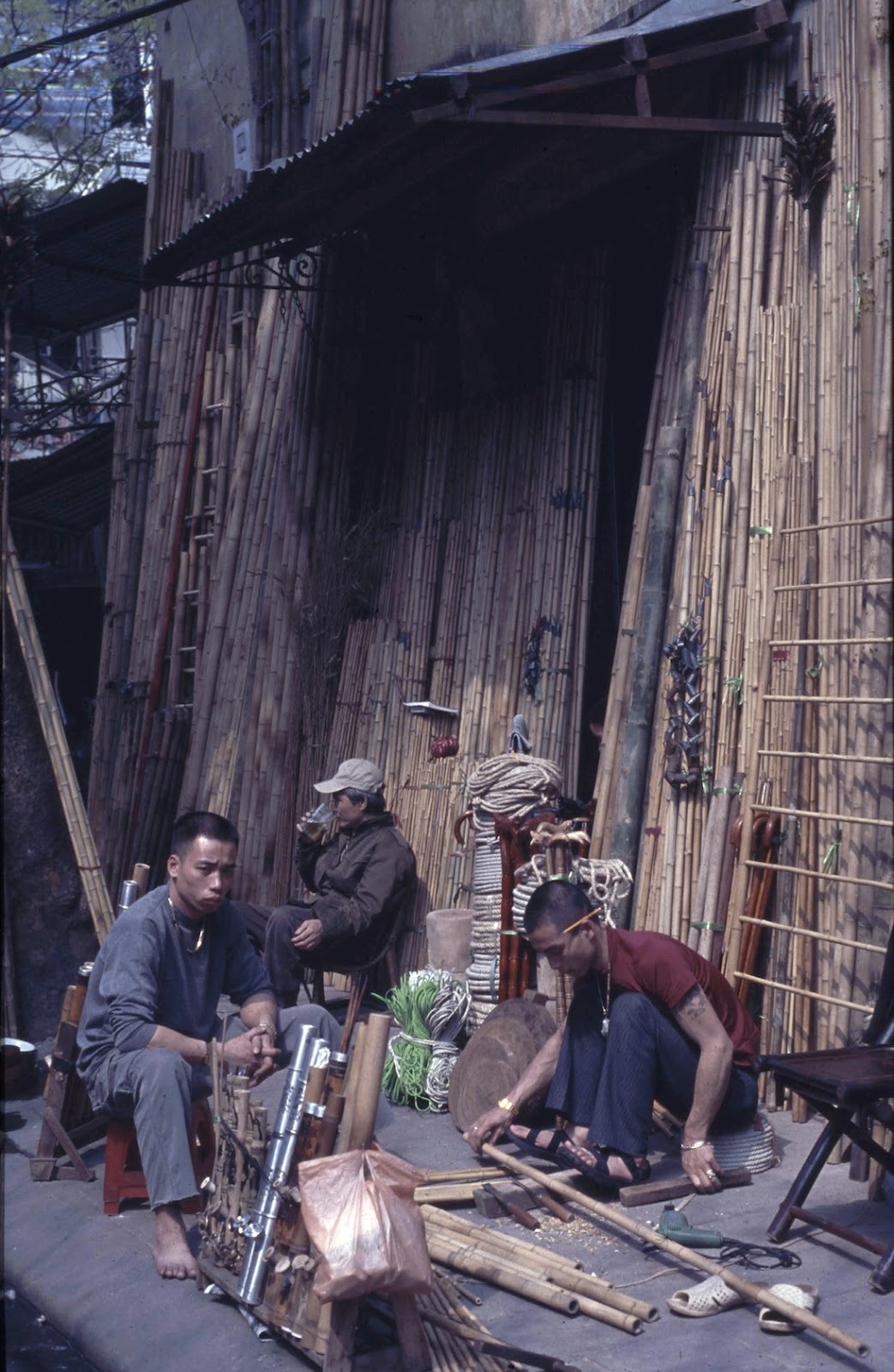
bamboo work outside on HàngVải, like the old days
       It was not very crowded back then.  Households had plenty of space for a house, workshop, garden and pond or well within their compounds.  They built stilted wooden and bamboo houses.  They became organized into craft guilds whose members lived on the same street.  Houses could not rise higher than a royal palace and they could not have an upper story window facing the street, from where a commoner (or assassin) could look down on the king if he passed through the city.  Another regulation limited how wide they could be.  Thus, when families expanded their buildings they did it lengthwise, back into the courtyard, instead of upward.  This was the origin of-the ’tube house’ style that came to characterize the city’s architecture.
lacquer workers, centuries ago
       The typical craft guild membership all came from the same village.  Some of these might also erect a small communal house (đình) to service their community or a modest temple honoring their village tutelary deity.  Besides the Bạch Mã Temple on Hàng Buồm, the oldest in the city, and Báo Thiên Pagoda, where the cathedral now stands, the city’s other temples were outside the main settled area.  From the survival of the custom evident in Hanoi today, one could assume Kinh Thành also had shrines to the spirits of particularly impressive old trees.
       No major transformations took place when the Trần Dynasty took over in 1238.  Growth affected the rural areas more than the city.  Princes and high mandarins had their estates in the countryside and hosted an assignment of soldiers.  Three times that century Mongol armies invaded Đại Việt.  Facing overwhelming numbers, the Vietnamese adopted the strategy of evacuating villages and removing all the food supplies—‘empty houses and gardens’.  Occupying a deserted capital and unsuccessful at foraging for food, the Mongols had to depart and Vietnamese guerrillas slaughtered them on their way out.
neighborhood temple on Bát Đân street
      Thăng Long residents rebuilt their city after each invasion, but in the late 14th century their Chăm rivals in south central Vietnam attacked and sacked Thăng Long three times.  The city revived, but the dynasty did not.  The ambitious official Hồ Quý Ly moved the capital to his home district in Thanh Hóa, 160 km south, slaughtered the extended royal family members and proclaimed a new Hồ Dynasty in 1400.  Two Trần princes escaped and appealed to China for help.  The Chinese invaded in 1407, captured Hồ Qúy Ly, but did not restore the Trân. Instead they took over administration and ruled for twenty harsh years before a native uprising, led by Lê Lợi from Thanh Họa, expelled them.
early 20th century house
one of a few remaining old houses
       Unlike its predecessors, the Lê Court required its officials to live permanently in the capital, now renamed Đông Kinh.  The new neighborhoods were clustered around the southeastern side of the Citadel, while more village migrants came to live in the Old Quarter, where the government filled in more of the marshes.  Most of the work produced in the city was on contract.  The idea of stocking non-contracted goods in a shop didn’t take hold for another century or two. 
mandarin being carried into the Old Quarter
       Đông Kinh faced no external threats for the next few centuries.  The Old Quarter staged a market day the 1st and 15th of the lunar month, when villagers flocked to town.  Every few years the government hosted the examinations, drawing hundreds of scholars and enlivening the city’s atmosphere.  In general, life in the commoners’ city was not affected by political developments, like the coup against the Lê regime and establishment of the Mạc Dynasty (1527-1592).  When civil war broke out the battlefields were far away and until Lê forces captured Đông Kinh in 1592 the war did not affect the capital.
beer break late 19th century
       The victors did nit sack the city after evicting Mạc forces.  Peace, order and ordinary commerce returned so quickly that the Lê commander Trịnh Tùng ordered the city walls completely leveled.  He also took absolute control of the government, keeping the restored Lê emperor as a figurehead confined to the Citadel.  His successors got caught up in a violent quarrel with their erstwhile allies the Nguyển family, whose lords ruled the southern provinces while the Trịnh ruled the north.
typical ward gate
       Intermittent wars failed to change anything, so the two sides signed a truce in 1670.  The result in Đông Kinh was a century of growth and prosperity.  All the marshland of the Old Quarter was filled in by now, though several ponds remained, used as food sources.  River commerce thrived.  The two main ports were the confluence of the Tố Lịch and Red River at Chơ Gạo and Tây Lường Gate, where the Hoàn Kiếm Lake channel entered the Red River.
       Though the city walls were gone, new walls and gates began to separate the wards. These were locked and guarded at night, isolating the separate neighborhoods.  No one could pass through the gate without being examined by the watchmen, who were armed with thick staves.  Without an acceptable excuse, people could not enter these guarded neighborhoods after dark anyway. 
city wall and entrance gate, 19th century
       Most were just doorways in a high earthen wall that stretched across the lane.  Wealthier neighborhoods like Hàng Ngang had fancier gates, protruding from the wall, with an entrance surmounted by a tiled roof with upturned corners, supported by wooden pillars.
       Most streets in the commercial quarter were wider than nowadays, and paved with rectangular stones with slightly curved surfaces that facilitated water run-off in the rains.  But the lanes that twisted around the city’s ponds and connected the main streets were themselves narrower, mostly unpaved, quite muddy in the rains and never very clean when dry.  Sanitation was a low priority in Đông Kinh,, with no unit assigned by the government to keep the city clean.
Hàng Khay, 19th century
       Mid-18th century, the city’s population exceeded 100,000, making it one of the biggest and most densely populated in East Asia.  Political developments threatened its future, though.  In 1749 Trnh Doanh rebuilt the city walls as a defense against rural insurrections.  The walls had 21 entrance gates, locked and guarded at night.
       Rebels never breached these walls, but the Trnh regime was in decline.  So was the Nguyn Lords realm in the south.  In the late 18th century armies of the Tây Sơn Revolt from south central Vietnam deposed the Nguyễn regime and later swept north, captured Đong Kinh in 1786, ended the Trinh Lords’ rule, restored the Lê emperor’s authority, then returned to their base around Huệ. 
      The aging emperor died soon after and his son Lê Chiêu Thống, in his first act as an independent emperor, ordered all the Trịnh palaces around Hoàn Kiếm Lake to be burned to the ground.  Unfortunately, the fire spread to the Old Quarter and consumed three-fourths of the houses.  Two years later he called on the Chinese to buttress his authority against the Tây Sơn, provoking the latter to march on the capital, drive out the Chinese, terminate the Lê Dynasty and set up their own.  It lasted until 1802, when Nguyễn Ánh’s army conquered the city and founded the Nguyễn Dynasty.
       Assuming the royal name Gia Long, the Nguyển emperor demolished the old citadel and replaced it with a smaller one and filled in the estuary connecting Hoàn Kiếm Lake with the Red River.  He made Huế his national capital and rarely visited the north.  He renamed the city Thăng Long, but with a different character for Long, rendering it Rising Prosperity.  It must have sounded overly optimistic to its residents.  The chaos of the last two decades had reduced the population to about 15,000, while official neglect of its infrastructure left nearly everything in need of repair and restoration.
\streetcar, early 20th century
       Nevertheless, under energetic and competent local administrators, by 1831, when Gia Long’s successor Minh Mạng renamed the city Hanoi, prosperity had returned and the city now had over 50,000 residents.  The Old Quarter streets were repaved with brick, new craft guilds set up residence and popular subscription enabled the renovation of old temples and the construction of new ones.  The city still had its walls and gates, locked at night, but at a later hour, allowing for the first stirrings of nightlife, with theaters and song cafés.  
       As the Nguyễn Dynasty fell into decline, by the 1880s French armies were fighting for control of the north.  Some of these battles took place in the Old Quarter, but by 1885 the French had won.  Two years later they made Hanoi the capital of the French Indochina Union.  Drastic changes ensued.  They immediately demolished the Lý Dynasty temple Chùa Bạo Thiên to erect St. Joseph’s Cathedral, created a French Quarter of European-style mansions for its colonists south of Hoàn Kiếm Lake and opulent administrative buildings near the Citadel.  
French postcard of Hàng Nóm
       They didn’t move into the Old Quarter, but remade it.  They filled in the ponds and the part of the Tố Lịch flowing through its northern side.  All the ward gates and city walls and gates came down except for one—Ô Quang Chướng.  They widened the streets and realigned the houses evenly.  They renovated the dikes, sharply reducing the flood threats, and in the early 20th century installed gas lighting on the streets, a huge water storage tower at the top of Hàng Giấy and eventually a streetcar route through the city. 
       Life improved, the city grew and bustled and then, with the end of World War II, disaster struck again.  Chinese Guomindang troops entered the city, ostensibly to receive the Japanese surrender, and ransacked it.  The new Provisional Revolutionary Government was forced to allow French forces to re-enter Hanoi in return for the Guomindang evacuation.  Shortly afterwards fighting broke out between the French and Việt Minh soldiers.  Most of this took place in the Old Quarter.  By the time the Việt Minh withdrew and the French took full control, only about 10,000 were left in the city.
copper and bronze ware, Hàng Đồng
tin workshop, Hàng Thiếc 
       Many returned, though, and built new houses of brick and wood, without stilts, and the wealthier families added stories to make them higher, since there were no laws restricting size anymore.  The Việt Minh campaign for independence continued, but the battles were far from the capital.  The final battle took place in Điếnbiếnphủ in the northwest, sparing Hanoi of any further damage.
reed mats, Hàng Chiếu
       After 1954 developments in Hanoi were slow.  While American planes bombed parts of the city during the American War, the Old Quarter, having no strategic value, wasn’t targeted.  After the war, Vietnam remained relatively isolated until the late 1980s, when the đổi mới (renovation) policies commenced and the country integrated with the global economy.  By the 21st century, Vietnam had become a popular tourist destination.
       The Old Quarter was one of the major attractions.  Increasing prosperity had resulted in many changes, like new buildings of four and five stories and the gradual disappearance of classic wooden, tile-roofed houses.  But the layout remained constant.  Some of the streets were still dominated by the craft they were named after, like Hàng Thiếc’s tin workshops and Hàng Bạc’s silver jewelry shops.  Others were partly so, as bamboo blinds were still available on Hàng Mành, reed mats on Hàng Chiếu and copperware on Hàng Đồng.  Its temples, shrines and đìnhs also still existed.
       Hanoi is not likely to suffer future bombings or invasions. Nor will the Old Quarter change its basic form.  Tourists appreciate it as the liveliest and most interesting part of Hanoi, largely unaware of its long and checkered history.  Local Vietnamese are quite conscious of that, though, and revere it for that reason.  The Old Quarter is the heart of their ancient capital, so often destroyed and always reviving—truly a phoenix city.

basket shop on Nguyễn Siêu street, built over the filled in Tố Lịch River

                                                                               * * *   

Friday, September 20, 2019

Huế’s Citadel

  
                                                                                      by Jim Goodman    

the left wing of Ngọ Môn Gate
        Throughout the 17th and most of the 18th centuries Vietnam was divided into two opposing administrations.  Both sides recognized the Lê Dynasty monarch as the nominal ruler of the country, but the Trịnh Lords controlled him as a figurehead in the north, while the Nguyễn Lords ruled over everything south of Đồng Hới in Quảng Binh province.  Four Trịnh invasions of the south and one Nguyễn campaign against the north failed to upset the status quo and in 1672 the two opponents settled on a truce that lasted just over a century. 
one of the ten entry gate to the CItadel
outer wall of the Citadel
       In the wake of the Tây Sơn Revolt in 1771 the Trịnh Lords captured and destroyed the Nguyễn capital at Phủ Xuân in 1774 and the royal family fled to the Mekong Delta.  But Tây Sơn forces caught up with them and massacred all of them except the teenaged Nguyễn Ánh, who escaped to organize resistance.  Subsequent Tây Sơn campaigns in the south defeated his forces but failed to capture him.  The Tây Sơn armies then marched north, overthrew the Trịnh regime and the Lê Dynasty and established their own rule.
Meridian Gate, entrance to the Imperial Enclosure
      But the Tây Sơn were never able to vanquish Nguyễn Ánh, who would become one of the most remarkable figures in Vietnamese history.  He allied with Chinese, Khmer and Chăm in the south and employed some very astute generals, including disaffected Tây Sơn commanders.  After 25 years, his forces finally ousted the Tây Sơn government in Hanoi and reunified the country under a new dynasty, with the borders it still has today.  Unsure of his support in the north, however, Nguyễn Ánh chose to move the nation’s capital back to the old Nguyễn Lords’ capital at Phủ Xuân, which lay on the southern side of the Perfume River and was in ruins.
the Flag Tower
       Inaugurating the new Nguyễn Dynasty and taking the name of Gia Long, he decided to build a new fortified city across the river, which became modern Huế.  In 1804 he commenced building a citadel, employing French engineers who, following the Vauban style that had been the model for the France of Louis XIV, created a walled compound ten km long enclosing an area of 520 hectares, with many gates and several bastions.  The original outer walls were earthen and stood seven meters in height and were later reinforced with brick and stone and were two meters thick 
Thái Hòa Palace
        A moat thirty meters wide and four meters deep flanked three sides and a canal ran across the northern side. Ten entry gates crossed the moat into the citadel area, within which was the Imperial Enclosure (Đại Nội), with its own moat and six-meter high walls around it running for 2.5 km.  The Forbidden Purple City, where the Emperor had his palace and pleasure gardens, took up most of this space. 
       Just inside the Citadel ramparts stood the Flag Tower, rising 37 meters high above a three-level brick terrace.  Behind it were the nine Holy Cannons, cast from bronze articles captured from the Tây Sơn forces, each of them five meters long and weighing ten tons.  Gia Long intended them to be symbolic protectors of the city and empire and they were never fired.  They represent the four directions and the five natural elements. 
painting of the Emperor's appearance
       The Flag Tower, Holy Cannons and the Citadel/s outer walls, ramparts and gates are still there, relatively intact.  So are the moats and canals, though some sections are not so deep anymore and visitors can sometimes spot local fishermen casting nets in the moats. The buildings and barracks that filled the areas inside the walls and outside the Imperial Enclosure are mostly gone, replaced by gardens and parks.  But a number of the old palaces, temples and such that played roles in the imperial government have survived the ravages of weather and war or have been restored.  
ruins of the Emperor's residential palace
       The biggest and most impressive building, facing the Flag Tower, is the Meridian Gate (Ngọ Môn), the southern entrance to the Imperial Enclosure.  It was built in 1833 in the reign of Minh Mạng, the second Nguyễn emperor, and replaced the smaller original gate.  Very wide, with two protruding wings, it consists of huge stone blocks on the ground level and two more wooden stories above it.  It has three main entrances in the center.  The central one was reserved for the emperor, while the other two were for his mandarins and soldiers.
the Emperor's Reading Room
       Directly above the entries, on the top floor, is the Five Phoenix Watchtower.  Here the emperor used to make two annual public appearances—at the start of the Lunar New Year and to announce the results of the civil service examinations.  A lacquer painting on a wall here nowadays depicts the latter event, with rows of mandarins and scholars in the square in front and Huế residents behind them.  It was surely the biggest spectacle of the year for the city.
roof decorations of the Reading Room
       After going through the Meridian Gate and past two square ponds, the next significant building is the Palace of Supreme Harmony (Điện Thái Hòa), a wide, single story hall on an elevated platform with a double tiled roof supported by eighty lacquered ironwood pillars.  This was the emperor’s throne room, the venue for coronations, royal birthdays and the reception of foreign ambassadors.  The spacious interior featured elegant furniture, lacquered in red and gold, wall decorations and a raised throne under a gilded canopy facing south, where the emperor sat wearing golden silk robes and a crown with nine dragons.
       Wherever the emperor appeared everything was very formal and ceremonial.   Behind Điện Thái Hòa were the Left and Right Houses, facing each other across a courtyard, where civil and military mandarins spruced themselves up to prepare for an imperial audience.  For this they lined up in ranks according to their grade or position and made formal obeisance by kowtowing, touching their noses to the ground.
Hiẻn Nhơn Gate, Đại Nội
lamppost next to the Royal Theater
       When finished with his official business, the emperor departed through the back exit on the northern side to the last walled compound---the Forbidden Purple City, forbidden, that is, to all except him and his family, the concubines and their eunuch servants.  On the northeast side stood the Emperor’s Reading Room, an elegant two-story pavilion where he examined Court documents and correspondence and read books. 
Pleasure Pavilion in the Forbidden Purple City
       It was built early in Minh Mạng’s reign and is flanked by a pond on one side and bonsai gardens on the other three sides.  Statues of scholars stand on the corners of the lower roof along with dragons, while oval cameos of a trio of scholars are mounted on the walls.  All these figures are covered in porcelain potsherds, added when a later monarch, Khải Định in the colonial period, renovated the building. The former Royal Theater stands southeast of it, with a carved lamppost in front, dragons winding around it all the way up and other dragons pointing in the four directions at the top.
       Near the center of the Forbidden Purple City is a small raised Pleasure Pavilion, in a style similar to the Reading Room, where the emperor went to listen to music concerts.  Behind this stood the emperor’s private palace, though this was mostly destroyed by war.  Only the base remains, its steps flanked by a pair of cannons, probably intended like the Nine Holy Cannons as symbolic protectors.
       Other important buildings in the Imperial Enclosure are west of the Forbidden Purple City.  The Queen Mothers Residence stands in the northwest corner, a two-story fancy villa with an audience hall, separate apartments, an open-air balcony above the entrance and a small temple in a lotus pond beside it. 
Thé Miều Square
       In the southwest corner is the long and low Thế Tổ Miều, the Nguyễn Dynastic Temple, where altars stand for most of the emperors, along a polished floor with a red wooden ceiling.  The set excludes the fifth and sixth sovereigns Dục Đức, who only reigned three days, and Hiệp Hòa, who lasted just six months, and Bảo Đại, the last emperor.  And the altars for those who were ousted for being anti-French—Hàm Nghi, Thành Thái and Duy Tân—could not be installed until the end of French colonial control.
       Across from the large square outside the temple stands the last major structure—Hiến Lâm Cáo, the Pavilion of Splendor.  Also built in Minh Mạng’s reign, the building is noted for the Nine Dynastic Urns that stand in front of it, made of bronze, about two meters in height, each dedicated to one of the Nguyễn emperors.  The largest, cast in 1835-6 to Gai Long, is in the center and weighs 2600 kg.  The others average 1950 kg and stand in a row.  All of them feature low relief decorations of a variety of images, including birds and animals, the sun, moon and clouds, vignettes of nature, early 19th century sailing ships, cannons, cutlasses and even a horse-drawn carriage.
interior of the Nguyến Dynastic Temple
       Gia Long had constructed the Citadel with high, thick defensive walls, but in the end they were almost superfluous.  There was never any uprising or attack by foreign armies on Huế, not even when the French conquered the country.  The French had to battle the Vietnamese at the Hanoi Citadel, but afterwards took over Huệ without a fight.  A violent typhoon in 1904 knocked down the Flag Tower, which was reconstructed in 1915, but otherwise the Citadel remained intact until 1947, when the Việt Minh occupied it briefly until the French were able to expel them, though the Flag Tower suffered severe damage in the battle, as did the imperial palace in the Forbidden Purple City.
       Both were reconstructed afterwards, but in the Tệt Offensive in January 1968 the Việt Cong attacked and occupied parts of the Citadel, raised their own banner on the Flag Tower and held on for three weeks before the Americans finally managed to oust them.  During this period the Việt Cong dueled with ARVN forces within the Citadel grounds and these battles, plus massive American bombardment, destroyed all but four major buildings, though not the ramparts or gates.
       Restoration and repair this time had to wait until long after the end of the war.  Even buildings that had survived war damage, like Điện Thái Hòa, became subject to decay.  Termites and humidity had nearly destroyed its ironwood pillars.  Restoration workers, beginning in 1991, had to manually remove them (they weighed two tons each), plug the little insect holes, and cover them with twelve coats of fresh lacquer, each coat taking one month to fully dry.
gates inside the Imperial Enclosure
the Dynastic Urns
       By that time, though, Vietnam was no longer isolated and its historical relics had attracted the world’s attention.  In 1993 UNESCO recognized the Huệ Citadel as a World Heritage Site and while the city couldn’t rebuild everything that used to be there, it did restore or renovate many of its classic structures.  The Left and Right Houses were completely rebuilt, as were the apartments of the Queen Mothers Residence.  The gates that used to line the pathways to several of the buildings were also rebuilt, painted an imperial yellow and decorated with plaques of dragons, birds and flowers.
the royal coach on one of the Dynastic Urns
      Some restored buildings were outfitted with exhibition rooms as well.  The audience hall of the Queen Mothers Residence holds a collection of royal garments.  The Emperor’s Reading Room has a display of historical photographs.  East of the Imperial Enclosure stands the Fine Arts Museum, first built in 1845, containing some remnants of royal furniture, including a sedan chair, plus royal costumes, ceramics and musical instruments.
       The Royal Theater was also restored and now stages a few daily performances of the kind of entertainment popular in Imperial times.  These include classical operas (tuồng) in elaborate costumes, lion dances, fan dances and lantern dances, all backed by a classical Vietnamese orchestra dressed in yellow silk clothing.
       The city also stages its Huế Festival every two years, inviting participants from several countries.  Besides decorating the streets with sculptures and the riverfront with paintings, a mixture of traditional and modern shows takes place at various urban sites and nearby villages.  The biggest spectacles occur in the evenings in front of Ngọ Môn Gate in the Citadel, beginning with processions of a gigantic yellow phoenix borne by about twenty women wearing white aó dais and a huge golden dragon borne by about twenty men, also in white aó dais.  Various dances in traditional and ancient Vietnamese costumes, as well as some by foreign troupes, follow the opening act.

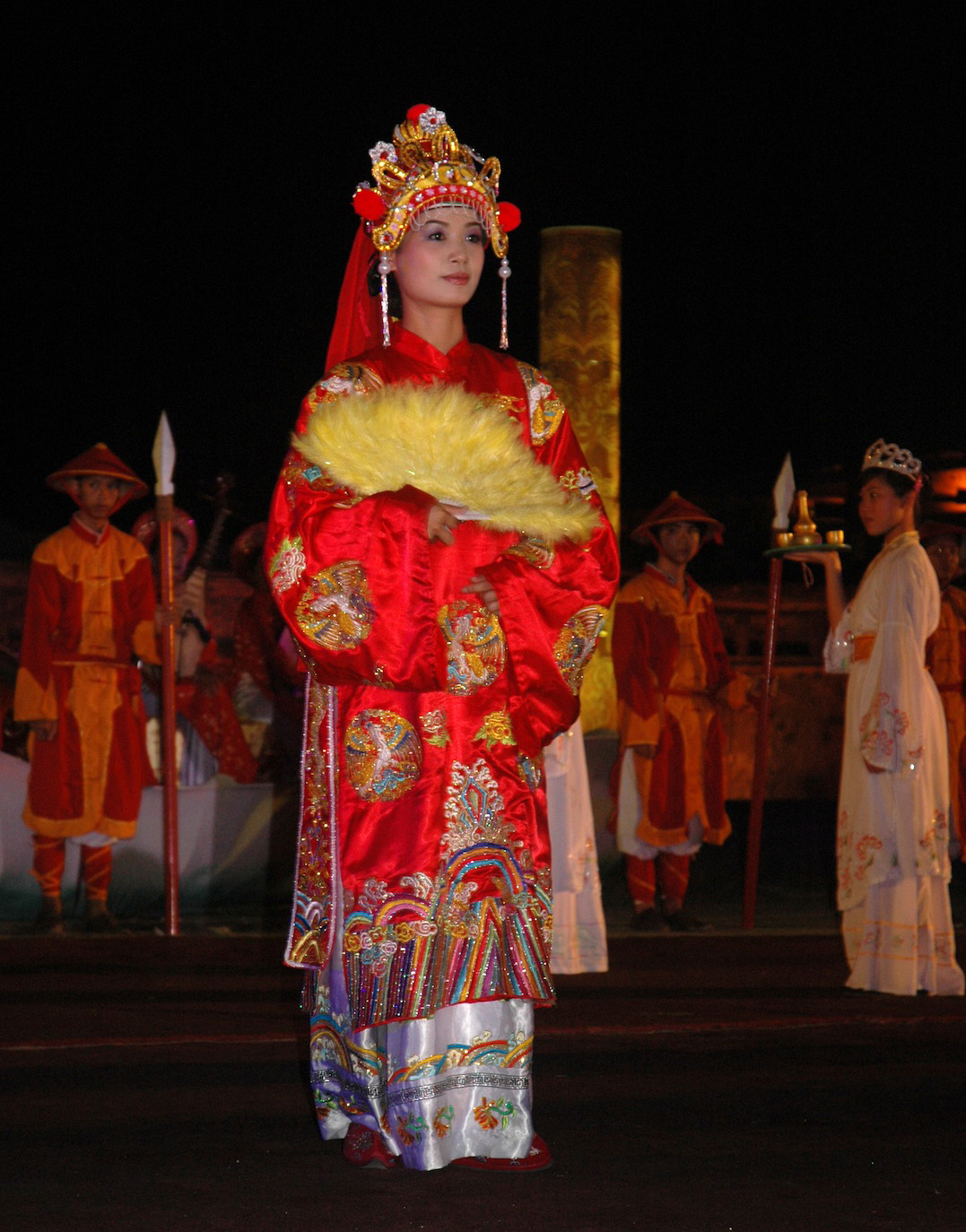
Nguyễn queen, Huế Festival
lantern dance at the Huế Festival
      On another night the shows reenact the entertainment enjoyed by the Nguyễn emperor and his Court, particularly the lion dances and lantern dance.  The show includes a visit by performers playing the Nguyến royal family and high mandarins.  The latter wear blue or green silk robes, while the royal entourage dresses in imperial yellow or red silk.  This skit is the crowd’s favorite.  The Nguyến heyday did not last very long, compared to that enjoyed by earlier dynasties, but it was indelibly associated with the city of Huế, whose modern citizens still remember it with pride.
                       
Đại Nội southwest wall
                                                                                ´* * *   
             The itinerary of Delta Tours Vietnam includes a visit to Huế’s Citadel.

Friday, June 14, 2019

Education in Imperial Vietnam


                                                                by Jim Goodman

laureate's procession, depiction inside Quốc Từ Giám
       After over a thousand years of Chinese administration, in 938 Vietnam won back its independence.  But after five years the new nation’s first ruler Ngô Quyn died and more than two decades of poly-sided civil war ensued.  Eventually Đinh Bộ Lĩnh prevailed and in 968 moved the capital to his hometown Hoa Lư.  After eleven years he was assassinated and the throne passed to Lê Hoàn, the military chief, just in time to repel a Chinese invasion.  He also defeated the Chăm on the southern front, but died in 1005.
       Four years of chaos followed until in 1009 Lý Thái Tô founded a new dynasty, stable enough to last over two centuries.  Buddhist monks had supported his enthronement and Buddhism became the state religion.  Government administrators came from the royal and aristocratic ranks and monks were in charge of education.
the Temple of Literature at the turn of the century
       But over time the Court came to the conclusion that, as an ideology for running the country and stabilizing society, Confucianism worked better.  It had been the ideology of statecraft in China since the Han Dynasty and the Vietnamese had had several centuries of experience living under it.  They may have revolted against individual Confucian administrators, but believed the system was the best way to hold a nation together.  Confucian ethics would guide the behavior of citizens towards the state and each other, with everyone aware of their place in society and their responsibilities to it.  Men familiar with the classics of Confucian principles would know how to properly manage state affairs.
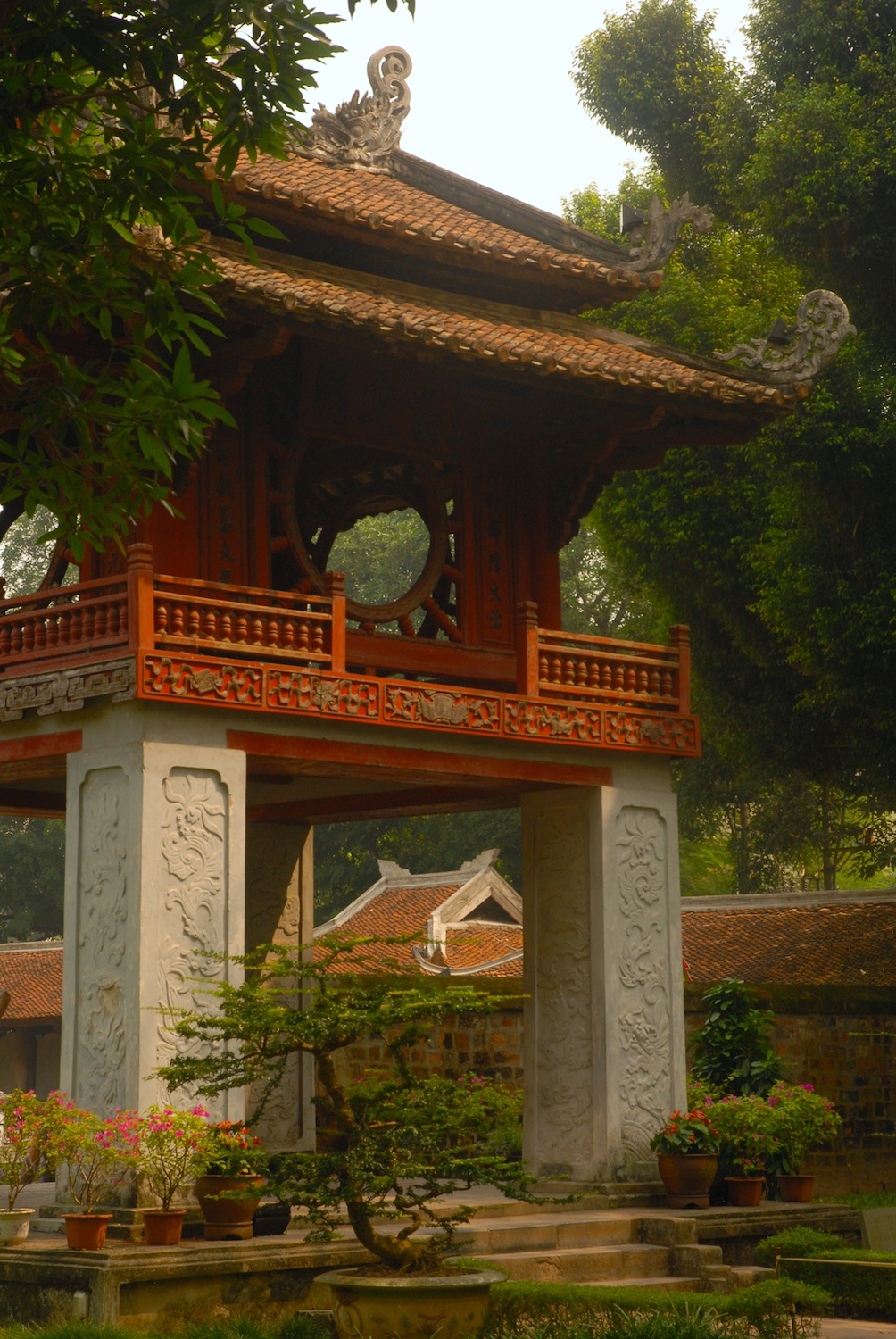
entrance to the Văn Miếu compound
       This line of thought elevated education to a level of prime importance and respect.  It culminated in 1071 when King Lý Thánh Tông, in the final year of his reign, ordered the construction of the Temple of Literature on a small island in the big lake that existed then just south of the Citadel. In 1075 the Court began the tutoring of royal princes in the compound of Văn Miếu (as the Vietnamese call the Temple of Literature).  The following year the Court inaugurated the National School (Quc T Giám) on the Văn Miếu premises to educate members of the aristocracy in order to appoint them as mandarins to administer the country and manage affairs at Court.  In subsequent years it established the examination system.

pond in a Văn Miếu courtyard
       The Temple of Literature we see today is no longer on an island.  Only a small pond opposite the entrance remains of the lake that once surrounded it.  Modeled on the temple to Confucius in his hometown in Qufu, China, the walled, rectangular compound encloses five courtyards.  A tall, columned, ornamented gate marks the entrance on the south side. 
      The first three courtyards were basically gardens beside artificial ponds.  These were the places where the students indulged in quiet, private study.  The temple to Confucius stood in the fourth compound, where mandarins and princes came to make offerings and honor the sage.  The fifth compound housed the Quc T Giám buildings and halls.  Here the tutors worked directly with the students, imparting their lessons in reading and writing, overseeing their compositions, quizzing them, preparing them for the examinations.
courtyard tower, Văn Miếu
Confucius image in the Temple of Literature
       To enter the service of the Court, monks and priests took the Tam Giáo (Three Religions) examinations, while sons of aristocrats, who were to hold most high mandarin positions, took the Thái Hc Sinh exams.  The most prestigious examination system was for attaining a doctorate (tién sĩ) and was open to any landowner or his son who had already passed the lower level of exams.  As the prevailing inheritance system was division among the children (including the daughters) rather than primogeniture, the class of eligible hopefuls constantly expanded.
private classes in the old days
       To pass the series of exams and make it to tiến sĩ required a sophisticated knowledge of the Chinese classics, Confucian mores, history, literature, philosophy and statecraft.  The arts and sciences were not part of the curriculum.  The emphasis was less on practical matters and more on molding a character and worldview proper for a socially responsible administrator. 
       Those who got high marks in the provincial examinations (thi hương) won the title of cứ nhân and were eligible for the next level--thi hội.  If they passed four rounds of thi hội exams they won the coveted title of tiến sĩ and eligible for the final, royal set called thi đình, carried out to rank the tiến sĩ and apportion honors and positions.  Even those who failed at the thi hội level were still compensated, for they usually wound up being teachers, still a prestigious occupation and sometimes very well paid.
Quộc Từ Giám, the National University
        Thăng Long played host to all three of these examinations. The thi hi examinations were held in the lakeside Giáng Võ palace, southwest of the Citadel. The site for the thi hương examinations, like the thi hi examinations held every three years, though not the same year for each, was the spot now occupied by the National Library on Tràng Thi street, off the southwest corner of Hoàn Kiếm Lake.  Ordinarily a vacant lot, at thi hương time it became the intellectual and social focal point for all of Thăng Long.
       Two thick fences and a moat lined with rows of pikes surrounded the examination grounds.  The compound was divided into four equal parts, all fenced in with a gate surmounted by a watchtower.  City authorities posted guards around the camp’s perimeters.  An office in the center of the compound stamped the examination papers, announced the subjects and collected the candidates’ compositions.
huts and beds in the examination ground
       The Ministry of Ceremonies organized the event, though the king himself appointed the inspectors and the mandarins in charge of supervision and control.  The ministry announced the list of examiners ten days prior and they immediately were locked in seclusion inside the camp, cut off from contact with the outside world.  When the candidates arrived camp guards searched their belongings three times before letting them in to find which quarter of the camp to which they had been assigned.  All this searching and sequestering was intended to eliminate any chance of cheating in any way.  The government viewed these examinations with the utmost gravity.  The candidates themselves were equally serious.  Since their whole future depended upon their performance, no event in their lives until now was as important.
punishing violators of the examination rules
       Citizens of Thăng Long were also well aware of the importance of these examinations and enjoyed the excitement when the scholars thronged the city every three years.  The candidates were recognizable by the baggage they lugged into the city’s inns and hostels, containing the set of items they would live off during the days they were ensconced in the examination camp.  A tent of lacquered cloth and a bamboo bench were the most obvious items, things only ever toted by examinees.  They also carried some clothes, a water canteen, a wooden cylinder for storing exam papers and a wooden box with paper, ink and brushes, which doubled as a table for meals.  Thăng Long residents were especially hospitable to them.  After all, today’s noodles customer might one day be the mandarin governing this district.
examination day
       Candidates had to write four successive compositions (they had a full day for each) in addition to fielding questions from the examiners.  A serious mistake in a composition meant failure.  As a result, as time progressed, there were fewer and fewer candidates remaining, so less time waiting around to be scheduled.  By law, though, the maximum time permitted between the first and last exam was twenty days.  When the examinations were concluded some candidates returned to their villages, while others waited around for several days for the posting of the results.
       The urban mood was at its liveliest and merriest at this time.  With the immediate pressure off, the candidates relaxed at the West Lake pavilions, went boating on the lake around the Temple of Literature after visiting the shrine to Confucius, indulged in their famous propensity for pranks and practical jokes, visited theaters and dined and drank in the inns.  Finally the results would be known and those who passed and attained the c nhân degree filed off to the palace, from where mandarins led them in a well-observed procession through the city.  High-ranking families with marriageable daughters paid particular attention to which of the cnhân were single.
honoring the scholar and his horse
       The treatment accorded those scholars who went on to make tin sĩ and pass the thi đình examinations at the palace was even grander.  The king awarded them ceremonial clothing and the Ministry of Ceremonies hosted a banquet in their honor.  Mandarins gave them a guided tour of the royal gardens and the streets of the capital, lined with citizens applauding their success. 
       Then officials led them in a procession all the way back to their villages, led by drummers and including separate palanquins for the scholar’s teacher and parents, the tiến sĩ riding in the last, most elegant palanquin or on a specially outfitted horse.  If he scored extraordinarily high marks, at the entrance to the village four men grabbed the horse’s legs and carried both the animal and the seated scholar to the village center, thereby honoring both horse and rider.  This theme of the successful scholar’s return home has inspired countless paintings and carvings over the centuries and is one of the most common skits presented in shows by contemporary water-puppet troupes.
stele house at Văn Miếu compound
       Upon arrival the laureate performed rites to his ancestors.  His village organized a welcome ceremony and feast in his honor.  They also granted him certain favors and honors.  They invited him to direct village affairs, to have the seat of honor at assemblies and rituals at the đình (communal house) and to supervise the distribution of votive offerings to the villagers at festivals.  Meanwhile, unless he had already made employment arrangements as a tutor he awaited his appointment to office by the Court.  When it came he was not given a salary, but instead an estate in which he collected taxes and services from its serfs.
       The system continued through the Lý and Trn Dynasties, was interrupted by the two decades of Chinese occupation early 15th century, and after their expulsion, revived by the Lê Dynasty.  Confucianism then became the official state ideology.  In 1475 the dynasty’s most accomplished emperor, Lê Thánh Tông, began the custom of erecting steles inscribed with laureate’s name, on the grounds of the Temple of Literature (which are still there).   
steles honoring tiến sĩ ar Văn Miếu
entrance to Văn Miếu at Huế
       In the early 16th century the Lê government, plagued by a succession of incompetent, cruel and lecherous teenage tyrants, fell to Mác Đăng Dung in 1527.  Lê forces retreated, but eventually launched a long campaign against the Mc that restored them in 1592.  Yet throughout the turmoil the examination system continued in the capital, even under siege.  And with the Lê restoration it was back.
scholars' steles at the Huế Văn Miếu
       The restored Lê emperor was just a figurehead, though, and in the 17th century the country split into administrative halves.  The Trnh Lords ruled the north and the Nguyn Lords controlled the south.  The Trnh Lords continued to rely on the examination system for their officials and after 1695 the Nguyn Lords adopted the system.  The Tây Sơn Revolt (1778-1802) destroyed both administrations, but after Nguyễm Ánh, the last surviving Nguyễn Lord, reunited the country, classic Confucianism made a comeback.
       Now known by the royal name Gia Long, the new emperor made Huế the national capital and in 1808 built a new Temple of Literature on the Perfume River a few km downstream from the Citadel.  National examinations took place here until the end of the system entirely in 1919.  Gia Long also continued the custom of erecting steles inscribed with the names of the laureates.  Today, two rows of these, plus two compound entry gates, are all that remain on the site.
compound gate to Văn Miếu at Huế
       In contrast, the original Temple of Literature in Hanoi still stands, albeit with renovated buildings, but still roughly in the original layout.  It’s naturally a top tourist attraction, but is also revered by Hanoi residents.  In the past, the examination system was more than just a tri-annual season of intellectual and social excitement.  It instilled a sense of status and respect for education that has persisted through to the 21st century, even though it’s an entirely different system of education now.  It made residents feel that their city was the epicenter of culture and civilization in Vietnam, the major source of its intellectual ferment, artistic innovation and cultural inspiration.  It’s a claim that can still be made. 

the tiến sĩ's triumphant procession--popular water-puppet skit

                                                                          * * *                       

The Temple of Literature is one of the stops in Hanoi on Delta Tours Vietnam's visit to the city. See the itinerary at https://www.deltatoursvietnam.com/destinations