Showing posts with label Huế. Show all posts

Friday, June 14, 2019

Education in Imperial Vietnam


                                                                by Jim Goodman

laureate's procession, depiction inside Quốc Từ Giám
       After over a thousand years of Chinese administration, in 938 Vietnam won back its independence.  But after five years the new nation’s first ruler Ngô Quyn died and more than two decades of poly-sided civil war ensued.  Eventually Đinh Bộ Lĩnh prevailed and in 968 moved the capital to his hometown Hoa Lư.  After eleven years he was assassinated and the throne passed to Lê Hoàn, the military chief, just in time to repel a Chinese invasion.  He also defeated the Chăm on the southern front, but died in 1005.
       Four years of chaos followed until in 1009 Lý Thái Tô founded a new dynasty, stable enough to last over two centuries.  Buddhist monks had supported his enthronement and Buddhism became the state religion.  Government administrators came from the royal and aristocratic ranks and monks were in charge of education.
the Temple of Literature at the turn of the century
       But over time the Court came to the conclusion that, as an ideology for running the country and stabilizing society, Confucianism worked better.  It had been the ideology of statecraft in China since the Han Dynasty and the Vietnamese had had several centuries of experience living under it.  They may have revolted against individual Confucian administrators, but believed the system was the best way to hold a nation together.  Confucian ethics would guide the behavior of citizens towards the state and each other, with everyone aware of their place in society and their responsibilities to it.  Men familiar with the classics of Confucian principles would know how to properly manage state affairs.
entrance to the Văn Miếu compound
       This line of thought elevated education to a level of prime importance and respect.  It culminated in 1071 when King Lý Thánh Tông, in the final year of his reign, ordered the construction of the Temple of Literature on a small island in the big lake that existed then just south of the Citadel. In 1075 the Court began the tutoring of royal princes in the compound of Văn Miếu (as the Vietnamese call the Temple of Literature).  The following year the Court inaugurated the National School (Quc T Giám) on the Văn Miếu premises to educate members of the aristocracy in order to appoint them as mandarins to administer the country and manage affairs at Court.  In subsequent years it established the examination system.

pond in a Văn Miếu courtyard
       The Temple of Literature we see today is no longer on an island.  Only a small pond opposite the entrance remains of the lake that once surrounded it.  Modeled on the temple to Confucius in his hometown in Qufu, China, the walled, rectangular compound encloses five courtyards.  A tall, columned, ornamented gate marks the entrance on the south side. 
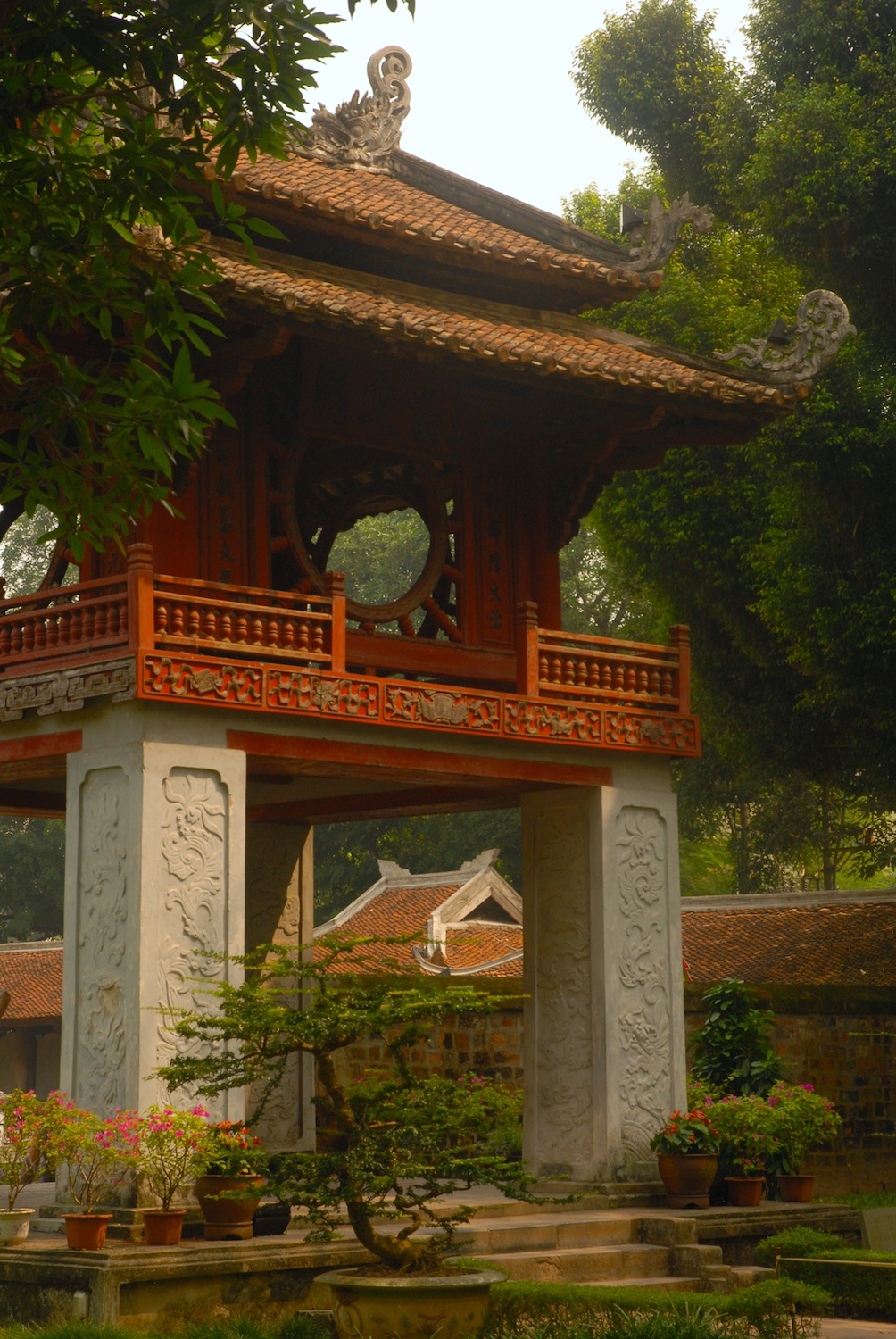
      The first three courtyards were basically gardens beside artificial ponds.  These were the places where the students indulged in quiet, private study.  The temple to Confucius stood in the fourth compound, where mandarins and princes came to make offerings and honor the sage.  The fifth compound housed the Quc T Giám buildings and halls.  Here the tutors worked directly with the students, imparting their lessons in reading and writing, overseeing their compositions, quizzing them, preparing them for the examinations.
courtyard tower, Văn Miếu
Confucius image in the Temple of Literature
       To enter the service of the Court, monks and priests took the Tam Giáo (Three Religions) examinations, while sons of aristocrats, who were to hold most high mandarin positions, took the Thái Hc Sinh exams.  The most prestigious examination system was for attaining a doctorate (tién sĩ) and was open to any landowner or his son who had already passed the lower level of exams.  As the prevailing inheritance system was division among the children (including the daughters) rather than primogeniture, the class of eligible hopefuls constantly expanded.
private classes in the old days
       To pass the series of exams and make it to tiến sĩ required a sophisticated knowledge of the Chinese classics, Confucian mores, history, literature, philosophy and statecraft.  The arts and sciences were not part of the curriculum.  The emphasis was less on practical matters and more on molding a character and worldview proper for a socially responsible administrator. 
       Those who got high marks in the provincial examinations (thi hương) won the title of cứ nhân and were eligible for the next level--thi hội.  If they passed four rounds of thi hội exams they won the coveted title of tiến sĩ and eligible for the final, royal set called thi đình, carried out to rank the tiến sĩ and apportion honors and positions.  Even those who failed at the thi hội level were still compensated, for they usually wound up being teachers, still a prestigious occupation and sometimes very well paid.
Quộc Từ Giám, the National University
        Thăng Long played host to all three of these examinations. The thi hi examinations were held in the lakeside Giáng Võ palace, southwest of the Citadel. The site for the thi hương examinations, like the thi hi examinations held every three years, though not the same year for each, was the spot now occupied by the National Library on Tràng Thi street, off the southwest corner of Hoàn Kiếm Lake.  Ordinarily a vacant lot, at thi hương time it became the intellectual and social focal point for all of Thăng Long.
       Two thick fences and a moat lined with rows of pikes surrounded the examination grounds.  The compound was divided into four equal parts, all fenced in with a gate surmounted by a watchtower.  City authorities posted guards around the camp’s perimeters.  An office in the center of the compound stamped the examination papers, announced the subjects and collected the candidates’ compositions.
huts and beds in the examination ground
       The Ministry of Ceremonies organized the event, though the king himself appointed the inspectors and the mandarins in charge of supervision and control.  The ministry announced the list of examiners ten days prior and they immediately were locked in seclusion inside the camp, cut off from contact with the outside world.  When the candidates arrived camp guards searched their belongings three times before letting them in to find which quarter of the camp to which they had been assigned.  All this searching and sequestering was intended to eliminate any chance of cheating in any way.  The government viewed these examinations with the utmost gravity.  The candidates themselves were equally serious.  Since their whole future depended upon their performance, no event in their lives until now was as important.
punishing violators of the examination rules
       Citizens of Thăng Long were also well aware of the importance of these examinations and enjoyed the excitement when the scholars thronged the city every three years.  The candidates were recognizable by the baggage they lugged into the city’s inns and hostels, containing the set of items they would live off during the days they were ensconced in the examination camp.  A tent of lacquered cloth and a bamboo bench were the most obvious items, things only ever toted by examinees.  They also carried some clothes, a water canteen, a wooden cylinder for storing exam papers and a wooden box with paper, ink and brushes, which doubled as a table for meals.  Thăng Long residents were especially hospitable to them.  After all, today’s noodles customer might one day be the mandarin governing this district.
examination day
       Candidates had to write four successive compositions (they had a full day for each) in addition to fielding questions from the examiners.  A serious mistake in a composition meant failure.  As a result, as time progressed, there were fewer and fewer candidates remaining, so less time waiting around to be scheduled.  By law, though, the maximum time permitted between the first and last exam was twenty days.  When the examinations were concluded some candidates returned to their villages, while others waited around for several days for the posting of the results.
       The urban mood was at its liveliest and merriest at this time.  With the immediate pressure off, the candidates relaxed at the West Lake pavilions, went boating on the lake around the Temple of Literature after visiting the shrine to Confucius, indulged in their famous propensity for pranks and practical jokes, visited theaters and dined and drank in the inns.  Finally the results would be known and those who passed and attained the c nhân degree filed off to the palace, from where mandarins led them in a well-observed procession through the city.  High-ranking families with marriageable daughters paid particular attention to which of the cnhân were single.
honoring the scholar and his horse
       The treatment accorded those scholars who went on to make tin sĩ and pass the thi đình examinations at the palace was even grander.  The king awarded them ceremonial clothing and the Ministry of Ceremonies hosted a banquet in their honor.  Mandarins gave them a guided tour of the royal gardens and the streets of the capital, lined with citizens applauding their success. 
       Then officials led them in a procession all the way back to their villages, led by drummers and including separate palanquins for the scholar’s teacher and parents, the tiến sĩ riding in the last, most elegant palanquin or on a specially outfitted horse.  If he scored extraordinarily high marks, at the entrance to the village four men grabbed the horse’s legs and carried both the animal and the seated scholar to the village center, thereby honoring both horse and rider.  This theme of the successful scholar’s return home has inspired countless paintings and carvings over the centuries and is one of the most common skits presented in shows by contemporary water-puppet troupes.
stele house at Văn Miếu compound
       Upon arrival the laureate performed rites to his ancestors.  His village organized a welcome ceremony and feast in his honor.  They also granted him certain favors and honors.  They invited him to direct village affairs, to have the seat of honor at assemblies and rituals at the đình (communal house) and to supervise the distribution of votive offerings to the villagers at festivals.  Meanwhile, unless he had already made employment arrangements as a tutor he awaited his appointment to office by the Court.  When it came he was not given a salary, but instead an estate in which he collected taxes and services from its serfs.
       The system continued through the Lý and Trn Dynasties, was interrupted by the two decades of Chinese occupation early 15th century, and after their expulsion, revived by the Lê Dynasty.  Confucianism then became the official state ideology.  In 1475 the dynasty’s most accomplished emperor, Lê Thánh Tông, began the custom of erecting steles inscribed with laureate’s name, on the grounds of the Temple of Literature (which are still there).   
steles honoring tiến sĩ ar Văn Miếu
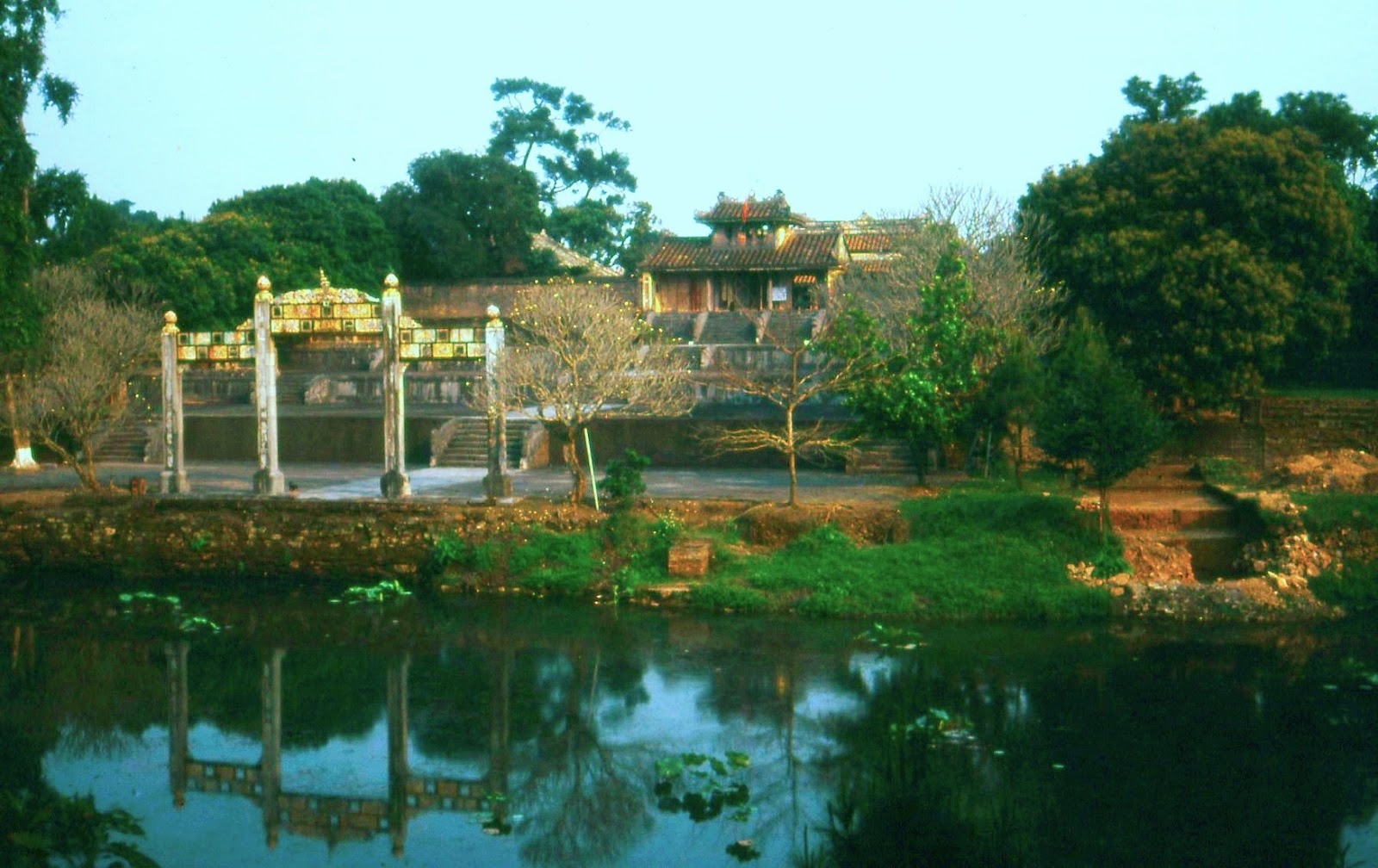
entrance to Văn Miếu at Huế
       In the early 16th century the Lê government, plagued by a succession of incompetent, cruel and lecherous teenage tyrants, fell to Mác Đăng Dung in 1527.  Lê forces retreated, but eventually launched a long campaign against the Mc that restored them in 1592.  Yet throughout the turmoil the examination system continued in the capital, even under siege.  And with the Lê restoration it was back.
scholars' steles at the Huế Văn Miếu
       The restored Lê emperor was just a figurehead, though, and in the 17th century the country split into administrative halves.  The Trnh Lords ruled the north and the Nguyn Lords controlled the south.  The Trnh Lords continued to rely on the examination system for their officials and after 1695 the Nguyn Lords adopted the system.  The Tây Sơn Revolt (1778-1802) destroyed both administrations, but after Nguyễm Ánh, the last surviving Nguyễn Lord, reunited the country, classic Confucianism made a comeback.
       Now known by the royal name Gia Long, the new emperor made Huế the national capital and in 1808 built a new Temple of Literature on the Perfume River a few km downstream from the Citadel.  National examinations took place here until the end of the system entirely in 1919.  Gia Long also continued the custom of erecting steles inscribed with the names of the laureates.  Today, two rows of these, plus two compound entry gates, are all that remain on the site.
compound gate to Văn Miếu at Huế
       In contrast, the original Temple of Literature in Hanoi still stands, albeit with renovated buildings, but still roughly in the original layout.  It’s naturally a top tourist attraction, but is also revered by Hanoi residents.  In the past, the examination system was more than just a tri-annual season of intellectual and social excitement.  It instilled a sense of status and respect for education that has persisted through to the 21st century, even though it’s an entirely different system of education now.  It made residents feel that their city was the epicenter of culture and civilization in Vietnam, the major source of its intellectual ferment, artistic innovation and cultural inspiration.  It’s a claim that can still be made. 

the tiến sĩ's triumphant procession--popular water-puppet skit

                                                                          * * *                       

The Temple of Literature is one of the stops in Hanoi on Delta Tours Vietnam's visit to the city. See the itinerary at https://www.deltatoursvietnam.com/destinations 

Wednesday, May 25, 2016

Splendor and Neglect: The Tombs and Times of the Early Nguyễn Emperors


                                                         by Jim Goodman

       Huế was the last imperial capital of Vietnam.  It was a natural choice for the newly established Nguyn Dynasty regime, for the re-unified nation’s borders now stretched from north to south to what they are today.  Huế was roughly in the middle of the country and had already seen service, officially since 1744, as a capital for the Nguyễn Lords realm, which comprised everything in Vietnam south of the Ghanh River in Quảng Binh province.
mausoleum of Gia Long, Nguyễn Dynasty founder
       With the fall of the Nguyễn Lords’ regime and the triumph of the Tây Sơn insurrection, it became the capital of self-proclaimed Emperor Quang Trung in 1788.  But while the Tây Sơn controlled the north and center of the country, they never established a permanent presence in the south.  They did catch up with the Nguyễn royal family in 1777 and executed all but one of them.  The sole escapee was the teenaged Nguyễn Ánh.
       For the next 25 years Nguyễn Ánh pursued his relentless campaign against the Tây Sơn.  He won and lost Saigon a few times but by 1792, the year Quang Trung died, he had a base in Saigon and ten years later in 1802 marched into Hanoi, deposing the last Tây Sơn emperor.  Nguyễn Ạnh then announced the inauguration of a new dynasty and renamed himself Emperor Gia Long.  As for the country’s new capital, it would not be Hanoi, as it had been traditionally, but Huế, the capital of his forefathers. 
       Gia Long’s first order was the construction of the Citadel on the north bank of the Perfume River that runs through the two parts of contemporary Huế.  The imperial audience hall, royal residences, theater and family temples lay inside the walls, which were surrounded by a moat.  The commoners, shopkeepers and craftsmen lived east of the Citadel or on the other side of the river.
row of guardian statues
Court mandarin, Gia Long's tomb
       Gia Long modeled his administration and new Code of Law on that of Qing Dynasty China, emphasizing Confucian precepts.  That included state rituals like the Sacrifice to Heaven the emperor performed every three years at Nam Giao, following a procession over the river and south about 3 km.  He set up six ministries to run the government, but the Huế Court actually only directly governed the central provinces.  He left his favorite generals in charge of the north and the south.
graceful buildings of Minh Mạng's mausoleum
       He also picked the site of his tomb by riding an elephant to explore possibilities south of the city.  In 1814 he selected a spot 16 km south of the palace, in a pine forest beside a pond, with a view of distant mountains.  He died in 1820, when the compound was all but finished.  His body and that of his chief imperial consort (the Nguyễn Dynasty didn’t have Queens) lie in simple twin tombs in a separate courtyard. 
       The buildings are all aligned on a horizontal axis, one of the features, along with a tranquil natural environment, to be repeated in the mausoleums of succeeding emperors.  Another is the pair of white towers that, in this case, stand across the pond from the temple.  A third is the statues of mandarins, soldiers, horses and elephants that line opposite sides of the main courtyard.
       His successor Minh Mạng was an even more dedicated Confucian.  He viewed himself as an intellectual and all but memorized the works of Confucius and Mencius.  He encouraged education and promoted tuồng theater, the Vietnamese version of Chinese opera, because its stories emphasized Confucian virtues.  The adoption of these virtues, he believed, would establish the harmony essential to a nation and its society.
the natural setting of Minh Máng's mausoleum
       Certainly the principle of harmony dominated the planning of Minh Mạng’s mausoleum.  Geomantic experts took 14 years to find the right location, just over the other side of the Perfume River.  The geomantic team’s leader won a double promotion from the emperor, who died soon afterward, in January 1841.  Construction was completed less than three years later and, in general, the result takes the best ideas from Gia Long’s mausoleum and perfects them. 
       The walled compound lies in a forest glade, with a rectangular peninsula jutting out into the Lake of Impeccable Purity.  The buildings are all laid out symmetrically on an east-west axis, beginning with the Honor Courtyard, flanked by statues of mandarins, soldiers, horses and elephants, then the Stele House and finally the wide-roofed family temple.  Crossing a narrow part of the lake here, the next stop is the elegant, two-story Pavilion of Pure Light, with frangipani trees on either side, as well as two tall white towers like those at Gia Long’s tomb.  In front of it lies a crescent-shaped pond and over its bridge on the hillside is Minh Mạng’s tomb, certainly a most serene location.
the Emperor carried to Nam Giao
Pavilion of Pure Light
       The layout of Minh Mạng’s mausoleum fully embraces the Confucian concepts of order, balance and harmony.  Unfortunately, these concepts did not carry over into Minh Mạng’s administration so much.  Gia Long had allowed the Chinese, Khmer and Chăm communities to retain local autonomy, keeping a promise he made when they joined his side in the war against the Tây Sơn regime.  He also granted autonomy to the northern and southern thirds of Vietnam. 
the lantern dance, a Nguyễn Court favorite
       Minh Mạng upended these arrangements by further centralizing power and expanding his own role.  He insisted on personally vetting, in private meetings, all high government and military officials before allowing them to take office.  He abolished the autonomy of the Mekong Delta provinces, sparking a revolt that he put down with stern ferocity.  He took over the administration of the last Chăm state of Panduranga and began a policy of forced assimilation in the Khmer and Chinese areas.
       He expanded the regime’s penchant for pageantry and spectacle as well.  He added hundreds of participants to the procession to Nam Giao for the Sacrifice to Heaven.  He patronized the royal theater and frequently attended performances of tuồng dramas, lantern dances, acrobatic acts and classical music shows.  He watched the battles staged in front of the Citadel between an elephant, representing the throne, and a tiger, symbolizing the emperor’s enemies.  The elephant always won, of course, but in 1830 a rebel tiger attacked Minh Mạng.  He escaped harm, but then ordered the construction of a Royal Arena across the river, where the contests were subsequently staged.
Thiệu Trị's mausoleum
       He was also an extremely amorous emperor, with 33 wives and 107 concubines, with whom he fathered 142 children.  With his pursuit of pomp and entertainment by day and sex by night, one wonders how much time he spent in contemplating the problems of the country he governed with such concentrated autocracy.  He had shut himself off from Western influence just at the time when Western powers, particularly France, were gearing up their colonial ambitions.
       Gia Long had also closed the country to Western influence, other than military technology.  But Westerners, particularly his long-time friend the Catholic priest Père Pigneau, had been instrumental in helping him win the throne.  In return, he tolerated the existence and even expansion of Christianity among his subjects.  Minh Mạng reversed this policy, arrested foreign missionaries and persecuted Christians, giving the French an excuse to get involved.  
       Things got worse with his successor, Thiệu Trị, who reigned from 1841-1847, a chip off the old block and just as determined as his father to follow strict Confucian orthodoxy, ignore the West and stamp out Christianity. A ban on its practice provoked a French naval expedition to sail into the harbor at Đà Nẵng in 1847 demanding its revocation.  Not getting acquiescence fast enough, they shelled and destroyed the coastal forts and sank three Vietnamese ships.
Stele House, Thiệu Trị's mausoleum
       Enraged, Thiệu Trị ordered the execution of all Christians in Vietnam, but died soon after the incident and the edict was never carried out. The construction of his tomb took place the following year.  It lies in a tranquil rural area 7 km south of Huế, divided into two sections, smaller than Minh Mạng’s, has no compound wall but basically features the same characteristics.  Here also is a courtyard with statue ranks of elephants, horses, soldiers and mandarins, ponds beside the compounds, two tall white towers, this time flanking the Stele House.  As fond of Chinese literature as his father, Thiệu Trị was himself a prolific poet, and several of his compositions adorn the temple walls.
       Another trait he shared with his father was multiple wives and concubines.  In his short life of 37 years he fathered 29 sons and 35 daughters.  His second son became Emperor Tự Đức at 19 years of age and reigned 35 years.  Brought up to revere the Confucian classics, he became more immersed in them after he was emperor.  He spent long hours reading them, composed poems himself, and held lengthy discussions with his mother, also a literary aficionado, on the lives and morals of ancient Chinese heroes, sometimes scribbling down her comments in a notebook.  He was at least equally devoted to theater and was responsible for the writing and production of a couple of the longest tuồng dramas ever, with over a hundred scenes each. 
Stele House, Tự Đức's mausoleum
       In frail health throughout his life, he made virtually no tours of his country and relied totally on squabbling ministers.  In foreign policy his view was that the isolationism that was good enough for his predecessors was good enough for him.  He even banned all foreign trade.
       Unfortunately for him and his country, it wasn’t.  In these rapidly changing times the classic Confucian model of government wasn’t going to work anymore.  It was already failing in China.  The West was growing stronger all the time, in the mood for expansion, and Vietnam’s isolationism only undermined its ability to deal with the threat.  Having a ruler more concerned with the production of a play and the architecture of his mausoleum than discontent in the countryside and threats to the nation’s sovereignty didn’t help.  
       In 1862 the French pressured Tự Đức’s government to cede Saigon and three provinces.  Tự Đức continued to resist his ministers’ calls for reform, French ambitions grew and in 1883, the last year of the emperor’s life, the French forced the Huế government to recognize the entire southern third of the country as a French colony. 
a palace while Tự Đức lived, the family temple after he died
       Construction of Tự Đức’s mausoleum was completed halfway through his reign and he used to spend much leisure time there.  The walled compound, just 5 km south of the city, features a lake on its eastern side, opposite buildings aligned on an east-west axis.  Tự Đức used what is now the main temple as a palace while he was alive and this compound includes a royal theater and quarters for the emperor’s concubines.  He also liked to drink wine and compose poems at an elegant pavilion beside the lake.  His tomb and Stele House are in a smaller compound north of the temple.  Like Ming Mạng’s mausoleum, that of Tự Đức exemplifies harmony and grace in design.
       Tự Đức had scores of consorts, but was apparently sterile, for he had no children.  A violent faction quarrel broke out among the Court mandarins, with the next three successors murdered.  The French proceeded to annex central and northern Vietnam, in 1885 setting up ‘protectorates’ in each.  When the young Emperor Hàm Nghi protested, French troops drove him from the Citadel, ransacked the royal palace, stole everything of any value from gold ornaments to mosquito nets, and from then on, other than the brief Japanese occupation, controlled Vietnam until 1954.
actors as the Nguyễn royal family at the Huế Festival
       Time passed.  People stopped looking after the mausoleums.  20th century wars wrecked damage and after 1975, the government couldn’t care less about the Nguyễn legacy.  Only from 1990 did attitudes begin changing.  Huế people had always been proud of their Nguyễn Dynasty relics and started pushing for restoration and preservation.  The government changed its attitude and began embracing anything characteristic of Vietnam’s special historical and cultural identity. 
       Since early this century the city has also hosted a bi-annual Huế Festival.  With international participation, the program includes everything from Thai classical dances to Germans walking on towering stilts, and on the local side kite-flying contests and village crafts competitions.  Performances at the Citadel and other venues feature Vietnamese dances, new and old, but also actors dressed in imperial garments impersonating the Nguyễn royal family attending the shows, and an early morning re-enactment of the procession to Nam Giao and the Sacrifice to Heaven.
       Nowadays most of the Nguyễn legacy damaged by war has been repaired and mausoleum buildings crumbling from neglect have been restored.  The people of Huế are pleased.  They like having reminders of the city’s past glory around them and in good condition.  They still take pride in Huế’s history. Whatever the failings of the Nguyễn Dynasty, it was the only one Huế could call its own.

the lakeside pavilion where Emperor Tự Đức drank wine and composed poems
                                                                                * * *           
     A stop in Huế is part of the program on Delta Tours Vietnam’s journey through the country.