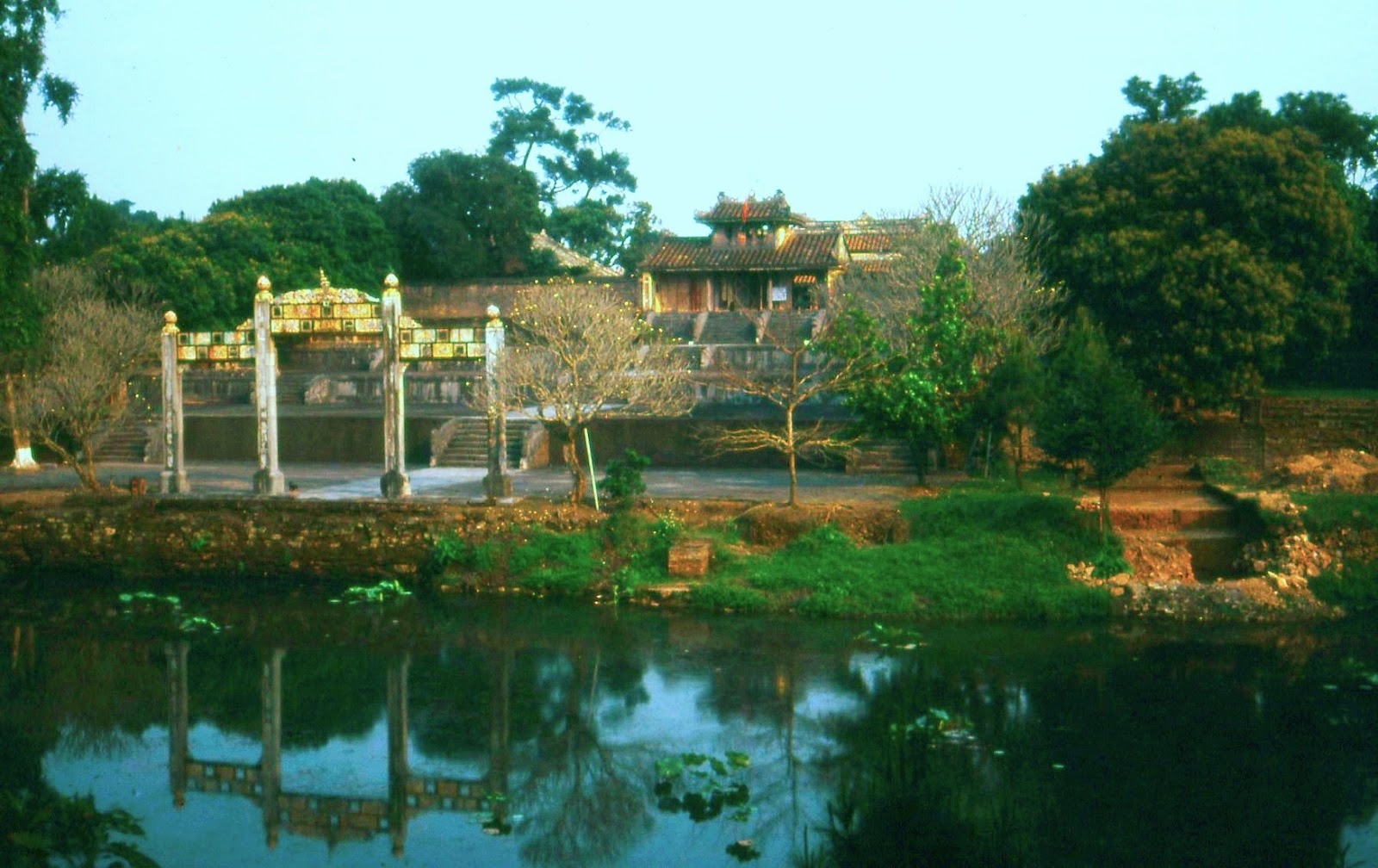
Showing posts with label Tây Sơn. Show all posts

Monday, November 7, 2016

Expanding and Adapting: When the Vietnamese Moved South


                                          by Jim Goodman

 
rice cultivation in the Red River Delta
     
Students of Vietnamese history know that, after over a thousand years of Chinese occupation, in 938 the Vietnamese finally expelled the Chinese and re-established their independence.   Books then go one to tell the story of the dynasties that followed, their defeat of Chinese attempts to take back the country, including three massive Mongol invasions, and the establishment of a distinct state and culture.  This development suffers a jolt in 1407, when the Chinese invade and occupy Vietnam for twenty years until an indigenous guerrilla movement throws them out and its leader founds the Lê Dynasty.  After that, the Vietnamese gradually expand south.
Chùa Dâu, the first Buddhist temple
       This is a summary of the history of the Vietnamese people, but not that of what today constitutes the territory of Vietnam.  The events just narrated concerned only the northern third of the country, called Đi Vit.  The narrow middle section, Central Vietnam, was home to several Chăm kingdoms, while the swampy, very sparsely populated Mekong Delta was part of the Khmer Empire. 
       Đi Vit was the most populated and centrally organized.  With the construction of dikes and canals, ancient Vietnamese had turned the swamps of the Red River Delta into productive rice-growing farms, enabling the formation of states based on agricultural revenue.  The long Chinese occupation didn’t change this, but imposed a Confucian system for organizing both government and everyday life, and introduced Mahayana Buddhism as a state-sponsored religion.
       Chùa Dâu in Bc Ninh province, constructed in the 3rd century, was the first Buddhist temple.  Vietnamese adopted the religion whole-heartedly and it spread throughout the north.  Buddhist monks served as advisors to Đi Viêt’s first kings and the Lý Dynasty lavished funds on temple construction and religious endowments.  Taoism also had its adherents, but in any case, animism never disappeared from the Vietnamese psyche.  The village’s main deity was its own guardian spirit, who was once a living person, quite often a general who fought northern invaders.
Quố Tử Giàm, the National University
       Like their former overlords, the Vietnamese followed Confucian ideals in everyday life, such as ancestral veneration, social hierarchies, models of behavior and respect for learning.  Confucian norms also characterized the government.  In 1076 the Lý Court established a National University (Quc TGiàm) to train officials.  Confucian classics dominated education.
       Besides the periodic invasions from Chins, Đi Vit also had problems with the Chăm kingdoms on its southern frontier.  Chăm people began migrating into Vietnam from the Philippines and Indonesia two thousand years ago, establishing different kingdoms along the coast of Central Vietnam from the late 2nd century, influenced by their Khmer neighbors to the southeast.  The religion was Hindu, the temples modeled on Khmer architecture and sculpture, the rulers god-kings, identified with Shiva, with occasional monarchs, as in Cambodia, Mahayana Buddhists.
Chăm Court, Đà Nẵng Chăm Museum
       The main difference between Chăm and Khmer kingdoms was that the Chăm were also great seafarers and supplemented their agricultural economy and national wealth by trading in ports throughout Southeast Asia.  After the 8th century, many of those involved in the maritime trade with Indonesia became Muslim, though Hindu Chăm still comprised the majority of the population. 
        They were also a very bellicose people, involved in frequent wars with Khmer princes and each other, as mercenaries for one Khmer contender for Angkor’s throne against another, and sometimes in alliance with the Khmer against the Vietnamese.  Northern Chăm states made a habit of raiding southern Đại Việt districts from the time of the Chinese occupation. The eventual Vietnamese response was always a punitive expedition that forced the Chăm to cede their own northern districts to Đái Việt. When Vietnamese began settling in these acquisitions the Chăm would start raiding them, provoking another expedition and another annexation.
Bánh Ít Chăm towers in Bình Định
       By the 14th century, the Vietnamese had pushed the Chăm south of Quảng Nam.  But the largest Chăm kingdom, Vijaya, with its capital in present-day Bình Định province, rose to new strength later that century under the charismatic King Chế Bồng Nga.  For nearly two decades, starting in 1371, he launched several invasions of Đại Việt, sacked the capital twice and would have done so a third time, but was killed by Vietnamese artillery after a defector had revealed which ship he was on.
royal court, Lê Dynasty
       Some decades later, grossly underestimating his enemy’s strength, the King of Vijaya resumed raids on Đại Việt territory.  However, his opponent this time was Lê Thánh Tông, the Lê Dynasty’s most talented king, who was determined to end the Chăm menace once and for all.  With an overwhelming invasion force, backed by the latest artillery technology, he captured Vijaya, obliterated its defenders and annexed the state, extending Đái Viết’s borders down through Phủ̉ Yên.  Many Chăm fled by sea north to Hainan Island, east to Cambodia or south all the way to Acheh, Indonesia. Others moved to the hills or simply stayed, adopted Vietnamese names and assimilated to the new order.
       Lê Thánh Tông then set up an immigration system of military colonies to promote Vietnamese settlement in the conquered territories.  But aside from political exiles, runaway convicts, criminals and dubious adventurers—the usual frontier riffraff—nobody went south.  Vietnamese are very conservative and don’t like to leave their ancestral lands without a serious compelling reason.
countryside near Huế--the heartland of old Thuận Hoá
       After two decades of four successive depraved, bloodthirsty, reckless and incompetent teenaged kings (with absolute power), each of whom was killed at the end of his rule, in 1527 Mạc Đăng Dung, the Court security chief, seized power and started a new dynasty.  Lê followers escaped to Laos and several years later launched a protracted war against the Mạc regime.  Every few years contending armies marched across the Red River Delta territories, conscripting every able-bodied man in the villages, fought furious battles, beheaded all their prisoners and retreated to regroup and campaign again later.
       In many places there were no men left for agricultural work.  Dikes fell into disrepair, rice fields became weed patches and famines stalked the land.  This bleak situation provided the motives for emigration, not over-population.  Đại Việt’s population fell sharply in the 16th century, especially in the Delta.  Life became untenable in the ancestral homelands.
       Vietnamese had already been settling in Thuận Hoà, the area below Quảng Binh down to the Hải Văn Pass near Đằ Nẵng.  Their numbers multiplied in the 16th century, while some continued on to Quảng Nam and former Chăm areas further south.  They were refugees fleeing a land they had no hope of returning to, pioneers that included hardy farmers, skilled crafts workers, canny merchants and dedicated soldiers.  
Thiên Mụ Pagoda
      Up north, two rival families, the Trịnh and Nguyễn, allies and inter-married but suspicious of each other, led the Lê forces.  Trịnh Tùng commanded the forces that drove the Mạc out of the capital in 1592 and installed the restored Lê king as a figurehead, keeping real power himself.  His rival Nguyễn Hoàng had been governor of Thuận Hóa since 1558 and made it his own autonomous fief.  He set up an efficient administration, dominated by military officers, and essentially broke away from the Lê government by refusing to send taxes back.  Visiting the Perfume River in 1601, he sponsored the building of the Thiên Mụ Pagoda, still standing and a major tourist attraction.       
       When he died in 1613 the country was effectively split.  The Trịnh Lords of the north were not yet strong enough to compel the Nguyễn Lords’ submission, but Nguyễn Hoàng’s capable successor, Nguyễn Phúc Nguyên, knew the showdown was imminent.  He married off one of his daughters in 1623 to Chay Chetta II, King of Cambodia, to insure the supply of war elephants and rice to his small and vulnerable realm.  To secure his southern flank, he also married off another daughter to Pôrômê, the Chăm King of Panduranga, south of former Vijaya.
       The long-expected invasion came in 1627 and the southerners turned it back. They resisted more invasions in the next decades and made one unsuccessful campaign into the north before finally, in 1672, the two sides signed a truce, dividing the country at the Ghanh River just above Đồng Hợt, Quảng Binh. 
       These campaigns were intermittent, leaving the south long periods of peaceful development.  Vietnamese settlers, less tradition-bound and more open to changes than they were up north, made several adaptations in the new lands, where they would be a minority for generations to come.  Farmers found the soil in Thuận Hóa the soil was different from that up north.  The plow they used there was not very strong in the sole or the blade, light enough to be drawn by a single animal, and quite suitable for the less compacted soil of the Delta.  But it would not work well with the thick grass and harder soil of Thuận Hóa.  So they used the Chăm plow, stronger in the sole and better suited for the fields.  Then they improved it by adding a part to alter the angle of the blade.
Pô Nagar, the main Chăm goddess
whale temple wall, Bạc Liêu
       The immigrants took to eating some of their food raw, like the Chăm, and wrapping their hair in headscarves, male and female, like the Chăm.  They also adopted the Chăm way of capturing, training and using elephants.  Northern armies had been using elephants in warfare for a long time, but now Vietnamese, like the erstwhile Chăm kings, also employed them as royal entertainment and to execute criminals.
       In spiritual matters, too, Chăm culture influenced immigrant Vietnamese.  The latter erected new temples on the site of ruined Chăm temples because they accepted the Chăm belief that the particular site was charged with holy power.  They adopted the cult of the whale, Cá Ông, in Phú Yên and took it with them further south.  Most significantly, they incorporated Pô Nagar into their own cult of the Holy Mothers, one that had only become part of Vietnamese culture since the 16th century.  They renamed her Thiên Ý A Na.
Khleang Temple, Sóc Trăng, originally built 1533
       After the truce with the Trịmh Lords, the Nguyễn regime focused on the south.  By this time Cambodia had fallen into a long series of succession struggles among its royal princes.  Since Nguyễn Phúc Nguyên’s daughter married Chay Chetta II, Cambodia had become weaker and the Nguyẽn Lords’ realm stronger.  Rival princes needed outside help to win and in return for Vietnamese help; ceded provinces in the Mekong Delta over which the Cambodian government had had no control for centuries. In this way, the Vietnamese were able to set up direct administration of Saigon in 1698 and in the following century gradually annexed the entire Mekong Delta.
       The Mekong Delta at that time was mostly an uninhabited swamp.  The Khmer lived mainly near the mouth of the Mekong, far from Cambodia proper, in communities virtually autonomous since their founding.  Vietnamese migrants did not displace them, but moved into the adjacent areas and beyond, cleared the swamps and created big rice plantations.  Local Khmer by then were Theravada Buddhists and while that did not influence the migrants, they did adopt the custom of field shrines to the land spirit, the use of split palm leaf to make houses, Khmer farming tools and the types of rice grown.
Khmer house of split palm leaf
       The late 17th century also saw the introduction of Chinese settlers in the Mekong Delta, when political refugees were allowed to settle in Biên Hoa and Mỹ Tho.  Other Chinese refugees established the port of Hà Tiên, now on the southwest border of Cambodia.   Vietnamese were still a minority, but their numbers increased with the arrival of Vietnamese Christians fleeing periodic persecutions by the Nguyễn regime. 
       By the mid-18th century the Nguyến regime was in decline.  The Tây Sơb revolt, named after a village in south central Vietnam where it began, broke out in 1771 and in a few years overthrew the regime.  They later went on tọ conquer the Trịnh regime in the north.  The Nguyễn family escaped to the south, but the rebels caught up with then and massacred every member except the teenaged prince Nguyễn Ánh.  The next chapter of Vietnamese history is the story of how this indomitable prince waged a 25-year campaign to finally defeat his Tây Sơn opponents.
Chinese stage show, Hồ Chị Minh City
Chợ Lợn Chinese market, Hồ Chí Minh CIty
       After several reverses and recoveries, he consolidated control over the Mekong Delta and used this as his base to slowly, methodically advance north.  As his close friend and advisor, as well as link to Western military technology, was the French priest Pére Pigneau, Nguyễn Ánh tolerated the practice and spread of Christianity.  He also promised local autonomy to the Chinese, Khmer, Chăm and other non-Vietnamese communities in return for their support for his cause.   And he kept those promises after victory.
       With this multi-ethnic army, Nguyễn Ánh ultimately rolled into the northern capital in1802, terminated the Tây Sơn regime, founded the Nguyễn Dynasty and took the reign name of Gia Long.  His triumph was more than just the restoration of his family’s power.  This was a new country, Vietnam, bigger and more culturally enriched than Đại Việt, with the boundaries it still has today.
 
Vietnamese-made canal in rural Vĩnh Long
                                                                           * * *   
                  For the full story, see my book Delta to Delta:  The Vietnamese Move South


Wednesday, May 25, 2016

Splendor and Neglect: The Tombs and Times of the Early Nguyễn Emperors


                                                         by Jim Goodman

       Huế was the last imperial capital of Vietnam.  It was a natural choice for the newly established Nguyn Dynasty regime, for the re-unified nation’s borders now stretched from north to south to what they are today.  Huế was roughly in the middle of the country and had already seen service, officially since 1744, as a capital for the Nguyễn Lords realm, which comprised everything in Vietnam south of the Ghanh River in Quảng Binh province.
mausoleum of Gia Long, Nguyễn Dynasty founder
       With the fall of the Nguyễn Lords’ regime and the triumph of the Tây Sơn insurrection, it became the capital of self-proclaimed Emperor Quang Trung in 1788.  But while the Tây Sơn controlled the north and center of the country, they never established a permanent presence in the south.  They did catch up with the Nguyễn royal family in 1777 and executed all but one of them.  The sole escapee was the teenaged Nguyễn Ánh.
       For the next 25 years Nguyễn Ánh pursued his relentless campaign against the Tây Sơn.  He won and lost Saigon a few times but by 1792, the year Quang Trung died, he had a base in Saigon and ten years later in 1802 marched into Hanoi, deposing the last Tây Sơn emperor.  Nguyễn Ạnh then announced the inauguration of a new dynasty and renamed himself Emperor Gia Long.  As for the country’s new capital, it would not be Hanoi, as it had been traditionally, but Huế, the capital of his forefathers. 
       Gia Long’s first order was the construction of the Citadel on the north bank of the Perfume River that runs through the two parts of contemporary Huế.  The imperial audience hall, royal residences, theater and family temples lay inside the walls, which were surrounded by a moat.  The commoners, shopkeepers and craftsmen lived east of the Citadel or on the other side of the river.
row of guardian statues
Court mandarin, Gia Long's tomb
       Gia Long modeled his administration and new Code of Law on that of Qing Dynasty China, emphasizing Confucian precepts.  That included state rituals like the Sacrifice to Heaven the emperor performed every three years at Nam Giao, following a procession over the river and south about 3 km.  He set up six ministries to run the government, but the Huế Court actually only directly governed the central provinces.  He left his favorite generals in charge of the north and the south.
graceful buildings of Minh Mạng's mausoleum
       He also picked the site of his tomb by riding an elephant to explore possibilities south of the city.  In 1814 he selected a spot 16 km south of the palace, in a pine forest beside a pond, with a view of distant mountains.  He died in 1820, when the compound was all but finished.  His body and that of his chief imperial consort (the Nguyễn Dynasty didn’t have Queens) lie in simple twin tombs in a separate courtyard. 
       The buildings are all aligned on a horizontal axis, one of the features, along with a tranquil natural environment, to be repeated in the mausoleums of succeeding emperors.  Another is the pair of white towers that, in this case, stand across the pond from the temple.  A third is the statues of mandarins, soldiers, horses and elephants that line opposite sides of the main courtyard.
       His successor Minh Mạng was an even more dedicated Confucian.  He viewed himself as an intellectual and all but memorized the works of Confucius and Mencius.  He encouraged education and promoted tuồng theater, the Vietnamese version of Chinese opera, because its stories emphasized Confucian virtues.  The adoption of these virtues, he believed, would establish the harmony essential to a nation and its society.
the natural setting of Minh Máng's mausoleum
       Certainly the principle of harmony dominated the planning of Minh Mạng’s mausoleum.  Geomantic experts took 14 years to find the right location, just over the other side of the Perfume River.  The geomantic team’s leader won a double promotion from the emperor, who died soon afterward, in January 1841.  Construction was completed less than three years later and, in general, the result takes the best ideas from Gia Long’s mausoleum and perfects them. 
       The walled compound lies in a forest glade, with a rectangular peninsula jutting out into the Lake of Impeccable Purity.  The buildings are all laid out symmetrically on an east-west axis, beginning with the Honor Courtyard, flanked by statues of mandarins, soldiers, horses and elephants, then the Stele House and finally the wide-roofed family temple.  Crossing a narrow part of the lake here, the next stop is the elegant, two-story Pavilion of Pure Light, with frangipani trees on either side, as well as two tall white towers like those at Gia Long’s tomb.  In front of it lies a crescent-shaped pond and over its bridge on the hillside is Minh Mạng’s tomb, certainly a most serene location.
the Emperor carried to Nam Giao
Pavilion of Pure Light
       The layout of Minh Mạng’s mausoleum fully embraces the Confucian concepts of order, balance and harmony.  Unfortunately, these concepts did not carry over into Minh Mạng’s administration so much.  Gia Long had allowed the Chinese, Khmer and Chăm communities to retain local autonomy, keeping a promise he made when they joined his side in the war against the Tây Sơn regime.  He also granted autonomy to the northern and southern thirds of Vietnam. 
the lantern dance, a Nguyễn Court favorite
       Minh Mạng upended these arrangements by further centralizing power and expanding his own role.  He insisted on personally vetting, in private meetings, all high government and military officials before allowing them to take office.  He abolished the autonomy of the Mekong Delta provinces, sparking a revolt that he put down with stern ferocity.  He took over the administration of the last Chăm state of Panduranga and began a policy of forced assimilation in the Khmer and Chinese areas.
       He expanded the regime’s penchant for pageantry and spectacle as well.  He added hundreds of participants to the procession to Nam Giao for the Sacrifice to Heaven.  He patronized the royal theater and frequently attended performances of tuồng dramas, lantern dances, acrobatic acts and classical music shows.  He watched the battles staged in front of the Citadel between an elephant, representing the throne, and a tiger, symbolizing the emperor’s enemies.  The elephant always won, of course, but in 1830 a rebel tiger attacked Minh Mạng.  He escaped harm, but then ordered the construction of a Royal Arena across the river, where the contests were subsequently staged.
Thiệu Trị's mausoleum
       He was also an extremely amorous emperor, with 33 wives and 107 concubines, with whom he fathered 142 children.  With his pursuit of pomp and entertainment by day and sex by night, one wonders how much time he spent in contemplating the problems of the country he governed with such concentrated autocracy.  He had shut himself off from Western influence just at the time when Western powers, particularly France, were gearing up their colonial ambitions.
       Gia Long had also closed the country to Western influence, other than military technology.  But Westerners, particularly his long-time friend the Catholic priest Père Pigneau, had been instrumental in helping him win the throne.  In return, he tolerated the existence and even expansion of Christianity among his subjects.  Minh Mạng reversed this policy, arrested foreign missionaries and persecuted Christians, giving the French an excuse to get involved.  
       Things got worse with his successor, Thiệu Trị, who reigned from 1841-1847, a chip off the old block and just as determined as his father to follow strict Confucian orthodoxy, ignore the West and stamp out Christianity. A ban on its practice provoked a French naval expedition to sail into the harbor at Đà Nẵng in 1847 demanding its revocation.  Not getting acquiescence fast enough, they shelled and destroyed the coastal forts and sank three Vietnamese ships.
Stele House, Thiệu Trị's mausoleum
       Enraged, Thiệu Trị ordered the execution of all Christians in Vietnam, but died soon after the incident and the edict was never carried out. The construction of his tomb took place the following year.  It lies in a tranquil rural area 7 km south of Huế, divided into two sections, smaller than Minh Mạng’s, has no compound wall but basically features the same characteristics.  Here also is a courtyard with statue ranks of elephants, horses, soldiers and mandarins, ponds beside the compounds, two tall white towers, this time flanking the Stele House.  As fond of Chinese literature as his father, Thiệu Trị was himself a prolific poet, and several of his compositions adorn the temple walls.
       Another trait he shared with his father was multiple wives and concubines.  In his short life of 37 years he fathered 29 sons and 35 daughters.  His second son became Emperor Tự Đức at 19 years of age and reigned 35 years.  Brought up to revere the Confucian classics, he became more immersed in them after he was emperor.  He spent long hours reading them, composed poems himself, and held lengthy discussions with his mother, also a literary aficionado, on the lives and morals of ancient Chinese heroes, sometimes scribbling down her comments in a notebook.  He was at least equally devoted to theater and was responsible for the writing and production of a couple of the longest tuồng dramas ever, with over a hundred scenes each. 
Stele House, Tự Đức's mausoleum
       In frail health throughout his life, he made virtually no tours of his country and relied totally on squabbling ministers.  In foreign policy his view was that the isolationism that was good enough for his predecessors was good enough for him.  He even banned all foreign trade.
       Unfortunately for him and his country, it wasn’t.  In these rapidly changing times the classic Confucian model of government wasn’t going to work anymore.  It was already failing in China.  The West was growing stronger all the time, in the mood for expansion, and Vietnam’s isolationism only undermined its ability to deal with the threat.  Having a ruler more concerned with the production of a play and the architecture of his mausoleum than discontent in the countryside and threats to the nation’s sovereignty didn’t help.  
       In 1862 the French pressured Tự Đức’s government to cede Saigon and three provinces.  Tự Đức continued to resist his ministers’ calls for reform, French ambitions grew and in 1883, the last year of the emperor’s life, the French forced the Huế government to recognize the entire southern third of the country as a French colony. 
a palace while Tự Đức lived, the family temple after he died
       Construction of Tự Đức’s mausoleum was completed halfway through his reign and he used to spend much leisure time there.  The walled compound, just 5 km south of the city, features a lake on its eastern side, opposite buildings aligned on an east-west axis.  Tự Đức used what is now the main temple as a palace while he was alive and this compound includes a royal theater and quarters for the emperor’s concubines.  He also liked to drink wine and compose poems at an elegant pavilion beside the lake.  His tomb and Stele House are in a smaller compound north of the temple.  Like Ming Mạng’s mausoleum, that of Tự Đức exemplifies harmony and grace in design.
       Tự Đức had scores of consorts, but was apparently sterile, for he had no children.  A violent faction quarrel broke out among the Court mandarins, with the next three successors murdered.  The French proceeded to annex central and northern Vietnam, in 1885 setting up ‘protectorates’ in each.  When the young Emperor Hàm Nghi protested, French troops drove him from the Citadel, ransacked the royal palace, stole everything of any value from gold ornaments to mosquito nets, and from then on, other than the brief Japanese occupation, controlled Vietnam until 1954.
actors as the Nguyễn royal family at the Huế Festival
       Time passed.  People stopped looking after the mausoleums.  20th century wars wrecked damage and after 1975, the government couldn’t care less about the Nguyễn legacy.  Only from 1990 did attitudes begin changing.  Huế people had always been proud of their Nguyễn Dynasty relics and started pushing for restoration and preservation.  The government changed its attitude and began embracing anything characteristic of Vietnam’s special historical and cultural identity. 
       Since early this century the city has also hosted a bi-annual Huế Festival.  With international participation, the program includes everything from Thai classical dances to Germans walking on towering stilts, and on the local side kite-flying contests and village crafts competitions.  Performances at the Citadel and other venues feature Vietnamese dances, new and old, but also actors dressed in imperial garments impersonating the Nguyễn royal family attending the shows, and an early morning re-enactment of the procession to Nam Giao and the Sacrifice to Heaven.
       Nowadays most of the Nguyễn legacy damaged by war has been repaired and mausoleum buildings crumbling from neglect have been restored.  The people of Huế are pleased.  They like having reminders of the city’s past glory around them and in good condition.  They still take pride in Huế’s history. Whatever the failings of the Nguyễn Dynasty, it was the only one Huế could call its own.

the lakeside pavilion where Emperor Tự Đức drank wine and composed poems
                                                                                * * *           
     A stop in Huế is part of the program on Delta Tours Vietnam’s journey through the country.


Sunday, October 27, 2013

Only the Ruins Remain: Chăm Relics in Bình Định


                                                          by Jim Goodman
   
    Quy Nhơn is a small but pleasant, uncongested city of about 300,000 on Vietnam’s south central coast.  The capital of Bình Định province, it lies halfway between the better-known tourist destinations of Hôi An and Nha Trang.  While endowed with the same basic features that make those places popular—splendid beaches, a landscape of rolling hills, the ruins of ancient Chăm towers and delicious seafood—it draws but a small fraction of the tourists.  Maybe it’s because the historical relics are scattered throughout the province and not concentrated in a single place, like the collection of monuments at Mỹ Sơn, near Hội An, or the sprawling Pô Nagar temple next to Nha Trang.  Maybe it’s because the city has no real nightlife.
the beach at Quy Nhơn
    It certainly has its attractions, both within the city and at various sites in the countryside.  Flanked by a bay that keeps the worst of the typhoon winds from striking the city, Quy Nhơn is blessed with beautiful clean beaches.  The most accessible is right next to the city, especially the southern stretch along Nguyôn Huệ Street. Pretty much deserted during the day, the beach fills up with local Vietnamese around 4 p.m., when the sun is low enough not to affect their skin tones.  Vendors appear selling grilled seafood, fruits and other snacks while groups form up on the beach for football or volleyball and others go for a wade or a swim in the sea, usually fully clothed.  A few indulge in jet-ski rides or parasailing and a couple of times during the year the waves are strong enough for surfboard riding.
    A long, hilly peninsula lies just offshore to the east, enclosing the Thị Nại Lagoon that bounds the northern part of the city.  The longest bridge in the country stretches across the southern part of this lagoon to connect the city with the port area on the peninsula.  North of this peninsula are several clean, white, secluded beaches beside small fishing villages.  A few guesthouses and restaurants serve the rare visitors, where the seafood is fresh and cheap.
secluded beach north of Quy Nhơn
    The city has a variety of religious monuments, the biggest of which is the centrally located Long Khánh Buddhist temple.  Originally a more modest building from the 18th century, it was rebuilt in recent years and is now much bigger, three stories high, housing an enormous Buddha statue inside and backed by a multi-tiered pagoda.  The city also has a few Catholic churches, a legacy of the Portuguese mission first established here in the early 17th century.  At that time Quy Nhơn was, after Hội An, the second most important port in Đằng Trong, the portion of the country ruled by the Nguyễn Lords from the late 16th century.  Quy Nhơn was a relatively young city then, for Vietnamese didn’t come here to settle until the beginning of the 16th century.
    Before that, until 1471, all of Bình Định, as well as Phú Yên to the south and Quảng Ngãi and parts of Quảng Nam to the north, were part of the Chăm Kingdom of Vijaya, which became the most important Chăm state from the late 11th century.  Its capital lay about 20 km northwest of Quy Nhơn, between two branches of the Côn River, which flowed into the sea at nearby Thị Nại, the state’s main port.  One of the principal Chăm relics from that period is within the urban area of Quy Nhơn, near National Highway 1A.  It’s called Tháp Đôi—Double Tower—because the two towers look like twins.  Originally three towers stood here, but the northern one collapsed long ago.  The two that remain are in relatively good condition, with sculpted friezes and garudas still intact on the upper levels.
    Vijaya rose to prominence because its northern neighbors, the Chăm states of Amaravati and Indrapura, had finally lost in their centuries-long conflict with the Vietnamese.  Trouble between the Vietnamese and the Chăm started during the period of Chinese rule over the northern third of the country, which they called their province of Giaochi (and later Annam).  The Chăm often raided the southern districts of Giaochi, which extended down to present-day Nghệ An province.  The Chinese, or even local Vietnamese militias and guerrillas, would then drive them back and this sort of situation continued even after the Vietnamese expelled the Chinese and won back their independence in 938.  Fed up with the raiding, sometimes the Vietnamese launched a punitive expedition against the offending Chăm capital, destroyed it, then forced the Chăm to cede their own northernmost districts, which could then no longer be used as bases for raiding parties on Vietnamese settlements.   
Bánh Ít--one of the Chăm temples from Vijaya's heyday
    Sometimes there were long periods of peace between the two sides, such as most of the 13th and early 14th centuries.  From the late 12th century Vijaya was more involved with wars with Angkor’s Cambodia and suffered Khmer occupation for a few decades at the start of the 13th century.  Not long after that the Mongols invaded both Vijaya and the Vietnamese state further north.  The invasions failed and Vietnamese-Chăm relations, forged by a common experience of invasion, were good for a while.  But by the mid-14th century they had soured and under a vigorous king named Chề Bổng Nga Vijaya forces sacked the Vietnamese capital Thăng Long three times.  Finally, in the late 15th century, the Vietnamese, under a strong young king named Lê Thánh Tông, decided to settle accounts with its main Chăm nemesis once and for all.  Leading a massive land and naval expedition in 1471, he destroyed the Chăm kingdom of Vijaya and leveled its capital. 
    The Chăm civilian population fled in several directions.  Many boarded ships under the command of a surviving Chăm royal prince to sail all the way to Hainan Island, where the Chinese Ming Emperor granted them permission to stay and autonomy within their own district.  Descendants of these refugees still live in Hainan.  Other Chăm fled west to Cambodia and Thailand, while a great number took up residence in northern Sumatra, becoming the ancestors of the people of Acheh province.
Tháp Bình Lâm, in old Thị Nại
    The triumphant Lê Thánh Tông announced that the former lands of Vijaya were now open to Vietnamese colonization and created a system of militarized settlements to achieve this.  But for the next hundred years the new settlers were mainly criminals, gangsters, political exiles and such.  Only after Vietnam became embroiled in dynastic struggles and civil war, from the mid-16th century on, when the population in the Red River Delta was declining from war-induced famines and life was becoming untenable there, did migration to the south begin in earnest.     
    From the beginning of the 17th century Vietnam was split into two parts:  the north, ruled by the Trịnh Lords, and everything south of Quảng Bình, ruled by the Nguyễn Lords.  The latter relied more on foreign commerce taxes than land-use fees as the basis of its state revenue and the newly established port of Quy Nhơn quickly rose in importance.  Foreign missionaries came with foreign trade and in the early 17th century the Portuguese set up a fairly successful mission there.  Government attitudes towards the foreign missionaries changed in later years and became quite hostile.  At the rocky promontory at the south end of the beach in Quy Nhơn are statues of the first Church officials and martyrs in Quy Nhơn.
Tháp Phườc Lốc
    When the Vietnamese conquered Vijaya they destroyed the citadels at the capital Chà Bàn and the port of Thị Nại but did not destroy Chăm religious monuments, just left them in place, where today they comprise most of Bình Đính’s tourist attractions.  Aside from Tháp Đôi, they lie north and northwest of Quy Nhơn.  The best preserved towers, called Bánh Ít, or Tháp Bạc (Silver Tower), stand on a hill just east of the highway 18 km north of Quy Nhơn.     Built in the late 11th century and originally comprising several buildings, today four of them remain, and from the summit one has a view of the heartland of old Vijaya, as well as some of the other towers.
    Another 12 km to the north, also east of the highway, the lone, phallic-like tower Tháp Phước Lộc stands on top of a broad, barren mound above the rice fields.  A lateral road running west from the junction leads, after a few kilometers, to the recently restored Tháp Cánh Tiên, standing on a small mound just west of Chà Bàn Citadel.  The remains of this citadel date from its reconstruction during the Tây Sơn Era in the late 18th century.  When it was the capital of Vijaya the citadel was much larger and the Cánh Tiên Tower was in its center.  
the roof of Cánh Tiên Tower
    Further west, off the road running north of the Côn River, on a low mound in a setting of rolling hills, stand the three towers of Đương Long.  These were the last major structures built in Vijaya’s heyday, exhibit strong Khmer influence in the shape and decorations and are the tallest Chăm towers in the province.  South of the river, off the road leading to Tây Sơn, the single tower Tháp Thủ Thiện stands among sugarcane fields, its foundations badly eroded, looking like it might topple over any day.
    The last of the province’s Chăm relics is the Bình Lâm tower, which used to be the centerpiece of the Thị Nại Citadel, 23 km northeast of Quy Nhơn.  A tributary of the Côn River ran from Chà Bàn to Thị Nại and Thị Nại was the first place the invading Vietnamese captured in 1471.  Before advancing on the capital they destroyed Thị Nại’s citadel and today only a 200-meter dilapidated fragment remains, though they left the tower intact.  The original population left after the fall of Vijaya and it never again served as a port.  When Vietnamese settlers finally moved into the area Quy Nhơn became their port city.  Those who moved into the old Thị Nại area reclaimed land towards the sea, so that nowadays the former Chăm seaport is several kilometers from the sea.
     In general the Chăm towers stand on slightly elevated square bases.  The entrance to the interior is on one side, with false doors on the other three sides, with sculpted decorations along the sides and above the doors.  The tops of the towers feature graduated, tapering tiers, some with flared tips at the corners.  Not much of the original sculptures are left, thanks to natural decay, war damage and looting, and the best examples have been removed to the big Chăm Museum in Đà Nẵng.  But the provincial museum in Quy Nhơn holds a few statues and other decorative elements.  A separate Chăm ceramics museum in the city, actually a private family collection, holds several lovely sculptures, imaginatively displayed, and a whole range of ceramics.   
Chăm stone sculpture
 
false doors, Tháp Đôi
    For the average Vietnamese, the Chăm legacy of Vijaya is less relevant than the fact that Bình Đính was the birthplace of the Tây Sơn Revolt, so called because it was led by three brothers from a village in Tây Sơn district, about 45 km northwest of Quy Nhơn.  The three—Nguyễn Nhạc, the eldest, Nguyễn Lữ and Nguyễn Huệ--launched their revolt against the Nguyễn Lords ruling Đằng Trong in 1771.  By 1778 they had seized the entire south and exterminated all but one member of the ruling family, Nguyễn Ánh, who escaped to Thailand.
remains of the Tây Sơn citadel at Chă Băn
    Nguyễn Nhạc proclaimed a new dynasty and decided to set up his capital on the old site of Chà Bàn.  Partly this was to curry favor with the Chăm as allies.  He had a new citadel built, though a much smaller version, in which Tháp Cánh Tiên was a couple hundred meters outside the walls.  
Eight years later he dispatched Nguyễn Huệ north to end the rule of the Trịnh Lords and restore the authority of the Lê king.  But when the latter died and his son took over and called in Chinese troops to establish his authority, Nguyễn Huệ, who had withdrawn to the south, announced the end of the Lê Dynasty and declared himself Emperor Quang Trung in December 1788.  He then had his army celebrate the Tết New Year holiday early, marched them north and on the Tết holiday pounced on the unsuspecting Chinese and utterly destroyed their army.   
Nguyễn Huệ, later Emperor  Quang Trung
    Quang Trung died suddenly in mid-1792.  Nguyễn Nhạc died the following year.  The Tây Sơn Dynasty lasted just under a decade more until it fell before the slow, steady, relentless campaign of Nguyễn Ánh.  While Nguyễn Nhạc has been all but neglected in Vietnam, Nguyễn Huệ, the military genius who defeated a massive Chinese army, has been elevated to national hero status.  Every city has a Nguyễn Huệ Street (in Quy Nhơn it’s the one along the beach) or a Quang Trung Street, or both.  A mighty statue of him stands in Quy Nhơn’s central roundabout.
    Another Nguyễn Huệ statue stands in front of the Tây Sơn Museum near Phú Phong village, the brothers’ birthplace.  Inside are displays such as weapons and uniforms used in that era, portraits and sculptures of the leading personalities of those days and models and maps of the major Tây Sơn campaigns.  The Tây Sơn rebels were good at marshaling the strength of angry, disaffected people, at overthrowing a feudal order and at ending the political division of the country.  For these achievements they still receive favorable portrayals in the state-run media and school textbooks.  They eventually lost to someone who reinstated the feudal order, but maintained the unity of the country.  What began as a local revolt in Bình Định in a long divided country ended in a single, unified nation stretching from the Chinese border to the tip of Cà Mau.  Unfortunately, six decades after Nguyễn Ánh’s triumph the French came in and broke it all up again.

Cánh Tiên Tower
                                                                    * * *
         Chăm and Tây Sơn sites in Bình Định are on the itinerary of my VIetnam tour program.
                                            See http://deltatoursvietnam.com for details.