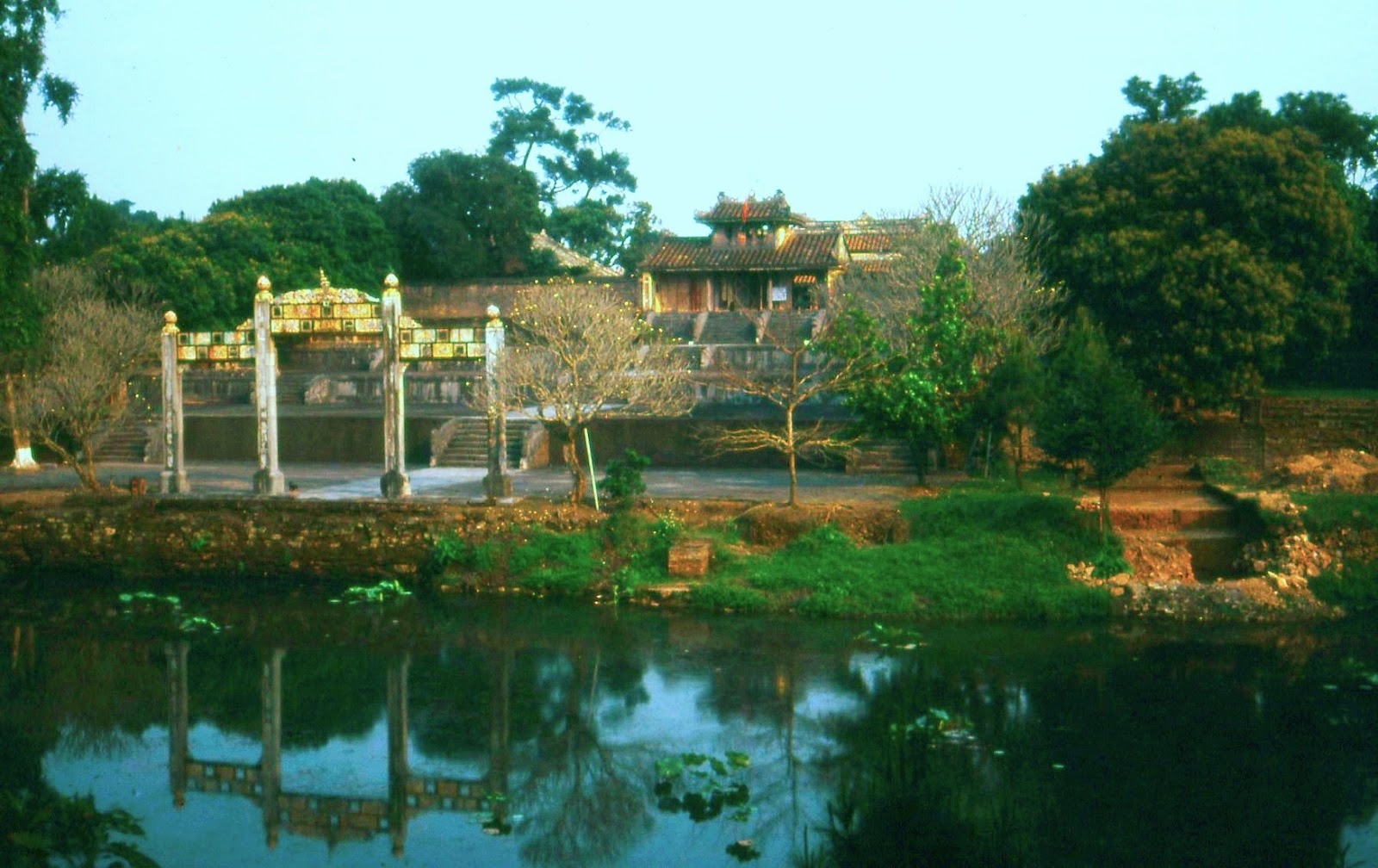
Showing posts with label Minh Mạng. Show all posts

Friday, September 20, 2019

Huế’s Citadel

  
                                                                                      by Jim Goodman    

the left wing of Ngọ Môn Gate
        Throughout the 17th and most of the 18th centuries Vietnam was divided into two opposing administrations.  Both sides recognized the Lê Dynasty monarch as the nominal ruler of the country, but the Trịnh Lords controlled him as a figurehead in the north, while the Nguyễn Lords ruled over everything south of Đồng Hới in Quảng Binh province.  Four Trịnh invasions of the south and one Nguyễn campaign against the north failed to upset the status quo and in 1672 the two opponents settled on a truce that lasted just over a century. 
one of the ten entry gate to the CItadel
outer wall of the Citadel
       In the wake of the Tây Sơn Revolt in 1771 the Trịnh Lords captured and destroyed the Nguyễn capital at Phủ Xuân in 1774 and the royal family fled to the Mekong Delta.  But Tây Sơn forces caught up with them and massacred all of them except the teenaged Nguyễn Ánh, who escaped to organize resistance.  Subsequent Tây Sơn campaigns in the south defeated his forces but failed to capture him.  The Tây Sơn armies then marched north, overthrew the Trịnh regime and the Lê Dynasty and established their own rule.
Meridian Gate, entrance to the Imperial Enclosure
      But the Tây Sơn were never able to vanquish Nguyễn Ánh, who would become one of the most remarkable figures in Vietnamese history.  He allied with Chinese, Khmer and Chăm in the south and employed some very astute generals, including disaffected Tây Sơn commanders.  After 25 years, his forces finally ousted the Tây Sơn government in Hanoi and reunified the country under a new dynasty, with the borders it still has today.  Unsure of his support in the north, however, Nguyễn Ánh chose to move the nation’s capital back to the old Nguyễn Lords’ capital at Phủ Xuân, which lay on the southern side of the Perfume River and was in ruins.
the Flag Tower
       Inaugurating the new Nguyễn Dynasty and taking the name of Gia Long, he decided to build a new fortified city across the river, which became modern Huế.  In 1804 he commenced building a citadel, employing French engineers who, following the Vauban style that had been the model for the France of Louis XIV, created a walled compound ten km long enclosing an area of 520 hectares, with many gates and several bastions.  The original outer walls were earthen and stood seven meters in height and were later reinforced with brick and stone and were two meters thick 
Thái Hòa Palace
        A moat thirty meters wide and four meters deep flanked three sides and a canal ran across the northern side. Ten entry gates crossed the moat into the citadel area, within which was the Imperial Enclosure (Đại Nội), with its own moat and six-meter high walls around it running for 2.5 km.  The Forbidden Purple City, where the Emperor had his palace and pleasure gardens, took up most of this space. 
       Just inside the Citadel ramparts stood the Flag Tower, rising 37 meters high above a three-level brick terrace.  Behind it were the nine Holy Cannons, cast from bronze articles captured from the Tây Sơn forces, each of them five meters long and weighing ten tons.  Gia Long intended them to be symbolic protectors of the city and empire and they were never fired.  They represent the four directions and the five natural elements. 
painting of the Emperor's appearance
       The Flag Tower, Holy Cannons and the Citadel/s outer walls, ramparts and gates are still there, relatively intact.  So are the moats and canals, though some sections are not so deep anymore and visitors can sometimes spot local fishermen casting nets in the moats. The buildings and barracks that filled the areas inside the walls and outside the Imperial Enclosure are mostly gone, replaced by gardens and parks.  But a number of the old palaces, temples and such that played roles in the imperial government have survived the ravages of weather and war or have been restored.  
ruins of the Emperor's residential palace
       The biggest and most impressive building, facing the Flag Tower, is the Meridian Gate (Ngọ Môn), the southern entrance to the Imperial Enclosure.  It was built in 1833 in the reign of Minh Mạng, the second Nguyễn emperor, and replaced the smaller original gate.  Very wide, with two protruding wings, it consists of huge stone blocks on the ground level and two more wooden stories above it.  It has three main entrances in the center.  The central one was reserved for the emperor, while the other two were for his mandarins and soldiers.
the Emperor's Reading Room
       Directly above the entries, on the top floor, is the Five Phoenix Watchtower.  Here the emperor used to make two annual public appearances—at the start of the Lunar New Year and to announce the results of the civil service examinations.  A lacquer painting on a wall here nowadays depicts the latter event, with rows of mandarins and scholars in the square in front and Huế residents behind them.  It was surely the biggest spectacle of the year for the city.
roof decorations of the Reading Room
       After going through the Meridian Gate and past two square ponds, the next significant building is the Palace of Supreme Harmony (Điện Thái Hòa), a wide, single story hall on an elevated platform with a double tiled roof supported by eighty lacquered ironwood pillars.  This was the emperor’s throne room, the venue for coronations, royal birthdays and the reception of foreign ambassadors.  The spacious interior featured elegant furniture, lacquered in red and gold, wall decorations and a raised throne under a gilded canopy facing south, where the emperor sat wearing golden silk robes and a crown with nine dragons.
       Wherever the emperor appeared everything was very formal and ceremonial.   Behind Điện Thái Hòa were the Left and Right Houses, facing each other across a courtyard, where civil and military mandarins spruced themselves up to prepare for an imperial audience.  For this they lined up in ranks according to their grade or position and made formal obeisance by kowtowing, touching their noses to the ground.
Hiẻn Nhơn Gate, Đại Nội
lamppost next to the Royal Theater
       When finished with his official business, the emperor departed through the back exit on the northern side to the last walled compound---the Forbidden Purple City, forbidden, that is, to all except him and his family, the concubines and their eunuch servants.  On the northeast side stood the Emperor’s Reading Room, an elegant two-story pavilion where he examined Court documents and correspondence and read books. 
Pleasure Pavilion in the Forbidden Purple City
       It was built early in Minh Mạng’s reign and is flanked by a pond on one side and bonsai gardens on the other three sides.  Statues of scholars stand on the corners of the lower roof along with dragons, while oval cameos of a trio of scholars are mounted on the walls.  All these figures are covered in porcelain potsherds, added when a later monarch, Khải Định in the colonial period, renovated the building. The former Royal Theater stands southeast of it, with a carved lamppost in front, dragons winding around it all the way up and other dragons pointing in the four directions at the top.
       Near the center of the Forbidden Purple City is a small raised Pleasure Pavilion, in a style similar to the Reading Room, where the emperor went to listen to music concerts.  Behind this stood the emperor’s private palace, though this was mostly destroyed by war.  Only the base remains, its steps flanked by a pair of cannons, probably intended like the Nine Holy Cannons as symbolic protectors.
       Other important buildings in the Imperial Enclosure are west of the Forbidden Purple City.  The Queen Mothers Residence stands in the northwest corner, a two-story fancy villa with an audience hall, separate apartments, an open-air balcony above the entrance and a small temple in a lotus pond beside it. 
Thé Miều Square
       In the southwest corner is the long and low Thế Tổ Miều, the Nguyễn Dynastic Temple, where altars stand for most of the emperors, along a polished floor with a red wooden ceiling.  The set excludes the fifth and sixth sovereigns Dục Đức, who only reigned three days, and Hiệp Hòa, who lasted just six months, and Bảo Đại, the last emperor.  And the altars for those who were ousted for being anti-French—Hàm Nghi, Thành Thái and Duy Tân—could not be installed until the end of French colonial control.
       Across from the large square outside the temple stands the last major structure—Hiến Lâm Cáo, the Pavilion of Splendor.  Also built in Minh Mạng’s reign, the building is noted for the Nine Dynastic Urns that stand in front of it, made of bronze, about two meters in height, each dedicated to one of the Nguyễn emperors.  The largest, cast in 1835-6 to Gai Long, is in the center and weighs 2600 kg.  The others average 1950 kg and stand in a row.  All of them feature low relief decorations of a variety of images, including birds and animals, the sun, moon and clouds, vignettes of nature, early 19th century sailing ships, cannons, cutlasses and even a horse-drawn carriage.
interior of the Nguyến Dynastic Temple
       Gia Long had constructed the Citadel with high, thick defensive walls, but in the end they were almost superfluous.  There was never any uprising or attack by foreign armies on Huế, not even when the French conquered the country.  The French had to battle the Vietnamese at the Hanoi Citadel, but afterwards took over Huệ without a fight.  A violent typhoon in 1904 knocked down the Flag Tower, which was reconstructed in 1915, but otherwise the Citadel remained intact until 1947, when the Việt Minh occupied it briefly until the French were able to expel them, though the Flag Tower suffered severe damage in the battle, as did the imperial palace in the Forbidden Purple City.
       Both were reconstructed afterwards, but in the Tệt Offensive in January 1968 the Việt Cong attacked and occupied parts of the Citadel, raised their own banner on the Flag Tower and held on for three weeks before the Americans finally managed to oust them.  During this period the Việt Cong dueled with ARVN forces within the Citadel grounds and these battles, plus massive American bombardment, destroyed all but four major buildings, though not the ramparts or gates.
       Restoration and repair this time had to wait until long after the end of the war.  Even buildings that had survived war damage, like Điện Thái Hòa, became subject to decay.  Termites and humidity had nearly destroyed its ironwood pillars.  Restoration workers, beginning in 1991, had to manually remove them (they weighed two tons each), plug the little insect holes, and cover them with twelve coats of fresh lacquer, each coat taking one month to fully dry.
gates inside the Imperial Enclosure
the Dynastic Urns
       By that time, though, Vietnam was no longer isolated and its historical relics had attracted the world’s attention.  In 1993 UNESCO recognized the Huệ Citadel as a World Heritage Site and while the city couldn’t rebuild everything that used to be there, it did restore or renovate many of its classic structures.  The Left and Right Houses were completely rebuilt, as were the apartments of the Queen Mothers Residence.  The gates that used to line the pathways to several of the buildings were also rebuilt, painted an imperial yellow and decorated with plaques of dragons, birds and flowers.
the royal coach on one of the Dynastic Urns
      Some restored buildings were outfitted with exhibition rooms as well.  The audience hall of the Queen Mothers Residence holds a collection of royal garments.  The Emperor’s Reading Room has a display of historical photographs.  East of the Imperial Enclosure stands the Fine Arts Museum, first built in 1845, containing some remnants of royal furniture, including a sedan chair, plus royal costumes, ceramics and musical instruments.
       The Royal Theater was also restored and now stages a few daily performances of the kind of entertainment popular in Imperial times.  These include classical operas (tuồng) in elaborate costumes, lion dances, fan dances and lantern dances, all backed by a classical Vietnamese orchestra dressed in yellow silk clothing.
       The city also stages its Huế Festival every two years, inviting participants from several countries.  Besides decorating the streets with sculptures and the riverfront with paintings, a mixture of traditional and modern shows takes place at various urban sites and nearby villages.  The biggest spectacles occur in the evenings in front of Ngọ Môn Gate in the Citadel, beginning with processions of a gigantic yellow phoenix borne by about twenty women wearing white aó dais and a huge golden dragon borne by about twenty men, also in white aó dais.  Various dances in traditional and ancient Vietnamese costumes, as well as some by foreign troupes, follow the opening act.
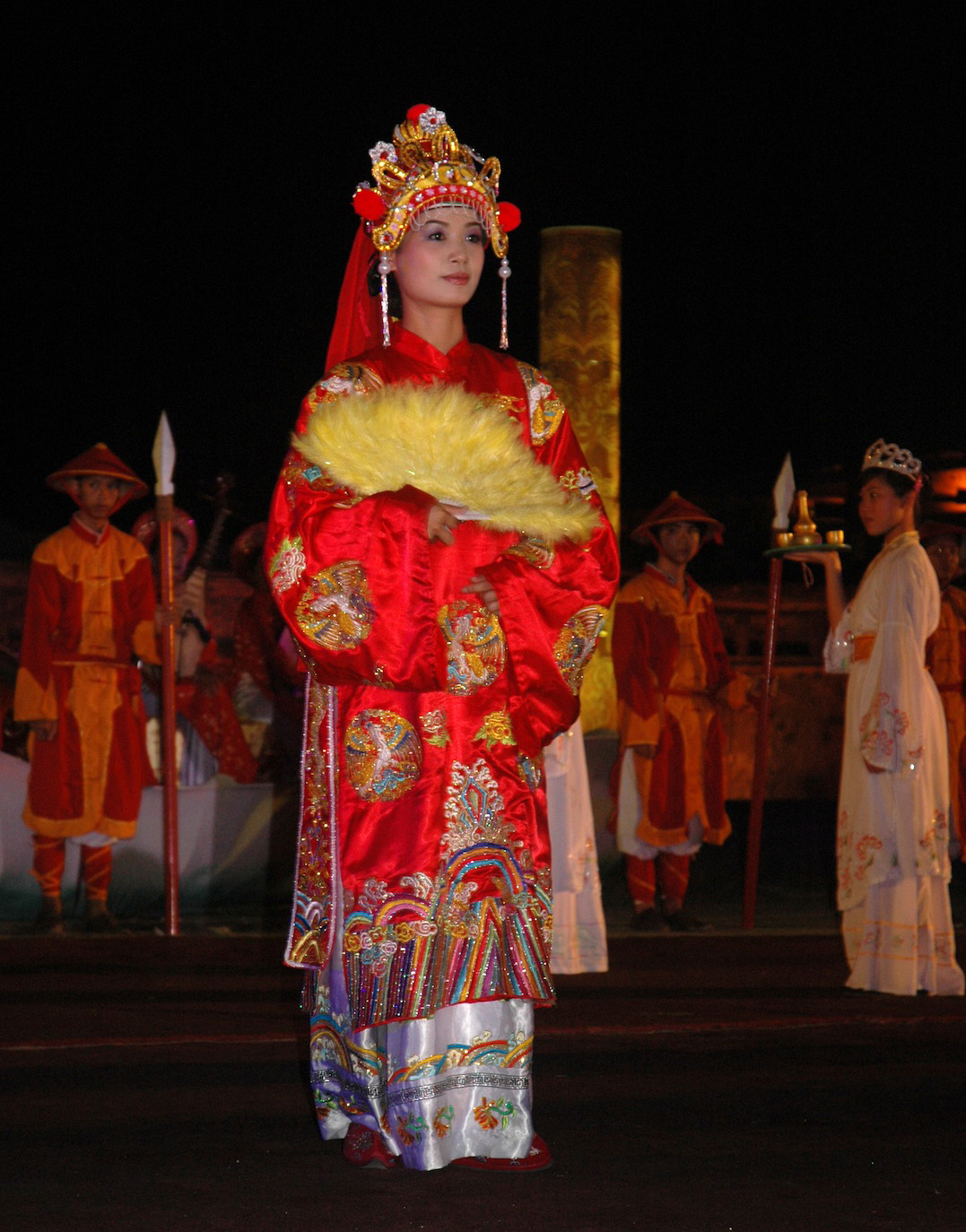
Nguyễn queen, Huế Festival
lantern dance at the Huế Festival
      On another night the shows reenact the entertainment enjoyed by the Nguyễn emperor and his Court, particularly the lion dances and lantern dance.  The show includes a visit by performers playing the Nguyến royal family and high mandarins.  The latter wear blue or green silk robes, while the royal entourage dresses in imperial yellow or red silk.  This skit is the crowd’s favorite.  The Nguyến heyday did not last very long, compared to that enjoyed by earlier dynasties, but it was indelibly associated with the city of Huế, whose modern citizens still remember it with pride.
                       
Đại Nội southwest wall
                                                                                ´* * *   
             The itinerary of Delta Tours Vietnam includes a visit to Huế’s Citadel.

Wednesday, May 25, 2016

Splendor and Neglect: The Tombs and Times of the Early Nguyễn Emperors


                                                         by Jim Goodman

       Huế was the last imperial capital of Vietnam.  It was a natural choice for the newly established Nguyn Dynasty regime, for the re-unified nation’s borders now stretched from north to south to what they are today.  Huế was roughly in the middle of the country and had already seen service, officially since 1744, as a capital for the Nguyễn Lords realm, which comprised everything in Vietnam south of the Ghanh River in Quảng Binh province.
mausoleum of Gia Long, Nguyễn Dynasty founder
       With the fall of the Nguyễn Lords’ regime and the triumph of the Tây Sơn insurrection, it became the capital of self-proclaimed Emperor Quang Trung in 1788.  But while the Tây Sơn controlled the north and center of the country, they never established a permanent presence in the south.  They did catch up with the Nguyễn royal family in 1777 and executed all but one of them.  The sole escapee was the teenaged Nguyễn Ánh.
       For the next 25 years Nguyễn Ánh pursued his relentless campaign against the Tây Sơn.  He won and lost Saigon a few times but by 1792, the year Quang Trung died, he had a base in Saigon and ten years later in 1802 marched into Hanoi, deposing the last Tây Sơn emperor.  Nguyễn Ạnh then announced the inauguration of a new dynasty and renamed himself Emperor Gia Long.  As for the country’s new capital, it would not be Hanoi, as it had been traditionally, but Huế, the capital of his forefathers. 
       Gia Long’s first order was the construction of the Citadel on the north bank of the Perfume River that runs through the two parts of contemporary Huế.  The imperial audience hall, royal residences, theater and family temples lay inside the walls, which were surrounded by a moat.  The commoners, shopkeepers and craftsmen lived east of the Citadel or on the other side of the river.
row of guardian statues
Court mandarin, Gia Long's tomb
       Gia Long modeled his administration and new Code of Law on that of Qing Dynasty China, emphasizing Confucian precepts.  That included state rituals like the Sacrifice to Heaven the emperor performed every three years at Nam Giao, following a procession over the river and south about 3 km.  He set up six ministries to run the government, but the Huế Court actually only directly governed the central provinces.  He left his favorite generals in charge of the north and the south.
graceful buildings of Minh Mạng's mausoleum
       He also picked the site of his tomb by riding an elephant to explore possibilities south of the city.  In 1814 he selected a spot 16 km south of the palace, in a pine forest beside a pond, with a view of distant mountains.  He died in 1820, when the compound was all but finished.  His body and that of his chief imperial consort (the Nguyễn Dynasty didn’t have Queens) lie in simple twin tombs in a separate courtyard. 
       The buildings are all aligned on a horizontal axis, one of the features, along with a tranquil natural environment, to be repeated in the mausoleums of succeeding emperors.  Another is the pair of white towers that, in this case, stand across the pond from the temple.  A third is the statues of mandarins, soldiers, horses and elephants that line opposite sides of the main courtyard.
       His successor Minh Mạng was an even more dedicated Confucian.  He viewed himself as an intellectual and all but memorized the works of Confucius and Mencius.  He encouraged education and promoted tuồng theater, the Vietnamese version of Chinese opera, because its stories emphasized Confucian virtues.  The adoption of these virtues, he believed, would establish the harmony essential to a nation and its society.
the natural setting of Minh Máng's mausoleum
       Certainly the principle of harmony dominated the planning of Minh Mạng’s mausoleum.  Geomantic experts took 14 years to find the right location, just over the other side of the Perfume River.  The geomantic team’s leader won a double promotion from the emperor, who died soon afterward, in January 1841.  Construction was completed less than three years later and, in general, the result takes the best ideas from Gia Long’s mausoleum and perfects them. 
       The walled compound lies in a forest glade, with a rectangular peninsula jutting out into the Lake of Impeccable Purity.  The buildings are all laid out symmetrically on an east-west axis, beginning with the Honor Courtyard, flanked by statues of mandarins, soldiers, horses and elephants, then the Stele House and finally the wide-roofed family temple.  Crossing a narrow part of the lake here, the next stop is the elegant, two-story Pavilion of Pure Light, with frangipani trees on either side, as well as two tall white towers like those at Gia Long’s tomb.  In front of it lies a crescent-shaped pond and over its bridge on the hillside is Minh Mạng’s tomb, certainly a most serene location.
the Emperor carried to Nam Giao
Pavilion of Pure Light
       The layout of Minh Mạng’s mausoleum fully embraces the Confucian concepts of order, balance and harmony.  Unfortunately, these concepts did not carry over into Minh Mạng’s administration so much.  Gia Long had allowed the Chinese, Khmer and Chăm communities to retain local autonomy, keeping a promise he made when they joined his side in the war against the Tây Sơn regime.  He also granted autonomy to the northern and southern thirds of Vietnam. 
the lantern dance, a Nguyễn Court favorite
       Minh Mạng upended these arrangements by further centralizing power and expanding his own role.  He insisted on personally vetting, in private meetings, all high government and military officials before allowing them to take office.  He abolished the autonomy of the Mekong Delta provinces, sparking a revolt that he put down with stern ferocity.  He took over the administration of the last Chăm state of Panduranga and began a policy of forced assimilation in the Khmer and Chinese areas.
       He expanded the regime’s penchant for pageantry and spectacle as well.  He added hundreds of participants to the procession to Nam Giao for the Sacrifice to Heaven.  He patronized the royal theater and frequently attended performances of tuồng dramas, lantern dances, acrobatic acts and classical music shows.  He watched the battles staged in front of the Citadel between an elephant, representing the throne, and a tiger, symbolizing the emperor’s enemies.  The elephant always won, of course, but in 1830 a rebel tiger attacked Minh Mạng.  He escaped harm, but then ordered the construction of a Royal Arena across the river, where the contests were subsequently staged.
Thiệu Trị's mausoleum
       He was also an extremely amorous emperor, with 33 wives and 107 concubines, with whom he fathered 142 children.  With his pursuit of pomp and entertainment by day and sex by night, one wonders how much time he spent in contemplating the problems of the country he governed with such concentrated autocracy.  He had shut himself off from Western influence just at the time when Western powers, particularly France, were gearing up their colonial ambitions.
       Gia Long had also closed the country to Western influence, other than military technology.  But Westerners, particularly his long-time friend the Catholic priest Père Pigneau, had been instrumental in helping him win the throne.  In return, he tolerated the existence and even expansion of Christianity among his subjects.  Minh Mạng reversed this policy, arrested foreign missionaries and persecuted Christians, giving the French an excuse to get involved.  
       Things got worse with his successor, Thiệu Trị, who reigned from 1841-1847, a chip off the old block and just as determined as his father to follow strict Confucian orthodoxy, ignore the West and stamp out Christianity. A ban on its practice provoked a French naval expedition to sail into the harbor at Đà Nẵng in 1847 demanding its revocation.  Not getting acquiescence fast enough, they shelled and destroyed the coastal forts and sank three Vietnamese ships.
Stele House, Thiệu Trị's mausoleum
       Enraged, Thiệu Trị ordered the execution of all Christians in Vietnam, but died soon after the incident and the edict was never carried out. The construction of his tomb took place the following year.  It lies in a tranquil rural area 7 km south of Huế, divided into two sections, smaller than Minh Mạng’s, has no compound wall but basically features the same characteristics.  Here also is a courtyard with statue ranks of elephants, horses, soldiers and mandarins, ponds beside the compounds, two tall white towers, this time flanking the Stele House.  As fond of Chinese literature as his father, Thiệu Trị was himself a prolific poet, and several of his compositions adorn the temple walls.
       Another trait he shared with his father was multiple wives and concubines.  In his short life of 37 years he fathered 29 sons and 35 daughters.  His second son became Emperor Tự Đức at 19 years of age and reigned 35 years.  Brought up to revere the Confucian classics, he became more immersed in them after he was emperor.  He spent long hours reading them, composed poems himself, and held lengthy discussions with his mother, also a literary aficionado, on the lives and morals of ancient Chinese heroes, sometimes scribbling down her comments in a notebook.  He was at least equally devoted to theater and was responsible for the writing and production of a couple of the longest tuồng dramas ever, with over a hundred scenes each. 
Stele House, Tự Đức's mausoleum
       In frail health throughout his life, he made virtually no tours of his country and relied totally on squabbling ministers.  In foreign policy his view was that the isolationism that was good enough for his predecessors was good enough for him.  He even banned all foreign trade.
       Unfortunately for him and his country, it wasn’t.  In these rapidly changing times the classic Confucian model of government wasn’t going to work anymore.  It was already failing in China.  The West was growing stronger all the time, in the mood for expansion, and Vietnam’s isolationism only undermined its ability to deal with the threat.  Having a ruler more concerned with the production of a play and the architecture of his mausoleum than discontent in the countryside and threats to the nation’s sovereignty didn’t help.  
       In 1862 the French pressured Tự Đức’s government to cede Saigon and three provinces.  Tự Đức continued to resist his ministers’ calls for reform, French ambitions grew and in 1883, the last year of the emperor’s life, the French forced the Huế government to recognize the entire southern third of the country as a French colony. 
a palace while Tự Đức lived, the family temple after he died
       Construction of Tự Đức’s mausoleum was completed halfway through his reign and he used to spend much leisure time there.  The walled compound, just 5 km south of the city, features a lake on its eastern side, opposite buildings aligned on an east-west axis.  Tự Đức used what is now the main temple as a palace while he was alive and this compound includes a royal theater and quarters for the emperor’s concubines.  He also liked to drink wine and compose poems at an elegant pavilion beside the lake.  His tomb and Stele House are in a smaller compound north of the temple.  Like Ming Mạng’s mausoleum, that of Tự Đức exemplifies harmony and grace in design.
       Tự Đức had scores of consorts, but was apparently sterile, for he had no children.  A violent faction quarrel broke out among the Court mandarins, with the next three successors murdered.  The French proceeded to annex central and northern Vietnam, in 1885 setting up ‘protectorates’ in each.  When the young Emperor Hàm Nghi protested, French troops drove him from the Citadel, ransacked the royal palace, stole everything of any value from gold ornaments to mosquito nets, and from then on, other than the brief Japanese occupation, controlled Vietnam until 1954.
actors as the Nguyễn royal family at the Huế Festival
       Time passed.  People stopped looking after the mausoleums.  20th century wars wrecked damage and after 1975, the government couldn’t care less about the Nguyễn legacy.  Only from 1990 did attitudes begin changing.  Huế people had always been proud of their Nguyễn Dynasty relics and started pushing for restoration and preservation.  The government changed its attitude and began embracing anything characteristic of Vietnam’s special historical and cultural identity. 
       Since early this century the city has also hosted a bi-annual Huế Festival.  With international participation, the program includes everything from Thai classical dances to Germans walking on towering stilts, and on the local side kite-flying contests and village crafts competitions.  Performances at the Citadel and other venues feature Vietnamese dances, new and old, but also actors dressed in imperial garments impersonating the Nguyễn royal family attending the shows, and an early morning re-enactment of the procession to Nam Giao and the Sacrifice to Heaven.
       Nowadays most of the Nguyễn legacy damaged by war has been repaired and mausoleum buildings crumbling from neglect have been restored.  The people of Huế are pleased.  They like having reminders of the city’s past glory around them and in good condition.  They still take pride in Huế’s history. Whatever the failings of the Nguyễn Dynasty, it was the only one Huế could call its own.

the lakeside pavilion where Emperor Tự Đức drank wine and composed poems
                                                                                * * *           
     A stop in Huế is part of the program on Delta Tours Vietnam’s journey through the country.


Sunday, January 24, 2016

Tuồng Theater: the Vietnamese Version of Chinese Opera


                                                               by Jim Goodman

tuồng actor, Hanoi theater
       In the thousand years before the 19th century French conquest, Vietnamese culture developed three separate theatrical traditions.  Chèo, the oldest, originated in the villages and featured dramas mixed with social commentary.  Chèo drama won royal patronage as early as the 10th century, when the capital was in Hoa Lư, and was just as popular at Court as in the countryside.  Its popularity and patronage continued through the Lỹ and Trần Dynasties.  The unique water-puppet tradition, also from the Red River Delta environment, developed soon after, with the first recorded performance in the 11th century.
       Unlike the other two traditions, tuồng, the third, was not an indigenous creation, but a local version of Chinese opera.  This is not surprising, considering the heavy influence Chinese culture had on Vietnam, due both to China’s long occupation and administration of northern Vietnam and its proximity as a big prestigious neighbor.  The Vietnamese gradually adopted many aspects of Chinese culture, particularly Confucian norms in society and government, but for centuries remained content with their own forms of entertainment.  The incorporation of a local kind of Chinese opera was not something gradually accepted, like the usual cultural influences, but the result of an incident of war.  
tuồng drama, Hanoi theater
       In 1285 the state of Đai Việt fought against the second of three Mongol invasions that century.  The Vietnamese had defeated the Mongols in 1258, would eventually expel them again this year and then annihilate them on the third Mongol attempt in 1288.  Though they are called the Mongol Wars, not all the invading forces were Mongol.  Most officers were, and probably the cavalry, but the ranks included hundreds of thousands of Chinese conscripted for the campaigns. 
       Among the Chinese foot soldiers captured in 1285 was Li Yuanji.  His interrogators discovered that back in Beijing he was a famous opera star.  They presented him to the Trần Court, whose officials persuaded him to stay and introduce the genre.  (Even in times of war the Vietnamese were not adverse to Chinese cultural influence; only to its political control.)  Under the new name of Lý Nguyên Cát, he trained the Court’s actors in the principles of Chinese opera, which became known as tuồng theater in Vietnam. 
tuồng warrior
       It was very different from chẻo.  For one thing, it was sung all the way through, whereas chèo then was a spoken drama.  From then on chèo dramas included both spoken and sung dialog, though the singing, based on rural folk melodies, differed from the style used in tuồng.  The stage settings for both were spare, but the costumes and make-up for tuồng were more elaborate and colorful.  The other major distinction between the two forms was tuồng’s narrative emphasis on heroics, loyalty to the throne and the primacy of Confucian precepts.  This genre offered no prospect for social satire, as chèo thrived on, but upheld the existing social order. 
       Therefore it became very popular with the ruling elite.  Though the Trần Dynasty patronized both forms throughout the 14th century, its successor the Lê Dynasty took a different attitude. In 1437 the strict Confucian King Lê Thánh Tông closed the royal theater and banned chèo as well as tuồng.  He relegated actors to the lowest rungs of the hierarchical order and forbade them and their offspring from entering the universities and trying to qualify for the mandarin class.  Popular entertainment had no place in the new Lê order.  Actors and playwrights were pariahs.
female protagonist in a Hanoi theater skit
       Chèo survived in the villages, but tuồng’s revival only came about with the 17th century division of the country into a Trịnh Lord’s regime in the north and a Nguyễn Lords regime in the south.  Tuồng theater became a favorite at both courts and later, in the Nguyễn Dynasty, was the special favorite at the court in Huế.  Mandarins in the service of the southern regime, and even some of the Nguyn lords and ladies themselves, wrote tung plays for the court’s theater. 
       One of the most enduringly popular of the plays from this period came from the writing brush of Đào Duy T, a minister and military strategist in the early 17th century.  He was himself the son of actors and was caught trying to sit for the civil examinations under an assumed name.  With nowhere to exploit his talents he later fled to the Nguyn Lords’ realm and became chief advisor to Nhuyn Phúc Nguyên, the second Nguyn Lord, who had no qualms about his ‘low status’ background.  In addition to his military talents, he also wrote plays.  His most famous work was called Sơn Hu (Behind the Mountain), set in the ancient state of Qi in China’s Zhou Dynasty.  It tells the story of an attempt by General T Thiên Lăng to usurp the throne after the King of Qi dies and leaves only an infant heir.  Loyalists led by Khương Linh Tá rescue the prince and spirit him away to the loyalist base behind the mountain.
festival performance at Đô Temple, Bắc Ninh
       One of the usurper’s co-conspirators, General Tá Ôn Đình, pursues the prince’s party, but Khương Linh Tá intervenes, while the rest of the party make their getaway.  Tá Ôn Đình beheads Khương Linh Tá.  But the latter picks up his head and runs off.  His soul becomes a light to lead the loyalists through a dark forest to their base, where they rouse their followers to attack the usurper in the citadel.  Khương Linh Tá’s spirit reappears in the battle and kills General Tá Ôn Đình.  Loyalists capture T Thiên Lăng and the play ends with the child prince on the throne, the royal lineage preserved, the villains foiled, loyalty to the throne triumphant.
tuồng actors in a festival procession
       A similar theme of self-sacrifice as the supreme act of loyalty to the throne dominates the tung drama Võ Hùng Vương, named for the rebel leader in the play.  It is also otherwise known as Ngoi t dâng đu (Grandfather Presents his Head).  In this story Võ Hùng Vương captures the prince he intends to displace, but the latter feigns madness, which confuses the conspirators.  Then one of the nastiest among them suggests a deal.  If Viên Hòa Ngn, the prince’s grandfather, presents his head to the rebels, the prince can go free.  Viên Hòa Ngn agrees.  But suspecting a double-cross he arranges for the loyalists to set up an ambush on the route the prince would take once he is free.
       The old man then calmly cuts off his own head and hands it to the rebels.  They duly set the prince at liberty, assemble a force to recapture him, but run into the loyalist ambush.  The latter escort the prince to their base, where he gathers his army, defeats Võ Hùng Vương’s forces and takes his legitimate place on the throne.
       Such themes resonated well with a court that had to establish its legitimacy by inculcating loyalty among its retainers, servants and subjects.  After the collapse of the Tây Sơn regime and the establishment of Nguyn supremacy throughout the country, tung once again became the court favorite at Huế.  Emperors Minh Mng and T Đc were both enthusiastic patrons.  They wanted to promote tuông as the “national art” and took an active interest in the actual staging of the plays.  T Đc himself was the “art director” of the most elaborate tung productions ever—Vb bo trình tường, with 108 acts, and Qun phương hiến thy, with 100.
the elaborate staging of tuồng drama in Huế
       These productions were notable for featuring Vietnamese heroes from indigenous history, instead of Chinese literary classics, while presented in the tung style.  Besides the upper strata of Vietnamese society, tung’s appeal extended to the commoners as well.  As a spectacle it had no rival other than the most elaborate religious processions.  They probably didn’t understand the lyrics, which were in the literary Sino-Vietnamese language, but were susceptible to the singing’s emotive power and anyway knew the stories. They could also appreciate the purely visual delights of the almost acrobatic martial arts scenes as resplendently garbed warriors leapt and twirled about the stage.
       Make-up in tung is always employed symbolically.  Noble, venerable and sympathetic characters wear pale make-up, their eyes slant upwards and they move with measured gestures.  Warriors paint their faces black, white and vermillion, wear long, dark, bristly beards and fierce expressions.  The bad guys—traitors and villains—have pasty faces, scanty beards and a shifty look.  In costumes, royalty and aristocrats wear gorgeous silks, the women decorating their hair with jewels and ornate headdresses.  The warriors wear multi-colored robes and elaborate headdresses and the generals are identified with flags attached to the back.  Villains wear simpler outfits, with little or no decoration.
female lead in the Huế Citadel show
male leads in the Huế tuồng drama
      When the Nguyn Dynasty fell into decline in the late 19th century, tung theater began modifying its style and its message, lest it be identified with a discredited system.   As part of its new look another form of the opera appeared, called tung đồ, where satire of the powerful and the venal directed the stories rather than heroics.  As the second half of the century progressed it became obvious that something was lacking in the neo-Confucian order of the realm, since it was not standing up very well against the colonial threat.
Hồ Nguyệt Cô
      The first classical tung drama to break with convention and challenge the system came in the late 19th century with Đào Tn’s Hoàng Phi H Crossing the Border. Like a typical tung play, it is a tale of political intrigue in ancient China, with the common theme of loyalty to the sovereign directing the conflicts in the story, told with all the usual pomp of elaborate make-up and splendid costumes.
       But instead of the customary message that loyalty to the ruler is the noblest of virtues, the play challenges that very idea.  The story is set in China’s Warring States era.  King Tr, to whom Hoàng Phi H has been loyal, is anything but a good Confucian ruler.  He is cruel, avaricious and lusty and even kills Hoàng’s wife.  After wandering disconsolate and stopping in a temple, he meets her spirit, who narrates the circumstances of her death.  His lingering sense of loyalty suddenly evaporates. “Loyalty to the king be damned!” he cries.
       Hoang decides to betray King Tr to the enemy and then surrender.  Then he passes through the border gate, where his own father is the guard, and persuades him to renounce his loyalty and attack King Tr as well.  Such sentiments were pretty revolutionary for the times, when the Nguyn regime still had nominal authority in the land.  But Đào Tn wrote the play to argue that blind loyalty can stand in the way of progress.
the transformation of Hồ Nguyệt Cô 
       Another turn in this period came with a work by Đào Nh Tuyên (Đào Tn’s son), taken from an old Chinese story, called H Nguyt Cô Transformed into a Fox.  The heroine is a beautiful woman who was born a fox, but after years of religious training allowed to become human, married a general but fell in love with an enemy officer named Tiết Giao. She throws herself at him and spills her big secret—she is only human so long as she keeps a certain gem in her mouth.  After they have become lovers Tiết Giao pretends to be sick and claims that only her gem can save his life.  She spits it out.  He swallows it and runs off, leaving her to face her fate—slowly changing from a human being back into a fox.
       The climax of the show is this transformation, with H’s pitiful laments commenting on the changes overcoming her, the itch on her skin as the fur grows back, the sight of her nails becoming claws, and the sound of her voice dissolving into the howl of a fox. Ttung actresses made their reputations on how imaginatively they played that scene.  With a good rendition the audience will see H Nguyt Cô as a tragic character, the victim of credulity and unrestrained sexual desire.
tuồng performer at Đền Đô
make-up and headdress of a tuồng character
       No royal courts subsidize tung theater anymore and with each passing generation in these modern times, fewer people feel inclined to undergo the rigorous training required for tung performances.   The potential audience has shrunken, too, with the proliferation of alternative entertainment offerings.  But it has not disappeared.  In Hanoi, the National Tung Theater, next to the Hàng Da market, stages skits from famous tung dramas, including H Nguyệt Cô’s transformation.  The theater inside the Huế Citadel hosts daily shows of tung opera scenes as well as other types of Nguyn Dynasty entertainment.
       Tourists are the main audience for these shows, but tung drama is still occasionally part of village festival programs, such as Đn Đô in Bc Ninh.  Actors in costume march in the morning procession and perform on an outdoor stage all afternoon.  For that portion of the Vietnamese population still fascinated by its ancient culture, tung remains relevant.  It’s had a long and fruitful run.

tuồng drama performance at the Đên Đô festival
                                                                     * * *