Showing posts with label Lý Thái Tổ. Show all posts

Sunday, October 27, 2019

Hanoi’s Old Quarter


                                            by Jim Goodman

clean and orderly--the Old Quarter after French renovation
       In 1010 Lý Thái Tổ, founder of the new Lý Dynasty, moved the capital of Đại Việt from Hoa Lư, in present-day Ninh Bình province, to the abandoned former Chinese administrative center on the Red River.  After a vision he had when arriving at the site, he called his new city Thăng Long (Rising Dragon), today’s Hanoi.  In designing its layout he divided the area into two parts:  Hoàng Thành, the Royal City, and Kinh Thành, the Commoner’s City.  Throughout the city’s ups and downs, this partition persisted until modern times.
Bạch Mã Temple, the first temple in the Old Quarter
       A sprawling walled compound comprised Hoàng Thành, featuring many royal palaces, administrative buildings, ponds, groves and gardens.  High-ranking mandarins, royal family relatives and military officers lived just outside the Citadel.  Kinh Thành included everything between the Citadel’s eastern gate and the Red River.  It soon drew a host of migrants, largely crafts workers and others employed by the palace, and in later times new residents to provide services to the growing population. 
       The Kinh Thành area--Hanoi’s contemporary Old Quarter--had a very different landscape a thousand years ago.  The Tố Lịch River, which ran along the northern wall of the Royal City, flowed through the northern side of Kinh Thành and into the Red River at today’s Chợ Gạo..  On the southeastern side, the water of what is now Hoàn Kiếm Lake was connected to the Red River.  The residential area in between was a partly reclaimed marsh with many ponds.
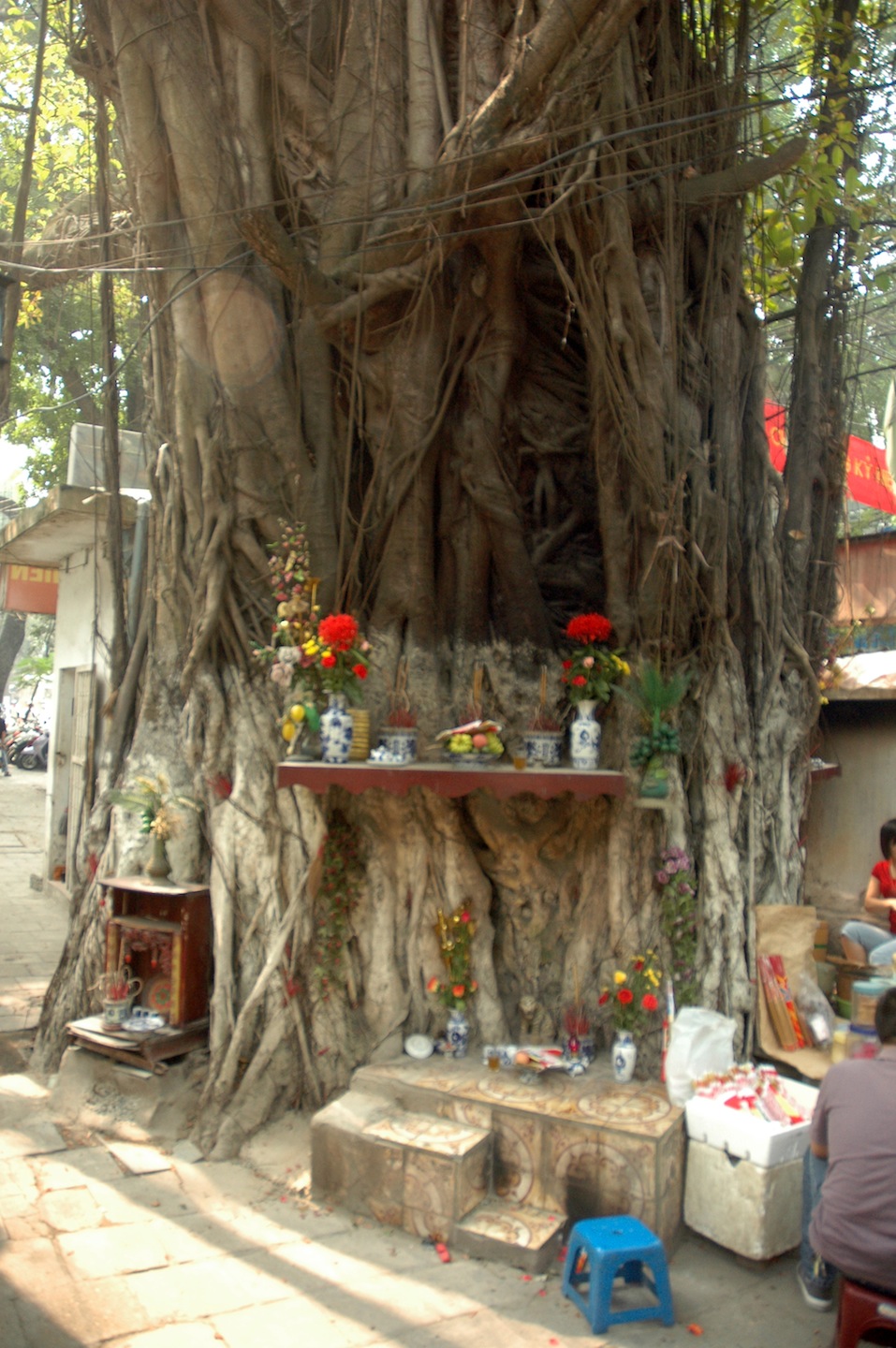
tree shrinn--an ancient custom still alive
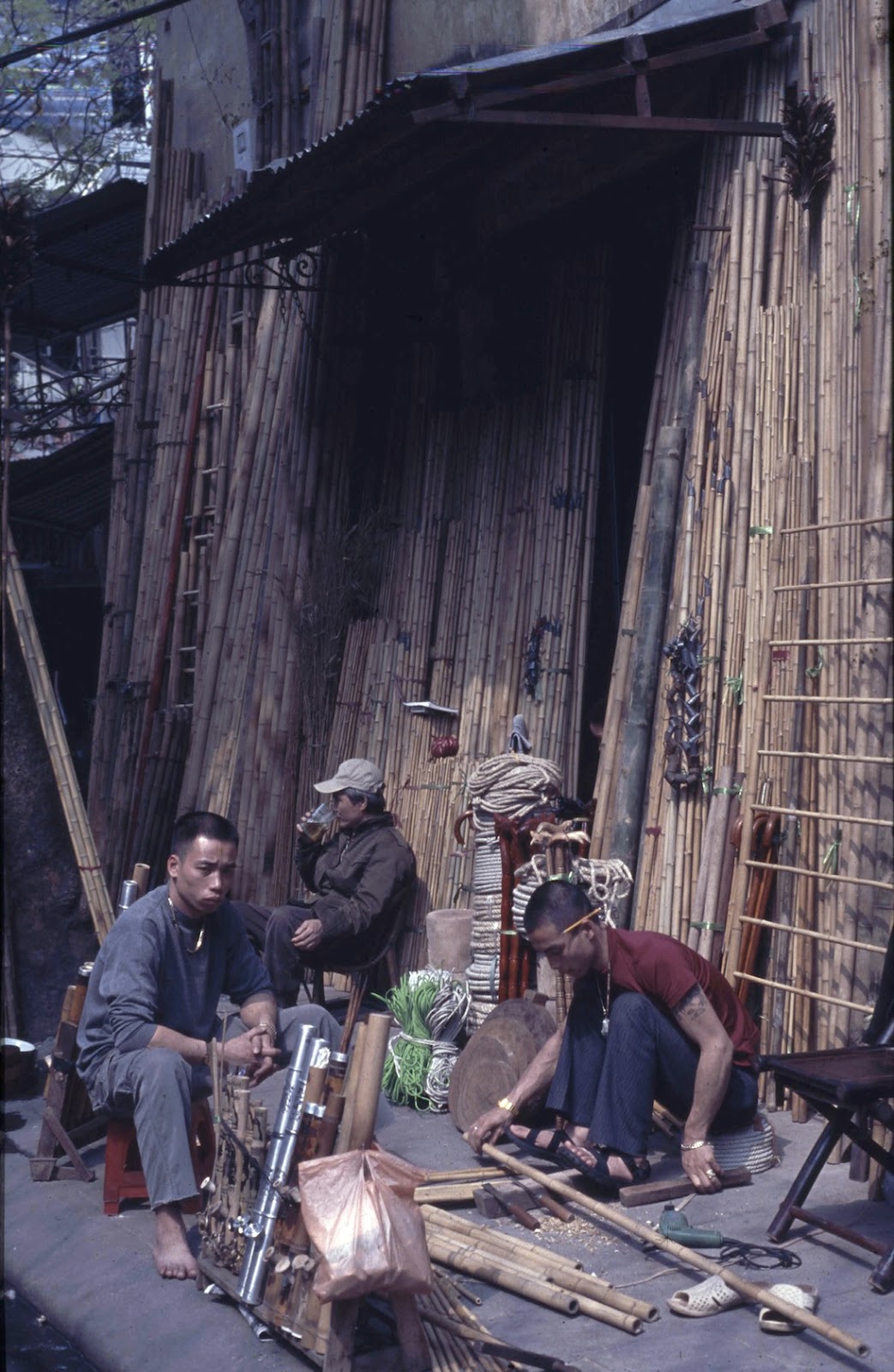
bamboo work outside on HàngVải, like the old days
       It was not very crowded back then.  Households had plenty of space for a house, workshop, garden and pond or well within their compounds.  They built stilted wooden and bamboo houses.  They became organized into craft guilds whose members lived on the same street.  Houses could not rise higher than a royal palace and they could not have an upper story window facing the street, from where a commoner (or assassin) could look down on the king if he passed through the city.  Another regulation limited how wide they could be.  Thus, when families expanded their buildings they did it lengthwise, back into the courtyard, instead of upward.  This was the origin of-the ’tube house’ style that came to characterize the city’s architecture.
lacquer workers, centuries ago
       The typical craft guild membership all came from the same village.  Some of these might also erect a small communal house (đình) to service their community or a modest temple honoring their village tutelary deity.  Besides the Bạch Mã Temple on Hàng Buồm, the oldest in the city, and Báo Thiên Pagoda, where the cathedral now stands, the city’s other temples were outside the main settled area.  From the survival of the custom evident in Hanoi today, one could assume Kinh Thành also had shrines to the spirits of particularly impressive old trees.
       No major transformations took place when the Trần Dynasty took over in 1238.  Growth affected the rural areas more than the city.  Princes and high mandarins had their estates in the countryside and hosted an assignment of soldiers.  Three times that century Mongol armies invaded Đại Việt.  Facing overwhelming numbers, the Vietnamese adopted the strategy of evacuating villages and removing all the food supplies—‘empty houses and gardens’.  Occupying a deserted capital and unsuccessful at foraging for food, the Mongols had to depart and Vietnamese guerrillas slaughtered them on their way out.
neighborhood temple on Bát Đân street
      Thăng Long residents rebuilt their city after each invasion, but in the late 14th century their Chăm rivals in south central Vietnam attacked and sacked Thăng Long three times.  The city revived, but the dynasty did not.  The ambitious official Hồ Quý Ly moved the capital to his home district in Thanh Hóa, 160 km south, slaughtered the extended royal family members and proclaimed a new Hồ Dynasty in 1400.  Two Trần princes escaped and appealed to China for help.  The Chinese invaded in 1407, captured Hồ Qúy Ly, but did not restore the Trân. Instead they took over administration and ruled for twenty harsh years before a native uprising, led by Lê Lợi from Thanh Họa, expelled them.
early 20th century house
one of a few remaining old houses
       Unlike its predecessors, the Lê Court required its officials to live permanently in the capital, now renamed Đông Kinh.  The new neighborhoods were clustered around the southeastern side of the Citadel, while more village migrants came to live in the Old Quarter, where the government filled in more of the marshes.  Most of the work produced in the city was on contract.  The idea of stocking non-contracted goods in a shop didn’t take hold for another century or two. 
mandarin being carried into the Old Quarter
       Đông Kinh faced no external threats for the next few centuries.  The Old Quarter staged a market day the 1st and 15th of the lunar month, when villagers flocked to town.  Every few years the government hosted the examinations, drawing hundreds of scholars and enlivening the city’s atmosphere.  In general, life in the commoners’ city was not affected by political developments, like the coup against the Lê regime and establishment of the Mạc Dynasty (1527-1592).  When civil war broke out the battlefields were far away and until Lê forces captured Đông Kinh in 1592 the war did not affect the capital.
beer break late 19th century
       The victors did nit sack the city after evicting Mạc forces.  Peace, order and ordinary commerce returned so quickly that the Lê commander Trịnh Tùng ordered the city walls completely leveled.  He also took absolute control of the government, keeping the restored Lê emperor as a figurehead confined to the Citadel.  His successors got caught up in a violent quarrel with their erstwhile allies the Nguyển family, whose lords ruled the southern provinces while the Trịnh ruled the north.
typical ward gate
       Intermittent wars failed to change anything, so the two sides signed a truce in 1670.  The result in Đông Kinh was a century of growth and prosperity.  All the marshland of the Old Quarter was filled in by now, though several ponds remained, used as food sources.  River commerce thrived.  The two main ports were the confluence of the Tố Lịch and Red River at Chơ Gạo and Tây Lường Gate, where the Hoàn Kiếm Lake channel entered the Red River.
       Though the city walls were gone, new walls and gates began to separate the wards. These were locked and guarded at night, isolating the separate neighborhoods.  No one could pass through the gate without being examined by the watchmen, who were armed with thick staves.  Without an acceptable excuse, people could not enter these guarded neighborhoods after dark anyway. 
city wall and entrance gate, 19th century
       Most were just doorways in a high earthen wall that stretched across the lane.  Wealthier neighborhoods like Hàng Ngang had fancier gates, protruding from the wall, with an entrance surmounted by a tiled roof with upturned corners, supported by wooden pillars.
       Most streets in the commercial quarter were wider than nowadays, and paved with rectangular stones with slightly curved surfaces that facilitated water run-off in the rains.  But the lanes that twisted around the city’s ponds and connected the main streets were themselves narrower, mostly unpaved, quite muddy in the rains and never very clean when dry.  Sanitation was a low priority in Đông Kinh,, with no unit assigned by the government to keep the city clean.
Hàng Khay, 19th century
       Mid-18th century, the city’s population exceeded 100,000, making it one of the biggest and most densely populated in East Asia.  Political developments threatened its future, though.  In 1749 Trịnh Doanh rebuilt the city walls as a defense against rural insurrections.  The walls had 21 entrance gates, locked and guarded at night.
       Rebels never breached these walls, but the Trịnh regime was in decline.  So was the Nguyễn Lords realm in the south.  In the late 18th century armies of the Tây Sơn Revolt from south central Vietnam deposed the Nguyễn regime and later swept north, captured Đong Kinh in 1786, ended the Trinh Lords’ rule, restored the Lê emperor’s authority, then returned to their base around Huệ. 
      The aging emperor died soon after and his son Lê Chiêu Thống, in his first act as an independent emperor, ordered all the Trịnh palaces around Hoàn Kiếm Lake to be burned to the ground.  Unfortunately, the fire spread to the Old Quarter and consumed three-fourths of the houses.  Two years later he called on the Chinese to buttress his authority against the Tây Sơn, provoking the latter to march on the capital, drive out the Chinese, terminate the Lê Dynasty and set up their own.  It lasted until 1802, when Nguyễn Ánh’s army conquered the city and founded the Nguyễn Dynasty.
       Assuming the royal name Gia Long, the Nguyển emperor demolished the old citadel and replaced it with a smaller one and filled in the estuary connecting Hoàn Kiếm Lake with the Red River.  He made Huế his national capital and rarely visited the north.  He renamed the city Thăng Long, but with a different character for Long, rendering it Rising Prosperity.  It must have sounded overly optimistic to its residents.  The chaos of the last two decades had reduced the population to about 15,000, while official neglect of its infrastructure left nearly everything in need of repair and restoration.
\streetcar, early 20th century
       Nevertheless, under energetic and competent local administrators, by 1831, when Gia Long’s successor Minh Mạng renamed the city Hanoi, prosperity had returned and the city now had over 50,000 residents.  The Old Quarter streets were repaved with brick, new craft guilds set up residence and popular subscription enabled the renovation of old temples and the construction of new ones.  The city still had its walls and gates, locked at night, but at a later hour, allowing for the first stirrings of nightlife, with theaters and song cafés.  
       As the Nguyễn Dynasty fell into decline, by the 1880s French armies were fighting for control of the north.  Some of these battles took place in the Old Quarter, but by 1885 the French had won.  Two years later they made Hanoi the capital of the French Indochina Union.  Drastic changes ensued.  They immediately demolished the Lý Dynasty temple Chùa Bạo Thiên to erect St. Joseph’s Cathedral, created a French Quarter of European-style mansions for its colonists south of Hoàn Kiếm Lake and opulent administrative buildings near the Citadel.  
French postcard of Hàng Nóm
       They didn’t move into the Old Quarter, but remade it.  They filled in the ponds and the part of the Tố Lịch flowing through its northern side.  All the ward gates and city walls and gates came down except for one—Ô Quang Chướng.  They widened the streets and realigned the houses evenly.  They renovated the dikes, sharply reducing the flood threats, and in the early 20th century installed gas lighting on the streets, a huge water storage tower at the top of Hàng Giấy and eventually a streetcar route through the city. 
       Life improved, the city grew and bustled and then, with the end of World War II, disaster struck again.  Chinese Guomindang troops entered the city, ostensibly to receive the Japanese surrender, and ransacked it.  The new Provisional Revolutionary Government was forced to allow French forces to re-enter Hanoi in return for the Guomindang evacuation.  Shortly afterwards fighting broke out between the French and Việt Minh soldiers.  Most of this took place in the Old Quarter.  By the time the Việt Minh withdrew and the French took full control, only about 10,000 were left in the city.
copper and bronze ware, Hàng Đồng
tin workshop, Hàng Thiếc 
       Many returned, though, and built new houses of brick and wood, without stilts, and the wealthier families added stories to make them higher, since there were no laws restricting size anymore.  The Việt Minh campaign for independence continued, but the battles were far from the capital.  The final battle took place in Điếnbiếnphủ in the northwest, sparing Hanoi of any further damage.
reed mats, Hàng Chiếu
       After 1954 developments in Hanoi were slow.  While American planes bombed parts of the city during the American War, the Old Quarter, having no strategic value, wasn’t targeted.  After the war, Vietnam remained relatively isolated until the late 1980s, when the đổi mới (renovation) policies commenced and the country integrated with the global economy.  By the 21st century, Vietnam had become a popular tourist destination.
       The Old Quarter was one of the major attractions.  Increasing prosperity had resulted in many changes, like new buildings of four and five stories and the gradual disappearance of classic wooden, tile-roofed houses.  But the layout remained constant.  Some of the streets were still dominated by the craft they were named after, like Hàng Thiếc’s tin workshops and Hàng Bạc’s silver jewelry shops.  Others were partly so, as bamboo blinds were still available on Hàng Mành, reed mats on Hàng Chiếu and copperware on Hàng Đồng.  Its temples, shrines and đìnhs also still existed.
       Hanoi is not likely to suffer future bombings or invasions. Nor will the Old Quarter change its basic form.  Tourists appreciate it as the liveliest and most interesting part of Hanoi, largely unaware of its long and checkered history.  Local Vietnamese are quite conscious of that, though, and revere it for that reason.  The Old Quarter is the heart of their ancient capital, so often destroyed and always reviving—truly a phoenix city.

basket shop on Nguyễn Siêu street, built over the filled in Tố Lịch River

                                                                               * * *   

Friday, August 19, 2016

Before the Dragon Rose: Vietnam’s Ancient Capitals


                                                      by Jim Goodman

life in ancient Văn Lang, the first Vietnamese state
       Founded in 1010, Hanoi is the oldest capital city in East Asia.  But it was not the country’s first.  It was the third capital since Vietnam recovered its independence in 938, after more than a thousand years of Chinese rule.  Before that there were two capitals, the one the Chinese conquered and the earliest one, the capital of the first Vietnamese state 2500 years ago.  It lay in the foothills bordering the Red River Delta plain, northwest of Hanoi, but no one knows exactly where it was.  No trace of it has survived; not even its name.
An Dương with his crossbow
       We do know the name of the state it served, however.  It was called Văn Lang, ruled by a succession of semi-legendary monarchs known as the Hùng kings, the first of whom is supposed to have taken power in the late 7th century BCE., at the dawn of the Bronze Age.  Vietnamese historians have identified 18 kings in the Hùng Dynasty, which lasted about four and a half centuries.  They were the first to establish authority beyond their immediate vicinity, amalgamating disparate peoples living in small, autonomous units into a state with a common identity.
       Văn Lang was the hub of the Bronze Age Đông Sơn Culture, the originator of the bronze drum cult, influencing places beyond its borders, especially southern China, northern Thailand and eastern Burma.  Văn Lang artisans used bronze to make drums, weapons, farm tools, utensils, votive objects and funeral offerings. In tombs of the ruling class of those times excavation has revealed that many fine bronze artifacts were interred with the corpse.
       Đông Sơn relics have survived to confirm the state’s existence and high level of achievement.  But little else has.  The Hùng Kings’ tombs have never been found.  No ruined buildings from that era exist.  Văn Lang had no writing system, so records were not kept.  Yet researchers have identified a tract of hilly land in Phú Tho province as the probable site of Văn Lang’s capital.  Today’s Vietnamese revere the Hùng Kings’ era as the birth of their nationality.  Every year the government sponsors a festival here, held for several days in the third lunar month, attracting tens of thousands.   
Cổ Loa today
       Unlike its origin, Văn Lang’s demise is better known. The state fell to an invader from a mountain kingdom to the north in the 3rd century BCE.  He took the royal name An Dương and established a capital and citadel at Cổ Loa, a little north of present-day Hanoi and at that time on the Red River.  Cổ Loa means ‘snail’ and refers to the series of concentric walls, like a snail shell, built to protect the city.  An Dương called the new realm Âu Lạc, combining the name of his own mountain state Âu Việt with the ancient name for the Red River Delta lands—Lạc Việt
Cổ Loa crossbow reconstruction in a Hanoi museum
       Local culture did not experience any disruption in its development.  In fact, An Dương even paid a visit to the former capital and, at a spot known today as the Swearing Stone, promised to venerate the souls of the departed Hùng kings and preserve the kingdom.  The only real novelty about the establishment of his rule was that it was the first time the local people had been beaten by a foe from the north.  Previous invasions they had always repulsed.  An Dương’s success foreshadowed what was to become a permanent potential danger in centuries to come.
village elders at the Cổ Loa festival
       Myth embellishes history in the story of Cổ Loa’s rise and fall.  When An Dương began building the city, every night whatever was built during the day was mysteriously dismantled.  The culprits turned out to be the spirits of the land, acting on behalf of the sons of the dispossessed former king.  Their leader was a thousand-year-old white chicken, residing on Tam Đào Mountain, northwest of Cổ Loa.  The new king An Dương was at a loss how to deal with these spirits.
       Suddenly a golden turtle appeared on the scene, fought and defeated the white chicken, and remained at Cổ Loa until the citadel was completed.  Upon departure he gave the king one of his claws to be used as a crossbow trigger.  The power of this would insure An Dương defeated any potential foe, for with this magic trigger the crossbow could fire one shot that would multiply into a thousand bolts.  
in the procession at Cổ Loa's festival
       All went fine for Âu Lạc for about a generation.  But then political changes to the north threatened the state.  The Qin Dynasty, whose expansion to the south had prompted An Dương to move south and seize Văn Lang, fell and the Han Dynasty took over.  But it did not assert control over the southern parts, which reverted to their pre-Qin Dynasty independence.  One of these states was Nan Yue in southeast China, and its ruler Zhao Tou, shortly after being confirmed as king by the Han Court in 196 BCE, decided to invade Âu Lạc.
        An Dương’s supernatural crossbow kept Zhao Tou’s forces from taking Cổ Loa and the attack stalled.  Another strategy was necessary. Zhao Tou called a truce and sent his son Trọng Thủy to An Dương’s court.  The young man made a favorable impression, won the heart of Princess Mỵ Châu and married her.  After time passed he persuaded her to let him gain access to the armory.  There he secretly stole the turtle claw crossbow trigger and then made up an excuse to visit his father’s camp.  Feeling qualms about his departure, Mỵ Châu showed him her mantle, padded with goose-down, and told him that if, in his absence, she should have to leave Cổ Loa, she would strew feathers from the mantle on the trail so that he could find her. 
Mỵ Châu's tomb at Tết
       Knowing the magic crossbow was now useless,  Zhao Tou renewed hostilities and soon took the citadel.  An Dương fled on horseback to the sea, the princess riding pillion.  When An Dương reached his destination the local genie informed him that the cause of his misfortune was right behind him.  Realizing it was his own daughter who betrayed him, he beheaded her and then flung himself into the sea.    Today, at the đình in Cổ Loa Historical Complex, an altar to the princess stands in the rear of the building.  Here supposedly is interred the headless corpse of Mỵ Châu and oddly enough, during Cổ Loa’s annual festival, shortly after Tết, Vietnamese lay offerings here.
       Back at Cổ Loa, after Zhao Tou captured the citadel, Trọng Thủy went searching for his wife Mỵ Châu.  He soon discovered the trail she had marked out with goose-down feathers during her escape.  When he came to the end of it he discovered her headless corpse.  He returned with it to Cổ Loa, had it buried properly and then killed himself.  Vietnamese have mixed feelings about Mỵ Châu, for if on the one hand she betrayed her father, on the other hand she was loyal to her husband.
Ngô Quyền
       Zhao Tou maintained Nan Yue’s independence until his death in 136 BCE, but the kingdom eventually fell to the Chinese 25 years later.  That was the end of any kind of Vietnamese independence, a period that would last over a thousand years and have a permanent impact on Vietnamese society and culture.  But the long occupation never extinguished the Vietnamese desire to run their own affairs.        Chinese control of northern Vietnam depended on the strength of its ruling dynasty.  When the state was strong, so was the administration.  When it weakened, fell victim to power struggles and such, Vietnamese revolted and at times briefly achieved autonomy again.   The Chinese established administrative centers, first in Long Biên, across the Red River from Hanoi, and later at Long Đỗ, on the site that is today Hanoi, where they built the Đai La citadel in the 9th century.
       Taking advantage of the continuing chaos in China following the fall of the Tang Dynasty, in 938 CE Ngô Quyền led native forces to expel the Chinese from the garrison at Đai La.  Counter-attacking, the Chinese sent a large naval force into Hạ Long Bay, intending to sail up the Red River to Đai La and suppress the revolt.  To stop them Ngô Quyền ordered his men to plant sharpened stakes in the bed of the Bạch Đằng River, the main tributary here to the Red River. The stakes were invisible at high tide. 
battle on the Bạch Đằng RIver, 938
       The invading fleet sailed in at high tide.  At a bend in the river, the Vietnamese came out in small boats to engage the enemy and delay them until the tide lowered.  With that, the Chinese fleet found itself impaled on the stakes and immobilized.  The Vietnamese in their small boats then advanced, burnt the ships and destroyed the fleet.  With that victory the Vietnamese finally won back their independence.
       To re-establish the new nation’s link with its past, Ngô Quyền made Cổ Loa the capital.  The Red River had changed course by then and the city was no longer next to it.  Whether he rebuilt the same kind of citadel is unknown.  Unfortunately, after five years Ngô Quyền died.  Since he did not establish a successor, for twenty-four years twelve clans fought it out.  The winner, Đinh Bộ Lĩnh, moved the capital to his hometown Hoa Lư, in today’s Ninh Bình province. 
Đinh Bộ Lĩnh
       Cổ Loa gradually became a ghost city and its buildings disappeared.  A thousand years later it was resurrected, not as a city, but as a reconstruction.  It did not include rebuilding the ‘snail’ walls of ancient times, but did include a temple to An Dương, a statue of him with the famous crossbow and a temple to the hapless Mỵ Châu.  An annual festival began, starting the 6th day of the first lunar month with a spectacular procession of men and women in ceremonial costumes, flags, ancient weapons and a miniature royal court.  The twelve villages belonging to Cổ Loa district organize the events, which also feature a great range of traditional games, contests, dramatic shows and fireworks.  The huge attendance at this event, particularly the first day, testifies to the continuing relevance of Cổ Loa in the national psyche.
       But that’s also true for Hoa Lư.  The festival there, honoring its two famous kings, held the same time as the one for the Hùng Kings, also draws thousands.  Temples venerating Đinh Bộ Lĩnh and Lê Hoàn lie on the far side of Hoa Lư and, except for Đinh Bộ Lĩnh’s tomb on a hill above the temples, are virtually all that is left of its ancient vestiges     The town today lies in the middle of surrounding hills, obviously easier back then to defend than Cổ Loa.  It was a hundred kilometers away from the old capital’s intrigues and a place where Đinh Bộ Lĩnh could count on local loyalty.  He ruled for eleven years until he and his son were assassinated in 979. 
contemporary Hoa Lư
      A child was next in line and the Chinese saw this as an opportunity to recapture Vietnam.  To meet this emergency the Hoa Lư Court deposed the boy and selected Lê Hoàn, the military commander, as the new king.  He stopped the Chinese invasion by employing the same trick used by Ngô Quyền:  planting sharpened stakes in the Bặch Đằng River to impale the Chinese ships.
       Lê Hoàn died in 1005 but left no heir.  A succession struggle broke out and after four years the winner was Lý Công Uẳn, commander of the palace guard, an orphan raised in a Buddhist temple. Buddhist influence at the Hoa Lư court had grown in the last years of Lê Hoàn’s reign and among the changes they advised the new king was to move the capital closer to the original Buddhist heartland, back to the old Chinese administrative center at Đai La.  Since its loss of status in 938 it had reverted to a village at more or less subsistence level.  But it still had an ideal location, with good water access to all parts of the delta as well as the sea. 
gateway to historic Hoa Lư
Lý Thái Tổ, founder of Hanoi
       The founder of the new Lý Dynasty, from then on known as Lý Thái Tổ, agreed.  The country seemed safe from any Chinese invasion and remote, mountainous Hoa Lư was far from the major areas of population and trade.  In 1010 he decided to take a trip to old Đại La and see for himself whether it would make a suitable site for a new national capital.  When the king’s boat arrived at the site of the ruined citadel, a dragon allegedly rose into the sky.  Taking that as a good omen, Lý Thái Tổ decided to stay and build a new capital city here.  He called it Thăng Long, Rising Dragon, the ancient city that eventually became Hanoi. Over a thousand years later, it’s still the capital of Vietnam.

at the annual Cổ Loa festival
                                                                 * * *       
      Hoa Lư is one of the stops on Delta Tours Vietnam's journey through the country.