Showing posts with label Hà Giang. Show all posts

Sunday, October 7, 2018

Making the Đồng Vân Circuit—the Northern Tip of Vietnam


                                                                           by Jim Goodman

Đồng Văn and its majestic setting
       The northeast border province of Hà Giang has always been one of the most remote parts of Vietnam.  Mountains cover most of its nearly 8000 km2 area and only in the last decade have good, all-weather roads been constructed linking its capital Hà Giang City with Hanoi, 320 km south, and other towns in the province.  Agriculture and forestry account for most of the economic activity.  While the province is rich in mineral resources—antimony, iron ore, zinc, manganese, copper tin, gold, bauxite and gemstones—these remain underexploited. 
the old market in Đồng Văn
       It is still a poor province, in terms of services, hospitals and the general standard of living in the rural areas.  Yet its population of around 730,000 is by no means destitute.  Those residing in the towns, mostly Vietnamese and some Ty, live moderately well and those in the highlands—Hmông, Dao and other minorities—enjoy basic self-sufficiency.  Travelers are unlikely to encounter malnutrition or dire poverty.
       Hà Giang is also one of the country’s most beautiful provinces.  Its four northernmost districts—Qun B, Yên Minh, Mèo Vc and Đng Văn—make up the UNESCO-recognized Đng Văn Karst Plateau Geopark.  Of its 2300 km2, limestone accounts for 80% of the surface, usually in the form of mountains up to 2400 meters, with some of it consisting of boulders that jut up from farmlands in the valleys.
Đồng Văn farms
       Rocks in this landscape contain fossils dating back 400-600 million years.  Excavators have also found stone tools made by early human settlers 10,000-30,000 years ago.  At the Sì Phài Pass above Đng Văn a stone inscription marks the spot as the site of one of the five biggest sudden mass extinctions in the history of the bio-world.  Due to climate changes, a fall in the sea level and changes in the composition of sea water, 33^ of marine fauna families disappeared.
Hmông village at Mã Pí Lèng
       In the recent past it could take at least three days to go from Hanoi all the way to Đng Văn.  Nowadays, leaving Hanoi in the morning, travelers can reach Đng Văn, 146 km further north of Hà Giang City, in the early evening.  The town’s stunning location is in a narrow oval plain at 1100 meters altitude, backed by high hills that flank the rice fields adjacent to the urban area.  Some farms lie on the slopes with more moderate gradients, but many of the hills are too steep for cultivation.
       In the town center is the old market square, marked by a large sculpture of a reed-pipe, a cultural symbol of the Hmông minority, the dominant ethnic group in the hills..  The new market is down a lane across the street and is especially active on Sunday, Đng Văn’s market day, when ethnic minorities from the hills stream into the town.  Many hotels and restaurants are in this area, while on the main street local folks set up convivial evening stalls offering cups of corn liquor and various grilled snacks.
Nho Quê River at Mã Pí Lèng
karst landscape near Mã Pí Lèng
       In colonial times Đng Văn was too remote to attract French settlers.  It did have a military base, though.  Behind the southwest suburbs stands a tall, steep hill where the French built a lookout post and fort called Đn Cao.  Only the ruins of its walls survive, but visitors can take the path up to it for a splendid view of the valley.
Mèo Vạc
       The French first arrived in the area in 1886, following victory in the Sino-French War, fought over the issue of which nation would control northern Vietnam.  As they tried to extend control they faced a revolt by the Dao minority in 1901.  They quickly quelled the uprising, then made an alliance with the district’s de facto ruler Vương Chính Đức, a Hmông lord whose family had been commissioned by the Nguyễn Dynasty to administer the district.  Now he would rule on behalf of the French and helped them put down another revolt, by the Dao and their allies, that lasted from 1913-1915.
White Hmông girls in traditional clothes
       In the vicinity of Đn Cao a road turns right and immediately ascends into the mountains and heads south 21 km to Mèo Vc, with fabulous scenery all the way.  This is the beginning of the Đng Văn circuit and after about ten kilometers the road reaches the Hmông settlement at Mã Pí Lèng Pass, just above the canyon of the Nho Quê River.  The view here is the best on the route, looking across to myriad shapes of jagged peaks and steep, nearly vertical slopes.
       The village sprawls below a high hill, the land much studded with rocks.  Small patches for grain and vegetables lie between.  It’s too high and the soil too stony for rice cultivation, so the main crop is corn, which grows wellhere.  People use it to feed themselves and their animals, turn a portion of it into liquor and use the husks and stalks as fuel.
elderly Dao Tá Pàn woman
Hmông woman in the Lũng Phìn market
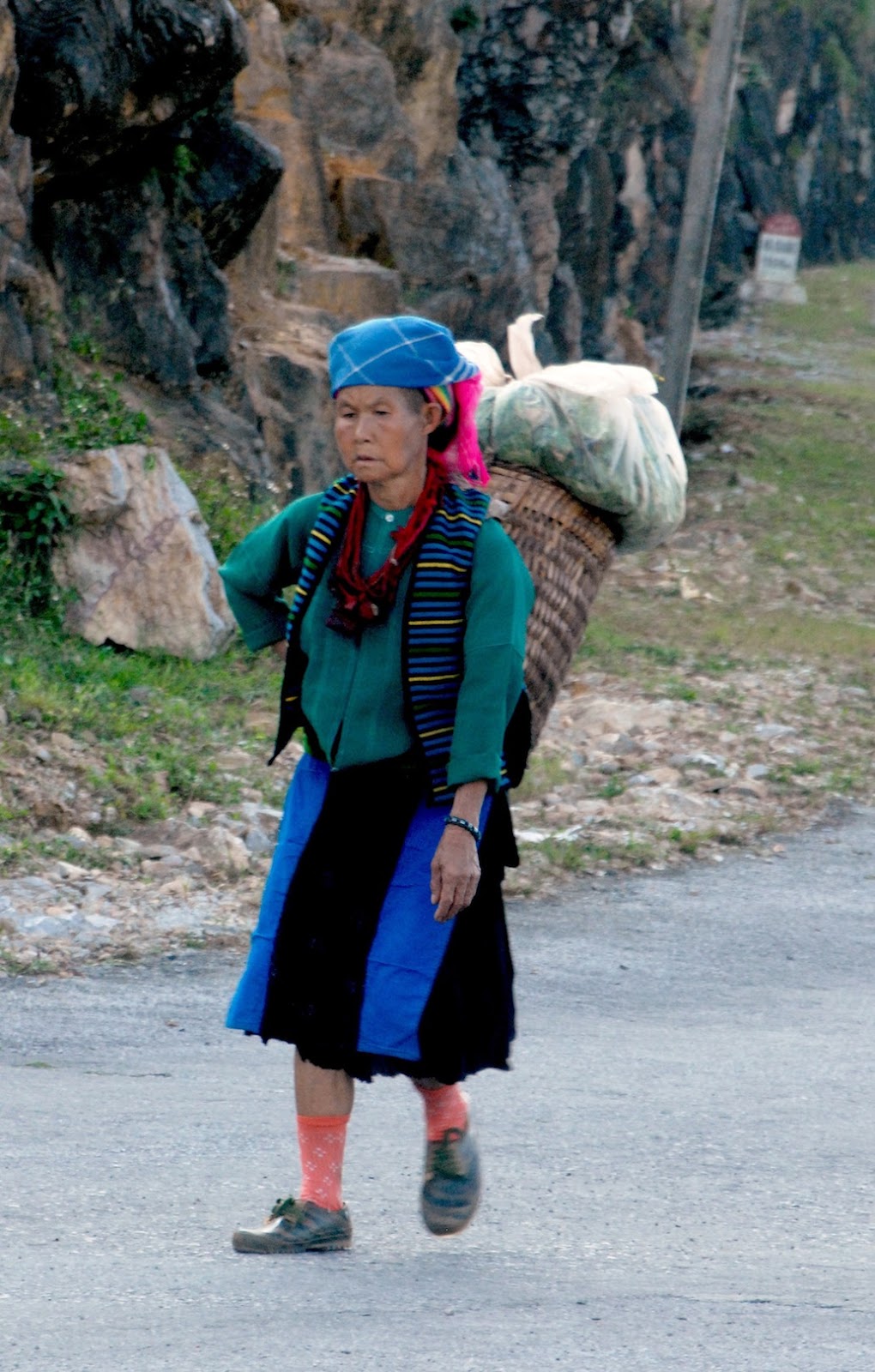
       The villagers belong to the White Hmông branch and are not as colorful as the various Flowery Hmông groups to their west.  Men dress in modern style and women wear knee-length, pleated skirts of a great variety of colors and patterns which mostly come from Chinese textile factories.  They may wear traditional leg wrappers and side-fastened jackets, but exhibit no sense of uniformity in the complete outfit.  Nevertheless, they are still recognizably Hmông, for no other ethnic group dresses like this.
Lũng Phìn market day
       The Hmông, lik their linguistic cousins the Dao, migrated to this area two to three centuries ago.  The plains and valleys were already occupied, so they had to settle in the mountains, with its rocky slopes, stony ground and less productive soil.  But that’s been a theme of Hmông history, always pushed out of good land by stronger neighbors and forced to make a living on the lands nobody else wanted.  Yet they succeeded, extracting the maximum from what was available for them.
       From Mã Pí Lèng the road continues high above the Nho Quê River and begins descending about five kilometers before Mèo Vc.  This town is about the same size as Đng Văn, though its enclosing hills are a little further away.  Ordinarily it’s a quiet place, except for Sunday, also Mèo Vc’s market day, with lots of hill people in and around the central covered market.
Dao woman in Lũng Phìn
Hmông girl in Lũng Phìn
       At the junction just outside of Mèo Vc, one road turns southeast towards Bo Lc, in Cao Bng province, and the other heads west to Yên Minh, 50 km distant.  The landscape is not as dramatic as that above the Nho Quê River, but it’s a pleasant ride through rolling, forested hills.  The biggest villages along the way are Sung Tra, about six km from Mèo Vc, and Lũng Phìn, another twenty km or so further.  Sung Tra holds its market day on Saturday, while Lũng Phìn hosts it on the tiger and monkey days of the 12-day animal cycle.
the road to Yên Minh
       Market days are the other prime attraction, besides the scenery, of the Karst Geopark districts.  Moreover, they are enjoyable on cloudy, misty days, when the scenery is barely visible.  Most foreigners confine their market day experience to Sundays, at Đng Văn and Mèo Vc.  The former starts very early, while the latter isn’t active until very late morning.  The other venues see few foreigners and are without any souvenir stalls catering to tourists. 
       Lũng Phìn’s market is especially attractive.  The village lies on the south side of the road and where its main street meets the highway the commercial activity is at its most congested.  All along the main street, which rises slightly uphill, Hmông and Dao women set up their stalls, on up to the covered market building at the top.  The Hmông here outnumber the Dao, and dress similarly to those around Mã Pí Lèng. Some of the younger ones don white skirts or very spangled blouses and lots of ornaments.
rich farm manor near Lũng Cú
      The Dao belong to the Tá Pàn sub-group and their women wear long coats, split at the sides, with embroidered strips running vertically down the front, fastened by rectangular silver buckles.  They also wear trousers that look plain black when they stand still.  But when they walk, or a breeze comes along while they are standing, the heavily embroidered patterns on the sides become visible.  Older women wear large black turbans, middle-aged ones wear round caps and the unmarried go hatless.
Lũng Cụ flag tower
       Past Lũng Phìn, the road continues across rolling hills, occasionally swerving around huge black granite boulders jutting up from the fields.  At Yên Minh it turns north and begins climbing into the mountains again.  After 20 km it comes to a junction.  The way left goes five km to a closed valley and the border post village of Phó Bng.  A right turn goes west back to Đng Văn.  Several km past the junction stands another big sculptured Hmông reed-pipe.  The road turning north here runs along high hills and then reaches Lũng Cú, a small town with its rice fields lying at the bases of a cluster of hills.
       Lũng Cú’s claim to fame is its position at the northernmost point of Vietnam, just below the Tropic of Cancer line.  On a hill on the northern side of town stands a flag tower, and from here one can have a view into southeastern Yunnan, China.  There’s not much to see in that direction but wild mountains, but the view down to the village and town layout and its farms is worth the excursion.
       Returning to the road junction with the reed-pipe, just a little further west is the next major stop.  This is the Hmông village of Sà Phìn.  It holds market day on snake and pig days, drawing mainly local and neighboring White Hmông.  It’s also the location of the Vương Palace, which sits in a wooded area outside the village. 
part of the Vương family palace
       After sealing their alliance with Vương Chính Đức, the French hired Chinese architects to build him a palace in 1902-03.  Comprising four two-story wooden buildings, separated by courtyards and surrounded by a white-plastered brick wall, the palace, now a museum, is the primary historical attraction in the area.  Side rooms in each quadrangular compound serve as exhibits of household items when the palace was in use.  These include the elegant furniture of the study, the family altar, the kitchen with its twin brick fireplace, the family altar, a wooden mortar for pounding corn, a vertical loom, thread-winder and spinning wheel, and an armory with a rack of  old rifles.
       For assistance in suppressing the 1913 revolt, for sending soldiers to the French garrison in Hà Giang City, and for keeping order in his domain, the French promoted Vương Chính Đức to General in 1927.  In the following decade, however, he became sympathetic to the anti-colonial resistance and after the Japanese occupied northern Vietnam in 1940, he began supplying covert assistance to the Việt Minh.  
the Vương family dining room
       He died in 1944, but his son and successor Vương Chính Sính pledged support to Hồ Chí Minh and helped enable the Việt Minh capture of Hà Giang City in March 1945.  After 1954 he donated his land to the provincial government and served it as the representative of Đồng Văn, Mèo Vạc and Yên Minh districts.  He died in 1966 and the palace became a school.  In recent decades a new school was erected below the palace, which then became a museum.
       The road back to Đồng Văn remains high in the hills most of the way, allowing many scenic views, especially on the slow descent to the city. The best time of year to visit is the autumn, when the fields are yellow with the ripening rice crop.  But winter is never very cold, as it rarely snows, even in the mountains, while during the summer it doesn’t rain continuously and the fields are bright green.  Planting takes place in mid-spring, but this is also the time of the area’s most interesting annual event—the Khâu Vai Love Market.
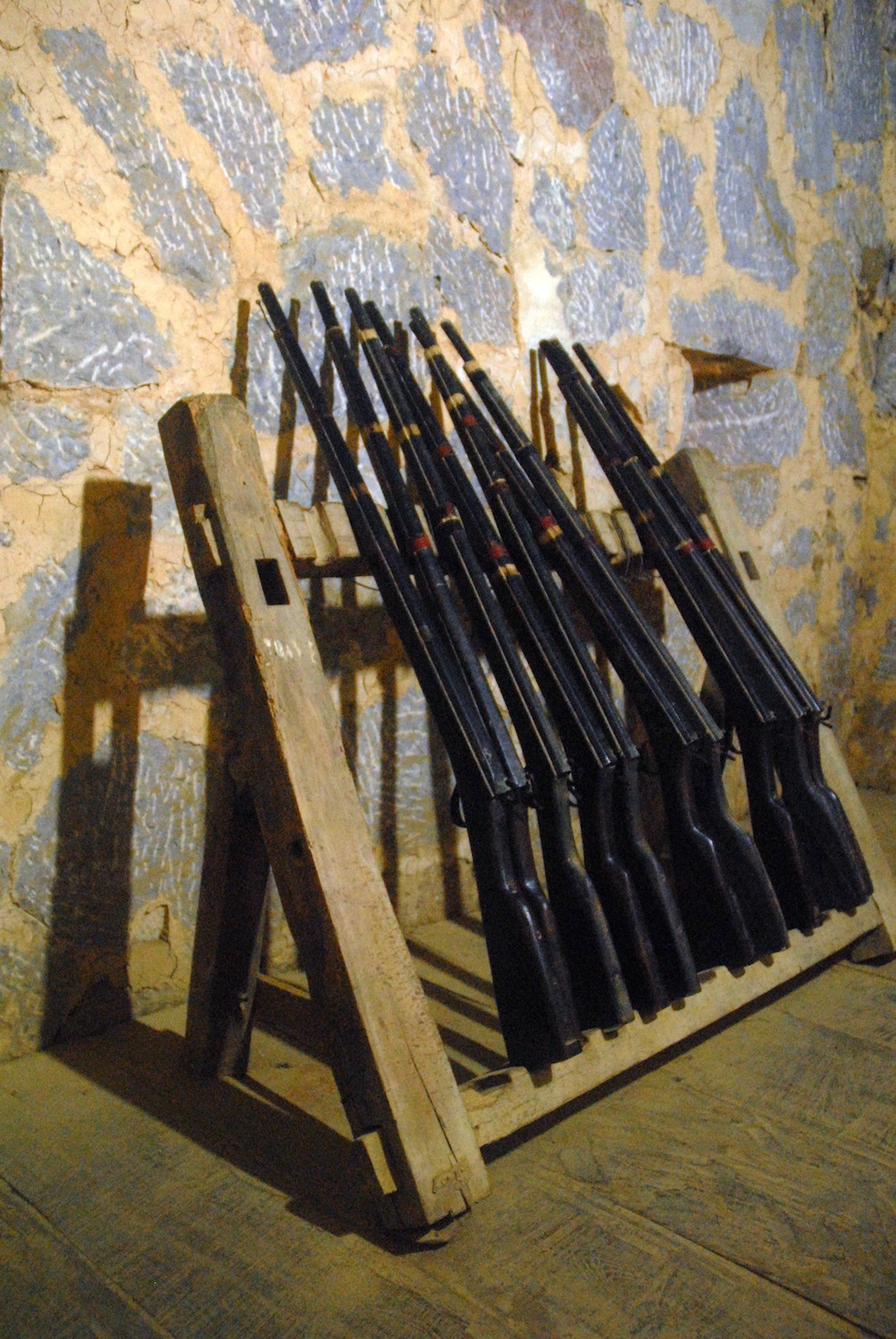
old rifles in the Vương palace
Hmông woman on the road above Đông Văn
       Khâu Vai holds a regular market day every five days beginning with the 2nd day of the lunar month.  But on the 26th-27th days of the 3rd lunar month it hosts the Love Market.  Unmarried young people may attend any ordinary market day with their eyes open for a potential partner, but this Love Market actually marks the opportunity for ex-lovers to meet again.  It originated long ago in an affair between a Giáy girl and a Nùng boy.  Opposition from Giáy elders led to a war between the two ethnic communities and the couple decided to terminate the relationship in the interests of peace.  But they arranged to meet once a year at Khâu Vai and since then the custom spread amongst other ex-lovers and became the Love Market Festival. 
       Besides former lovers, the popular event attracts a broad range of ethnic minorities in the area, dressed in their best, enjoying a variety of activities and entertainment.  And like the fabulous karst landscape, it is unique to the northern tip of Vietnam.

farms behind Đồng Văn 
                                                                             * * * 
Delta Tours Vietnam can make arrangements to visit Đồng Văn and other destinations in Hà Giang province.  See https://www.deltatoursvietnam.com/other-tour-options


Friday, March 23, 2018

Home-stay with the Dao in Quản Bạ


                                                       by Jim Goodman

Núi Đôi--the breast-shaped hills of Quản Bạ 
       The northeastern province of Hà Giang is one of the most remote in Vietnam.  It’s also one of the poorest, consisting mostly of rocky mountains with stone-studded slopes, the kind of terrain that precludes agricultural development.  But it is becoming more attractive to travelers, for access is much easier nowadays.  Around the turn of the century it took two full days to drive the 313 km from Hanoi to the provincial capital Hà Giang City, and another full day to reach Đng Văn in the far north.  Now it’s a smooth ride of six to seven hours.
       Hà Giang City, the provincial capital, is not particularly interesting.  Other than a small museum housing prehistoric artifacts and the clothing of the ethnic minorities, there is little to appreciate.  The city lies along the Lô River, but its banks are usually full of refuse.  But it does have an attractive setting among steep hills backed by high mountains, a foretaste of what’s to come further north.
typical Dao house in Nậm Đâm
       Leaving the city, the road north runs a while through pleasant valleys, passing stilted houses of the Tày minority, and then climbs into the hills.  About 40 km north of Hà Giang City it comes to the pass known as Heaven’s Gate.  From here is a splendid view of Qun Btown and its unique setting.  Just beyond the flat fields of the northern suburbs sit two hills beside each other, called the Twin Mountains (Núi Đôi), bereft of farms or trees, exactly the same size and shaped like a woman’s breasts.  Higher mountains lie in the distance beyond.
       According to a local legend, once upon a time a Hmông man playing his gourd-pipe lured a fairy from Heaven who heard his music and fell in love.  She stayed on Earth and bore him a child.   The Lord of Heaven found out and ordered her back.  So she left her breasts behind to nourish the child.
Dao male attire
Dao Aó Dài woman's outfit
       A medium-sized town with little traffic other than inter-city buses, Qun B is becoming more geared up for tourism, with several hotels, trekking services and restaurants with Western food and English menus. Vietnamese dominate the urban population, while Hmông and Dao are the main ethnic minorities in the district.  Most hotels offer home-stay arrangements for travelers to stay in minority villages.
Dao women going home from the fields
       The nearest of these is the Dao village of Nm Đâm, a few km north of Quàn B, consisting of about fifty houses and 250 inhabitants, members of the Dao Aó Dài sub-group of the Làn Tn branch.  [In Vietnamese the letter ‘d’ is pronounced like a ‘z’ so it’s Zao Aó Zai.]  Some Dao are famous for the colorful embroidery with which the women embellish their jackets, trousers or both, like the Red Dao around Sapa, the Tá Pàn Dao in northern Hà Giang and the Sewing Dao of Lào Cai province.  The Dao Aó Dài dress in mainly plain black clothes, without any embroidery, like other Làn Tển sub-groups the Black Dao and Dao Tuyền.
       Men wear a front-fastened, long-sleeved, plain black jacket over black trousers.  The aó dài tunic worn by the women is also long-sleeved, but side-fastened, knee-length and split on each side from the waist down.  It resembles the aó dài worn by Vietnamese women, except it is shorter and has no upturned collar.  It’s not completely black, for a thin band of red trimming runs along the neck and lapel and thicker bands of red, blue or white wraparound the sleeve cuffs.  The women also wear a red cloth belt tied around the waist.
Dao woman with child
Nậm Đâm children
       The headscarf is more like a turban with a flap in the back.  The front features bands of spangled white and red across the brow and the top is usually white.  The long flap that hangs halfway down the back is black underneath and bright red on the outside. Young girls and children dispense with the headgear, but otherwise dress the same.  Silver neck rings, often more than one, and long silver chain necklaces are the most popular ornaments.
host couple with home-made herbal rice liquor
       Like other sub-groups of the Dao, the Dao Aó Dài in Quản Bạ have maintained their traditional culture and are very conservative.  Thus, the women prefer to wear their traditional garments and one of the attractions of a visit to Nậm Đâm is the exotic sight of ethnic clothing everywhere.  In addition, the houses are old-fashioned, two-story structure of wood and rammed earth, with thick thatched roofs.  Fields and gardens separate the houses and there is no real congested area in the entire village.  The only non-traditional buildings in Nậm Đâm are those constructed for the home-stay guests.
preparing dirt for house walls
       “Home-stay” is a bit of a misnomer.  Unlike trekking in the Himalayas in Nepal, or visiting hill tribe villages in northern Thailand (my own experience) visitors do not actually stay in anyone’s home, but in a separate building.  The individual rooms have a thick mattress on the floor, lots of pillows and blankets, an electrical outlet and no furniture.  Guests share a toilet and shower and a computer if they haven’t brought their own, and every such home-stay establishment, of which Nậm Đâm has five at the moment, has wi-fi connections.
       By staying overnight in villagers’ homes, whether a separate bedroom or s mattress on the dining room floor, travelers witnessed a great deal of domestic life.  They saw who goes to bed early or late, who wakes up first, what was the first task of the day, how the meals were prepared and so on—all insights into traditional culture.  By putting guests in a separate building, all that is lost. 
the 'rammed earth' method
       The simple breakfast consists of a choice between noodles or banana pancake—the backpacker favorite, with at most one family member joining the guests.  But for the mid-day and evening meals, the whole host family joins.  And of course, the greater the number of guests, the greater number of dishes, both of meat and vegetables.  Rounds of herbal rice liquor, a local specialty, punctuate the repast and the Dao women will drink as much as the men.  But they don’t get drunk, for the Dao only consume alcohol at meal times and not afterwards.
      While the home-stay experience does not allow for the observation of the intimacy of family life, for anyone interested in the ethnic life style, it’s still preferable to lodging in a city hotel.  “Home-stay” may be just a rural guesthouse, but travelers wake up in an authentic village environment with plenty of opportunity to observe the people’s outdoor work.  This depends on the season, naturally, for farming is every Nậm ̣Đâm family’s occupation. 
Dao domestic altar
Dao girl excavating dirt for house walls
       I was there in winter, when the fields lay fallow.  Women went to gather herbs and edible plants growing wild or harvested something raised in their gardens.  Winter is also house construction time.  The Dao first layout the foundation and then place two long parallel boards on the lines where they want to erect the walls.  Women dig up dirt from a pit created nearby, break up the large clods of earth, load the dirt into a basket and carry it to the house site.  Then they empty the basket of dirt into the trough between the parallel boards.  A man with a big wooden hammer pounds the dirt to make it compact. 
young Dao man learning to write Chinese characters
       Then men raise the boards to make a new trough to receive another load of dirt and slowly but surely the walls rise, by what is known as the ‘rammed-earth’ method. The two-story building, when finished, will include wooden corner posts and window frames and a roof of thick thatch.
       Nậm Đâm is an officially recognized ‘culture village’ and has its own modest museum.  Tools, implements and machines used in agricultural work comprise the bulk of the exhibits, as well as a palm fiber rain cape.  But a typical home altar is also on display, for it’s an essential ingredient of every Dao household.  Dao religion is basically animist with a heavy Taoist overlay.  Shamans are still an active tradition and the people take their religious ceremonies very seriously.  
       Shamans undergo successive initiations to become qualified to conduct a range of rituals for different events.  These include rites of passage like births, becoming an adult, marriage and funerals, others’ initiations, expelling bad luck, honoring ancestors, calling back the wandering souls blamed for unexplained illnesses and so forth.  They wear special coats and hats and for major rituals they may decorate the venue with paintings of Taoist deities.  They often accompany the rites with the deployment of power sticks, fortune-telling dice or musical instruments such as gongs, cymbals and drums.
shaman manuscript pages
       They also read aloud from ancient Taoist manuscripts, written in Chinese characters, which around Nậm Đâm could be up to five centuries old.  They contain narratives of myths or complex prayer formulas and tradition requires a chicken sacrifice and a ritual before they can even be taken out for use.  Most pages are just text, but some contain colored illustrations of life in the afterworld, its pleasures and its punishments.  
       Other than the New Year rites, ceremonies conducted by shamans are semi-public, in that they take place in a private house or yard, but anyone, including passing travelers, is welcome to observe and even join the feast afterwards.  That certainly enhances any visitor’s experience, but even without such a lucky coincidence, a stroll around the village, or out to another one a few km away, is quite pleasant.  The people are friendly and hospitable, used to foreigners without being overwhelmed by great numbers of them and the landscape offers views of other valleys and of black limestone boulders jutting up from the ground, sometimes in arresting shapes.
Hmông in Quản Bạ on market day
       Sunday is market day in Quản Bạ, which draws many of Nậm Đâm’s residents to town, mostly women.  They may add a little jewelry for the occasion, or a colorful scarf, but otherwise dress the same as any other day.  Dao Aó Dài from other villages in the vicinity also turn up in Quản Bạ in Sunday, as do a few Tày, lots of Hmông and local Quản Bạ Vietnamese.    
       Dao Aó Dài women dress more or less the same, with little variation in the outfits.  Hmông women around Quản Bạ, in contrast, do not have a uniform style.  They may wear some of the traditional clothing components, like long slit tunics, pleated, over-the-knee skirts and a long, thin apron in front, but very different from one individual to the next.
pigs for sale in Quản Bạ
Hmông girls examining a necklace
       The regular daily covered market is in the southwest quarter of the town.  On Sunday stalls and stands, or just goods laid out on a cloth, go up on all the lanes branching off from the covered market, as well as the main street in front of it.  Vietnamese run the shops and most of the stalls in the covered market, but Hmông and Dao-run stalls occupy side streets and the areas outside the covered market.  Some hawk vegetables or herbs, others textiles or jewelry.
       At the north end of the market an empty field is the venue for the livestock market, mostly buffaloes.  On the market side of it smaller animals are on sale.  The pigs wear a muzzle of split bamboo and are tied to bamboo poles to make for easy vertical transport on the buyer’s back.  The fowl vendors provide a cage for those purchasing chickens and ducks.  Dog vendors are also there, the dogs tied to leashes for customers to walk them home, whether purchased as pets or as food.
Hmông woman selling vegetables
Dao Aó Dài women in Quản Bạ
       Sugar cane is a popular item and customers often break off a small piece to gnaw on while touring the market.  The liveliest stalls are those selling jewelry, crowded with girls holding up and examining necklaces, bangles and neck rings, fantasizing what they would like look wearing the ornaments.  The older Hmông and Dao women tend to congregate around the textile and thread stalls, buying cloth to make their own clothing.
       Several noodle stands open for the day, so lunch is possible in the market area.  But shortly after noon the crowd begins thinning.  Some look for last-minute bargain finds, youths may arrange for a date with someone they met today, and villagers running stalls gather up the unsold merchandise and prepare to take it home.  Unless it’s a particularly busy time in the agricultural cycle, they’ll be back next Sunday.
Dao women at a silver jewelry stall
                                                                            * * *               
Delta Tours Vietnam can make arrangements to visit Quản Bạ and other destinations in Hà Giang province.  See https://www.deltatoursvietnam.com/other-tour-options