Showing posts with label Jinuoshan. Show all posts

Sunday, July 31, 2022

Jinuo Villages in Xishuangbanna, Past and Present


                                  by Jim Goodman


       The Jinuo people were one of the earliest settlers in Xishuangbanna, Yunnan, and nearly all of them still live there today, mostly around Jinuoshan in the center of the prefecture.  The area is very hilly and has become famous as of one of the six major mountain regions cultivating Pu’er tea.  Legends trace the Jinuo origin to a detachment of soldiers in Zhuge Liang’s army during the 3rd century Three Kingdoms Era.  The unit overslept one night and when it finally caught up with the army Zhuge Liang would not allow them to rejoin.  They were to stay and settle where they overslept.  But to make it easier for them, Zhuge Liang gave them seeds for tea bushes.

       This was supposed to have happened around Mojiang, but the Jinuo later migrated south to Xishuangbanna.  The Jinuo never developed a script for their language so never recorded these events.  It’s not possible to say precisely when they began living in Banna, but the best known and most popular Jinuo origin myth casts them as indigenous to Jinuoshan.  Accordingly, the first human, a giantess called Amo Yaobai, using clay models, created the Han, Dai and Jinuo people.  The Han and Dai occupied the plains, but the shy Jinuo opted for the hills.  When a great flood swept across the land Amo Yaobai bade one Jinuo couple to hide inside a sealed drum to keep them safe from drowning.  When the waters receded the drum landed at the foot of contemporary Bapo village in Jinuoshan district.  The couple who emerged from the drum became the Jinuo ancestors.   

       Only in recent decades have any Jinuo opted to take up residence in the plains.  Always a reclusive people, they have remained ensconced in the forested mountains around Jinuoshan throughout their existence.  At an elevation a few hundred meters higher than the plains, they enjoyed a cooler summer, while the winter was never very cold.  Establishing their villages within the tropical forests, they could take advantage of jungle resources like wood and bamboo for building materials, animal and plant food and natural medicines.

       When setting up a new village the Jinuo usually chose a site on a hill slope facing the morning sun.  After clearing the area they marked off the village boundary with tablets of stone or wood, decorated with carved spears and swords, presumably protection against nefarious spirits.  They built stilted houses of wood and bamboo, roofed with thatch or wooden tiles.  The political and spiritual leaders stayed in individual houses.  Everyone else lived in longhouses, usually ten to twelve families from a single clan, occasionally large enough to fit twenty families.  Residents shared one big room for meetings, socializing, cooking and dining.  Families lived in compartments on both sides of a central aisle, each with a separate fireplace.  When families got larger, to three generations, it became so crowded that people built another longhouse.

       In the longhouse tradition private life was mostly public, for every family was keenly aware of what other families were doing.  It’s hard to imagine growing up in such conditions with a strong sense of individualism or inclined to rebel against any cultural norms.  The family was an important institution, but the village as a whole was the main social unit.  They were farmers and the land and labor on it were collectively shared.

       They cultivated dry rice, corn, bananas, papaya, cotton and tea.  The latter they grew in gardens, which could begin yielding the right kind of leaves four years after planting.   Fruit trees were permanent, but the grains and cotton required fields cleared from the jungle.  In early spring farmers cut down the trees in a section of the forest and burnt them down to the layer of ashes that would soak into the soil when hit by the first rains and provide enough fertilization to grow crops for a year or two.  Then they would have to clear a new patch and leave the just used one fallow for ten years.  After that, with the land fully rejuvenated, they could clear and sow it again.

       The Jinuo were not the only ones to practice this ‘shifting cultivation’ (or ‘slash-and-burn’), it was common throughout the hills of the province.  So long as the population was small and stable the system worked.  The people rotated fields over the same route, re-using the fields and not extending further into the forest.  There was little strain on the overall ecology.

       Besides sharing the produce of the land, the collective ethic also characterized hunting.  Men formed parties and hunted together.  Whatever they caught was shared equally, though the one who shot the animal got to keep the pelt.  They also carried with them bamboo tubes of different lengths, each making a different sound when struck.  The way the party played these on their return informed the village how successful they were.

       Women were not part of these parties, nor were they allowed to do the butchering, because these were life-taking activities.  Jinuo women were the life-givers of the society, giving birth, nurturing babies, planting seeds after the men cut down (and killed) and burnt the trees.  But they were also subject to ritual restrictions, such as not being allowed to touch or beat the village drum.  This drum, intended as a replica of the one that saved the Jinuo progenitors in the great flood, was housed in its own building, beaten by the headman as a summons to a collective meeting, and put to use during important rituals and festivals. 

       The schedule for the preparation of their fields ran according to the annually predictable weather pattern.  At the end of the hot, dry season it was time to cut down and burn the trees and wait for the first rains to mix the ashes with the soil.  But the day to begin sowing the fields depended upon the spiritual leader’s decision and that was after conducting ritual animal sacrifices to appease the land spirits.  Beating the drum accompanied the ritual prayers.  Then the elders ceremonially planted a few seeds in their own fields and after that the rest of the village could start planting.

      Later in the year Jinuo villages also roll the drum out to the center of the settlement on the occasion of Temaoke, a festival honoring the blacksmith, a Jinuo cultural hero.  Before the blacksmith came into society Jinuo life was harsh.  Nearly everything they did was slow and laborious.  The blacksmith introduced tools and weapons that transformed their lives:  axes, machetes, hoes, spades and plows for the field work; knives, spears and swords for hunting and defense.  As a result the Jinuo work load became easier and life was more tenable and sustainable.

       The festival events include rituals by the men honoring the drum and a series of dances mimicking the successive activities of the rice-growing cycle.  The theme is unique to the Jinuo.  Other peoples have blacksmiths, too, but they do not accord them the same cultural prominence.  Temaoke thus represents a celebration of what’s special about being Jinuo and nowadays the people dress in their best traditional garments for it, even if they no longer wear them every day.

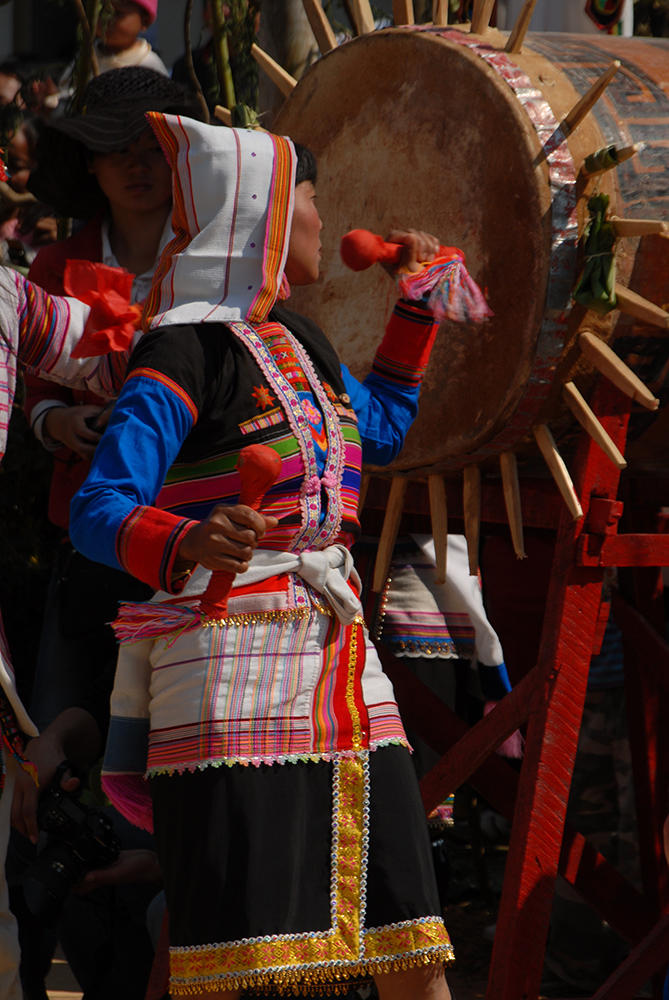
       Nowadays, too, the festival includes vigorous drum-beating while the dances transpire, especially by women, no longer forbidden to touch or play it.  In fact, the women’s drum dance is more attractive than the men’s.  Men beat it from a single position, standing in front of it and striking forward.  Women move around, hitting it forward, sideways and backwards, dancing while doing so, making for an energetic, more entertaining performance, especially when more than one woman is playing.

       Besides the taboo on touching the drum, the injunction against women being butchers has also lapsed.  They still do not take part in killing animals for sacrifices to the spirits, for the control of religion belongs to the men, but in recent decades a few Jinuo women have undertaken jobs as butchers.  Nowadays there is virtually no occupation off-limits to women and they hold a highly respected position in society.  Tradition says that in the past Jinuo society was divided into seven matriarchal and seven patriarchal clans, but that the matriarchal system was abandoned three centuries ago.

       Nevertheless, Jinuo villages have two recognized leaders:  the oldest male and the oldest female and the latter supervises women’s affairs.  Within the longhouse the younger generation engaged in fieldwork, while the elderly women stayed behind and looked after the children.  Thus grandmothers were of strong influence on a child’s upbringing.


      The Jinuo did not venture down to the plains very often and were a mystery to the Han and Dai, who called them Youle people, after a prominent mountain in Jinuoshan.  Governments classified them as a branch of the Dai nationality, though their language belongs to the Tibeto-Burman linguistic family, unrelated to Dai.  Familiarity with Jinuo culture and identity only began with the founding of New China in 1949.

       From 1954 Communist Party cadres began contacting isolated Jinuo communities to help them improve their lives.  The following year they set up cooperative work teams for agriculture and introduced wet-rice cultivation to replace the dry-rice farming that relied on the slash-and-burn method of field preparation.  Now the Jinuo built permanent fields in terraces, irrigated by water pumps.  Production increased and, thanks to health care improvements, so did the population, nowadays reaching 25,000.  The old way of shifting cultivation would not have been tenable much longer anyway.

       The government also established the town of Jinuoshan, an administrative seat for the Jinuo-inhabited area.  A network of roads came next, linking major villages within the district.  Hydroelectricity projects reached the villages and electric lights replaced the tiny oil lamps for internal illumination, while electric milling machines took over from mortar and pestle action.

       In 1979 the government finally recognized the Jinuo as a separate minority nationality.  They were no longer a branch of anyone.  They were their own people.  The year was the start of the Reform Era, the dismantling of the commune system and the revival of ethnic consciousness, long castigated as “little nation chauvinism”.  For the Jinuo this meant a new appreciation of their traditional clothing and subsidies for their festivals, as well as other cultural promotions appealing to ethnic pride.

       From 1979 many Jinuo families took the newly possible option now to leave the commune system altogether and started their own farms.  They also began building separate homes outside the longhouse.  In general they were stilted houses of wood and bamboo with roofs of wooden tiles.  Into the 21st century they began deviating in style, with roofs of corrugated iron, walls of brick or cement and directly on the ground.  This has been the fate even of the officially designated “cultural village” of Bapo, where the drum landed after the great flood.

       The village lies above a slope and lying across that slope is a massive stone sculpture of Amo Yaobai.  It was made by a Sichuanese sculptor after a design drawn up by the Sichuan Academy of Art.   She is lying on her back, limbs outstretched, face up and eyes open.  A walkway alongside right up to the village enables visitors to view the entire work up close.  Tour agencies bring groups here, usually arranging for ethnic dances as well.  Bapo, like all Jinuo villages, still has its drum house, though the village architecture has modernized so much it hardly justifies the enormous ticket price to enter.

      One of the government projects designed to promote ethnic consciousness in Jinuoshan was the opening of a Jinuo museum.  Unfortunately, it was not in Bapo cultural village, nor in or near Jinuoshan, where visitors might look for such a thing.  Instead it is in Baka, east towards Menglun, in a rather dilapidated state, converted from an abandoned longhouse.  Separate cubicles hold exhibits of hunting gear like crossbows, traps, snares and rifles, spinning and weaving material, ritual items and sets of local Jinuo clothing.  The museum has never been properly maintained and the glass cases are so encrusted with dirt the exhibits within them are only visible from the sides.

       Traditional clothing is similar throughout Jinuoshan except in Mengwang District in the northeast, where the government sponsored a sub-group recently to move from deforested hills to vacant land in the plains.  The women’s much longer peaked cap reaches to the waist in back, while the blouse, wraparound skirt and gaiters are similar they do not wear the same kind of colorful jacket, but plain blue or purple cotton or silk.  Men wear black jackets with red trimming and a red sun, with spokes like the drum, over the front pocket and the upper back.  Mengwang clothing differs from the Jinuo norm, but its components and style make it recognizably Jinuo.  And though the last longhouse residents in Jinuoshan moved out in 2002, the collective spirit survived and villages stage their own village feasts and celebrations in which all the residents participate.   It’s essential to being Jinuo.     


* * *

For more on the Jinuo see my e-book Xishuangbanna:  the Tropics of Yunnan


Thursday, November 21, 2013

The Jinuo People Honor the Blacksmith


                                                            by Jim Goodman

Jinuo girl
    Of China’s 55 recognized minority nationalities the Jinuo of Yunnan’s Xishuangbanna Prefecture were, in 1979, the last to be granted official status.  Never a very numerous people, today scarcely 22,000, before that they were considered a branch of the Dai nationality, though they had little in common with the Dai.  The Jinuo language is part of the Tibeto-Burman family, the people are animist, not Buddhist, and for the most part tea cultivators, not wet-rice growers.
    The Jinuo were among the earliest migrants to Xishuangbanna coming into the prefecture from the north.  Jinuo legends claim that the people originated from a group of soldiers attached to the army of Zhuge Liang during the 3rd century C.E. in the campaign against Meng Huo, a tribal leader controlling much of Yunnan at the time.  This particular detachment fell asleep at one point on the march and when the group woke up they discovered the main army had already moved out. 
    When they caught up they were not allowed back into the army.  But instead of having them executed for dereliction of duty, Zhuge Liang ordered them to settle down on the spot where they fell asleep.  The legends also say Zhuge Liang gave them seeds for tea trees as a compensation for their expulsion.  This was supposed to be somewhere between Pu’er and Mojiang, but it is doubtful Zhuge Liang’s forces marched that far south, so more likely the spot was further north.
Jinuo men
    At any rate, the group did not stay there long.  After the army had departed they moved south.  How soon afterwards they moved into Xishuangbanna is not certain, but nowadays, unlike the other major ethnic groups here, there are no Jinuo villages anywhere beyond Xishuangbanna.  Most settled around Jinuoshan, near Mengyang, with smaller numbers around Kongmingshan, west of Xingmeng, and in Mengwang district.
    Contemporary Jinuo are familiar with the Zhuge Liang story, but their own traditional mythology puts their origin right there in Jinuoshan.  And they have more than one version.  In the first, a great flood washed all the way up to the hills, drowning everyone as it rose.  The goddess Amo Yaobai instructed a young man and young woman to escape the deluge by enclosing themselves in a big drum.  The drum floated on the floodwaters while everyone else died.  When the waters receded the drum landed at the foot of what is now Bapo village.  The couple cut their way out of the drum and set foot on the land.  Amo Yaobai then gave then seeds for rice and for tea.  This couple, then, was the progenitor of the Jinuo people.
village in Jinuoshan
     Another myth credits the origin of the Jinuo to a widow with seven sons and seven girls.  These children married and as the original clan grew it divided into matriarchal and patriarchal villages.  Today Jinuo society is completely patriarchal, but that has apparently only been true for the last three centuries.
    Neighboring people called them Youle, after the mountain that dominates Jinuoshan district, where most of them lived.  They were mainly tea cultivators, which they traded for rice, though they did grow a little rice of their own, along with cotton, bananas and papayas, and supplemented their diet with wild game, fruits and vegetables from the adjacent jungles.
    Traditionally their villages were small, sited in isolated places in the mountains, only in contact with the lowlands when they went down to market their tea.   Most people lived collectively in longhouses.  Their leaders, and ultimate authorities in maters of ritual, custom and the arbitration of disputes, were the oldest male and the oldest female in the village.  People were poor and lived a harsh life of bare self-sufficiency.
    Like other hill peoples, they compensated for this with a rich cultural and community life.  Mutual aid was built into their environment.  When hunting parties went on a foray, while the choicest parts of the game they bagged went to the hunters who brought it down, the rest of the meat was distributed to all the families in the village.  Families helped each other at harvest time and banded together to fend off wild animals like elephants, boars and buffaloes threatening any of their fields.
Jinuo girls all dressed up
    The unmarried youth belonged to male and female bachelor associations that sponsored collective rites of passage for new members, usually at age 15, when boys shaved their heads except for three tufts of hair and girls stopped braiding theirs and wore it in the adult style.  They also underwent tattooing.  Girls had simple tattoos, like geometric patterns, applied to their lower legs.  Boys favored more elaborate designs of animals, flowers, the sun, moon and stars, applied to both their arms and their legs.  Youths worked at their individual domestic or field tasks and met at night for informal song and dance sessions near the communal house.   They chose songs from a vast traditional repertoire and accompanied them with a three-string lute, bamboo flutes of two, four or six holes, bamboo Jew’s harps and upright bamboo xylophones, comprising seven tubes of different lengths and diameters. 
      Marriage was by free choice and girls often initiated the romance.  Jinuo custom laid no restrictions on pre-marital sex, and in fact, some villages erected small huts for the privacy of this activity.  When they had a child the couple formally married, an event celebrated by the entire village. Then they moved into a separate cubicle in the communal longhouse and were expected to remain faithful after that.  Divorce, while theoretically possible, was very rare.
Nowadays Jinuo families live in separate houses
    1979 was a watershed year for the Jinuo.  Their recognition as a separate minority nationality coincided with the dismantling of the communes and the acceleration of changes wrought by economic development, like the extension of roads and electricity, the growth of markets and the boom in tea prices.  This process also brokered major cultural changes among this formerly isolated people.
    Now that they could earn more income by having been allowed to opt out of the communal farming system, they began to abandon their communal domestic system as well.  Slowly but surely, individual families left the longhouses and built their own individual dwellings.  These were stilted houses of wood and bamboo, in the standard general style of Xishuangbanna, though by the end of the century more often of brick or cement, with roofs of corrugated iron.  By the end of 2003 the longhouse was just a memory.  The last Jinuo families living in one moved out of it that year.
    The new villages were bigger than the old longhouse-based ones.  People were not as intimately involved with each other simply because there were perhaps three times as many now in a single settlement, in separate houses and neighborhoods, not all together in a single building.  The youth associations faded away and people sought entertainment from radios and televisions instead of traditional songs and dances.
weaving with a back-strap loom
    Nevertheless, Jinuo ethnic consciousness survived these changes.  The people still take pride in those peculiarly Jinuo characteristics that distinguish them from others.  The ethnic costume is one of the most obvious.  From bolls collected off the cotton trees on their farms, women spin thread and then turn it into bolts of cloth up to half a meter wide on a simple back-strap loom. Then they cut up the bolts and stitch the pieces together to make the costume components.
    The main men’s item is a short, long-sleeved jacket, basically white, with a few vertical and horizontal red pinstripes and a band of red on the lapels, hem and around the middle of the jacket.  Thicker bands are on the sleeves at the elbows and just below the shoulders.  A brightly embroidered disk representing the sun might grace the back of the jacket, just below the neckline.  They wear these with a pair of simple trousers, traditionally knee-length, a round embroidered cap or a black headscarf and a shoulder bag in a design similar to the jacket.
    The women’s jacket reaches to the hips.  The lower part only is white with red lines and bands, while the upper part is basically black with many horizontal bands of red, blue, green and yellow.  The sleeves are blue with red cuffs and a pair of embroidered sun disks enhances the back at the shoulder blades.  They were a breast-cloth under this, the top part heavily embroidered in cross-stitch designs.  The wraparound black skirt, with a band of bright color and embroidered flowers along the hems, drops to the knees.  Black or red and white leggings cover the legs from knee to ankle.  On their heads they wear a peaked, cowl-like cap, mostly white, with red and black lines and bands, falling to the shoulder blades.  They also carry shoulder bags of the same style as that worn by the men. 
woman's cap and ear ornaments
    Modern clothing has become more common for everyday wear in Jinuo villages, but a decent percentage of both men and women, young and old, still prefer to don part or all of their traditional outfits both at home and in the fields.  They may be more likely to wear it, or at least the jacket and shoulder bag, when going to the markets and attending village weddings.  And of course at festival time most Jinuo will dress fully traditional style, including the odd ear ornaments worn by both sexes, such as small tubes of bamboo, woolen thread or pompom balls, or even plucked flowers.
    While they no longer live communally in a single building, contemporary Jinuo villages are still tightly knit social units.  Each one houses a large village drum mounted on a stand. The drum symbolizes the sun and the spikes around its rim are the sunrays.  The Jinuo consider it sacred and only use it for special rituals and festivals.  The most important of these is the Temaoke Festival in winter, formerly in the twelfth lunar month, now fixed for 6-8 February by the solar calendar.  At this time villagers bring the drum on its big frame to the village square and place a table of offerings in front, holding chickens, egg, wine, tea and rice.
village elders, who preside over the festival events
    While prayers to the sun, represented by the drum, constitute an important part of the festival, it is actually staged in honor of the blacksmith.  Temaoke in the Jinuo language means “iron-forging festival.”  In ancient times primitive societies always regarded the blacksmith as a kind of magician, able to harness nature’s powers to create tools and weapons that enabled people to obtain what they needed to live from nature’s resources.  The Jinuo trace their origin, and that of the festival as well, to ancient times and credit the blacksmith with playing the major transformative role in their history.  Thanks to the blacksmith, the Jinuo got the tools and implements needed to sustain their lives by hunting and farming.
pouring libations to the drum
    The most important sacrifice takes place at the blacksmith’s home.  On the first morning of the festival he goes to the senior village woman’s house to recount the dream he had the previous night.  She then interprets the dream for what it will mean for the coming year’s harvest.  Dreams of swelling rivers and blossoming trees are good portents, for example, while deserts and barren trees are not.  A feast in her home follows this event.  Then the blacksmith, accompanied by his apprentices and one member of the senior lady’s family, returns to his workshop, kills a chicken and spreads its blood and feathers on his anvil, smithy and tools.  His family cooks the chicken and while dining the blacksmith mimics his work, shouting, “hammer out the old year, hammer in the new year.”
blackface 
    The main public event takes place in the village square and includes ritual homage to the drum and a set of traditional dances.  A large crowd attends, dressed almost entirely in Jinuo style, with a few variations, such as girls with knee-high, heeled boots or in blue jeans instead of skirts, or men wearing neckties embroidered with Jinuo motifs.  One by one a few of the senior males, escorted by a young man and a young woman, approach the drum and pour a libation of rice spirits on the top of its rim.  The performance show that ensues portrays the history of the Jinuo people through the medium of dance.
    The first act features a troupe of men in blackface and rags, some playing females, representing ancient, primitive Jinuo in the harsh times before they had a blacksmith.  A few carry a big drum suspended from two balance poles.  The others wield sticks, swords and pack-baskets and in the dance mime scraping and digging the earth, looking for something edible.  The blacksmith dance follows this one, with men swinging hammers as they move around an anvil and a tray of offerings.  The next act features men with plows, then ranks of women wielding hoes.
dancing with hoes
    After these skits, the elders wheel the drum on its stand into the center of the square.  Lines of men and women wave their tasseled drumsticks while they dance and a few men and women beat the big drum.  The show concludes with a big ring dance.  Action continues at the fairground, where traditional clothing items, shoulder bags, silver ornaments, tea and snacks are on sale until late afternoon, when the crowd returns to their homes to indulge in a grand feast of chicken, field crabs, ground pork cooked in bamboo tubes, fish baked in banana leaves and, naturally, plenty of liquor.
    Nowadays villages don’t actually need a resident blacksmith anymore.  People can get their tools, weapons, knives, axes and anything made of metal from the markets.  But Temaoke is not just a festival that honors the blacksmith.  Temaoke today celebrates the history of the Jinuo people and the maintenance of their strong sense of ethnic identity.  

(for more on the Jinuo and other people of Xishuangbanna, hill and plain, see my e-book Xishuangbanna:  the Tropics of Yunnan)
 

dance depicting ancient, pre-blacksmith life

 
                                                                       * * *