Showing posts with label Zhuge Liang. Show all posts

Sunday, July 31, 2022

Jinuo Villages in Xishuangbanna, Past and Present


                                  by Jim Goodman


       The Jinuo people were one of the earliest settlers in Xishuangbanna, Yunnan, and nearly all of them still live there today, mostly around Jinuoshan in the center of the prefecture.  The area is very hilly and has become famous as of one of the six major mountain regions cultivating Pu’er tea.  Legends trace the Jinuo origin to a detachment of soldiers in Zhuge Liang’s army during the 3rd century Three Kingdoms Era.  The unit overslept one night and when it finally caught up with the army Zhuge Liang would not allow them to rejoin.  They were to stay and settle where they overslept.  But to make it easier for them, Zhuge Liang gave them seeds for tea bushes.

       This was supposed to have happened around Mojiang, but the Jinuo later migrated south to Xishuangbanna.  The Jinuo never developed a script for their language so never recorded these events.  It’s not possible to say precisely when they began living in Banna, but the best known and most popular Jinuo origin myth casts them as indigenous to Jinuoshan.  Accordingly, the first human, a giantess called Amo Yaobai, using clay models, created the Han, Dai and Jinuo people.  The Han and Dai occupied the plains, but the shy Jinuo opted for the hills.  When a great flood swept across the land Amo Yaobai bade one Jinuo couple to hide inside a sealed drum to keep them safe from drowning.  When the waters receded the drum landed at the foot of contemporary Bapo village in Jinuoshan district.  The couple who emerged from the drum became the Jinuo ancestors.   

       Only in recent decades have any Jinuo opted to take up residence in the plains.  Always a reclusive people, they have remained ensconced in the forested mountains around Jinuoshan throughout their existence.  At an elevation a few hundred meters higher than the plains, they enjoyed a cooler summer, while the winter was never very cold.  Establishing their villages within the tropical forests, they could take advantage of jungle resources like wood and bamboo for building materials, animal and plant food and natural medicines.

       When setting up a new village the Jinuo usually chose a site on a hill slope facing the morning sun.  After clearing the area they marked off the village boundary with tablets of stone or wood, decorated with carved spears and swords, presumably protection against nefarious spirits.  They built stilted houses of wood and bamboo, roofed with thatch or wooden tiles.  The political and spiritual leaders stayed in individual houses.  Everyone else lived in longhouses, usually ten to twelve families from a single clan, occasionally large enough to fit twenty families.  Residents shared one big room for meetings, socializing, cooking and dining.  Families lived in compartments on both sides of a central aisle, each with a separate fireplace.  When families got larger, to three generations, it became so crowded that people built another longhouse.

       In the longhouse tradition private life was mostly public, for every family was keenly aware of what other families were doing.  It’s hard to imagine growing up in such conditions with a strong sense of individualism or inclined to rebel against any cultural norms.  The family was an important institution, but the village as a whole was the main social unit.  They were farmers and the land and labor on it were collectively shared.

       They cultivated dry rice, corn, bananas, papaya, cotton and tea.  The latter they grew in gardens, which could begin yielding the right kind of leaves four years after planting.   Fruit trees were permanent, but the grains and cotton required fields cleared from the jungle.  In early spring farmers cut down the trees in a section of the forest and burnt them down to the layer of ashes that would soak into the soil when hit by the first rains and provide enough fertilization to grow crops for a year or two.  Then they would have to clear a new patch and leave the just used one fallow for ten years.  After that, with the land fully rejuvenated, they could clear and sow it again.

       The Jinuo were not the only ones to practice this ‘shifting cultivation’ (or ‘slash-and-burn’), it was common throughout the hills of the province.  So long as the population was small and stable the system worked.  The people rotated fields over the same route, re-using the fields and not extending further into the forest.  There was little strain on the overall ecology.

       Besides sharing the produce of the land, the collective ethic also characterized hunting.  Men formed parties and hunted together.  Whatever they caught was shared equally, though the one who shot the animal got to keep the pelt.  They also carried with them bamboo tubes of different lengths, each making a different sound when struck.  The way the party played these on their return informed the village how successful they were.

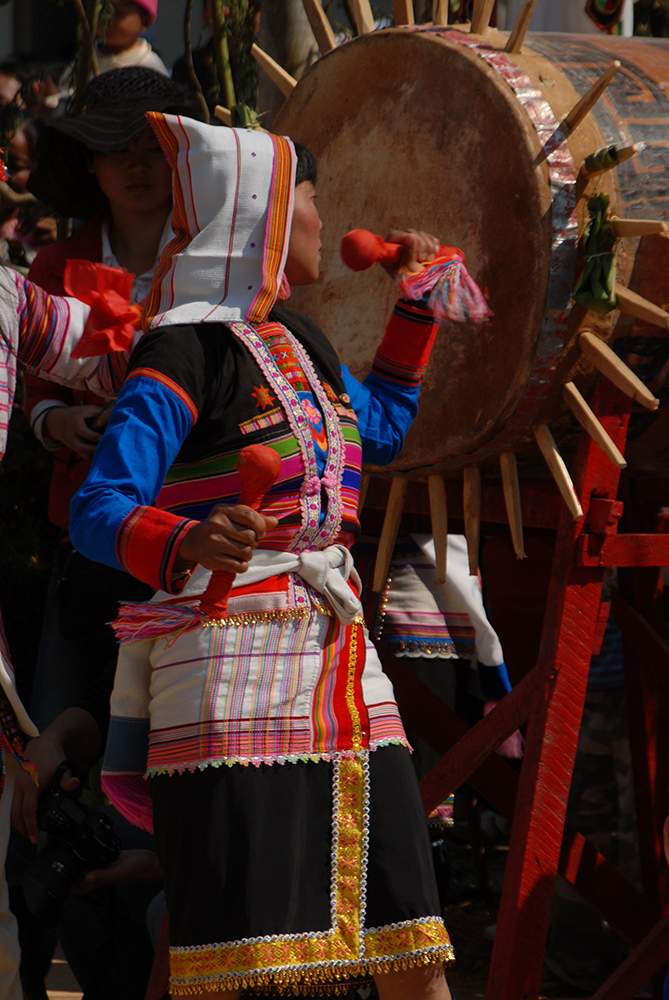
       Women were not part of these parties, nor were they allowed to do the butchering, because these were life-taking activities.  Jinuo women were the life-givers of the society, giving birth, nurturing babies, planting seeds after the men cut down (and killed) and burnt the trees.  But they were also subject to ritual restrictions, such as not being allowed to touch or beat the village drum.  This drum, intended as a replica of the one that saved the Jinuo progenitors in the great flood, was housed in its own building, beaten by the headman as a summons to a collective meeting, and put to use during important rituals and festivals. 

       The schedule for the preparation of their fields ran according to the annually predictable weather pattern.  At the end of the hot, dry season it was time to cut down and burn the trees and wait for the first rains to mix the ashes with the soil.  But the day to begin sowing the fields depended upon the spiritual leader’s decision and that was after conducting ritual animal sacrifices to appease the land spirits.  Beating the drum accompanied the ritual prayers.  Then the elders ceremonially planted a few seeds in their own fields and after that the rest of the village could start planting.

      Later in the year Jinuo villages also roll the drum out to the center of the settlement on the occasion of Temaoke, a festival honoring the blacksmith, a Jinuo cultural hero.  Before the blacksmith came into society Jinuo life was harsh.  Nearly everything they did was slow and laborious.  The blacksmith introduced tools and weapons that transformed their lives:  axes, machetes, hoes, spades and plows for the field work; knives, spears and swords for hunting and defense.  As a result the Jinuo work load became easier and life was more tenable and sustainable.

       The festival events include rituals by the men honoring the drum and a series of dances mimicking the successive activities of the rice-growing cycle.  The theme is unique to the Jinuo.  Other peoples have blacksmiths, too, but they do not accord them the same cultural prominence.  Temaoke thus represents a celebration of what’s special about being Jinuo and nowadays the people dress in their best traditional garments for it, even if they no longer wear them every day.

       Nowadays, too, the festival includes vigorous drum-beating while the dances transpire, especially by women, no longer forbidden to touch or play it.  In fact, the women’s drum dance is more attractive than the men’s.  Men beat it from a single position, standing in front of it and striking forward.  Women move around, hitting it forward, sideways and backwards, dancing while doing so, making for an energetic, more entertaining performance, especially when more than one woman is playing.

       Besides the taboo on touching the drum, the injunction against women being butchers has also lapsed.  They still do not take part in killing animals for sacrifices to the spirits, for the control of religion belongs to the men, but in recent decades a few Jinuo women have undertaken jobs as butchers.  Nowadays there is virtually no occupation off-limits to women and they hold a highly respected position in society.  Tradition says that in the past Jinuo society was divided into seven matriarchal and seven patriarchal clans, but that the matriarchal system was abandoned three centuries ago.

       Nevertheless, Jinuo villages have two recognized leaders:  the oldest male and the oldest female and the latter supervises women’s affairs.  Within the longhouse the younger generation engaged in fieldwork, while the elderly women stayed behind and looked after the children.  Thus grandmothers were of strong influence on a child’s upbringing.


      The Jinuo did not venture down to the plains very often and were a mystery to the Han and Dai, who called them Youle people, after a prominent mountain in Jinuoshan.  Governments classified them as a branch of the Dai nationality, though their language belongs to the Tibeto-Burman linguistic family, unrelated to Dai.  Familiarity with Jinuo culture and identity only began with the founding of New China in 1949.

       From 1954 Communist Party cadres began contacting isolated Jinuo communities to help them improve their lives.  The following year they set up cooperative work teams for agriculture and introduced wet-rice cultivation to replace the dry-rice farming that relied on the slash-and-burn method of field preparation.  Now the Jinuo built permanent fields in terraces, irrigated by water pumps.  Production increased and, thanks to health care improvements, so did the population, nowadays reaching 25,000.  The old way of shifting cultivation would not have been tenable much longer anyway.

       The government also established the town of Jinuoshan, an administrative seat for the Jinuo-inhabited area.  A network of roads came next, linking major villages within the district.  Hydroelectricity projects reached the villages and electric lights replaced the tiny oil lamps for internal illumination, while electric milling machines took over from mortar and pestle action.

       In 1979 the government finally recognized the Jinuo as a separate minority nationality.  They were no longer a branch of anyone.  They were their own people.  The year was the start of the Reform Era, the dismantling of the commune system and the revival of ethnic consciousness, long castigated as “little nation chauvinism”.  For the Jinuo this meant a new appreciation of their traditional clothing and subsidies for their festivals, as well as other cultural promotions appealing to ethnic pride.

       From 1979 many Jinuo families took the newly possible option now to leave the commune system altogether and started their own farms.  They also began building separate homes outside the longhouse.  In general they were stilted houses of wood and bamboo with roofs of wooden tiles.  Into the 21st century they began deviating in style, with roofs of corrugated iron, walls of brick or cement and directly on the ground.  This has been the fate even of the officially designated “cultural village” of Bapo, where the drum landed after the great flood.

       The village lies above a slope and lying across that slope is a massive stone sculpture of Amo Yaobai.  It was made by a Sichuanese sculptor after a design drawn up by the Sichuan Academy of Art.   She is lying on her back, limbs outstretched, face up and eyes open.  A walkway alongside right up to the village enables visitors to view the entire work up close.  Tour agencies bring groups here, usually arranging for ethnic dances as well.  Bapo, like all Jinuo villages, still has its drum house, though the village architecture has modernized so much it hardly justifies the enormous ticket price to enter.

      One of the government projects designed to promote ethnic consciousness in Jinuoshan was the opening of a Jinuo museum.  Unfortunately, it was not in Bapo cultural village, nor in or near Jinuoshan, where visitors might look for such a thing.  Instead it is in Baka, east towards Menglun, in a rather dilapidated state, converted from an abandoned longhouse.  Separate cubicles hold exhibits of hunting gear like crossbows, traps, snares and rifles, spinning and weaving material, ritual items and sets of local Jinuo clothing.  The museum has never been properly maintained and the glass cases are so encrusted with dirt the exhibits within them are only visible from the sides.

       Traditional clothing is similar throughout Jinuoshan except in Mengwang District in the northeast, where the government sponsored a sub-group recently to move from deforested hills to vacant land in the plains.  The women’s much longer peaked cap reaches to the waist in back, while the blouse, wraparound skirt and gaiters are similar they do not wear the same kind of colorful jacket, but plain blue or purple cotton or silk.  Men wear black jackets with red trimming and a red sun, with spokes like the drum, over the front pocket and the upper back.  Mengwang clothing differs from the Jinuo norm, but its components and style make it recognizably Jinuo.  And though the last longhouse residents in Jinuoshan moved out in 2002, the collective spirit survived and villages stage their own village feasts and celebrations in which all the residents participate.   It’s essential to being Jinuo.     


* * *

For more on the Jinuo see my e-book Xishuangbanna:  the Tropics of Yunnan


Sunday, April 8, 2018

Pu’er Tea in Xishuangbanna


                                  by Jim Goodman

Jinuo tea farms in Youleshan
       When tea cultivation began in Yunnan is difficult to pinpoint.  Local legends say that Zhuge Liang, the famed strategist from the Three Kingdoms era in the 3rd century, popularized tea cultivation in Yunnan after he conquered the province.  But no record exists of him ever reaching Xishuangbanna.  That he popularized it rather than introduced it implies tea cultivation was already going on in Yunnan.  In Banna, the Jinuo people may already have been residing there, and their origin myth says the goddess Yaobai gave seeds for both tea and rice to the first Jinuo couple.  So the cultivation of tea in Xishuangbanna may well have begun around 2000 years ago.
tea gardens near Menghun, Menghai County
     
The main growing areas in Xishuangbanna, all inhabited by non-Dai ethnic minorities, were the ‘six major tea mountains’ of Yiwu and Kongmingshan in Mengla County, Youleshan in Jinuoshan district and Nannuoshan, Bulangshan and Xiding’s hills in Menghai County.  The type cultivated was Pu’er tea, named after the town in southern Pu’er Prefecture (formerly called Simao) where the tea was packed and shipped north to Tibet along the famous Tea and Horses Road.
       Tea gardens, factories and ancient tea trees are among the contemporary tourist attractions in Xishuangbanna, especially among Chinese connoisseurs of fine quality tea.  Way up near the summit of Nannuoshan, just east of Menghai, stands the oldest extant cultivated tea tree in Banna, said to be at least 900 years old.  Today it is accessible on a trail that takes about a half-hour’s walk from the nearest Aini village, passing numerous, generations-old tea trees one to three meters in height, which local workers climb up to pick the leaves.  The ancient tree, festooned with chains of linked bamboo loops, is off-limits for tealeaf pickers.  So is the oldest living wild tea tree, said to be 1600 years old, which stands in a mixed forest above a small reservoir several km west of Bada, in southwestern Menghai County.
oldest wild tea tree (1600 years) near Bada
oldest cultivated tea tree (900 years) at Nannuoshan
       Tea bushes grow in long, evenly spaced rows on the mountain slopes.  After four years their leaves are ready for picking.  Unlike rice fields in the mountains, created by slash-and-burn agriculture, and only used for an average two years before being abandoned in favor of new ones, tea gardens are permanent.   They do not deplete the soil of nutrients the way rice cultivation in the hills does.  In fact, as time passed and the hills became more densely populated, fields could not be left fallow long enough to insure, when prepared again by slash-and-burn, a rice output similar to the previous yield.  So rice cultivation became impractical and people switched to tea as a cash crop, for which they didn’t need to periodically make new fields.
Aini girl in a tea tree in Nannuoshan
picking from the bushes south of Menghun
       Compared to the work of rice farming—plowing fields, planting and harvesting—it’s not very laborious.  Harvesting starts in late summer, when the rains have somewhat subsided.  Because they were far from the population centers, tea cultivators did not get involved in the marketing of it.  They kept a portion to use themselves and sold the rest to middlemen from the plains.
Dai tea garden in the plains near Menghai
     
From the 1909 foundation of the first tea company in Menghai, the tea trade turned into a more organized business.  Over the next two decades seventeen more started operations.  All of these were Han-owned, but Dai nobles often acted as middlemen between the companies and the growers, arranging the annual collections in the hills and deliveries to the towns, earning a 10% fee for their services.
       Tea merchants from the different companies belonged to an association in the towns, which met annually to determine prices and allocate collection zones.  Sometimes merchants advanced money to growers in the spring, when the hill people’s food stocks and cash were in short supply, enabling the merchants to collect the harvest at a reduced rate when picking season commenced in August.  They also advanced loans, at a monthly interest rate of 8-10%.  The presence of Chinese military units and administrators helped guarantee the Han monopoly in the tea trade
drying tea near the top of Nannuoshan
drying tea in Yiwu
       As in the rest of China, tea in Xishuangbanna was originally considered a medicine.  Only in the last few centuries has tea become an ordinary beverage taken with meals, as a refresher, or served as part of hospitality.  But even today, for people like the Jinuo and Bulang, who have been growing tea for many centuries, tea is not only a beverage, but also something that can be eaten—for good health.
loading up the raw tea harvest
sorting the tea
       To make their mixed cold tea dish Jinuo people collect young tealeaves in the early morning and roast them over a fire for thirty minutes.  Then they mix the cooked leaves with salt, spicy pepper, ginger and garlic paste.  They eat this concoction, slightly sweet and with a distinct aftertaste, with sticky rice.  This particular preparation is supposed to alleviate internal heat in the summer and reduce the feeling of cold in the winter.
selecting the best quality buds
       In Bulang villages a traditional favorite dish served at weddings and other festive occasions is pickled tea.  To make this specialty the people collect new sprouts and young leaves from the tea bushes and spread them out in layers on a mat to dry in the sun.  When the lot begins to darken in color the people rub the still moist leaves and sprouts with their hands, mix salt, ground pepper and other spices with them, then pack them tightly in a sealed bamboo tube.  After thirty days the tea will start to sour and in another thirty days is ready to serve.  The pickled tea retains all its vitamin C and other nutrients, is served cold as an appetizer, tastes slightly sweet and is supposed to aid digestion.
       The tea the Bulang like to drink, though, is slightly bitter.  To process the leaves they either first stir-fry them, then bake them in bamboo tubes, or else stir-fry or boil the leaves and then dry them in the sun.  Most of the tea processed by these methods, similar to the processing done by other tea-growing mountain peoples, goes to the commercial markets.  Freshly picked tealeaves and unprocessed, sun-dried leaves are sold directly to the tea factories, where a more complex form of processing and packing takes place.
filtering chutes
       In a typical tea factory one large room contains sacks of leaves, which workers open one by one and toss the leaves onto a screen to filter out the bigger sticks and pieces.  The tea passes through two more screens of finer mesh.  The portions obtained with each filtering are saved and processed as separate qualities.  Workers remove to another room the leaves that pass through the filter and pile them up, uncovered, raking them frequently, to dry indoors.  In a third room several workers, usually women, sit over big winnow trays of tea and select the best buds for the highest quality brands.
       The tea is allowed to ferment for a period of time determined by the managers, then steamed to halt the fermentation and moved to the packing room.  Several molding machines in this room press the processed tea into different compact shapes, the most common being a round discus, thicker in the middle than at the circumference.  These are wrapped in handmade paper and stacked up in wooden racks until sold or picked up for delivery to the market.  Smaller portions of the processed tea get pressed into shapes of balls, cones, pumpkins and wheels with square holes in the middle, like the old coins, and low-relief Chinese characters on the surface. 
steaming to halt fermentation
       Samples of these shapes of compressed tea will be on display in the factory’s receiving room, where guests and buyers can try out various qualities.  The host prepares the tea almost ritually, over a meter-long, carved wooden table with built-in drains.  After heating the water the host washes the cups with it to warm them up, then brews the tea and serves it in small cups.  With each refill the brew is darker and stronger and after three or four cups the host proceeds to prepare another pot, of a different quality.
       Tea production in Xishuangbanna increased throughout the Republican Era, but by the time the Menghai Tea Factory opened in 1939, the first large-scale processing and packing facility in Banna, trade disruptions caused by the war with Japan had reduced the annual yield.  Production for local consumption continued, but exports out of Banna didn’t resume until after 1949.  But now it was a state-owned enterprise and production stagnated until the reforms of the 1980s allowed private initiatives in the tea business.
stacking discs of packed tea
       Still, as a cash crop substitute for rice cultivation, rubber was a more lucrative business until the late 90s, when prices dropped considerably for several years.  Around the same time a sudden national mania for Pu’er tea developed, spurring the extension of tea cultivation, especially in Menghai County, an elevated plateau that was too high for rubber plantations anyway.  Even the Dai in the plains began switching from rice to tea.
       Pu’er tea has long had a good reputation among tea connoisseurs for its flavor and salubrious properties.  It is supposed to aid digestion, balance the internal body temperature and relieve hangovers.  Unlike other brands, like Longjing, which is good only for a short period after processing, Pu’er tea improves with age.  Indeed, for the maximum benefit to the health, it should be consumed only after having been kept for five years.  Newly rich Chinese at the beginning of the 21st century, looking for a domestic product in which to invest their money, suddenly took a keen interest in Pu’er tea.
preparing tea cakes for shipment
       The mania took hold after a cabal of speculators cornered Banna’s tea market, bought everything available and drove up prices.  Ambitious investors from other parts of China arrived to contract for some of the expanded production and set up tea factories of their own.  By mid-decade there were 3000 tea merchants and manufacturers in Xishuangbanna, intensely competitive and suspicious of one another.  And the price of Pu’er tea had risen to ten times what it sold for at the start of the century.  The top grade aged variety was going for over $300 a kilo. 
       Besides the speculators, pickers and growers also saw their incomes soar.  At the peak of the frenzy ordinary farmers could get 200 yuan per kilo for fresh leaves and 300 yuan per kilo for leaves sun-dried in one of the village squares for a few days.   Much of this new income they spent on improving their lives, beginning by building a new, “modern” house. So they demolished their traditional stilted houses and erected cement and brick houses that sat on the ground, shaped like a box, with flat roof and no open-air balcony.  They basically copied the design of the immigrant Han houses around the state rubber plantations, a type actually inappropriate for the tropical climate.  In some places they retained the angled roof and perhaps the open-air balcony, but in most newly rich villages what formerly consisted of nothing but traditional stilted wooden houses were now transformed into villages of nothing but virtually identical concrete boxes.
balls of compressed Pu'er tea
       In the spring of 2008 tea prices reached their highest level.  Pu’er tea had such an inflated reputation that counterfeits began entering the market.  Tea producers from other parts of the country shipped their tea to Xishuangbanna to have it repackaged and sold as Pu’er tea.  Government intervention followed and suddenly hoarders started selling off their stock and in no time the prices fell precipitously.  By the end of the year Pu’er tea fetched prices comparable to that in the mid-90s; i.e., less than 10% of the peak earlier that year.
       Over a third of the new tea factories closed down permanently.  The six-story new tea emporium built in Menghai for buyers and producers was nearly empty.  Visitors stopped coming to the fancy new tea museum.  Buyers from other parts of China, who had been flocking to Xishuangbanna, stopped coming.  Cobwebs gathered on stacks of unsold bricks of tea, for which merchants had paid premium prices and now couldn’t sell at all. 
       In general, the bursting of the tea bubble was less disastrous for the cultivators than for the speculating merchants.  While they could no longer garner the returns they once did, the market didn’t die completely and at least they had new houses to show for their luck during the boom years.  Those who had just started new tea gardens uprooted the immature bushes, plowed the fields over and planted rice or corn in them instead.   
shaping tea cakes
preparing Pu'er tea
     
Tea prices eventually recovered, but nowhere near the figures during the boom.  The frenzy had faded forever, but Chinese people still drank tea and Pu’er tea, with its fine taste and therapeutic value, is still a connoisseur’s favorite.  Culturally associated with philosophy, creativity and good health, drinking tea is a national habit and venerable custom.  There will always be a market for Pu’er tea.
tea gardens south of Mengxing, Mengla County
                                                                      * * *
for more information on Xishuangbanna, see my e-book Xishuangbanna  the Tropics of Yunnan

Overnight  in a tea garden is on the itinerary of one of Delta Tours Vietnam’s routes in Yunnan—Xishuangbanna and the Wa Hills.  See the whole schedule at https://www.deltatoursvietnam.com/xishuangbanna-wa-hills 


            =


Monday, January 15, 2018

Qujing to Zhaotong: a Look at Northeast Yunnan


                                    by Jim Goodman

Qujing's reconstructed ancient gate
       Throughout the 90s I made repeated excursions to Yunnan province, fascinated everywhere I went.  By the end of the decade the only area I hadn’t visited was the northeast-- Qujing and Zhaotong prefectures.  Little information was available, for neither place drew tourists in significant numbers.  Those looking for something different from the ordinary Yunnan itinerary might venture to the Colored Sand Forest or the Duoyi River area, home to the Buyi minority, both in Qujing.  Zhaotong was only a stopover for those coming to Yunnan from Sichuan or Guizhou.    
       A new highway has opened in 1999, so the journey from Kunming only took two hours.  Qujing lies on one of the broadest plains in Yunnan and is the province’s second largest city, after Kunming.  The prefecture was one of the earliest settlement zones for Han immigrants, even long before the Ming Dynasty officially sponsored migration. 
Ashima and Ahei statue
       The city was clean and well laid out, but nearly every building was new and in modern style.  No traditional neighborhood of wooden shop-houses flanked the business district, as in Yuxi and Kunming.  The residents seemed to be all Han and I spotted several old-fashioned elderly women wearing turbans, embroidered bibs, plain aprons and embroidered shoes.   Some attempt had been made to give the city a Chinese look, with traditional pavilions and bridges in the parks and the impressive recreation of the South Gate, erected in the mid-90s. 
the park at  historic Liaokuoshan
       The gate, with its massive, two-tiered tower, stood at what was then the southern city limit, in a park decorated with flower gardens and fountain and flanked by a stream.  The wall extends about 40 meters each side of the entrance, with watchtowers at each end.  At night, lights illuminated the fountain and gate.
       The main east-west street—Qilinlu—is named after the city’s mythical mascot the unicorn (qilin).  In fact, the city is more commonly referred to by residents as Qilin.  At the eastern roundabout stands a statue of the Unicorn Fairy, holding a pitcher of pouring water.  Further up, at the western roundabout, was a statue of the Sani Yi heroine Ashima, riding a horse with her brother Ahei behind, using his bow and arrow against the enemy. 
Meng Huo and Zhuge Liang toasting their agreement
       For me this was an odd statue to see, being familiar with the Sani story already.  Both figures wore the faces of grim and resolute determination, very much in the old socialist-realist style. According to the myth, the two were actually fleeing in terror from a demon chief who had tried to abduct Ashima.  He subsequently used his magic power to thrust up the stone pillars of the Stone Forest and then sent a flood through it to drown her and her brother.  And anyway, that all happened in an area far from Qujing and no Sani Yi lived in the prefecture. 
       While its connections to the famous Sani myth are suspect, Qujing historically was the site of two important events in Chinese history, both taking place in Baishijiang, just north of the city.  In the 3rd century Three Kingdoms wars, upon the death of the western state of Shu Han’s leader Liu Bei in 223, revolts broke out in Nanzhong, corresponding to today’s southern Sichuan and most of Yunnan.  Shu Han’s chancellor Zhuge Liang, led his Southern Expedition to quell the revolt, but in a manner that would win the hearts and minds of the people.
Duoyihe RIver and village
Buyi girl near Duoyihe
       His final opponent was the popular tribal leader Meng Huo.  According to legend, and the 14th century Three Kingdoms novel, six times Zhuge Liang captured Meng Huo, but when the latter refused to admit defeat, he let him go and try again.  On the seventh capture Meng Huo submitted.  The victor offered him palatable terms.  Meng Huo acknowledged Shu Han’s sovereignty and agreed to send regular tribute.  In return, he remained in charge of internal affairs.  This was the forerunner to the modern policy of autonomous areas in areas dominated by non-Han peoples.
Jinji Peaks in Luoping County
       A broad stone relief sculpture of the event stands at Baishijiang today.  The central panel depicts Zhuge Liang and Menghuo toasting their agreement.  Other panels render scenes of Shu Han troops, bull fights and other Yi customs.
       Over a millennium later, the Ming Dynasty launched a campaign in 1381 to expel the remnant Yuan Dynasty forces from Yunnan, their last refuge in China.  Dispatching 300,000 Han and Hui troops against the Mongol and local Hui forces, the final battle in January 1382 took place on the same field at Baishijiang.   The Ming side annihilated its opponents.  The last Yuan survivors held out briefly at Liaokuoshan, a wooded hill that is  now the city’s largest and finest park, outside the southwest corner of the city, for just a few days longer. That was the end of Yuan resistance and the hill’s name translates as Peak of Victory.
Jiulong Waterfalls, Luoping Coiunty
       No memorial of any kind exists around Baishijiang commemorating this event, which marked the final triumph of the Ming Dynasty over all of China.  Two relics of earlier periods, however, in the form of inscribed stone steles, stand in pavilions in the courtyard of the No. 1 Middle School.  The earlier, dated 404, is famed for its calligraphy, supposedly a transition from the ancient style to the contemporary.  The other, erected by the King of Dali in 937, records details of the state’s eastern expedition and lists its tribal allies.
Qianfota, Luliang
       Among its natural features, Qujing Prefecture is the site of the origin of the Pearl River, 47 km north of the capital in Luyi County.  The source is a spring, the waters directed into the Huashan reservoir.  It wasn’t very impressive, but other places in the prefecture, particularly Luoping County in the southeast, certainly are.  The most extensive scenic area is near the junction of Yunnan, Guizhou and Guangxi provinces, marked by steep limestone mountains, with one range named the Sea of Ten Thousand Forested Peaks.  The lovely Duoyi River valley lies near here, with its numerous water-wheels and friendly Buyi ethnic minority and the Lubu artificial lake, created by filling in a gorge.
       About 12 km east of Luoping is the county’s most famous natural attraction—the Jinji Peaks, a broad cluster of small hills dotting the plain south of the highway.  They are not very tall, averaging 200 meters, nor irregular in shape.  But spaced close to each other over a wide and utterly flat plain they make an appealing sight, especially in February and March when the canola flowers (also called rapeseed flowers) carpet the plain in bright yellow.  Hordes of tourists show up to photograph the landscape.  
central Zhaotong, 1999
       After another 20 km or so the highway comes to a junction turning north.  After a route through pleasant rural scenery several km this branch road terminates at Jiulong Waterfalls, the widest and most visited falls in the province.  The cataracts spill over two broad ledges about 8-10 meters high and perhaps 20 meters apart.  Forested hills provide the backdrop.
       A different kind of mountain attraction exists west of Luoping, in Shizong County.  Lying 30 km from the county seat, it’s called Mushroom Mountain after the abundance of edible mushrooms growing there, especially in rainy season.  In the center of Shizong itself stands the White Pagoda, with nine tiers and a column of dark, arched windows on each of its eight sides.  In the western suburbs lies the Xihua Temple, a large complex of buildings originally constructed in 1610.
traditional-style Han in Zhaotong
Miao herbal doctor in Zhaotong
       The next city west, Luliang, had some quiet, old-style neighborhoods with tree-lined streets and wooden shop-houses back then. In the southern suburbs is the Dajiao Temple, a Ming Dynasty compound erected four years after Shizong's Xihuasi.  The temple itself is a modestly decorated building.  But the compound contains one of Yunnan's most interesting pagodas--the Thousand Buddha Pagoda (Qianfota).   Seven stories tall on a hexagonal base and pale yellow-white in color, the pagoda gets its name because of the thousand square niches on its exterior walls, each of them containing a small Buddha image.
Zhaotong old town, 1999
       To get to Zhaotong from Qujing I traveled via Weining in Guizhou, with a stop at Xuanwei en route.  Lishan, at 2678 meters the highest mountain in Qujing Prefecture, towers just north of the city.  Xuanwei was famous for its ham, but not interesting otherwise.  Neither was Weining and its cement buildings and much of it under construction.   Weining is a Yi, Hui and Miao Autonomous County, but I didn’t see anyone dressed in clothing associated with any of the three, neither in the city nor on the road out to Zhaotong next day.
       After the boring streets of Xuanwei and Weining, I found Zhaotong a pleasant city.  At that time the southern and western quarters were all modernized, but traditional architecture, markets and lifestyle still dominated the northern and eastern quarters.  The city had a strong Hui presence, indicated by the mosque standing above the neighborhood houses at the southeast entrance to the city.  A tall sculpture of a black-necked crane, the city mascot, stood on a pedestal near the man bus station.
basket shop in the old town
       The former old town, little of which remains, comprised wooden shop-houses down narrow lanes, brick and tile private dwellings, shops selling the whole range of split bamboo handicrafts, from furniture to winnowing trays, or ceramic vessels.  Though the buildings lacked the carved embellishments once replete in Kunming's old town, they did create a setting of Old China.  Traffic was largely pedestrian, plus some three-wheeled pedicabs with bright yellow frames and fenders.  The traditional feel of the area was augmented by the old-fashioned clothing style favored by the older generations of the Han--women in big turbans, side-fastened jackets and long aprons; men in ankle-length, side-fastened coats, slit on the sides, with long wispy beards on their chins.  They were the only ones in town dressed in traditional style, save for a few Miao women marketing herbal medicines and Hui women in white headscarves.
old houses in Zhaotong,1999
       The old town and new city meet in the north at the Qingguanting Park.  Just inside the entrance is the modest but attractive Qingguan Pavilion, of gray brick and red wood, beside a big tree next to a small pond.  It was built in 1809 and is the one  major historical structure extant in the city.  A stream from this pond passes into an adjacent park under an arched bridge to a larger pond, with a long pavilion and rest-house beside it. 
       Most of the prefecture’s population is Han, both in the towns and the countryside.  Besides the Hui in the towns and in some plains villages, the more mountainous districts are home to Yi and Miao.  They are not as colorful as their counterparts elsewhere in the province and have assimilated much to modern Han culture.  Most Miao and some Yi became Christian after vigorous American missionary efforts in the Nationalist period.  Coincidentally, at that time the province was under the control of Long Yun, a Yi warlord born in Zhaotong.
Qingguan Pavilion, Shaotong
       North of the city the mountains rise quite steeply.  Having time for but one excursion I opted for Daguan, 63 km north.  But that was the year new roads were under construction all over Yunnan and the normal route to Daguan was closed.  My ride instead was a long bumpy, 170 km detour via Yilong Country, then east and north again and finally, 12 hours later, I arrived in Daguan.  The city is on a spur beside a river, but 300 steep meters above it.  No parks or old quarter existed, but the location was superb, backed by high mountains, the slopes studded with Miao villages.
       The reason to be in Daguan was to see the Huanglian Falls, several km south of the town and a wonderful morning walk with views of steep, majestic, jagged mountains all around.  Paths in the park led in several directions among the different cataracts.  A few of these tumble from high precipices.  Others seem to have been artificially directed, like the one that passes over a ledge where one can walk and see the waterfall from the inside.  Another path leads to a cave with three elephant statues at the entrance and illuminated stalactites within.  One path leads to a viewpoint high above the cataracts, while another branches off to the Miao villages.  The area is thickly forested and full of flowers in the spring.
terrcaed cataract of Huanlian falls
Huanglian Falls and its forest
     
Following this pleasure I took an overnight bus back to Kunming, over the same slow, grueling detour.  Our early morning stop was somewhere in northern Qujing Prefecture.  Before me stretched a landscape of relatively barren auburn hills and rich reddish soil freshly plowed in the nearest fields.  It was not the best place to see this Yunnan phenomenon, yet a reminder of other attractions in northeast Yunnan.  There were still scenic spots and ethnic minority districts I had not yet visited.  As with every other part of Yunnan, a first look just provoked ambitions to see more.

red soil landscape in northwest Qujing
                                                                    *  * *