Showing posts with label Honghe. Show all posts

Saturday, January 9, 2016

Congratulations, Hani Farmers


                                 by Jim Goodman

Hani village, Yuanyang County
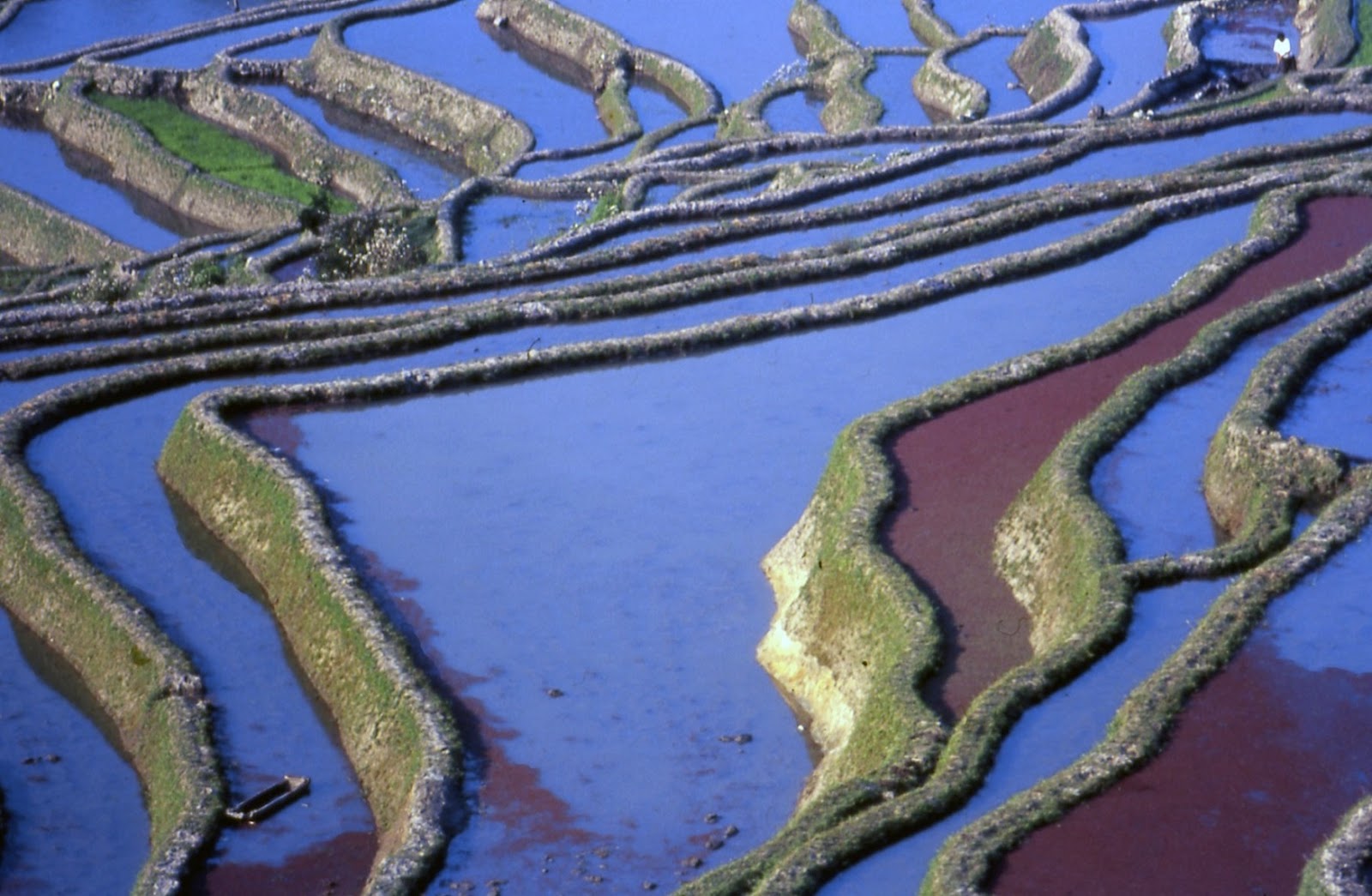
      Every year UNESCO announces new additions to the list of World Heritage Sites.  This year’s selections, revealed in June, included a rather unusual entry—the Honghe Hani Rice Terraces.  Ordinarily World Heritage Sites are spots of outstanding natural beauty, like mountains or canyons, or something manmade, like a magnificent building or an ancient city.   This is one of those rare occasions when contemporary farms made the list.   True, they are very ancient farms, perhaps as old as 1300 years or more, for they are mentioned in Tang Dynasty records.  That makes them older than the famous Inca terraces in the mountains of Peru.  But unlike the latter, long ago abandoned, the Honghe rice terraces have been in continuous use since they were first built.
       Honghe is the name of a prefecture in Yunnan, south of Kunming to the border of Vietnam, comprising several counties north and south of the Red River. Those south of the river are very mountainous and it is the rice terraces here, in the Ailao Mountains, that are so ancient, so beautiful, so amazing, and now becoming internationally recognized for the wonder that they are.  The designated Heritage Site area consists of a large part of southern Yuanyang County, including the stunning section around Panzihua village known as the Tiger’s Mouth.  Farmers here centuries ago cut as many as 3000 terraces into the mountain slopes, from just below the forested hilltops, at around 2000-2500 meters, all the way down to the rivers, lying at around 400 or 500 meters.
terrace irrigation
       While the terrace scenery is particularly impressive in southern Yuanyang County, the same kind of farming system exists throughout the other counties south of the Red River, as well as upriver west of the prefecture as far as Xinping County.  Plenty of other places in Yunnan feature terrace farming, for the province is full of hills and mountains and even the plateaus are more often undulating valleys rather than flat plains.  What makes the Honghe terraces so special is the complex irrigation system established with their initial foundation.  Water flows from terrace to terrace and remains in the fields all year round.
       Farmers only get one crop of rice each year from these farms.  After the conclusion of the harvest work the fields are left full of water until planting time around April.  This is the time the terraces are at their best visually, the water in them reflecting the colors of the sky.  During the dry season the terraces become the abode of ducks, frogs, eels, small fish and snails, which supplement the local diet.  The UNESCO citation takes note of the local “integrated farming system” and states, “The resilient land management system of the rice terraces demonstrates extraordinary harmony between people and their environment, both visually and ecologically, based on traditional and long-standing social and religious structures.”
Hani farmer girl
       They might have added the extraordinary harmony among the people themselves, as well.  And this is precisely because of their land management.  When the Hani ancestors first laid out a village they chose a site near a stream or spring, adjacent to a forest, built their houses there and their rice terraces below the settled area.   The main irrigation stream ran above the set of terraces, with dividers placed at intervals to allow water to spill into the terrace below through notches cut into its wall.  Notches cut in the walls of that terrace allowed water to flow into the one below and so on all the way down to the lowest terrace on the slope.
       Villages had a water guardian whose job it was to keep the main channel free of debris and oversee its renovation after the harvest and to check the dividers to ensure they had not been altered so that someone’s field got more water than what was allotted to them.  This would upset the balance, for the original system, including the position and notches of the dividers, guaranteed that every terrace plot would receive the proper amount of water for the crop.
       It is not clear how they divided up the land, who got the terraces nearest the village and who got the ones far away down the slope.  But all the terraces got the proper amount of water required.  Thus, the economy and society of a village started out on the basis of equality.  As time went on and generations passed this equality did not persist, for in some families more children, i.e. more workers, survived infancy and could contribute to a family’s income.  But the differences in wealth among the people in any given Ailaoshan village were never very great, nor ever resented because they were perceived as due to good luck and diligence and not exploitation, and so a strong sense of village solidarity has persisted over the centuries.
Hani terraces
       This solidarity extends to the entire ethnic group and sub-group and even beyond, as implied in the Hani saying that Yi and Hani are children of the same mother.  Several minority nationalities inhabit the Ailao Mountains—Hani, Yi, Miao, Yao, Zhuang and Dai—and all of them are terrace farmers.  They live in roughly the same manner, with different house types sometimes but with the same kind of material life.  No particular ethnic group ever had power over another and they all lived peacefully with each other, often meeting at the various market day venues.
       Even within the designated World Heritage Site boundaries Yi villages lie scattered over the slopes, with a Miao settlement here and there and Dai in the lower areas.  So it’s a bit inaccurate to make the award to the “Hani rice terraces,” even if they are the majority community in this particular part of the mountains.  The other ethnic minorities are also terrace builders and everything the UNESCO citation praises about the Hani is just as true of the other ethnic communities in Ailaoshan.
       They are all animist societies, venerating spirits associated with forces of nature, the land and their own ancestors, fearing and propitiating troublemaking spirits that could harm them.  They held regular rituals to honor the land spirit or the rice spirit so that nothing would interfere with the cultivation of the rice crop.  Their economy was one of self-sufficiency, though that was more of a goal than a reality, for in general the terraces did not produce enough rice to feed the family all year that tilled it.  In the last weeks before harvest cassavas took the place of rice as the main filler of the meal.
a part of the "Tiger's Mouth"
       The rituals, festivals, even the ethnic styles of clothing all came under sustained attack first in the late 50s and then throughout the tumultuous years of the Cultural Revolution.   After Deng Xiaoping consolidated power such policies ceased once and for all and ethnic culture was now not only tolerated, but also encouraged.  For the Hani and their neighbors, the family responsibility system basically meant a return to the old way of farming.  And since the old way of farming included festivals and rituals to the rice spirit, these revived, too. 
       The one major innovation in their material way of life was the introduction of high-yield rice seeds.  This improved production so much that families could not only grow enough rice to feed themselves the entire year, they very well might even have a little surplus to sell in the market.  Population had gone way up since, say, a century ago, and extra terraces had been made, but now these terraces were producing more rice than at any time in their history.  Traditional material culture had achieved an unprecedented success.
       Besides the magnificent scenery of sculpted mountains, the area’s other main attraction is its ethnic variety.  The Hani are the most numerous of the communities, split into several sub-groups, each with its own distinctive traditional-style women’s clothing.  All the other minorities have at least three sub-groups dressing very differently from each other.  Most of the regular market days in the area witness the presence of several ethnic groups and sub-groups, mainly women, just about all of whom dress in their traditional style clothing.
       These market venues will have stalls with ethnic minority women selling clothing components to other minority women.  There will be Miao stalls selling batik cloth, embroidery thread and Miao jewelry, Hani women hawking Hani women’s jackets, trousers, belts and bags, Yi women offering embroidery and appliqué patterns for blouses and belt ends, etc.  Their customers, of course, will be other Miao, Hani or Yi women who don’t have time to make the items themselves.    
transplanting the rice seedlings
       Now the ethnic revivalism that is so obviously apparent in Ailaoshan has been going on throughout Yunnan for the past generation.  Ethnic festivals have been revived, sometimes with lavish government subsidies, traditional religion has re-emerged and ethnic clothing is popular again, even if only for festivals and other special events.  Definitely ethnic pride has returned.  But nowhere has traditional culture made such a complete comeback as in Ailaoshan.  Elsewhere modern influences have seeped in to the extent that people may be proud of their traditions, but less likely to “revert” to living the traditional way with its antique mind-set.
       The modern influences that are slowly but surely undermining traditional culture elsewhere in Yunnan include basic changes in their material way of life.  A major Hani sub-group, the Aini (elsewhere known as the Akha) in Xishuangbanna and adjacent counties, practiced slash-and-burn agriculture as their traditional way of life.  Due to population pressures, this is no longer viable as a system and so they have largely switched from growing rice to growing tea, rubber or sugar cane, cash crops that they can trade for rice.  However, because they are not growing rice they don’t need to have all those festivals that marked critical points in the rice-growing cycle.  So a big part of their culture disappeared when they changed crops. 
       Other ethnic minorities employing the slash-and-burn method also went through the same changes.  In other areas, with permanent fields, the introduction of modern machinery and fertilizers altered relations between the people and their environment.  In one way or another, in nearly every place in Yunnan, traditional material culture has altered and this has modified other aspects of tradition as well, from religious beliefs to aesthetic views.
Hani on the way to market day
       But Ailaoshan is different.  The material culture has proven its value and so the non-material aspects of tradition have survived to a greater degree than elsewhere in the province.  Festivals have revived because the people still believe in them and the Hani hold several a year.  Villagers have televisions now and are aware of what, for example, people in the outside world wear.  But the women, even the teenaged girls, prefer their own ethnic style because they still retain their traditional aesthetic view.  The most beautiful clothes they can put on, they feel, are their best traditional ones.  They see lots of modern clothing in the markets, but the only items likely to attract their interest are shoes and umbrellas.
       Besides keeping their traditional aesthetic sense, the Hani and their neighbors also maintain the village altars and spiritual specialists who conduct rituals on behalf of the community.  In a grove at the edge of a Hani or Yi village a small area next to a large tree is fenced off and three upright stones stand in the rear.  The taller one in the center represents humans, the smaller two flanking ones represent crops and animals.  The arrangement exemplifies what the UNESCO citation referred to as the “symbiotic relationship” established between man and the animal and plant world.  Major annual rituals take place here.
Hani village altar
       Ailaoshan and the Hani world are not shielded from modern influences.  But the impact is not so heavy.  Villagers have televisions, but what do they watch?  News, sports, soap operas, comedies, police stories, action films?  Not at all.  They like the Hong Kong-style period piece stories, set in the Qing Dynasty or earlier, costume dramas with or without magical warriors.  Basically, the television has simply replaced the village storyteller.
       What about education and the general exposure to modern, secular ideas?  Well, from my own years doing research in the area for my book The Terrace Builders I witnessed several traditional rituals, both by ritual specialists acting on behalf of the entire village and private rites carried out by family heads on the rice terraces.  In every case the person carrying out the ritual was one of the more educated men in the village.  In other places in Yunnan, in similar circumstances, when I asked about the ritual I was told they carried it out because it was part of their tradition, not that they necessarily believed in it.  In Ailaoshan the reply centered on the efficacy of the rite, the meaning of whatever was used for it and the “good reasons” to perform it.  Part of the tradition, yes, but a part they obviously still believed in.
ritual offering to the rice spirit
       Well, why shouldn’t they?  Such acts have apparently worked for them for many centuries now and with the agricultural sector now stronger than ever they have definitely shown the value of their part in the procedure.  And it’s not likely to change.  It’s not really possible to “modernize” terrace farming.  Farmers can’t use tractors in the terraces.  They still have to use buffaloes to draw the plows and plant the seedlings by hand and cut the stalks with sickles at harvest time.  And they are never going to change the use of the terraces from growing rice to growing rubber trees or some other cash crop.
       The traditional material system will persist and so, more than likely, will other aspects of tradition, from clothing preferences and rice field rituals to domestic customs, taste in food and village social life.  Their self-confidence and geniality is also likely to persist, rooted as they are in their awareness of their traditional culture’s success.
       So congratulations, Hani farmers, on the world’s recognition of your achievement.  You and the Yi, Miao, Yao, Dai and Zhuang, not mentioned in the UNESCO citation, can be proud of the genius of your ancestors.  In this remote mountainous terrain they created a system of irrigated farms, and a lifestyle to go with it, that has survived intact for over 1300 years and is flourishing here now in the fast-evolving world of the 21st century.  In a time of shrinking natural resources you can give the world lessons in land and water management, as well as how to achieve harmony between man and his environment.  By its very name, a World Heritage Site is a place with a value relevant to the entire human race.  Congratulations, Hani farmers.  You deserve the award. 
Hani farmers going home 
                                                                        * * *

note:  For more information on the area and its people, see my newest book—The Terrace Builders:  the Hani and their Neighbors in Yunnan’s Ailao Mountains.  Published as an e-book, covering the area from Xinping to the far north of Vietnam, it has 300 photographs.


Wednesday, November 11, 2015

Dai Ways in Yunnan’s Red River Counties


                                                             by Jim Goodman
 
Laomeng White Dai village, Jinping County
       Sprawling southeast of Kunming all the way to the Vietnam border, Honghe Hani and Yi Autonomous Prefecture comprises two distinct parts.  The landscape of the counties north of the Red River, high plateaus and rolling hills, resembles that of central Yunnan.  Famous old cities like Shiping, Jianshui and Mengzi lie in this part of the prefecture.  While there are districts here and there dominated by Yi and Miao, the Han make up the majority north of the Red River.
       The four counties south of the river—Honghe, Yuanyang, Luchun and Jinping—are famous for the irrigated terraces that line the slopes of the Ailao Mountains that dominate the land from the river to the Vietnam border.  Here the Han live only in the towns and cities.  Most of the population consists of minority nationalities, particularly the Hani, but also Yi, Yao, Miao, Zhuang and Dai.  All of them have sub-groups, too, including the Dai, with differences not only in traditional apparel, but in lifestyle as well.
Dai La, Huangmaoling
       The sub-group of Dai occupying the Red River valley in Honghe and Yuanyang Counties call themselves the (Dai) La.  Like their neighbors and cousins the Huayao Dai upriver in Yuxi Prefecture, they live in villages of 50-60 mud-brick, flat-roofed houses.  They are wet-rice cultivators, but the sugar cane stands that speckle the valley upriver are here replaced by fruit orchards, particularly banana groves, which lie in abundance all around the rice fields and up the lower slopes of the Ailaoshan foothills. 
       Dai La villages along the alluvial plain obtain two rice crops a year from their fields.  Those living higher up, above irrigated terraces, get only one crop annually, but supplement their income with, besides bananas, mango and litchi groves. They engineer water from the nearest mountain stream to flow through the village first and then into the terraces fanning out below the settled area.  They set traps in this stream to catch eels and small fish, part of their regular diet, and go fishing in the river with both traps and nets.  Women use the river to do their washing, farmers bathe their buffaloes there and beneath big leafy shade trees on the bank the children come to splash and play.
Dai La woman
ginning cotton in Huangmaoling
       Other people in the area often refer to them as the Black Dai, after the dominant color of the women’s traditional outfit.  It consists of a headscarf, a side-fastened, short-sleeved jacket, plain black, calf-length sarong and leggings.  The jacket fits loosely and hangs to just below the waist.  Basically black, it is trimmed with silver studs around the neck and in a broad strip along the lapel, bordered by bright, narrow bands of appliquéd silk or embroidery.  Color bands also go along the right side and the hem all around, while the sleeves consist of a broad strip of bright color, like red, pink or orange, and narrow bands of contrasting colors.  Beneath the black skirt they wear tight black leggings, lavishly cross-stitched with bright patterns, no two pair alike.  They also carry a shoulder bag with the same lush embroidery.
Dai La embroidered leggings
       Women tie their hair in a bun and wrap it with a narrow strip of black cloth.  The end, featuring a block of embroidered designs, is tucked into the scarf along the right ear and the decorative end left to dangle.  They do not wear much jewelry, but many still tattoo the backs of their hands with an auspicious symbol that looks like a cross with a V on each end.
       The preference for traditional fashion still dominates the daily dress of Dai La women.  Even the younger generation wears it, though they may opt for a shorter, knee-length sarong with a band of embroidery and appliqué around the hem.  In the slack time of the year, when agricultural activity is not so demanding, in Dai La village lanes girls may gather in a group while they embroider shoulder bags and leggings.  And in another house an older woman may be ginning cotton, spinning thread, or weaving cloth on a narrow loom.
Dai woman from Qimaba
       In the southern part of Yuanyang County the Dai La also inhabit the upper Tengtiao River valley down to Huangmaoling on the main Yuanyang-Laomeng route.  Dai La villages lie next to and around this township, which holds its market day on Saturdays.  But in Laomeng and the rest of Jinping County the Dai are the White Dai sub-group, while in Luchun County the only resident sub-group is the one in Qimaba, unrelated to any other Ailaoshan Dai.  This large township of over 200 houses lies in the center of Luchun County, 65 km southeast of the main Luchun-Jiangcheng route from the turn-off in the western corner of the county.
      All the county’s Dai live in Qimaba, an isolated township in the most forested and least populated section of the county.  Its residents migrated here in the late Qing Dynasty from their original homeland in Shiping County.  They call themselves Dai Neu-a, the same appellation as the Buddhist Dai in Lincang and Dehong, though they are animist like most other Ailaoshan Dai.
       The population lives in two-story houses of mud-brick, with tile roofs and an adjoining open balcony.  The roofs do not cover the entire house but leave an open space in the middle, directly above the sunken courtyard on the ground floor just inside the entrance.  This space, roughly 20 meters square, holds the household’s water tanks and has a drain in the center to convey the waste water outside into the channels that run through all parts of the town.  Here families do their washing and bathing.  The kitchen lies behind it and the dining area to the side.  Two bedrooms lie adjacent to this, while other sleeping and storage quarters are upstairs.  In back of the house are the sties for pigs and pens for ducks and chickens.
in the terraces of Qimaba
       The town lies above a broad fan of stone-reinforced terraces, on a gradual slope of around twenty degrees gradient, reaching all the way to the edge of the cliff above the river.  Water flows from one terrace into another.  But the Dai have also cut channels throughout Qimaba’s neighborhoods and directed the water to flow alongside almost every stone path.  No house is far from running water and for most households it is right outside their front doors.
       Most of the women in Qimaba, young and old, wear their distinctive Dai outfit, comprising a heavily embroidered bodice that reaches to the hips, worn under a waist-length, black long-sleeved jacket with colored sleeves, fully embroidered on the back, and over an ankle-length tubular skirt.   These components are the same for all ages, though younger women embroider the hem of the skirt as well.
White Dai house in Laomeng
       The headdress differs, though.  The younger women and girls wear a black cloth on the top of the head, the front trimmed with rows of silver studs and old silver coins.  Long tassels of pink woolen thread cascade down either side.  On older women the black cloth rises up over a frame at the back of the head, decorated with silver coins, triangles of studs and embroidery.
       Almost all the Dai of Jinping’s Tengtiao River valley and its tributaries, from Laomeng on downriver into Vietnam, belong to the sub-group called White Dai.  They live in medium-sized villages beside or just above the rivers, raising mainly rice and vegetables, supplemented by fruits and sugar cane.  In Laomeng, their first settlement in Yunnan, they also cultivate vegetables in the dry season on the sandy banks of the Tengtiao, which here changes its name to the Laomeng River.
White Dai woman, Mengla district
       Unlike the flat-roofed, mud-brick dwellings of the Dai La, White Dai houses resemble those in Xishuangbanna.  They are made of wood and bamboo, sit 1.5 to 2 meters above the ground on stout wooden stilts and have roofs of thatch.  An open balcony extends from the front entrance, used for drying crops, hanging laundry or strips of dyed cloth on the rails to dry, for spinning and winding thread, or just for sitting in the sunshine and fresh air.  Interiors are capacious and cool, with a central hearth and a couple of walled-off bedrooms in the far end.
       In the back yard may stand a small ancestral altar—a bamboo cubicle with a thatched roof about 1.5 meters off the ground.  Usually a large group of these stands together in one area of the village.  In addition, villages also have a large shed housing the ceremonial drums, which are beaten throughout the New Year festivities.
       The men dress in modern style, but most women prefer their traditional outfit of blouse and black sarong.  On special occasions the women also don a long-sleeved, front-fastened jacket in solid pastel colors, fastened with silver butterfly clasps.  They often wear these jackets on market day in Laomeng and further east in Jinping and the largely Dai district of Mengla in the south.
Dai Lu in Mengla, Jinping County
       Besides the White Dai, residents of three villages near the hot springs a few km south of Mengla are Dai Lu, immigrants from Xishuangbanna a few decades ago.  Their women dress like Banna women and they are the only Buddhist Dai in all of Ailaoshan.  Buddhist proselytizers never reached this area and all the rest of Honghe Prefecture’s Dai are animist.
      Dai villages all have a spiritual leader who conducts ceremonies on behalf of the community, mainly at annual festivals. Employed more often is the mogung, the specialist handling affairs of the unseen world, such as expelling evil influences, or calling back wandering souls and directing the souls of the deceased to the world of the afterlife.  The role is similar to that of ritual specialists among their neighbors in the hills.  The Dai also share the hill peoples’ taboos, domestic etiquette and life-cycle ceremonies, including most aspects of the all-important funeral ceremony.
       Where they differ is in the concept of the afterlife and in their attitude towards the faults, misdeeds and the darker side of the personality of the deceased.  For the Dai the afterlife is similar to the current life, in that people who were farmers or teachers or something else in their life will be doing the same work in the afterlife.  But a few differences exist.  Elders will become children again.  Children will take on the roles of adults.  Daily life and work will be characterized by complete harmony and happiness.  Those who have had a full life, meaning they created descendants to carry on the family line, will all enjoy this kind of afterlife.  Those without descendants will have to make do with another place, called Li in Dai, a sort of limbo, somewhat less comfortable.  But it is not an unpleasant place and the idea of Hell, so prominent among the Buddhist Dai, has no place in the animist Dai conception of the afterlife.
White Dai New Year
Dai Lu festival dance
       The unique part of the Dai funeral ceremony takes place just before the coffin is removed for burial.  Usually this is three days after death, but no one may be buried on a monkey day or on the animal day on which they were born.  After the lamenting, the visits of relatives and friends, the condolences and feasts, the last act is the Song for Sending Off the Dead.  A mogung, or anyone familiar enough with the deceased to want to do it, takes a seat beside the corpse and begins a long song that narrates the life of the deceased, his or her achievements, virtues and memorable good actions.  All faults, misdeeds, even crimes, are ignored, for once a person dies, everything is forgiven.
drumming for the White Dai New Year
       As for public events, each sub-group has its own festivals.  Places like Nansha, next to the county capital of Yuanyang, and Mengla stage a government-sponsored one-day Water-Sprinkling Festival.  The Dai Lu celebrate it with the performance of dances by the young women in each of the three villages for three nights. Near the end of the second lunar month the Dai in Zhemi host the Men’s Festival, commemorating a time in their history when the men were all off at war and missed New Year.  When they returned late the women staged a new festival to compensate them for missing the other one. 
       All Dai in the area mark the Lunar New Year with celebrations that begin the last morning of the old year and conclude three days later.  Ritual bathing, feasting, processions, rituals and noises expelling evil spirits and drumming are the festival features, details varying from valley to valley.  But whatever the event, it is done with gusto. The Dai know how to make their rituals enjoyable events.  These are people who perceive life as Heaven on Earth and the afterlife as Earth in Heaven.
young Dai women in Qimaba, Luchun County
                                                           * * *                                                                 
                    for more on the Ailaoshan Dai see my e-book The Terrace Builders


Friday, May 10, 2013

The Longest Dinner in Yunnan


                                           by Jim Goodman

Hani village surrounded by its irrigated terraces
       One of the great unpublicized pleasures of Yunnan is hiking in the Ailao Mountains.  This is the range running along the right bank of the Red River, from central Yunnan southeast to Hekou, and on into northern Vietnam.  No snow peaks in this part of the province and the summits rarely rise above 2500 meters.  Deep valleys sometimes, but no outstanding gorges or major waterfalls.  But throughout Ailaoshan the slopes of the mountains are wonderfully terraced and usually irrigated, so that they remain flooded all year.  The swirling lines of the terrace walls follow every conceivable contour and the eye never tires of them. Villages speckle the mountains, home to several colorfully dressed minorities, of whom the Hani are the most numerous and among the most hospitable people in the region.
Hani rice terraces, Yuanyang County
      Lower Ailaoshan, the four counties between the Red River and the Vietnam border--Honghe, Luchun, Yuanyang and Jinping--is the Hani heartland.  Six sub-groups live in Yuanyang alone, differing in costumes and minor cultural aspects.  But all of them share the same material lifestyle, growing rice in irrigated terraced fields, said to be the prototypes for the entire region.  Some terraces are still in use since being described by chroniclers of the early Song Dynasty.  And in recent decades, thanks to fertilizers and new strains of rice, their annual yield is greater than ever.  Collectively, the Hani have advanced from mere self-sufficiency to a small measure of prosperity.
       Though one may prefer to simply wander all day along paths through the fields, and marvel at the engineering skills it took to create this special landscape, one cannot get very far in Hani areas if there around anyone's meal time.  Often the first encounter in a remote Hani village leads to an invitation to drink and dine.  The Hani of Ailaoshan see the arrival of a visitor as a welcome interruption of the daily routine and strive to make the most of the event.  Hospitality is second nature to these people, an indication of a basically friendly, honest and outgoing character, brimming with self-confidence.
traditional Hani houses
        This innately gregarious people will turn the dinner invitation into a social event.  Many are those in Yunnan who advise their guests to "eat slowly," but the Hani take that as an order.  Without guests the meal might not take too long, but having guests is considered a better way to dine.  And when guests are on hand, male guests in particular, then the meal will be augmented by lots of alcohol, tobacco and conversation.  Women and children, who don't drink, finish soon, while the men may drag it out for up to two hours.
       The table will hold several dishes.  Meat, fish, chicken, bean curd, leaf vegetables, beans and radishes might comprise the fare, perhaps seasonally supplemented by edible fungi and insects, small fish, snails or baby frogs netted in their flooded terraces, and cassavas, which used to be the main filler when the previous year's rice ran out.  Rice itself, as well as soup, is only served to the women and children in the beginning.  The Hani follow the general Yunnanese style of dining, in which those who are going to take alcohol with their meal, whether it's beer or distilled spirits, first conclude their drinking before having rice or soup.
heavy drinking is part of a big meal
       Thus the men, all of whom must drink, for it's a social affair after all, nibble at the several dishes in between repeated toasts with cups of strong liquor.  Every fifteen minutes or so one of the men passes out cigarettes and hands the water pipe to one of the diners as all the men pause for a tobacco break.  Hani men consider eating, drinking and smoking as related pleasures and so partake of them all at the same time.
       Several of Yunnan's minority groups are fond of tobacco.  Among the Wa, for example, the women smoke constantly in long, ornate silver pipes.  But others rarely smoke during meals, while for the Hani it is normal procedure.  When calling on a Hani house the guest is first given a clean, freshly filled bamboo water pipe, a pinch of Yunnanese blonde tobacco and a lighter.  Then the host will prepare tea.  In other societies the tea precedes the smoke.
       And at funerals, though Hani women in general don't smoke, whether the deceased is male or female a tobacco bong is placed at the side of the corpse and its spirit is invited to have a smoke.  When the body is buried a few tools and implements used by the person when living--knife and crossbow for a male, for example, and spindle and cooking pot for a female--go on top of the grave.  A tobacco bong is included for both.
three stones: for humans, animals and crops
       As the dinner drags on the water pipe needs cleaning and refilling and the dishes get cold.  The women, who have finished much earlier, keep watch over the meal.  When one man has finished smoking a woman takes the pipe away to ready it for the next.  As the contents of one or more dishes become half-consumed a woman comes to refill them.  If they turn cold she takes them back to the kitchen to reheat them.  When the bottle of spirits has been emptied she is there with a fresh one.
       Men's work in this strongly patriarchal society consists of heavy labor like terrace-building and repair, plowing, construction and long-distance trade.  But minibuses have replaced the old caravans and Hani men only work steadily part of the year.  In contrast, the women work all the time, in addition to their domestic chores.  In the fields they do the planting, weeding and harvesting, and together with the men the threshing.  They also do all the gardening, make the family's clothing, and do the bulk of he buying and selling at the periodic market days in their vicinity.  Besides trade, Hani women come to socialize, quite freely without the men around.  Perhaps because so much of their daily life depends on the women, Hani men accord them a great deal of respect and freedom of choice in matters of the women's own interests; marriage partners, for example.
Rhamatu rituals
       Among the items for sale at these markets are the components of Hani women's costume, as well as those of their neighbors the Yi, Miao, Dai and Yao.  Hani women of all ages wear traditional clothing every day and most are well off enough to afford three or four sets.  Silver jewelry in the Hani style may also be on offer, though the women save this for special occasions.  Women of other ethnic groups in the four counties also prefer their own traditional costumes.  Even the teenagers working temporarily in urban shops and restaurants usually dress in ethnic style, for their aesthetic sense is still within the tribal parameters.  Lower Ailaoshan, dominated by proud and self-assured ethnic minorities, may well be the most colorful part of the entire province.
dressing for the festival in Huangcaoling
       Because their material culture--terraced fields-works so well, and there is no way to mechanize that kind of farming, their mode of agriculture is likely to endure. Hence, the non-material aspects of their culture are also strong.  The women's preference for ethnic clothing is one example.  Use of the language in the urban areas is another, as is the maintenance of food preferences and domestic manners.  But, after costumes, the most public aspect is the continuation of traditional annual festivals.  Among the Hani, programs for events like the Swing Festival, Installing the Village Gate and New Rice will automatically include, besides the ceremonies, a leisurely banquet.
       The grandest feast of the year, however, is reserved for Rhamatu, the most important of the annual Hani festivals.  The event honors the dragon-spirit guardian of the sacred grove, a patch of woods at the edge of the traditional Hani village.  The spirit is incarnated in one of the trees and its deputy, the rhama-abaw, chosen at the outset of the festival, emcees the rites and activities.  Beyond its esoteric religious value, however, Rhamatu celebrates the unity and solidarity of the Hani village, for its main feature is a collective dinner held outdoors on the main street of the village.
reading the liver
      Rhamatu is a dry-season event, but different Hani sub-groups stage it at different times.  In Yuanyang County, for example, northern villages near the hill town of Xinjie hold it in late November, but around the southern township of Huangcaoling another sub-group begins it on the first tiger day following the Lunar New Year.  In Jinping and over the border in Vietnam it comes a month later.  Besides separate dates, the various sub-groups also differ in the ritual details.  Elaborate feasting is the main feature common to Rhamatu no matter which Hani sub-group.
   The first day mainly involves preparation for the second day.  The women are especially busy preparing food for the great feast.  A smaller dinner, requiring the presence of one man from each household, transpires the first evening in front of the dragon-spirit's tree, which has a modest fence installed around it.  Within this sits the rhama-abaw, beside an altar holding offerings like tiny cups of liquor, pieces of the sacrificial pig, painted eggs in bowls of colored glutinous rice, silver coins and a balance-stick.  A resident specialist comes to read the pig's liver and make prognostications.  Soon darkness falls and the men take their meal, and their liquor and tobacco, on the grounds in front of the tree.
Rhamatu feast,Huangcaoling
     Next day, though they are about to partake of a meal lasting the entire afternoon, that does not stop Hani men from having their ordinary mid-morning repast, along with the usual accompaniment of liquor and tobacco, consumed in the customary leisurely manner.  By the time they have finished it's nearly time to bring out the food for the public meal.  Just after mid-day members of each individual household carry tables laden with dishes from their homes to the main village street, setting them side by side in a long line occasionally broken by a space to allow men to pass to the other side of the tables and sit.
       Before taking seats the men stand in line at the far end to donate gifts to the rhama-abaw, consisting of a small amount of liquor and two cigarettes, one for the rhama-abaw and one for the dragon-spirit.  Then they choose a place to sit, pour a cup of liquor, pick up their chopsticks and start eating...slowly.  As every household must contribute one table's worth of food the quantity and variety is enormous.  It looks as though the village is displaying its wealth in the form of food. Every part of the pig, cooked in sundry different manners, will dominate the dinner, but chicken, beef, half a dozen or more species of fish, three or four kinds of edible insects, usually deep-fried in oil, green vegetables and cassavas, eggs and fruit are also part of the feast.
       The nibbling at the bowls of food, like the sipping of alcohol, is slow but steady, only interrupted (often!) by turns on the tobacco bong or the smoking of cigarettes.  About midway through the afternoon the men at one end of the line of tables call out to those at the other end, standing up and toasting their health.
       Meanwhile, in the open ground next to the rhama-abaw's end of the line the young women and children perform dances.  Though it's only the men taking part in the feast, the women dress in their newest and nicest traditional costumes and this is definitely the day to put on silver ornaments and accessories.  Not many of the dances are truly traditional, however, for in larger villages and townships a dance leader, usually a slightly older young woman, will create choreography just for this festival, often to Chinese tunes or even pop songs.          
Hani dancer at Rhamatu
Hani drummer girl
      Not until after five o'clock do the people begin to remove the tables back to their homes.  Guests, fully sated and quite as inebriated as their hosts, then have to find excuses to decline persistent invitations, now that the feast is over, to their new friends' houses for dinner and drinks!  This is, though, the chance for the women to enjoy some of the food they have so lovingly prepared.  An evening song and dance show rounds out the festival, a mixture of traditional dances and contemporary acts, also created for the occasion.
       The next day all is back to normal.  The traveler moves on to another section of Ailaoshan for another walk among the terraces, hoping for a splendid sunset to bounce colors off the water-filled terraces.  Failing that, one can hope for the next best alternative--an invitation to a Hani dinner.

one family's contribution to the collective feast
                                                                         * * *
                for more on Ailaoshan and the Hani, see my e-book The Terrace Builders