by Jim Goodman
 |
| Hani village, Yuanyang County |
Every year UNESCO announces new additions to the list of World Heritage
Sites. This year’s selections, revealed in June, included a rather
unusual entry—the Honghe Hani Rice Terraces. Ordinarily World Heritage
Sites are spots of outstanding natural beauty, like mountains or
canyons, or something manmade, like a magnificent building or an
ancient city. This is one of those rare occasions when contemporary
farms made the list. True, they are very ancient farms, perhaps as
old as 1300 years or more, for they are mentioned in Tang Dynasty
records. That makes them older than the famous Inca terraces in the
mountains of Peru. But unlike the latter, long ago abandoned, the
Honghe rice terraces have been in continuous use since they were first
built.
Honghe is the name of a prefecture in Yunnan, south of Kunming to the border of Vietnam, comprising several counties north and south of the Red River. Those south of the river are very mountainous and it is the rice terraces here, in the Ailao Mountains, that are so ancient, so beautiful, so amazing, and now becoming internationally recognized for the wonder that they are. The designated Heritage Site area consists of a large part of southern Yuanyang County, including the stunning section around Panzihua village known as the Tiger’s Mouth. Farmers here centuries ago cut as many as 3000 terraces into the mountain slopes, from just below the forested hilltops, at around 2000-2500 meters, all the way down to the rivers, lying at around 400 or 500 meters.
 |
| terrace irrigation |
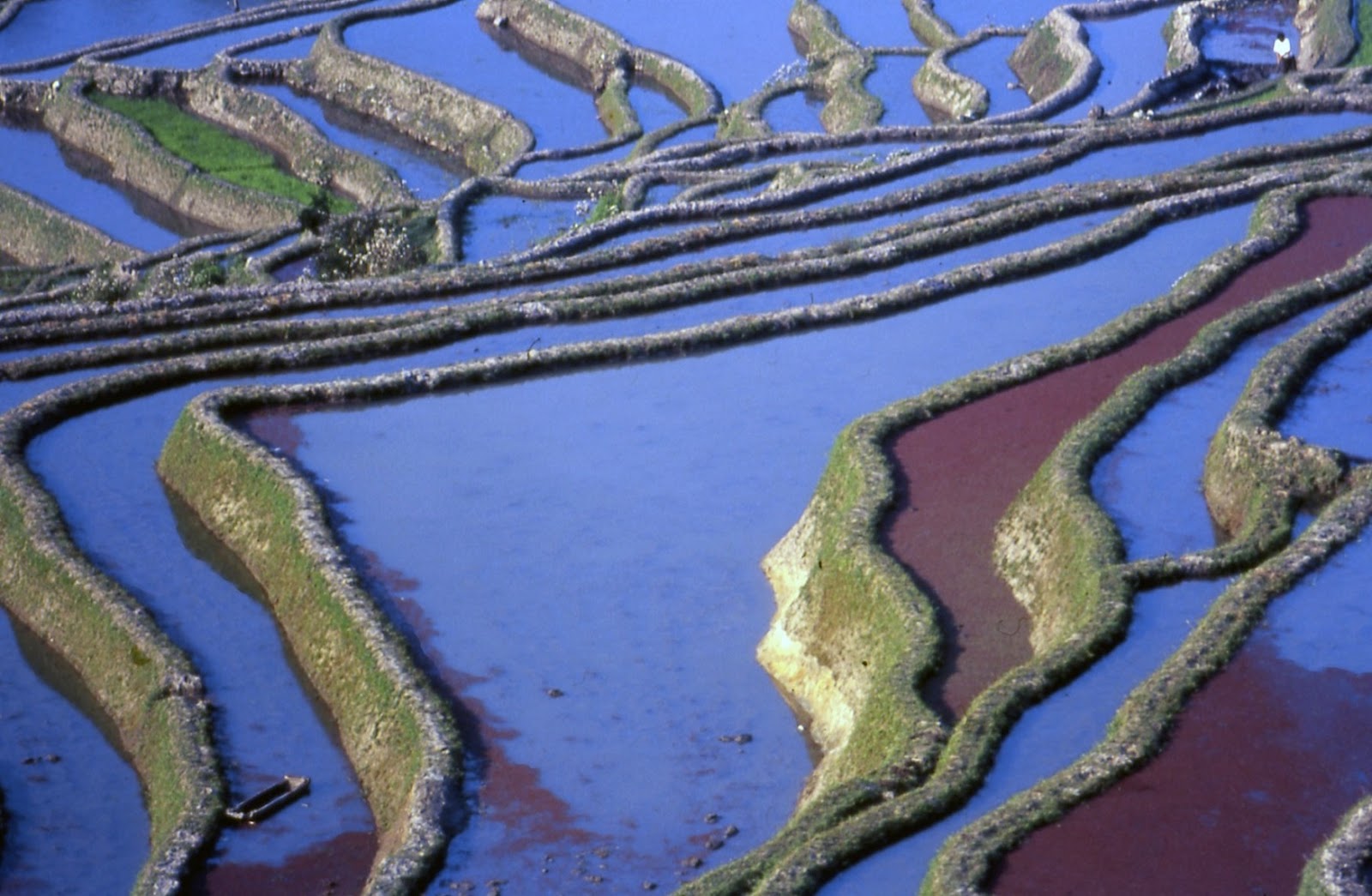
While the terrace scenery is particularly impressive in southern Yuanyang County, the same kind of farming system exists throughout the other counties south of the Red River, as well as upriver west of the prefecture as far as Xinping County. Plenty of other places in Yunnan feature terrace farming, for the province is full of hills and mountains and even the plateaus are more often undulating valleys rather than flat plains. What makes the Honghe terraces so special is the complex irrigation system established with their initial foundation. Water flows from terrace to terrace and remains in the fields all year round.
Farmers only get one crop of rice each year from these farms. After the conclusion of the harvest work the fields are left full of water until planting time around April. This is the time the terraces are at their best visually, the water in them reflecting the colors of the sky. During the dry season the terraces become the abode of ducks, frogs, eels, small fish and snails, which supplement the local diet. The UNESCO citation takes note of the local “integrated farming system” and states, “The resilient land management system of the rice terraces demonstrates extraordinary harmony between people and their environment, both visually and ecologically, based on traditional and long-standing social and religious structures.”
 |
| Hani farmer girl |
They might have added the extraordinary harmony among the people themselves, as well. And this is precisely because of their land management. When the Hani ancestors first laid out a village they chose a site near a stream or spring, adjacent to a forest, built their houses there and their rice terraces below the settled area. The main irrigation stream ran above the set of terraces, with dividers placed at intervals to allow water to spill into the terrace below through notches cut into its wall. Notches cut in the walls of that terrace allowed water to flow into the one below and so on all the way down to the lowest terrace on the slope.
Villages had a water guardian whose job it was to keep the main channel free of debris and oversee its renovation after the harvest and to check the dividers to ensure they had not been altered so that someone’s field got more water than what was allotted to them. This would upset the balance, for the original system, including the position and notches of the dividers, guaranteed that every terrace plot would receive the proper amount of water for the crop.
It is not clear how they divided up the land, who got the terraces nearest the village and who got the ones far away down the slope. But all the terraces got the proper amount of water required. Thus, the economy and society of a village started out on the basis of equality. As time went on and generations passed this equality did not persist, for in some families more children, i.e. more workers, survived infancy and could contribute to a family’s income. But the differences in wealth among the people in any given Ailaoshan village were never very great, nor ever resented because they were perceived as due to good luck and diligence and not exploitation, and so a strong sense of village solidarity has persisted over the centuries.
 |
| Hani terraces |
This solidarity extends to the entire ethnic group and sub-group and even beyond, as implied in the Hani saying that Yi and Hani are children of the same mother. Several minority nationalities inhabit the Ailao Mountains—Hani, Yi, Miao, Yao, Zhuang and Dai—and all of them are terrace farmers. They live in roughly the same manner, with different house types sometimes but with the same kind of material life. No particular ethnic group ever had power over another and they all lived peacefully with each other, often meeting at the various market day venues.
Even within the designated World Heritage Site boundaries Yi villages lie scattered over the slopes, with a Miao settlement here and there and Dai in the lower areas. So it’s a bit inaccurate to make the award to the “Hani rice terraces,” even if they are the majority community in this particular part of the mountains. The other ethnic minorities are also terrace builders and everything the UNESCO citation praises about the Hani is just as true of the other ethnic communities in Ailaoshan.
They are all animist societies, venerating spirits associated with forces of nature, the land and their own ancestors, fearing and propitiating troublemaking spirits that could harm them. They held regular rituals to honor the land spirit or the rice spirit so that nothing would interfere with the cultivation of the rice crop. Their economy was one of self-sufficiency, though that was more of a goal than a reality, for in general the terraces did not produce enough rice to feed the family all year that tilled it. In the last weeks before harvest cassavas took the place of rice as the main filler of the meal.
 |
| a part of the "Tiger's Mouth" |
The rituals, festivals, even the ethnic styles of clothing all came under sustained attack first in the late 50s and then throughout the tumultuous years of the Cultural Revolution. After Deng Xiaoping consolidated power such policies ceased once and for all and ethnic culture was now not only tolerated, but also encouraged. For the Hani and their neighbors, the family responsibility system basically meant a return to the old way of farming. And since the old way of farming included festivals and rituals to the rice spirit, these revived, too.
The one major innovation in their material way of life was the introduction of high-yield rice seeds. This improved production so much that families could not only grow enough rice to feed themselves the entire year, they very well might even have a little surplus to sell in the market. Population had gone way up since, say, a century ago, and extra terraces had been made, but now these terraces were producing more rice than at any time in their history. Traditional material culture had achieved an unprecedented success.
Besides the magnificent scenery of sculpted mountains, the area’s other main attraction is its ethnic variety. The Hani are the most numerous of the communities, split into several sub-groups, each with its own distinctive traditional-style women’s clothing. All the other minorities have at least three sub-groups dressing very differently from each other. Most of the regular market days in the area witness the presence of several ethnic groups and sub-groups, mainly women, just about all of whom dress in their traditional style clothing.
These market venues will have stalls with ethnic minority women selling clothing components to other minority women. There will be Miao stalls selling batik cloth, embroidery thread and Miao jewelry, Hani women hawking Hani women’s jackets, trousers, belts and bags, Yi women offering embroidery and appliqué patterns for blouses and belt ends, etc. Their customers, of course, will be other Miao, Hani or Yi women who don’t have time to make the items themselves.
 |
| transplanting the rice seedlings |
Now the ethnic revivalism that is so obviously apparent in Ailaoshan has been going on throughout Yunnan for the past generation. Ethnic festivals have been revived, sometimes with lavish government subsidies, traditional religion has re-emerged and ethnic clothing is popular again, even if only for festivals and other special events. Definitely ethnic pride has returned. But nowhere has traditional culture made such a complete comeback as in Ailaoshan. Elsewhere modern influences have seeped in to the extent that people may be proud of their traditions, but less likely to “revert” to living the traditional way with its antique mind-set.
The modern influences that are slowly but surely undermining traditional culture elsewhere in Yunnan include basic changes in their material way of life. A major Hani sub-group, the Aini (elsewhere known as the Akha) in Xishuangbanna and adjacent counties, practiced slash-and-burn agriculture as their traditional way of life. Due to population pressures, this is no longer viable as a system and so they have largely switched from growing rice to growing tea, rubber or sugar cane, cash crops that they can trade for rice. However, because they are not growing rice they don’t need to have all those festivals that marked critical points in the rice-growing cycle. So a big part of their culture disappeared when they changed crops.
Other ethnic minorities employing the slash-and-burn method also went through the same changes. In other areas, with permanent fields, the introduction of modern machinery and fertilizers altered relations between the people and their environment. In one way or another, in nearly every place in Yunnan, traditional material culture has altered and this has modified other aspects of tradition as well, from religious beliefs to aesthetic views.
 |
| Hani on the way to market day |
But Ailaoshan is different. The material culture has proven its value and so the non-material aspects of tradition have survived to a greater degree than elsewhere in the province. Festivals have revived because the people still believe in them and the Hani hold several a year. Villagers have televisions now and are aware of what, for example, people in the outside world wear. But the women, even the teenaged girls, prefer their own ethnic style because they still retain their traditional aesthetic view. The most beautiful clothes they can put on, they feel, are their best traditional ones. They see lots of modern clothing in the markets, but the only items likely to attract their interest are shoes and umbrellas.
Besides keeping their traditional aesthetic sense, the Hani and their neighbors also maintain the village altars and spiritual specialists who conduct rituals on behalf of the community. In a grove at the edge of a Hani or Yi village a small area next to a large tree is fenced off and three upright stones stand in the rear. The taller one in the center represents humans, the smaller two flanking ones represent crops and animals. The arrangement exemplifies what the UNESCO citation referred to as the “symbiotic relationship” established between man and the animal and plant world. Major annual rituals take place here.
 |
| Hani village altar |
Ailaoshan and the Hani world are not shielded from modern influences. But the impact is not so heavy. Villagers have televisions, but what do they watch? News, sports, soap operas, comedies, police stories, action films? Not at all. They like the Hong Kong-style period piece stories, set in the Qing Dynasty or earlier, costume dramas with or without magical warriors. Basically, the television has simply replaced the village storyteller.
What about education and the general exposure to modern, secular ideas? Well, from my own years doing research in the area for my book The Terrace Builders I witnessed several traditional rituals, both by ritual specialists acting on behalf of the entire village and private rites carried out by family heads on the rice terraces. In every case the person carrying out the ritual was one of the more educated men in the village. In other places in Yunnan, in similar circumstances, when I asked about the ritual I was told they carried it out because it was part of their tradition, not that they necessarily believed in it. In Ailaoshan the reply centered on the efficacy of the rite, the meaning of whatever was used for it and the “good reasons” to perform it. Part of the tradition, yes, but a part they obviously still believed in.
 |
| ritual offering to the rice spirit |
Well, why shouldn’t they? Such acts have apparently worked for them for many centuries now and with the agricultural sector now stronger than ever they have definitely shown the value of their part in the procedure. And it’s not likely to change. It’s not really possible to “modernize” terrace farming. Farmers can’t use tractors in the terraces. They still have to use buffaloes to draw the plows and plant the seedlings by hand and cut the stalks with sickles at harvest time. And they are never going to change the use of the terraces from growing rice to growing rubber trees or some other cash crop.
The traditional material system will persist and so, more than likely, will other aspects of tradition, from clothing preferences and rice field rituals to domestic customs, taste in food and village social life. Their self-confidence and geniality is also likely to persist, rooted as they are in their awareness of their traditional culture’s success.
So congratulations, Hani farmers, on the world’s recognition of your achievement. You and the Yi, Miao, Yao, Dai and Zhuang, not mentioned in the UNESCO citation, can be proud of the genius of your ancestors. In this remote mountainous terrain they created a system of irrigated farms, and a lifestyle to go with it, that has survived intact for over 1300 years and is flourishing here now in the fast-evolving world of the 21st century. In a time of shrinking natural resources you can give the world lessons in land and water management, as well as how to achieve harmony between man and his environment. By its very name, a World Heritage Site is a place with a value relevant to the entire human race. Congratulations, Hani farmers. You deserve the award.
 |
| Hani farmers going home |
* * *
note: For more information on the area and its people, see my newest book—The Terrace Builders: the Hani and their Neighbors in Yunnan’s Ailao Mountains. Published as an e-book, covering the area from Xinping to the far north of Vietnam, it has 300 photographs.




 c
c
