Showing posts with label Panzihua. Show all posts

Sunday, August 18, 2019

Colors and Crowds in Yuanyang County


                                                                 by Jim Goodman

Yi coming to Niujiaozhai on market day
       Variety is the hallmark of every characteristic of Yunnan Province.  This applies to its landscapes, climate, food, lifestyles, languages and especially its people.  One third of the population, occupying two thirds of the territory, consists of 24 different ethnic minorities.  And among the larger ones are numerous sub-groups that dress in different outfits.  For anyone into ethnic fashions, Yunnan is a treasure trove.
       The greatest ethnic diversity in the province is in the four counties of the Lower Ailao Mountains, between the Red River and the Vietnam border:  Honghe, Luchun, Jinping and Yuanyang.  In these counties the Han are a minority, only 12% in Yuanyang, basically confined to cities and towns.  The ethnic minorities have been living here more than a thousand years, cultivating in the same irrigated rice terraces that form such a dramatic backdrop to the area.  And for its landscapes, vibrant market days and ethnic variety, Yuanyang County is the best.
Yuanyang County terraces on a winter morning
       The usual way into Yuanyang County is via Jianshui, from where Highway S214 runs south to the Red River and crosses into the county seat before ascending into the hilly heartland.  About 20 km before it reaches the river, a long village on a flat top ridge with steep sides lined with terraces is visible across a valley to the west.  It is a foretaste of what’s to come.
       Yuanyang city is only about thirty years old, the result of shifting the county’s capital from the old Yuanyang in the hills, now called Xinjie, to the riverside Dai La village of Nansha.  At this location the government had more room to expand.  The original village still exists, though obscured from view by the new buildings. 
Yi village next to Xinjie
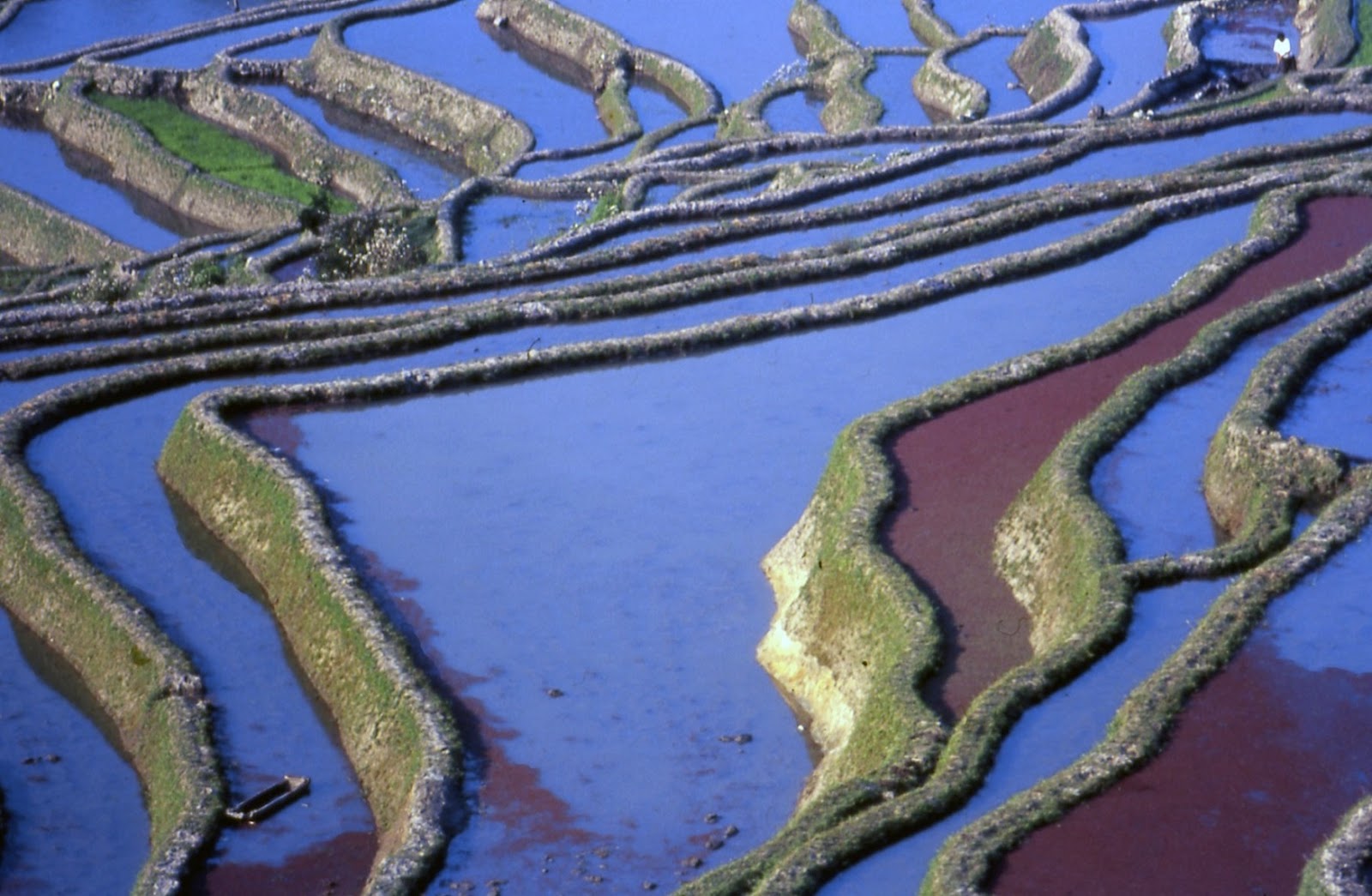
       From here the road passes a lot of banana groves and begins climbing.  It’s about 30 km to Xinjie and before long the traveler can see the famous rice terraces cut into the slopes of the hills.  During the dry season they are filled with water and reflect the colors in the sky.  After the planting in April they turn green until September when the crop ripens to yellow.  By November the harvest has emptied the terraces and they once again fill with water.
Nisu Yi belt ends
       In the late 90s, having completed my research of the northwest, I chose Ailaoshan as my next project.  This involved journeys to all its counties, but I spent more time in Yuanyang than anywhere else.  Inexpensive hotels were available.  The terraces and villages were a short walk beyond the urban zones.  Xinjie had several Yi and Hani-run restaurants and a daily presence of many minorities, well augmented on market days, which were every four days.  And frequent minibuses plied the routes back and forth to other village market venues or places to view the terraces.
Nisu Yi gitls wearing the"chicken hat"
       Yuanyang didn’t get much traveler attention then and I was usually the only foreigner in town or, if with a friend, we were the only two foreigners in town.  In winter some Chinese photographers showed up, aiming to take the ultimate terraces photo, when fog covered the lower parts of the hills and left terraces above them to catch the first sunlight.  I often did the same and in constant search of better angles got used to walking along the terrace walls with my knees lightly bent so as not to slip and fall into the water.
       During dry season visits, in late afternoon I liked to take hikes south of the city, heading straight where the main city road turned left at the southern bus station, and out in the rural area towards the terraces and villages, hoping for a dramatic sunset that splashed the water-filled terraces with golden hues.  Once in a while the sun slid behind thick clouds and I didn’t take any photos at all except of people on the trail walking home.  But sometimes, besides friendly greetings, they invited me to their homes for a drink or a meal.  And that always made my day.
Laló Hani mother and daughter
Laló Hani woman
       Hani and Yi villages dominated the Xinjie vicinity, with houses of mud-brick, usually two stories.  Most had flat roofs, sometimes with a small shed on top, but some Hani villages had angled thatched roofs and were called ‘mushroom houses’.  Some villages lay on slopes above their terraces.  Others were on more level ground, surrounded by their fields.  
Laló Hani heading home from the Xinjie market day
      Nearly all the county’s Yi belong to the Nisu sub-group.  As with the county’s other ethnic minorities, nearly all the women dressed in traditional style.  They wore a long-sleeved jacket, fastened on the right side, bright colors for the young and dark for the older women, over plain slacks.  The jacket featured broad bands of embroidered patterns around the shoulders, lapel and sleeves.  Sometimes silver studs covered the entire front.  They fastened it with a belt with large quadrilateral embroidered ends that hung over the buttocks, the most distinctive feature of the outfit.
Hani village just south of Xinjie
       The usual women’s headgear was a long strip of black cloth with a panel of embroidery at each end.  They wrapped it around their hair and tucked one end into the top and left the other dangling over the side.  The favorite of the girls, and even young married women, was the “chicken hat” (wúbi túmaw in Yi).  So named because of its intended resemblance to a cockscomb, it was a colored piece of hard cloth, cut to shape and covered on both sides with inlaid silver or nickel bulbs, cultured pearls or white pile embroidery, with spaces left open to form arabesques and spirals.
Hani in tie-dyed imdigo
Hani woman in Huangcaoling
       Nisu myth attributes the origin of the wúbi túmaw to a story of two young lovers caught in the forest by the Prince of Devils.  First he killed the young man, then tried to capture the young woman.  She fled through the forest, with the Prince of Devils in hot pursuit, until she came to a village in a clearing.  A cock crowed, which stopped the demon in his tracks.  A witness to that, she guessed the demon was afraid of roosters.  So she grabbed it, chased off the demon and ran back into the forest to where her lover lay.  The cock crowed again and the young man came back to life.  Ever since then Yi girls wear the hat in honor of the rooster, to symbolize good luck and happiness in love.
Hani women in Majie district
       To make the floral, spiral, arabesque and other patterns on the jacket, belt ends and headgear, the Yi used paper stencils cut by specialists and sold at market days.  Xinjie’s market day always had tables selling the stencils, while at several other stalls women sold Nisu jackets, headgear and belts.  Hani women also ran stalls with Hani jackets, headgear, vests and bolts of cloth.  And a couple stalls sold silver ornaments, mostly those used to decorate jackets and hats—rings, buckles, coin buttons, chains and pendants.
Hani girls in Niujiaozhai
       Several subgroups of Hani live in the county.  Around Xinjie and south as far as Panzihua live the Laló Hani, whose women wear dark blue or black jackets, fastened on the right side, over blue or black trousers.  Bands of appliquéd designs in light, contrasting colors go around the cuffs, upper sleeves, neck, shoulders and calves.  Married women don a heavily fringed headscarf, held by a silver clasp in back, under which hangs a long, silver studded tail, 5 cm wide.  Unmarrried girls dress in brighter colors and wear no headgear.
       A slightly different style prevails among the Goho Hani of Huangcaoling district, southwest of Xinjie.  Goho jackets feature embroidered and silver-studded lower sleeves and are tied with a belt with big tabs hanging over the buttocks, similar to that of the Nisu, usually with spiral designs.  And the cap is a round one, with silver studs in the front and pendants on the side.
Niujiaozhai Hani in the Xinjie market
Dai woman and red sticky rice
       In the western part of Yuanyang County, around Shalatuo and Niujiaozhai, the Hani women’s jacket resembles that of their Nisu Yi neighbors, but hangs in the back over a separate cloth underneath.  The lower end and corners of this piece are heavily embroidered, as are the lower parts of the trousers.  It’s also tied with a belt with the ends draped over the buttocks, though these are either triangular or 10 cm-wide embroidered strips.
Xinjie on market day
       Just west of Yuanyang city, in Majie district the Hani wear similar bright jackets, but some attach a tie-dyed indigo section to the front.  A subgroup closer to Xinjie favors the tie-dyed cloth for the entire jacket.  Nisu Yi in Majie dress like those in Xinjie, but the ‘chicken hat’ is always studded with silver.  And in the eastern districts, besides Laló Hani, one can meet the Black Hani, who also dominate northern Jinping County and tie their artificially lengthened braids in a coil on top of the head.
       On market days, all these costume variations and embellishments made the moving crowds a constant swirl of color.  And with the fancy Yi and Hani belt ends, headgear tails and embroidered baby-carrriers, the women could be just as attractive from the back as from the front.  Around 80% of those attending were women and probably 95%, young and old, would dress in traditional style.
Landian Yao women in Xinjie
Nisu mother and child
       In the south, Huangcaoling held its market day on Friday and the Dai La town of Huangmaoling on Saturday.  Depending on the12-day animal cycle, Majie, Panzihua and Galiang hosted market day every six days, while Niuzhaozhai, Shalatuo, Xingcun and Xinjie staged it every four days.  They were always crowded, even in the rain.  Though the activity at each resembled that of every other venue, it was worth the journey just to see the ethnic variety and ever more views of a spectacular landscape, especially Panzihua, with a great view of the vast valley known as the Tiger’s Mouth.
Nisu Yi pattern stencils on sale in Xinjie
       My own favorite was Xinjie’s, every dragon, rat and monkey day and attracting the largest and most ethnically diverse crowds.  Starting from the center of town near the bus station and stadium, stalls and layouts spread down the steps and all along the long ridge forming the lower part of the city.  Besides the Nisu and Laló Hani, three or four other Hani subgroups would turn up, as well as Dai La and Zhuang from villages lower down on the road back to the Red River. 
       The Dai wore short-sleeved black jackets, fastened on the right side and trimmed along the lapel. sleeves and hem with bright color bands.  The plain black skirt reached to the calves, which were bound with embroidered wrappers.  The Zhuang dressed much like the Nisu, but with ruffled trimming to the jacket collar and different headgear.  Usually some Landian Yao turned up, too, standing out from the colorful crowd by their all black garments—tight trousers, loose jackets, headdress cover.  The only color component was a skein of magenta thread hanging from the collar down the front of the jacket.
Xinjie on market day
Zhuang mother and daughter
       Farm crops, fruits, vegetables and household goods comprised most of the merchandise on sale.  Yet there were always busy Yi and Hani stalls selling traditional clothes and cloth for making them.  Some odd traditional medicine plants and woods were also available and for snacks one could try steamed buns, the grilled bee larva or sticky red rice.  And wash it down with a cup of rice liquor.
Hani clothing stall in Xinjie
       Around three p.m. the crowds began to thin, as those living far away began to pack up and go.  Local Yi and Hani might hang around another couple hours.  And I would head for the rural road south of the town to get photos of them walking home towards the setting sun.  Sometimes I even got a photogenic sunset,
       After the turn of the century the scene began changing, particularly in Xinjie.  In 2002 the very scenic terraced fields around Panzihua, the Tiger’s Mouth, won the national government’s support for its bid for UNESCO recognition as a World Heritage Site (eventually awarded 2013).  That prompted the city government in Xinjie to make some drastic changes.  It ordered the leveling of the central bus station and the stadium, to be replaced by a three-story Cultural Center.  The place where all the minibuses parked now had a stone model of the terraces, with life-sized bronze sculptures of farmers and buffalos in them. 
       The main streets into the city were widened and the market venue altered.  Instead of the continuous line of stalls from the center down through the ridge in the lower section of the city, now the market day areas were scattered in separate, disconnected spots.  Attendance on the day I witnessed was only about a quarter of that in the so recent past.  But other market days were as full and lively as ever.  And the wonderful rice terraces flanking the city were untouched.  Yuanyang was still a county replete with color, in the landscapes and in the amazing diversity of its peoples, colors that would never fade.

sunset on the terraces south of Xinjie
                                                                        * * *       
      

               For more on Ailaoshan and its people, see my e-book  The Terrace Builders

Saturday, January 9, 2016

Congratulations, Hani Farmers


                                 by Jim Goodman

Hani village, Yuanyang County
      Every year UNESCO announces new additions to the list of World Heritage Sites.  This year’s selections, revealed in June, included a rather unusual entry—the Honghe Hani Rice Terraces.  Ordinarily World Heritage Sites are spots of outstanding natural beauty, like mountains or canyons, or something manmade, like a magnificent building or an ancient city.   This is one of those rare occasions when contemporary farms made the list.   True, they are very ancient farms, perhaps as old as 1300 years or more, for they are mentioned in Tang Dynasty records.  That makes them older than the famous Inca terraces in the mountains of Peru.  But unlike the latter, long ago abandoned, the Honghe rice terraces have been in continuous use since they were first built.
       Honghe is the name of a prefecture in Yunnan, south of Kunming to the border of Vietnam, comprising several counties north and south of the Red River. Those south of the river are very mountainous and it is the rice terraces here, in the Ailao Mountains, that are so ancient, so beautiful, so amazing, and now becoming internationally recognized for the wonder that they are.  The designated Heritage Site area consists of a large part of southern Yuanyang County, including the stunning section around Panzihua village known as the Tiger’s Mouth.  Farmers here centuries ago cut as many as 3000 terraces into the mountain slopes, from just below the forested hilltops, at around 2000-2500 meters, all the way down to the rivers, lying at around 400 or 500 meters.
terrace irrigation
       While the terrace scenery is particularly impressive in southern Yuanyang County, the same kind of farming system exists throughout the other counties south of the Red River, as well as upriver west of the prefecture as far as Xinping County.  Plenty of other places in Yunnan feature terrace farming, for the province is full of hills and mountains and even the plateaus are more often undulating valleys rather than flat plains.  What makes the Honghe terraces so special is the complex irrigation system established with their initial foundation.  Water flows from terrace to terrace and remains in the fields all year round.
       Farmers only get one crop of rice each year from these farms.  After the conclusion of the harvest work the fields are left full of water until planting time around April.  This is the time the terraces are at their best visually, the water in them reflecting the colors of the sky.  During the dry season the terraces become the abode of ducks, frogs, eels, small fish and snails, which supplement the local diet.  The UNESCO citation takes note of the local “integrated farming system” and states, “The resilient land management system of the rice terraces demonstrates extraordinary harmony between people and their environment, both visually and ecologically, based on traditional and long-standing social and religious structures.”
Hani farmer girl
       They might have added the extraordinary harmony among the people themselves, as well.  And this is precisely because of their land management.  When the Hani ancestors first laid out a village they chose a site near a stream or spring, adjacent to a forest, built their houses there and their rice terraces below the settled area.   The main irrigation stream ran above the set of terraces, with dividers placed at intervals to allow water to spill into the terrace below through notches cut into its wall.  Notches cut in the walls of that terrace allowed water to flow into the one below and so on all the way down to the lowest terrace on the slope.
       Villages had a water guardian whose job it was to keep the main channel free of debris and oversee its renovation after the harvest and to check the dividers to ensure they had not been altered so that someone’s field got more water than what was allotted to them.  This would upset the balance, for the original system, including the position and notches of the dividers, guaranteed that every terrace plot would receive the proper amount of water for the crop.
       It is not clear how they divided up the land, who got the terraces nearest the village and who got the ones far away down the slope.  But all the terraces got the proper amount of water required.  Thus, the economy and society of a village started out on the basis of equality.  As time went on and generations passed this equality did not persist, for in some families more children, i.e. more workers, survived infancy and could contribute to a family’s income.  But the differences in wealth among the people in any given Ailaoshan village were never very great, nor ever resented because they were perceived as due to good luck and diligence and not exploitation, and so a strong sense of village solidarity has persisted over the centuries.
Hani terraces
       This solidarity extends to the entire ethnic group and sub-group and even beyond, as implied in the Hani saying that Yi and Hani are children of the same mother.  Several minority nationalities inhabit the Ailao Mountains—Hani, Yi, Miao, Yao, Zhuang and Dai—and all of them are terrace farmers.  They live in roughly the same manner, with different house types sometimes but with the same kind of material life.  No particular ethnic group ever had power over another and they all lived peacefully with each other, often meeting at the various market day venues.
       Even within the designated World Heritage Site boundaries Yi villages lie scattered over the slopes, with a Miao settlement here and there and Dai in the lower areas.  So it’s a bit inaccurate to make the award to the “Hani rice terraces,” even if they are the majority community in this particular part of the mountains.  The other ethnic minorities are also terrace builders and everything the UNESCO citation praises about the Hani is just as true of the other ethnic communities in Ailaoshan.
       They are all animist societies, venerating spirits associated with forces of nature, the land and their own ancestors, fearing and propitiating troublemaking spirits that could harm them.  They held regular rituals to honor the land spirit or the rice spirit so that nothing would interfere with the cultivation of the rice crop.  Their economy was one of self-sufficiency, though that was more of a goal than a reality, for in general the terraces did not produce enough rice to feed the family all year that tilled it.  In the last weeks before harvest cassavas took the place of rice as the main filler of the meal.
a part of the "Tiger's Mouth"
       The rituals, festivals, even the ethnic styles of clothing all came under sustained attack first in the late 50s and then throughout the tumultuous years of the Cultural Revolution.   After Deng Xiaoping consolidated power such policies ceased once and for all and ethnic culture was now not only tolerated, but also encouraged.  For the Hani and their neighbors, the family responsibility system basically meant a return to the old way of farming.  And since the old way of farming included festivals and rituals to the rice spirit, these revived, too. 
       The one major innovation in their material way of life was the introduction of high-yield rice seeds.  This improved production so much that families could not only grow enough rice to feed themselves the entire year, they very well might even have a little surplus to sell in the market.  Population had gone way up since, say, a century ago, and extra terraces had been made, but now these terraces were producing more rice than at any time in their history.  Traditional material culture had achieved an unprecedented success.
       Besides the magnificent scenery of sculpted mountains, the area’s other main attraction is its ethnic variety.  The Hani are the most numerous of the communities, split into several sub-groups, each with its own distinctive traditional-style women’s clothing.  All the other minorities have at least three sub-groups dressing very differently from each other.  Most of the regular market days in the area witness the presence of several ethnic groups and sub-groups, mainly women, just about all of whom dress in their traditional style clothing.
       These market venues will have stalls with ethnic minority women selling clothing components to other minority women.  There will be Miao stalls selling batik cloth, embroidery thread and Miao jewelry, Hani women hawking Hani women’s jackets, trousers, belts and bags, Yi women offering embroidery and appliqué patterns for blouses and belt ends, etc.  Their customers, of course, will be other Miao, Hani or Yi women who don’t have time to make the items themselves.    
transplanting the rice seedlings
       Now the ethnic revivalism that is so obviously apparent in Ailaoshan has been going on throughout Yunnan for the past generation.  Ethnic festivals have been revived, sometimes with lavish government subsidies, traditional religion has re-emerged and ethnic clothing is popular again, even if only for festivals and other special events.  Definitely ethnic pride has returned.  But nowhere has traditional culture made such a complete comeback as in Ailaoshan.  Elsewhere modern influences have seeped in to the extent that people may be proud of their traditions, but less likely to “revert” to living the traditional way with its antique mind-set.
       The modern influences that are slowly but surely undermining traditional culture elsewhere in Yunnan include basic changes in their material way of life.  A major Hani sub-group, the Aini (elsewhere known as the Akha) in Xishuangbanna and adjacent counties, practiced slash-and-burn agriculture as their traditional way of life.  Due to population pressures, this is no longer viable as a system and so they have largely switched from growing rice to growing tea, rubber or sugar cane, cash crops that they can trade for rice.  However, because they are not growing rice they don’t need to have all those festivals that marked critical points in the rice-growing cycle.  So a big part of their culture disappeared when they changed crops. 
       Other ethnic minorities employing the slash-and-burn method also went through the same changes.  In other areas, with permanent fields, the introduction of modern machinery and fertilizers altered relations between the people and their environment.  In one way or another, in nearly every place in Yunnan, traditional material culture has altered and this has modified other aspects of tradition as well, from religious beliefs to aesthetic views.
Hani on the way to market day
       But Ailaoshan is different.  The material culture has proven its value and so the non-material aspects of tradition have survived to a greater degree than elsewhere in the province.  Festivals have revived because the people still believe in them and the Hani hold several a year.  Villagers have televisions now and are aware of what, for example, people in the outside world wear.  But the women, even the teenaged girls, prefer their own ethnic style because they still retain their traditional aesthetic view.  The most beautiful clothes they can put on, they feel, are their best traditional ones.  They see lots of modern clothing in the markets, but the only items likely to attract their interest are shoes and umbrellas.
       Besides keeping their traditional aesthetic sense, the Hani and their neighbors also maintain the village altars and spiritual specialists who conduct rituals on behalf of the community.  In a grove at the edge of a Hani or Yi village a small area next to a large tree is fenced off and three upright stones stand in the rear.  The taller one in the center represents humans, the smaller two flanking ones represent crops and animals.  The arrangement exemplifies what the UNESCO citation referred to as the “symbiotic relationship” established between man and the animal and plant world.  Major annual rituals take place here.
Hani village altar
       Ailaoshan and the Hani world are not shielded from modern influences.  But the impact is not so heavy.  Villagers have televisions, but what do they watch?  News, sports, soap operas, comedies, police stories, action films?  Not at all.  They like the Hong Kong-style period piece stories, set in the Qing Dynasty or earlier, costume dramas with or without magical warriors.  Basically, the television has simply replaced the village storyteller.
       What about education and the general exposure to modern, secular ideas?  Well, from my own years doing research in the area for my book The Terrace Builders I witnessed several traditional rituals, both by ritual specialists acting on behalf of the entire village and private rites carried out by family heads on the rice terraces.  In every case the person carrying out the ritual was one of the more educated men in the village.  In other places in Yunnan, in similar circumstances, when I asked about the ritual I was told they carried it out because it was part of their tradition, not that they necessarily believed in it.  In Ailaoshan the reply centered on the efficacy of the rite, the meaning of whatever was used for it and the “good reasons” to perform it.  Part of the tradition, yes, but a part they obviously still believed in.
ritual offering to the rice spirit
       Well, why shouldn’t they?  Such acts have apparently worked for them for many centuries now and with the agricultural sector now stronger than ever they have definitely shown the value of their part in the procedure.  And it’s not likely to change.  It’s not really possible to “modernize” terrace farming.  Farmers can’t use tractors in the terraces.  They still have to use buffaloes to draw the plows and plant the seedlings by hand and cut the stalks with sickles at harvest time.  And they are never going to change the use of the terraces from growing rice to growing rubber trees or some other cash crop.
       The traditional material system will persist and so, more than likely, will other aspects of tradition, from clothing preferences and rice field rituals to domestic customs, taste in food and village social life.  Their self-confidence and geniality is also likely to persist, rooted as they are in their awareness of their traditional culture’s success.
       So congratulations, Hani farmers, on the world’s recognition of your achievement.  You and the Yi, Miao, Yao, Dai and Zhuang, not mentioned in the UNESCO citation, can be proud of the genius of your ancestors.  In this remote mountainous terrain they created a system of irrigated farms, and a lifestyle to go with it, that has survived intact for over 1300 years and is flourishing here now in the fast-evolving world of the 21st century.  In a time of shrinking natural resources you can give the world lessons in land and water management, as well as how to achieve harmony between man and his environment.  By its very name, a World Heritage Site is a place with a value relevant to the entire human race.  Congratulations, Hani farmers.  You deserve the award. 
Hani farmers going home 
                                                                        * * *

note:  For more information on the area and its people, see my newest book—The Terrace Builders:  the Hani and their Neighbors in Yunnan’s Ailao Mountains.  Published as an e-book, covering the area from Xinping to the far north of Vietnam, it has 300 photographs.